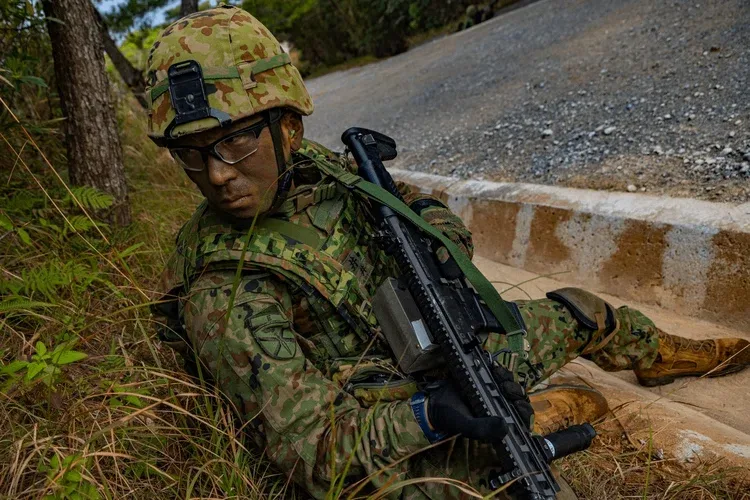
Approved for unit use in 2020, the 'Type 20 5.56mm Rifle' developed by Howa Machinery is a domestically produced rifle that succeeds the Type 89 5.56mm rifle.
With an eye toward the harsh and complex modern tactical environment, including CQB (Close Quarters Battle) and island defense, it has evolved into a 'life-saving tool' that fully incorporates world-standard modularity and operability.
Ammunition: 5.56×45mm NATO (adopts US MAGPUL PMAG GEN3 M3 Window)
Operating System: Gas-operated (short-stroke gas piston)
Overall Length: 779–851 mm (with stock extended/retracted)
Barrel Length: 330 mm (approx. 13 inches)
Weight: Approx. 3.5 kg
Rate of Fire: 650–850 rounds/min
What is particularly noteworthy is that the barrel length has been shortened to 330mm (approx. 13 inches).
Compared to the Type 89 (420mm), handling has been significantly improved, dramatically increasing its superiority in indoor combat, hard-target strategies involving movement in vehicles or boats, and urban warfare.
In addition, the 3-round burst function, which had low operational frequency, has been eliminated, focusing instead on 'Safe, Semi-auto, Full-auto' to simplify the mechanism, reduce costs, and ensure reliable operation.
1. Fully Ambidextrous Specifications
The selector, magazine catch, and bolt release are all ambidextrous, allowing for seamless operation even when switching (changing shooting stance from left to right). The layout and rotation angle of the selector are based on the AR-15/M4 series, enabling intuitive fire control.
2. Latest Modular System Adopting M-LOK
It features a Picatinny rail from the top of the receiver to the top of the handguard, and the M-LOK system is standard on the sides and bottom of the handguard.
This has allowed it to completely break away from the provisional accessory mounting seen in the Type 89 era and achieve world-class expandability. As official accessories, the following high-end tactical gear has been selected and deployed.
Optical Sight: DEON Optical Design March-F Compact 1x-8x24 short scope
Aiming Assist: Aimpoint Comp M5
Night Vision Device: SUREFIRE M300C Scout Light
Night Aiming Assist: Steiner OTAL-C
Foregrip: Quick-release bipod grip manufactured by B&T (Brügger & Thomet) of Switzerland
Furthermore, early prototypes tested the Gunfighter Grip from BCM (Bravo Company Manufacturing) in the U.S., showing that trends in the civilian tactical market were deeply researched. The mass-produced version also adopts an AR-compatible resin grip with an internal compartment.
Environmental Resistance Designed for Taiwan Contingencies and Island DefenseIt is designed with operations by units such as the Amphibious Rapid Deployment Brigade (ARDB) in mind, featuring extremely high corrosion resistance and drainage capabilities against seawater and sand. It incorporates special surface coating treatments and a water-drainage structure that prevents malfunctions even when water enters the internal mechanism, providing the robustness needed to avoid failure under harsh conditions such as amphibious landings or maritime operations in the rain.
The stock is a multi-stage telescopic type with a cheek pad (vertically adjustable), similar to the FN SCAR. It is designed to maintain proper eye relief and shooting posture even when wearing plate carriers or armor, which are essential in modern warfare.
The '5.56x45mm NATO' round adopted by the Type 20 rifle has reigned as the standard for many years, but several issues have emerged in modern warfare.
1. Decrease in 'Stopping Power' due to Shortened BarrelShortening the barrel to 13 inches reduces the muzzle velocity of the bullet. The 5.56mm round generates lethality through high-speed rotation and fragmentation upon impact; however, a shorter barrel shortens the effective range, creating a dilemma where lethality at long distances is reduced.
2. Evolution of Body Armor and Lack of PenetrationDue to the widespread use of personal protective equipment (such as plate carriers), there are increasing cases where conventional 5.56mm rounds struggle to penetrate.
Global Trends: In response, the U.S. Army is moving toward updating to the 'XM7 (NGSW),' which uses the more powerful 6.8mm round.
Current Status of the Self-Defense Forces: The Type 20 intentionally maintained the 5.56mm caliber. This is a result of prioritizing logistical commonality, the physique of Japanese personnel, and ease of recoil control, but it carries the inherent risk of facing 'insufficient firepower' in the future.
To address this issue, the Self-Defense Forces have introduced a new rifle round (J3) optimized for the Type 20. It is designed to ensure sufficient muzzle velocity and penetration even from a short barrel by using higher pressure than the conventional Type 89 ammunition. However, performance variations when mixed with older ammunition (Type 89 or U.S. military standards) and the complexity of ammunition management between units remain operational challenges.
The 'Realistic Choice' Represented by the Type 20 RifleThe Type 20 rifle is an 'extremely realistic tool' that incorporates global trends at a high level while being specialized for the Japanese environment.
Comparison: It possesses operability and expandability comparable to the HK416 and SCAR, and is fully compatible with modern tactical movements.
Ammunition: While maintaining the established 5.56mm standard, performance has been enhanced through the adoption of specialized ammunition (J3) and PMAGs; however, how to address the future '6.8mm era' will be the focus of upcoming discussions.
Conclusion: The Type 20 is not merely a weapon, but is positioned as 'the optimal solution for maximizing the survival rate of personnel within Japan's geographical and political constraints.'
With this evolution in equipment (standardization of M-LOK and short scopes), field personnel will be more strongly required to exercise 'advanced tactical judgment to master the equipment' rather than simply 'relying on the equipment.'
Tokyo Marui Type 20 rifle airsoft gunAirsoft version of the Type 20 rifle. It was released as an officially licensed gas blowback airsoft gun through a formal agreement with Howa Machinery.
It is also supplied to the Self-Defense Forces for training purposes.