When discussing healing music or comfortable spaces, we often hear the term
1/f fluctuation
used.
From the beautiful singing voice of a vocalist to
natural wood grain and pleasant-to-touch materials,
this phenomenon is said to be hidden in
everything, but
there are surprisingly few people who can accurately explain its physical nature
is there not? In this article,
we will unravel the mathematical and
physical facts behind this term.
The Physical Nature of 1/f Fluctuation
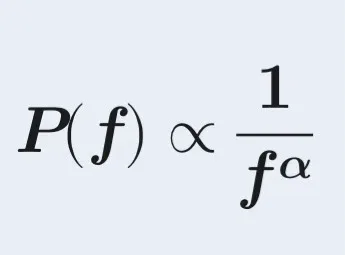
The f included here is frequency,
that is, frequency.
When some phenomenon changes,
it refers to a pattern of change where
the power or energy decreases in inverse proportion to the frequency.
Expressing this with the physics formula for power spectral density
looks like the following.
Here, a state where alpha is exactly 1,
or a state extremely close to 1 is 1/f fluctuation.
In the world of physics and acoustic engineering,
this state is also called pink noise.
Comparison of Fluctuations and the Position of Pink Noise
To truly understand this phenomenon,
comparing it with other noises is the shortest path.
A representative example is white noise.
This has constant power at any frequency,
and like the sound of static on a television,
it is a completely random and disordered state
. The unpredictability is extremely high
,
giving an inorganic impression. On the other hand, there is also something called brown noise
.
This power attenuates in inverse proportion to the square of the frequency,
and like the roar of a waterfall, the change is heavy and smooth.
The regularity is high, and it can be said to be a state where
what happens next is almost predictable.
1/f fluctuation,
that is, pink noise,
is located
in the middle of this complete disorder and complete regularity.
It is a state with an exquisite balance of being moderately predictable and moderately surprising
.
Why Do Humans Feel Comfortable?
This moderate balance is the biggest reason why it gives humans comfort.
In an environment filled only with
completely random white noise,
humans cannot predict what will happen next at all,
causing the
brain to become exhausted.
Conversely, in an environment that is
completely regular like a metronome,
we feel boredom
.
In fact, the intervals of human heartbeats, fluctuations in brain waves,
and the fine movements of the eyeballs themselves have this 1/f distribution.
Therefore, by synchronizing with fluctuations from the external environment,
it is thought that as a living organism,
we can obtain a natural sense of security and comfort.
The Meaning of Frequency That Changes Depending on the Phenomenon
A very interesting point of this theme is
that the meaning of frequency changes
depending on the phenomenon being targeted.
Fluctuation in music and singing voices
refers to temporal change.
It is an indicator of how the pitch and volume of sound
change over time.
When analyzing the waveforms of a great singer's voice,
the hoarseness of the voice and the fluctuation width of the vibrato
often fit perfectly
into this statistical distribution.
On the other hand, fluctuation in architecture and texture
refers to spatial change, that is, spatial frequency.
It is an indicator of
how many changes or pattern waves there are per centimeter.
Natural wood grain,
the unevenness of the surface of hand-thrown pottery,
and the scattering of fibers in Japanese paper
have a 1/f distribution spatially.
If this were to be applied to design,
instead of inorganic louvers (lattices)
arranged at regular intervals,
one could consider arrangements with random spacing
that have slight laws in their intervals and thickness.
Because it is neither an artificial straight line drawn with a ruler
nor completely random noise,
it provides natural comfort through sight and touch.
Facts That Are Often Misunderstood
Finally, as a calm perspective,
I will touch upon points that are often misunderstood.
First, 1/f is not a specific musical scale or
a magic frequency.
It is a statistical property
indicating the degree of variation in change.
Also, just because it has this fluctuation
does not mean it will necessarily become a masterpiece or great architecture.
It is merely a statistical property,
and it is necessary to be careful that
it is nothing more than a foundation that is easily accepted comfortably.
It tends to walk alone as a buzzword,
but the essence is ultimately just
one aspect of a physical phenomenon.
The True Value Created by the Thickness of the Time Axis
1/f fluctuation is
preparing a physical foundation,
which is nothing more than one entrance in design.
What is truly important is
what kind of relationship is built
between the people living there, nature,
and society.
Architecture is not at its peak the moment it is completed,
but rather something that should increase in value
with the time that flows from there.
The irregular expressions that natural materials show through aging,
and the activities of people's lives carved into them.
I believe that the depth of the time axis
created by these layers overlapping is what
truly goes far beyond mere statistical fluctuation,
creating a space that is rich and comfortable in the truest sense.