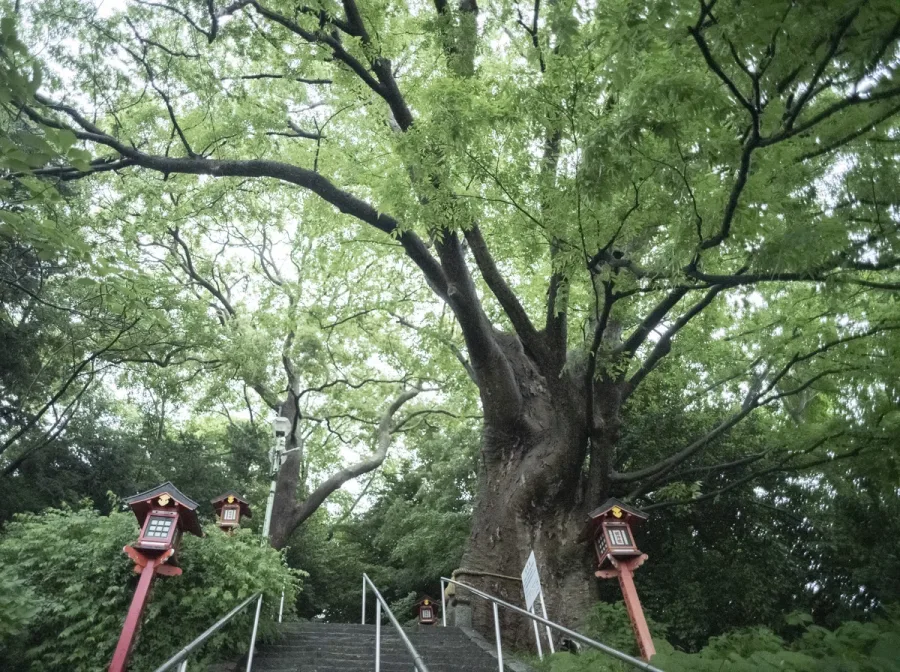
When I went on a pilgrimage to ancient sites in the Tohoku region this past May, my final stops were Yoshida Shrine and the Yoshida Kofun (tumulus) in Mito City, Ibaraki Prefecture.
The reason for choosing this location is that it serves as the base for Yamato Takeru's suppression of the Emishi in mythology, and furthermore, the octagonal Yoshida Kofun is built in its immediate vicinity.
Octagonal tombs are a type of tumulus of which only 13 were built across the country at the time the Ritsuryo system was established; only 8 remain in the Kinki region and 5 in the Kanto region.
The octagonal tombs in the Kinki region include the joint mausoleums of Emperor Tenmu and Empress Jito, the mausoleums of Emperor Tenji, Empress Saimei, Emperor Jomei, Prince Kusakabe, and Emperor Monmu, as well as two others in Tottori and Takarazuka whose occupants are unknown. Meanwhile, the five in the Kanto region are located in Mito, which was a district administrative center (gunke) in Hitachi Province, and near the sites of the provincial government offices (kokufu) in Musashi Province (Tokyo), Kai Province (Yamanashi), and Kozuke Province (Gunma).
Interestingly, the locations of these octagonal tombs in the Kanto region are either places where Yamato Takeru legends remain, like the Yoshida Kofun in Mito, or places associated with the 'Ono clan,' descendants of Yamato Takeru's mother, the Wani clan.
Near the Mitsuya Kofun, an octagonal tomb in Yoshioka Town, Gunma Prefecture, is Mt. Tachibana, the place where Yamato Takeru prayed for the repose of Princess Ototachibana, saying, 'I miss Princess Tachibana.' Near the Kyozuka Kofun in Fuefuki City, Yamanashi Prefecture, is the Sakaori Palace, which houses Yamato Takeru's flint bag as its sacred object.
Furthermore, near the Inarizuka Kofun in Seiseki-Sakuragaoka, Tokyo, stands the Ono Shrine, the Ichinomiya (first shrine) of Musashi Province, and the area near the Isezuka Kofun in Fujioka City, Gunma Prefecture, is still called Ono-go today.
The octagonal tombs built around the time the Ritsuryo system began were not only tombs for the royalty of that era but were also constructed in places associated with Yamato Takeru and the Ono clan in the Kanto region. This suggests that the governance of the country under the Ritsuryo system was linked to the Yamato Takeru myth, and that the Ono clan, descendants of the Wani clan, were involved in this psychological manipulation.
In other words, it is highly likely that the Yamato Takeru myth is not about events in the 3rd or 4th century as commonly thought, but is instead related to the vision of the late 7th to early 8th century, the period when the Ritsuryo system was established and these octagonal tombs were built.
Mythology does not record events as they happened, but rather expresses them to convey important matters to future generations.
Therefore, for example, regarding the description of Yamato Takeru falling ill and dying as a result of challenging the deity of Mt. Ibuki, there is much debate about what the deity of Mt. Ibuki represents. However, what is more important than that is to consider why the gears of Yamato Takeru's activities, which had been running smoothly until then, went awry.
To do this, it is necessary to re-read the intentions of the myth-makers hidden behind Yamato Takeru's activities.
Generally, the Yamato Takeru myth is perceived as a story symbolizing the sweeping away of the barbaric world by the civilized world, or the military domination of the entire country by the Yamato Kingship, but is that really the truth?
First of all, Yamato Takeru's conquest of the Kumaso was not carried out by force with an army, but by disguising himself as a beautiful woman.
After that, Yamato Takeru was dispatched by his father, Emperor Keiko, to conquer the Emishi in the eastern provinces. On that occasion, he was caught in an enemy trap in Suruga and lured into a field where he was surrounded and set on fire. He used the Kusanagi sword, given to him by Yamato-hime-no-mikoto, to mow down the grass and used a flint to set a counter-fire to burn the enemy.
The Kusanagi sword is the sword that emerged from the body of Yamata no Orochi when Susanoo defeated it. Rather than a symbol of civilization, it is more of a 'priestly tool from the age of mythology that connects with wild nature deities.' Flints were also considered to have magical protective powers in ancient times. In other words, the tools Yamato Takeru used were deeply connected to the ancient world of nature mythology.
Furthermore, as Yamato Takeru advanced east, he encountered a storm while sailing through the Uraga Channel in present-day Kanagawa Prefecture. At that time, his wife, Princess Ototachibana, committed suicide by drowning herself to appease the anger of the sea god, thereby calming the sea.
This was a human sacrifice to appease the anger of the sea god, the same structure as when daughters were offered annually to the Yamata no Orochi that Susanoo defeated.
In the first place, according to the 'Nihon Shoki,' during the reign of the 11th Emperor Suinin, before Yamato Takeru's father, the 12th Emperor Keiko, the practice of human sacrifice (junshi) that had been performed at royal funerals was abolished at the suggestion of Nomi no Sukune, and haniwa (clay figures) were used as substitutes.
This, like Susanoo's defeat of the Yamata no Orochi, conveys the transition from excluding ancient magical powers to governance through systems and formalities.
However, the story of Yamato Takeru runs counter to this trend of 'civilization'.
It was the Kusanagi sword that protected Yamato Takeru. Because he entrusted this spiritual sword to Princess Miyazu, the daughter of the Owari no Kuni-no-miyatsuko, when he went to defeat the deity of Mt. Ibuki, he was struck by poisonous vapors and fell ill.
This episode is extremely suggestive; it can be interpreted not as a mere 'failure' of a hero, but as a performance to highlight the spiritual power and symbolism of the Kusanagi sword.
The Kusanagi sword is the sword that appeared from the tail of the Yamata no Orochi when Susanoo defeated it. The Yamata no Orochi is interpreted not just as a monster, but as a symbol of natural disasters such as floods and inundations, so the Kusanagi sword can be said to be a sacred treasure related to the spiritual power of nature, rather than a 'tool of civilization'.
Yamato Takeru judged that he could 'defeat the deity of Mt. Ibuki with his own wisdom and martial prowess alone,' and as a result, he was struck down by the poison of nature (= spiritual impurity).
Yamato Takeru's death due to not possessing the spiritual sword known as the Kusanagi sword demonstrates the existence of forces that cannot be controlled by human intelligence, reason, or martial prowess alone.
Here, if we check the 'Nihon Shoki' for what was happening in Japan just before the start of the Ritsuryo system, it reads like the Book of Revelation in the Bible, with records of celestial omens such as comets, followed by a massive Nankai Trough earthquake, a major volcanic eruption thought to be Mt. Asama, and the resulting chaos, famine, and disease.
The compilers of the Kojiki likely created the myths with these natural disasters and the way the country should confront them in mind.
The Yamato Takeru myth is not a record of the Yamato Kingship's trajectory of national domination.
Before the story of Yamato Takeru, Susanoo defeated the Yamata no Orochi and the 11th Emperor Suinin abolished human sacrifice, creating a situation where human wisdom and reason were prioritized over ancient magic. However, there arose a need to put a stop to the tendency of 'placing the measure of all things on humans' becoming too strong. The Yamato Takeru story, which shows a 'return to antiquity,' conveys exactly that.
Around the time the Ritsuryo system began, there was a succession of empresses: Empress Jito, Empress Genmei, and Empress Gensho. It is generally explained that they were placeholders because Emperor Monmu and Emperor Shomu were young, but is that really the case?
Recent research has raised the theory that even after Emperor Monmu ascended the throne, Empress Jito, and even after Emperor Shomu ascended the throne, Empress Gensho, and furthermore, Empress Komyo, the consort of Emperor Shomu, played important roles in government affairs in practice.
In Yamato Takeru's conquest of the Kumaso, Takeru disguised himself as a beautiful woman. In ancient times, 'cross-dressing' was not merely a sexual perversion, but a disguise for bringing down divine spirits—a shamanistic act.
And when Yamato Takeru went on his eastern expedition, Princess Ototachibana threw herself into the sea to appease the anger of the sea god. Ancient priestesses were the 'substitutes for the sins and pain' of the community, and they were sacrificed to become the 'receptacle for sins and pain'.
Yamato Takeru himself is a self-sacrificial existence, positioned as a tragic hero.
After finishing the conquest of the Kumaso in the west, he was ordered to conquer the Emishi in the east, and in the end, he fell ill on Mt. Ibuki, died without being able to return home while reciting a song of longing for his homeland, and his soul wandered as a white bird.
Ancient people regarded 'birds' as symbols of the souls of the dead or 'things that carry souls,' and the fact that the soul of the deceased Yamato Takeru is superimposed on a white bird also indicates a return to antiquity.
In other words, one can feel that the story of Yamato Takeru is not a 'story of civilization conquering barbarism,' but a story that calls back magical and shamanistic powers.
If so, it is highly likely that the Kumaso and Emishi conquered by Yamato Takeru were not uncivilized, primitive worlds, but rather the opposite.
The Kumaso were a power in southern Kyushu with their own culture, iron production, and navigation technology, and the eastern forces were the same.
The Nihon Shoki records that in the Jinshin War, Prince Oama (later Emperor Tenmu) was able to win the battle by obtaining military support from the eastern provinces, and archaeologically, it is known that in the late Kofun period, weapons such as armor and horse trappings excavated from tombs were far more numerous in the Kanto and Kyushu regions than in the Kinki region.
Yamato Takeru was dispatched by the imperial court's orders to pacify Kyushu and the eastern provinces, but the meaning of pacifying those regions was not to suppress them by force. Rather, it was the opposite: the need to permeate Japan with the idea that there are things that cannot be controlled by human intelligence, reason, or martial prowess alone, which was happening in the situation of Japan at that time.
The Ritsuryo system is not a national system where the Emperor in Nara dominates the whole country by military force.
The Prince Shotoku faith, based at Horyu-ji Temple in Ikaruga, also actually began during this period. The fact that octagonal tombs were built during this period, just like the Yumedono (built in 738) of Horyu-ji, which houses the Kuse Kannon, said to be the very image of Prince Shotoku, is because this octagon reflects the vision of 'harmony is to be valued'.
Just as the lotus pedestal, which is the base for the Buddha, is octagonal, in Buddhism, the eight directions (east, west, south, north, southeast, southwest, northeast, northwest) are called the 'eight directions,' which symbolize the totality and universality of the world.
The octagon visually expresses these 'eight directions,' meaning that the Buddha's teachings reach in all directions.
Yamato Takeru's expeditions to the east and west are thought to be a mythological expression of this Buddhist vision.
The Yamata no Orochi defeated by Susanoo was not the embodiment of evil, but the power of the natural world that had been temporarily excluded by the discernment of civilization symbolized by Susanoo, and the Kusanagi sword was something endowed with that spirituality.
Yamato Takeru was protected by the power of the Kusanagi sword while he cherished it, but he let go of it when he felt he could do anything with his own power alone. Yamato Takeru's death can be said to be the end result of the arrogance that humans are prone to falling into in such a way.
-------------------------------
I will be holding workshops in Kyoto and Tokyo.
<Kyoto> July 26, 2025 (Sat) Waitlist, July 27, 2025 (Sun)
Fieldwork in Kameoka is planned.
<Tokyo> August 30, 2025 (Sat), August 31, 2025 (Sun)
*Both days will end in one day.
Please check the website for details and registration.
https://www.kazetabi.jp/%E9%A2%A8%E5%A4%A9%E5%A1%BE-%E3%83%AF%E3%83%BC%E3%82%AF%E3%82%B7%E3%83%A7%E3%83%83%E3%83%97-%E3%82%BB%E3%83%9F%E3%83%8A%E3%83%BC/
_
My new book, 'Kannagara no Michi,' is also available for purchase on the website.