When studying English vocabulary,
astronomy = astronomy
astrology = astrology
you learn these definitions. But don't you find it strange? Even though both contain 'astro-' meaning 'star,' why is astronomy a science while astrology is fortune-telling? In fact, in the ancient world, these two were almost the same discipline.
astro- means 'star'
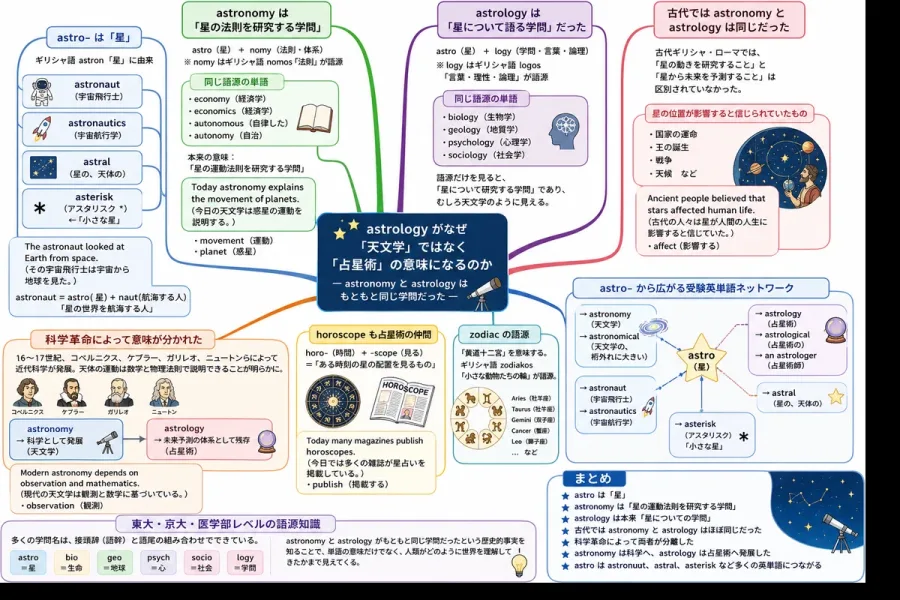
The 'astro-' common to both comes from the Greek word 'astron' meaning 'star.' Many English words are derived from this root.
an astronaut
astronautics
astral (of the stars, celestial)
an asterisk (*) ← 'a little star'
The astronaut looked at Earth from space.
(The astronaut looked at Earth from space.)
'An astronaut' is made of 'astro' (star) + 'naut' (sailor), meaning 'a person who sails the world of stars.'
astronomy is 'the study of the laws of the stars'
Astronomy is made of 'astro' (star) + 'nomy' (law/system). 'Nomy' comes from the Greek word 'nomos' (law). Words with the same root include economy, economics, autonomous, and autonomy. Astronomy originally meant 'the study of the laws of stellar motion.'
Today astronomy explains the movement of planets.
(Today astronomy explains the movement of planets.)
astrology was 'the study of speaking about the stars'
On the other hand, astrology is made of 'astro' (star) + 'logy' (study/word/logic). 'Logy' comes from the Greek word 'logos' (word/reason/logic). For this reason, it is used in a large number of academic names such as biology, geology, psychology, and sociology. In other words, looking only at the etymology, astrology is 'the study of the stars,' and it actually looks like astronomy.
In ancient times, astronomy and astrology were the same
Modern people think of astronomy as science and astrology as fortune-telling. However, in ancient Greece and Rome, 'studying the movement of the stars' and 'predicting the future from the stars' were not distinguished. People believed that the positions of the stars influenced the fate of nations, the birth of kings, wars, and the weather.
Ancient people believed that stars affected human life.
(Ancient people believed that stars affected human life.)
The meanings diverged due to the Scientific Revolution
In the 16th and 17th centuries, modern science developed through figures such as Nicolaus Copernicus, Johannes Kepler, Galileo Galilei, and Isaac Newton. It became clear that the motion of celestial bodies could be explained by mathematics and physical laws, and astronomy became independent as a science. As a result,
astronomy → developed as a science
astrology → remained as a system for predicting the future
This separation occurred.
Modern astronomy depends on observation and mathematics.
(Modern astronomy is based on observation and mathematics.)
Horoscope is also a companion of astrology
When it comes to astrology, the horoscope is also important. 'Horo-' means 'time,' and '-scope' means 'to look.' In other words, a horoscope means 'something that looks at the arrangement of stars at a certain time.'
Today many magazines publish horoscopes.
(Even today, many magazines publish horoscopes.)
The etymology of zodiac
The word 'zodiac,' which frequently appears in astrology, means the 'twelve signs of the zodiac.' It originates from the Greek word 'zodiakos,' meaning 'a circle of little animals.' From there, constellation names such as Aries, Taurus, Gemini, Cancer, and Leo were born.
A network of exam English vocabulary expanding from 'astro-'
astro (star)
→ astronomy (the study of stars)
→ astronomical (of astronomy, astronomically large)
The telescope revealed an astronomical object.
(The telescope observed a celestial object.)
astro (star)
→ astrology (the study of stars)
→ astrological (of astrology)
→ an astrologer (a practitioner of astrology)
astro (star)
→ an astronaut (a space traveler)
→ astronautics (the science of space travel)
astro (star)
→ astral (of the stars, celestial)
astro (star)
→ an asterisk (a star symbol)
→ 'a little star'
Etymological knowledge at the level of the University of Tokyo, Kyoto University, and medical schools
In exam English, students tend to memorize astronomy, astrology, biology, geology, psychology, and sociology separately. However, in essence,
astro = star
bio = life
geo = earth
psych = mind
socio = society
logy = science/study
It is merely a combination of these parts. Even more important is the historical fact that astronomy and astrology were originally the same discipline. Learning etymology reveals not only the meanings of words but also how humanity has understood the world.
Summary
astro means 'star'
astronomy is 'the study of the laws of stellar motion'
astrology was originally 'the study of stars'
In ancient times, astronomy and astrology were almost the same
The two separated due to the Scientific Revolution
astronomy developed into a science, while astrology developed into divination
astro connects to many exam-level English words such as astronaut, astral, and asterisk
The reason astrology means divination is not a matter of etymology, but because the history of human knowledge is etched directly into the English word.