This article is the Feedforce Group Advent Calendar 2023 25th day entry. Since it's the final day, I've written to my heart's content.
Yesterday's post was by Daisuke Mori of Feedforce Vietnam, titled 5 Characteristics of Digital Marketing Agencies in Vietnam I am honored that he recognized my article from the year before last... The content itself was fresh and interesting, such as the active use of message-driven advertising which is rarely used in Japan, and it was a post that satisfied my intellectual curiosity as it also touched upon the national character of Vietnam behind it!
I am Nishio, a writer and designer at Anagrams, who wrote this article ↓ on Christmas Eve the year before last.
This time, I have summarized "What is an Oshi?", "How can I find one?", and "What is a healthy way to support an Oshi?"
(*This is strictly my own highly subjective, prejudice-filled opinion. Dissenting views are very welcome.)
Recently, there is a question often thrown at me.
"I want an Oshi, but I can't find one. What should I do?"
As for how to find one, I introduced "just try engaging with various content" in the article mentioned above.
However, when I listen to people, they say,
"I like anime and manga and watch a lot of things, but I can't get deeply hooked on a specific character or work, so I can't find an Oshi." It seems.
In other words, is whether or not you have an Oshi determined by something other than the amount of content you consume?
I couldn't explain that well and felt frustrated, so I tried to put it into words on this occasion.
To begin with, are people who have an Oshi really happy?
I have a friend who spends too much money on their Oshi, has no money left, and lives by eating plain rice with salt or soy sauce.
Hearing this, do you think people who have an Oshi are happy?
Supporting an Oshi might look like irrational entertainment from an objective perspective, but for the person involved, it can be the most rational life-sustaining activity.
To take an extreme example, I believe that the more you are in a situation where you can only maintain your sanity by immersing yourself in something and escaping reality, the more you can benefit from an Oshi.
People who can live healthily without having an Oshi to be obsessed with might actually be happier.
Of course, I think it functions not only to fill a deep sense of lack, but also as wonderful entertainment to fill the boredom of life.
However, in my personal sense, "I guess I like this character within this work" is not an "Oshi" but a "favorite character/person".
An Oshi originally has the nuance of "an existence you want to recommend to someone," so I believe that an Oshi is something that triggers contribution activities toward the subject, such as spending money or evangelizing it to others.
Oshi as a means of self-expression and Oshi as a means of protecting dignityOn the other hand, with the recent Oshi-supporting boom, I feel that more people are consuming an Oshi for purposes other than the above.
That is, an oshi as a means of self-expression.
In an age where we are expected to be ourselves, even if you don't have any particular merits or things you are passionately engaged in, having an "oshi" allows you to establish your identity.
People who fit this pattern have the following characteristics. (This is just my bias)
・The necessity of that specific oshi is low, and the level of passion (i.e., dependence/obsession) is also relatively low
・The target is often a 3D idol, actor, or character from a hit work that is easy to use as a common topic of conversation
・They find meaning in the act of "oshi-katsu" (supporting an oshi) itself
There are also people who consume for both purposes, and since keeping the economy moving and increasing human connections through oshi-katsu are good things, I think any way of having an oshi is wonderful.
However, if it is because "someone else looks like they are having fun with their oshi-katsu, so I want an oshi too", then even if you force yourself to get one, happiness will not last. This is because it is highly likely that you were just made to feel like you wanted one by someone else, and it is not your true desire. This was written in a book introduced by Mr. Abe, and it really resonated with me.
Still, for those who want to know how to get deeply hooked on an oshi, I dug a little deeper.
An oshi is basically something that "exists," not something you "make"To summarize what we have discussed so far, if you need an oshi right now, you should already have one. If you don't, you probably don't need one.
If there is a way to get an oshi, the answer might be closer to "let's go out and hit many walls."
Thinking this, I tried talking to someone who couldn't get an oshi, and they said,
"I'm sure I've had various hardships in my life, too..."
Indeed, everyone must have experienced some kind of hardship.
Even so, there are people who "can't get" one and people who "have" an oshi. I thought about what that difference is.
The difference between people who "can't get" an oshi and people who "have" an oshi
In conclusion, the difference lies in the following two points.
① Can you unconditionally believe that you have value?
② Have you ever had an experience that allowed you to strongly empathize with or admire your oshi target?
Although it is a matter of degree, people who can unconditionally believe they have value do not get that depressed, even if they are temporarily plagued by feelings of incompetence, because they have a nearby presence or foundation that makes them feel that it is okay for them to exist.
However, those who are not like that feel worthless because they cannot do it, avoid interacting with others for fear of getting hurt, and become even more depressed.
If there is nothing that affirms you unconditionally, you have no choice but to rely on something that affirms you "conditionally." other than that.
That something that affirms you conditionally is what we call 'self-love'..
When you hear the term self-love, do you have a positive image like "loving oneself" or a negative image like being a "narcissist"?
Both can essentially be understood as "a mental process of trying to affirm a 'self that is not affirmed without conditions' in some way.".
In "Self Psychology," the psychology regarding this self-love, there are three ways to satisfy self-love.
Three ways to satisfy self-love<Mirroring self-object experience>
An approach to satisfying self-love by gathering praise and attention. For someone with mature self-love, even just exchanging greetings can make them feel that their existence is acknowledged and leave them satisfied.
I remembered a book recommended by my boss that wrote that "a sense of mission" and "an inferiority complex" drive people. I recalled that.
People with a strong inferiority complex work hard to gather praise and attention, so perhaps that is why many of them are highly capable. (Though it depends on where they direct their sense of mission and energy.)
Satisfying self-love through one's own power requires a certain amount of cost, but the following method allows one to satisfy self-love more easily.
<Idealizing self-object experience>
This is the so-called approach of satisfying self-love through 'oshi-katsu' (supporting an oshi)..
Supporting sports might be the easiest to visualize. Feeling down when the results are bad or happy when they are good happens because you are identifying yourself with your oshi.
Even if you cannot gather attention or praise for yourself, you can feel proud yourself just by enthusiastically supporting or admiring your ideal object, so you can satisfy your self-love instantly.
Truly, an oshi is the Strong Zero of the heart.
<Twinship self-object experience>
An approach to satisfying self-love by interacting with people similar to oneself.
You can satisfy your self-love when you talk about commonalities or feel a sense of unity with people who share your hobbies or are from the same hometown. (A feeling of being accepted as a member of society?)
For otaku, engaging in 'oshi-katsu' (supporting one's favorite) and interacting with fellow fans satisfies their self-love, so it's killing two birds with one stone!
2. Have you ever had an experience that allowed you to feel strong "empathy" or "admiration" for the target of your affection?Now, if you ask whether using the methods above will guarantee the satisfaction of your self-love, the answer is NO.
The more immature a person's self-love is, the higher their demand level for a self-object (someone who satisfies their self-love), and they cannot be satisfied by people close to them.
(Especially for those who try to gain affirmation through effort, expectations for a self-object tend to become excessively high.)
That is where the existence of an 'oshi' comes in.
Since three-dimensional humans live with their own wills, it is quite difficult for them to be exactly as you idealize them.
However, the probability of being disappointed by a two-dimensional character is lower than with a three-dimensional one so it is better for your mental health.
※Please be sure to read this↓
Three-dimensional people offer greater returns, but they also carry greater risks, so I basically can only support up to 2.5D.
However, to those unfamiliar with it, a two-dimensional character is nothing more than "just a drawing".
To make them an oshi, besides being in a "mental state of needing an oshi," it is important to be able to "strongly attach your heart to the target of your affection" becomes necessary.
What determines whether you can "strongly attach your heart" is "empathy" and "admiration".
For example, "I like their visuals" can be a trigger for interest, but you cannot attach your heart to them unless you also come to like their inner self. (Except for the purpose of sexual consumption.)
I also believe that the feeling of "wanting to support them" comes from empathy, where you overlap them with your past self, or from admiration for a target that is trying to achieve something you cannot.
How can you feel empathy or admiration for a two-dimensional character?A. Have experiences similar to those of the person who needs an oshi
In the first place, two-dimensional characters are often created to "strike a chord with people who need an oshi".
Therefore, the more deep-seated complexes a person has, the higher the probability that it will strike a chord.
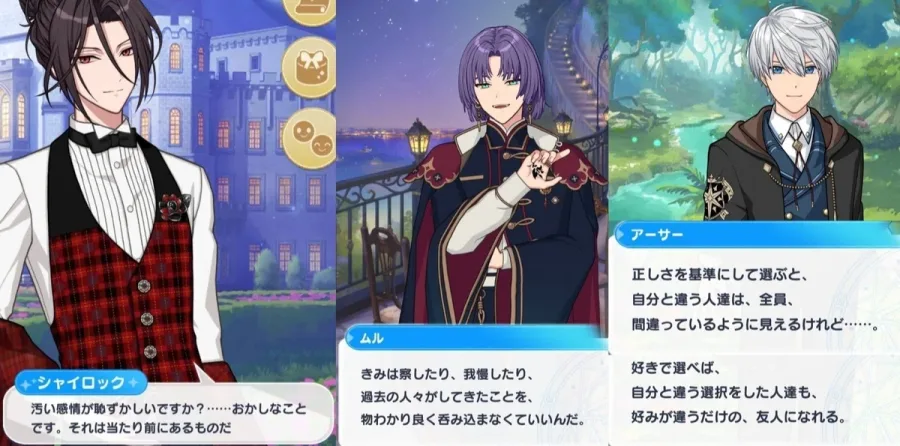
I will use "Promise of Wizard," which I have been mentioning, as an example.
※To briefly introduce the work: "It is a story about a protagonist who is transported to a world where wizards and humans coexist, where they open their hearts to eccentric wizards and fight against the moon, which is the 'Great Calamity'."
In this world, there are many depictions of wizards living in loneliness while being the targets of prejudice and discrimination.
Rather than simply pitying them as "poor things," you won't be strongly drawn to them unless you can feel a sense of having your heart tightened or being saved, as if overlapping with your past self.
But please rest assured.
Recently, to match the expanding otaku demographic, there has been an increase in characters and lines that resonate with a wider audience.
For example, this.
A whimsical and powerful wizard (≈ the ultimate self-object) affirms the failures and regrets that everyone has experienced.
Truly the pinnacle of mirroring self-object experience.
There are many other wizards who are easy to empathize with or admire, so if you want to get into 2D characters, please check out "Promise of Wizard."
By the way, the reason I started was because I heard there was a character who swapped (or more accurately, stole) their left and right eyes.
It has a fantasy world setting, but the story has many cruel parts and is not a predictable happy ending.
You can gain the courage to live from a story where they accept a reality that doesn't go as planned, respect both humans and wizards, and somehow manage to join hands and move forward in a gritty way.
There is an auto-function, so those who are not good at games can rest easy!
Moreover, part of the main story is currently unlocked! If you're going to start, now is the time!
\Easy installation in 10 seconds/
↓↓↓ Find your oshi right now ↓↓↓
Please consume your oshi appropriately while following the recommended dosage and usage.
Mahoyaku is the best, but there is one thing to be careful about.
An oshi is best consumed just enough for someone who cannot unconditionally affirm themselves to stand alongside someone who can.
This is because getting energy from an oshi is too cost-effective, and you stop spending the necessary cost on connections with real people who provide unconditional affirmation, or on recognizing yourself.
To keep your heart strong in the long term, I think it is important to balance the effort to establish an unwavering self (internal) with creating and diversifying your sources of dependency (external).
That's all! Thank you for sticking with this rambling text of about 5500 characters.
(Bonus)
The year before last, I watched a live stream of my 2.5D oshi on Christmas, but today I'm going to enjoy my oshi-katsu with an afternoon tea bus collaboration!
I am often entrusted with article LPs for work, so please feel free to consult me if you have any concerns.
Since more CTAs increase conversion rates, here is one more.
\Easy installation in 10 seconds/
↓↓↓ Find your oshi now ↓↓↓