You work in the same department, do the same job, and work the same hours. Yet, there can be a 1 million yen difference in annual income. The reason is neither ability nor performance. It is a condition unrelated to work: whether or not you have a spouse or children.
In its article 'Single Employees Without Family Allowances Face Income Gaps into Old Age' on September 8, 2026, the Nikkei introduced the voice of a single woman in her 40s working in the information and communications industry: 'Even if we live in the same building, there is an allowance for those on unaccompanied assignments. Singles have more out-of-pocket expenses.' Compared to the annual income of peers with spouses or children, she says, 'I think it lowers my motivation.'
This sense of discomfort is not a matter of individual feelings. It is a design flaw in the system, stemming from the fact that Japan's wage system was built on the premise that 'the breadwinner supports the family,' a premise that has shifted significantly from reality. Moreover, the problem does not end with the income gap during one's working years. Because family allowances are included in the calculation base for social insurance premiums, the disparity carries over into the amount of Employees' Pension Insurance received in the future. The gap that accumulates over 40 years continues for another 20 or 30 years as a difference in the monthly pension payments received in old age.
This article uses public statistics to organize how much of a monetary gap this uniquely Japanese mechanism of family allowances creates, why it persists into old age, and how Western countries design their systems. This is not to speak for the grievances of single people. It is to identify the issues in how to redesign a system where the premise that 'everyone will eventually benefit' has collapsed, in a society where single-person households exceed one-third of all households and will reach 44.3% by 2050.
1. Same work, different take-home pay. The true nature of the 'frustration' felt by single women in their 40s
Let's break down the woman's words from the beginning a little further.
'Even if we live in the same building, there is an allowance for those on unaccompanied assignments.' This refers to the fact that company support for housing changes depending on family structure. Employees on unaccompanied assignments receive a transfer allowance as compensation for living apart from their families, in addition to housing costs at their new location. On the other hand, employees who are single and living in the same building, paying the same rent, do not receive that allowance. From the company's perspective, they are paying for the 'cost of being separated from family,' which is logical. However, the actual expenses incurred are almost identical.
'Singles have more out-of-pocket expenses.' This is compounded by the fact that many companies set the requirement for housing allowances as 'being the head of the household.' Some companies provide housing allowances only to married employees. Even if they pay the same rent, one receives a subsidy while the other does not.
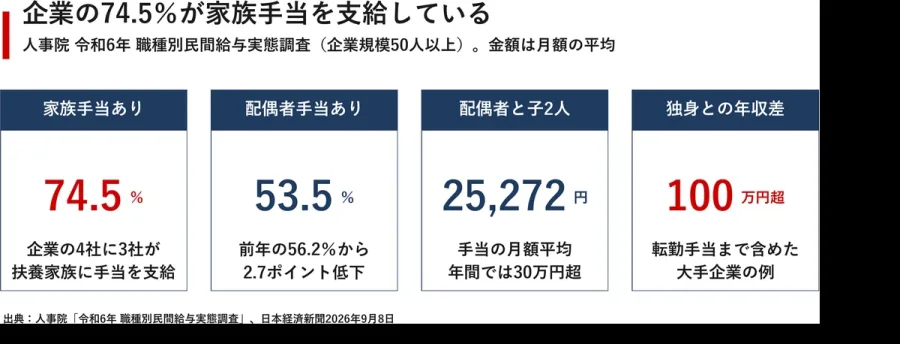
And 'compared to the annual income of peers with spouses or children, including dependency allowances, I think it lowers my motivation.' This is the essence. Allowances may look like small lines on a pay stub, but when added up, they are comparable to a difference in base salary. According to the Nikkei article, one major company provides an education allowance in addition to a child dependency allowance, totaling up to about 600,000 yen for two children. Their annual income becomes higher than that of a single person doing the same job. Including allowances for transfers, the gap exceeds 1 million yen.
A 1 million yen difference in annual income is equivalent to one or two grades in terms of career evaluation. The range that employees strive for over many years regarding promotions and advancements is bridged by the single point of family structure. Furthermore, even if a single employee is promoted faster or works more overtime during busy periods, a situation can arise where they are paid less than a married employee who does not. This is a departure from the principle that wages are compensation for work.
Professor Ikuko Kanki of the University of Tokyo Graduate School pointed out in the Nikkei article, 'The benefits of family allowances, which once reached many, now create a sense of unfairness as a difference in compensation for the same work. It could undermine the incentive to work.' The point is the part about 'once reached many.' The system itself was not unfair from the beginning, but it became unfair because society changed. If this is misunderstood, the discussion will fall into a fruitless conflict of 'singles versus households with children.'
2. The reality of family allowances in numbers
First, let's confirm how widespread family allowances are in Japanese companies and how much is paid. The basic data is the National Personnel Authority's 'Survey on Private Sector Pay by Job Type.' This is a survey conducted annually to compare the salary levels of national public servants with the private sector, targeting establishments with 50 or more employees.
The results of the 2024 (Reiwa 6) survey are as follows.
74.5% of establishments have a family allowance system. Roughly three out of four companies provide some form of allowance to employees with dependents. Looking at the breakdown, 53.5% of establishments provide family allowances for spouses, and 74.0% provide them for children.
The average monthly payment is 25,272 yen for a spouse and two children. Annually, this exceeds 300,000 yen. Even in companies without a spousal allowance, 25,241 yen per month is paid for two children, which is about the same level. In other words, even in companies that have abolished spousal allowances, the funds have been shifted to child allowances, so from the perspective of employees without children, the total difference remains largely unchanged.
Looking closely at the National Personnel Authority survey, the average is 12,320 yen for a spouse only, 17,418 yen for a spouse and one child, and 22,525 yen for a spouse and two children. In companies that do not pay for spouses but only for children, the average is 13,303 yen for one child, 25,241 yen for two children, and 37,208 yen for three children.
What is noteworthy here is that the percentage of establishments providing spousal allowances continues to decline. It was 56.2% in the 2023 (Reiwa 5) survey, but 53.5% in the 2024 survey. It dropped 2.7 points in one year. The percentage of establishments with a family allowance system itself also fell 1.0 point, from 75.5% in 2023 to 74.5%.
Regarding spousal allowances, about 80% set limits on the spouse's income. Typical criteria are less than 1.03 million yen or less than 1.3 million yen in annual income. These are the so-called 'income walls.' According to Ministry of Health, Labour and Welfare data, the percentage of establishments using the 1.03 million yen spousal income threshold halved from 40.4% in fiscal 2015 to 20.6% in fiscal 2023. Companies are also recognizing that this standard leads to employment adjustments for spouses working part-time and are proceeding with reviews.
However, the data so far shows a 'reduction in spousal allowances,' not a 'reduction in family allowances.' Many companies are cutting the spousal portion and shifting it to the child portion. Even for national public servants, the 2024 National Personnel Authority recommendation indicated a policy to phase out dependency allowances for spouses starting in fiscal 2025 and to allocate those funds to increase allowances for children.
The direction is rational. Supporting child-rearing, which actually incurs costs, is a clearer policy objective than a spouse allowance based on the assumption of a full-time housewife. However, from the perspective of employees without children, the amount in their wallets remains unchanged. The explanation that 'it became fair because the spouse allowance was abolished' does not resonate with single people or dual-income couples without children.
3. The gap doesn't end with annual income. A mechanism that carries over into old age
This is where the most important part of this issue lies.
The difference in allowances during one's working years does not end with the difference in take-home pay for that year. It is carried over as a difference in the pension amount received in the future.
According to calculations requested by Nikkei from social insurance labor consultant Mie Ido, the monthly pension amount (median) for a single man who was a regular employee was 158,000 yen. If an allowance of 25,000 yen per month is added to this for 20 years, the pension increases to 161,000 yen per month. If the additional allowance is 50,000 yen per month, it becomes 164,000 yen, and if it is 100,000 yen per month, it becomes 169,000 yen.
Why does this happen? The mechanism is as follows.
Employees' pension insurance premiums and future pension amounts are calculated based on a classification called 'standard monthly remuneration.' The 'remuneration' subject to the standard monthly remuneration is determined not by its name, but by whether it is paid continuously by the company as compensation for labor. Therefore, in principle, this calculation includes not only basic salary and overtime pay, but also commuting allowances, housing allowances, position allowances, and family or dependent allowances.
When a family allowance is included in the standard monthly remuneration, the grade may increase accordingly. If the grade increases, the employees' pension insurance premiums paid while employed will increase. However, insurance premiums are split between the employer and the employee, with the employer bearing half. And since the earnings-related portion of the old-age employees' pension is calculated by multiplying the average standard remuneration by a certain rate (5.481/1000 for periods after April 2003) and the number of months of enrollment, those with higher standard remuneration will receive a higher pension in the future.
In other words, employees who received family allowances not only received the allowance during their working years, but part of that allowance also accumulated into the pension fund along with the company-paid portion of the insurance premiums, and they receive an increased pension in their old age as well. To borrow the expression from the Nikkei article, 'the insurance premiums become higher, but the amount the employer splits and bears also increases, so the benefits become greater.'
The woman mentioned at the beginning said, 'It's frustrating. It lacks equality,' likely because she realized this structure.
Let's confirm the magnitude of the amounts. If you receive an allowance of 25,000 yen per month for 20 years, the total amount received during your working years alone is 6 million yen. To that, a difference of 3,000 yen per month in pension is added. If you receive it for 25 years from age 65 to 90, that is 900,000 yen from the pension alone. In the case of a 100,000 yen monthly allowance, the difference in the monthly pension amount becomes 11,000 yen, which is 3.3 million yen over 25 years.
As noted in the Nikkei chart, this calculation does not include retirement money. Since the retirement money of Japanese companies is often designed to be linked to basic salary and years of service, allowances do not directly affect it. However, in companies that include allowances in the calculation of bonuses, the difference also affects bonuses. Looking at lifetime income, as illustrated by Nikkei, the cumulative income curve from age 25 to 80 clearly diverges between those who have an additional 50,000 yen monthly allowance and those who do not.
When viewed in terms of a lifetime, this difference can no longer be expressed by the lightness of the word 'allowance'.
4. Why did Japan choose 'living wages'?
Here, I will step away from criticism for a moment to look at why this mechanism was created. If you destroy a system without understanding the intent of its design, you will end up destroying things that should be protected along with it.
At the root of Japan's wage system is the philosophy of 'living wages.' This is the idea that wages are compensation for work, but at the same time, they are a means to support the lives of workers and their families. As age increases, the family grows and educational expenses rise. Therefore, wages are increased according to age and family structure. This was the theoretical pillar of seniority-based wages and family allowances.
This design had rationality at the time. In post-war Japan, social security was underdeveloped, child allowances were meager, and people had no choice but to secure housing on their own. Because the country's mechanism for supporting families was weak, companies took on that role. Enterprise-based labor unions also placed the acquisition of family and housing allowances at the center of wage negotiations from the perspective of protecting the lives of their members.
And what is important is that this mechanism functioned as a system where 'everyone eventually receives benefits.' In 1980, the unmarried rate at age 50 was 2.60% for men and 4.45% for women. In a society where almost everyone married and had children, even if you didn't receive an allowance when you were young, you would eventually move to the side that receives it. It is unfair within a generation, but it evens out over a lifetime. That is why it worked.
In a sense, family allowances were 'mutual aid with a time lag.' Young people supported the families of their seniors, and when they had families of their own, they were supported by the next generation of young people. It can be said that it was a form of social security that was completed within the community of the company.
The problem is that this premise has collapsed. Moreover, the way it collapsed was sudden.
5. The 'Standard Household' is No Longer Standard
For a long time, Japan's statistics, tax systems, and social security have been based on the 'standard household.' This is a four-person household with two parents and two children, where there is only one breadwinner. In practice, this consists of a husband who works, a wife who is a full-time homemaker, and two children. This model was adopted by the Ministry of Internal Affairs and Communications' Family Income and Expenditure Survey in the 1970s and has been used repeatedly ever since to explain taxes and pensions.
However, what is the reality of this household image?
According to 2022 statistics, households with two unmarried children under the age of 18 account for only 6.9% of all households. Even under a broad definition that does not distinguish whether one or both parents work, this is the extent of it. It is too small to be called standard.
On the other hand, single-person households are increasing. In the 2020 National Census, out of approximately 55.7 million general households, about 21.15 million were single-person households, accounting for 38.0%. According to the Ministry of Health, Labour and Welfare's Comprehensive Survey of Living Conditions (though a simple comparison is not possible due to differences in survey methods and denominators), single-person households have increased from 18.2% in 1986 to 35.4% in 2025. During the same period, households consisting only of a married couple and unmarried children shrank from 41.4% to 24.3%.
Looking further ahead, the National Institute of Population and Social Security Research's 'Future Projections for the Number of Households in Japan' (2024 projection) estimates that the proportion of single-person households will reach 44.3% in 2050. The number of single-person households aged 65 and over is expected to increase from approximately 7.38 million in 2020 to approximately 10.84 million in 2050.
The trend toward remaining unmarried is also progressing. The unmarried rate at age 50 (an indicator once called the lifetime unmarried rate) was 28.25% for men and 17.81% for women in the 2020 National Census. Compared to 1980, this is about 11 times higher for men and about 4 times higher for women. As a Nikkei article states, 'the lifetime unmarried rate is approaching about 30% for men and 20% for women.'
The meaning of these figures is clear. Family-related allowances are no longer a system that 'everyone will eventually benefit from.' Nearly 30% of men and nearly 20% of women will never receive a spousal allowance throughout their lives. The design philosophy of time-lagged mutual aid within companies has lost its premise.
And for those who do not receive the benefits, only the burden remains. The source of funds for these allowances comes from the company's total labor costs. If the total amount is constant, the funds for base salaries and bonuses are reduced by the amount allocated to allowances. Employees without children are effectively bearing the cost of benefits they do not receive in the form of suppressed wage curves.
6. What are Western countries doing? Companies pay the same amount, while child-rearing is supported by social security
The Nikkei article writes very briefly, 'In Western countries, it is common for companies not to provide family allowances and to pay the same amount to employees doing the same job. Child-rearing is supported by social security.' This single sentence contains a significant design philosophy regarding the division of roles between wage systems and social security systems.
The situation in major countries can be summarized as follows.
In the United States, it is not common for companies to provide cash allowances based on spouses or children. What companies provide are fringe benefits such as family enrollment in health insurance, parental leave, and defined contribution pensions, while salaries themselves are paid for the job performed. Child-rearing support is handled by the federal tax system's Child Tax Credit (generally up to $2,000 per eligible child) and state systems.
In Germany, family allowances from private companies are not common (though public servants do receive them). The core of child-rearing support is the national child benefit, Kindergeld, which is 255 euros per child per month in 2025 and 259 euros per month in 2026. In principle, there are no income restrictions. For low-income households, a supplement called Kinderzuschlag is added, which will be a maximum of 297 euros per month in 2026.
In France, spousal allowances in private companies are not common, with some exceptions based on collective bargaining agreements. The national family allowance (allocations familiales) is generally aimed at households with two or more dependent children, and the representative amount in 2025 is about 151 euros per month for two children, about 344 euros per month for three, and about 193 euros per month added for each child from the fourth onwards. There is a gradual reduction based on income.
The UK's Child Benefit, as of April 2025, is £26.05 per week for the first (eldest) child and £17.25 per week for each subsequent child. There are no strict income restrictions on the benefit itself, but if the adjusted net income of the individual or their cohabiting partner exceeds £50,000, a portion is recovered through taxes, and it is generally fully repaid at £60,000 or more.
Sweden's child allowance (barnbidrag) is 1,250 Swedish kronor per child per month. It is a universal benefit without income testing and is generally paid automatically. There are also additional payments for multiple children.
What they all have in common is the following division of labor: Companies pay wages for jobs and performance. The costs of child-rearing are borne by society as a whole through taxes and social security.
This division of labor has clear advantages.
The first is that fairness is easier to guarantee. Because the principle of equal pay for equal work is upheld, there is no unfairness in the workplace based on family structure. Since support for people with children is provided uniformly nationwide as a national system, the support one receives does not change depending on whether one's employer has a support system.
The second point is that support should not fall through the cracks. Naturally, corporate family allowances only reach regular employees of that company. They do not reach those working at small and medium-sized enterprises, non-regular employees, the self-employed, or the unemployed. A system that leaves child support to companies structurally results in 'only the children of regular employees at large companies receiving generous support.' If it were a national child allowance, it would reach children regardless of their parents' employment status.
The third point is that it should not become an obstacle to changing jobs. People working at companies with generous family allowances see their annual income drop if they change jobs. This lowers labor market liquidity and hinders the movement of talent to growth sectors.
So, how does the level of resources that Japan's social security system invests in child-rearing support compare internationally?
Looking at the OECD's public social spending on family benefits (the sum of cash benefits, benefits in kind such as childcare, and tax breaks for families) as a percentage of GDP, as of 2021, Germany was at approximately 3.46%, France at approximately 3.38%, and Sweden at approximately 3.32%. The OECD average is approximately 2.29%. Japan is around 2%, and the United States is under 1.5%.
In other words, while Japan supports child-rearing through companies in the form of family allowances, its family support through social security is below the OECD average. If we are to transition to a European-style model where 'companies pay the same amount, and social security provides the support,' simply abolishing corporate allowances is not enough. Without a design that properly transfers the abolished funds to the social security side, it will simply be an increased burden for child-rearing households.
7. The 'Male Breadwinner' Bias of Allowances and the Gender Income Gap
Family allowances also have problems from a perspective other than fairness. They work in a direction that widens the income gap between men and women.
A Nikkei article points this out accurately. According to the 2020 National Census, 98.5% of households consisting only of a married couple and children had the husband as the head of the household. And many companies make being the head of the household a requirement for receiving the allowance.
What happens as a result? Suppose there is a dual-income couple working in the same way at the same company; the family allowance is attached to the husband's salary. It is not attached to the wife's salary. While the couple's household is receiving it, as far as individual annual income is concerned, only the husband's increases. And as mentioned above, only the husband's employees' pension increases through the standard monthly remuneration.
In the event of divorce or bereavement, this difference becomes decisive. While the employees' pension during the marriage period is subject to division, that is a systemic remedy, and it is a measure that would not be necessary if the same wages were paid for the same work in the first place.
Furthermore, the income limits (1.03 million yen, 1.3 million yen) attached to about 80% of spousal allowances discourage the spouse from working. If the wife increases her working hours and her annual income exceeds the limit, the husband's allowance disappears, which can actually reduce the household's take-home pay. This constitutes part of the 'annual income wall.' The Ministry of Health, Labour and Welfare is encouraging companies to review spousal allowances precisely to eliminate this employment adjustment.
In other words, spousal allowances are simultaneously creating three things: the suppression of the work motivation of the spouse who is not the head of the household; the relative increase in the annual income and pension of the man who is the head of the household; and the disparity with employees who do not have a spouse. When Tomoko Yoshino, president of Rengo (Japanese Trade Union Confederation), argues that companies and the government should review the 'male breadwinner'-centered system, she is referring to this structure.
8. Companies in Motion and the Challenges Ahead
The system is moving little by little.
First, there are national public servants. Due to the 2024 National Personnel Authority recommendation, the dependency allowance for spouses will be phased out starting in fiscal year 2025, and the funds will be used to increase the allowance for children. Since the salary system for national public servants influences the private sector, the significance of this shift in direction is not small.
In the private sector, moves to reduce or abolish spousal allowances and shift the focus to support for children and child-rearing have been reported at companies such as Toyota Motor, Hitachi, NTT Group, Panasonic, Toyota Industries, and Meiji Yasuda Life Insurance. The Ministry of Health, Labour and Welfare's collection of corporate case studies shows five patterns for revision methods: abolishing the family allowance itself, excluding the spouse from the eligibility for payment, incorporating the spousal portion into the basic salary, transferring the funds to the child allowance, and implementing a transition period for a certain amount of time.
As a more advanced example, the Nikkei article cites LY Corporation. Since its inception in 2023, the company has not provided family-related allowances and pays salaries based on performance. It is introduced with the words of a human resources representative: 'Whether or not someone has a family is irrelevant to their work. We judge purely on what that person is doing, so there is a certain sense of fairness.' The idea is to support employees who are raising children through things like enhanced leave systems rather than allowances.
This design is compatible with the transition to job-based employment. In job-based employment, the assigned duties, their difficulty and responsibility, the necessary expertise, the degree of goal achievement, and work-related burdens such as transfers or night and holiday work are placed at the center of compensation. There is no room for family structure anywhere in this design.
However, it is not a simple matter that if you get rid of family allowances, it will be fair. Three challenges remain.
The first is the issue of disadvantageous changes for existing employees. If you suddenly take away 25,000 yen a month from an employee who has taken out a mortgage and planned for education expenses based on that allowance, some people will find it impossible to make ends meet. Even under the Labor Contract Act, rationality and procedures are required for disadvantageous changes to working conditions. That is precisely why many companies are transitioning while maintaining the total amount in the form of incorporating it into the basic salary or transferring it to the child allowance, while setting a transition period of several years. This is the point that Rengo is arguing when it says, 'It should not be a simple uniform abolition, but a review that involves the reallocation of funds.'
The second point is the side effects of performance-based standards. If a company abolishes family allowances and compensates solely based on performance, employees with time constraints due to childcare or nursing care will be at a disadvantage. If support in the form of allowances is removed, other forms of support must be provided simultaneously, such as job designs where evaluations do not drop despite time constraints, income security during leave or reduced working hours, and career continuity after returning to work. If a company stops at just 'abolishing allowances to make things fair,' it is a pure step backward for households raising children.
The third point is where the funds from the abolished allowances go. If a company stops family allowances and distributes that amount into base salaries, the total amount for all employees is maintained. However, if a company recovers those funds to reduce labor costs, it is effectively a wage cut. During the transition period, it is essential for labor and management to clearly state where the funds will go.
9. The 'Bachelor Tax' Controversy and Child and Child-rearing Support Funds
Outside of companies, there is also a debate regarding the relationship between burdens and benefits. This is the Child and Child-rearing Support Fund.
This is a system based on the revised Child and Child-rearing Support Act enacted in 2024, and collection will begin in April 2026 by adding it to medical insurance premiums. The financial resources will be used for the expansion of child allowances, prenatal support benefits, and the expansion of childcare leave benefits.
The government has indicated that the estimated monthly burden per subscriber will be approximately 250 yen in fiscal 2026, approximately 350 yen in fiscal 2027, and approximately 450 yen in fiscal 2028. This is an average estimate across all systems and all subscribers, and the actual burden amount will vary depending on the medical insurance, income, and standard remuneration of the subscriber. In employee insurance, the burden is generally split equally between the employer and the individual.
This system was called a 'bachelor tax' in some quarters because it imposes a burden even on people without children, while many of the benefits go to households raising children. However, under the system, it is not a tax aimed only at single people. Employees, self-employed individuals, and the elderly—anyone enrolled in medical insurance—will bear the burden broadly. Married households without children and households that have finished raising children are also subject to it.
Although the term 'bachelor tax' is inaccurate, the background behind its spread cannot be ignored. From the perspective of a single person, it looks like two burdens are piling up. At the workplace, they are paying for the source of funds in the form of family allowances but cannot receive the benefits. In social insurance, they are paying in the form of support funds but cannot receive the benefits.
What should be understood here is that child-rearing support as social security has a legitimacy that corporate family allowances do not. Children are the future bearers of society and also the supporters of pensions and medical care. Single people will also be supported by the insurance premiums and taxes paid by that generation when they themselves become elderly. The logic that the beneficiaries of measures to combat the declining birthrate are society as a whole, and that the costs should also be borne by society as a whole, holds up.
On the other hand, this logic cannot be applied to corporate family allowances. Within the same company, for the same job, paying different compensation based on whether or not one has a family cannot be explained as being for the benefit of society as a whole. The children supported by a certain company's family allowance are only the children of that company's employees, and it is not a system open to society as a whole.
That is precisely why the words of Tomoko Yoshino, President of Rengo (Japanese Trade Union Confederation), which appeared in a Nikkei article, are effective: 'Child-rearing support is important, but it should be done by the government as social security, not by corporate allowances.' The argument is that if it is government support, it can prevent dissatisfaction among employees without allowances and disparities in old age.
Consolidating child-rearing support under the government is a consideration for single people, and at the same time, it is also beneficial for households raising children. Corporate family allowances are influenced by the size and performance of the employer. They do not reach those working for small and medium-sized enterprises or those working in non-regular positions. If it is moved to a government system, it will reach children regardless of how their parents work.
Japan's child allowance was significantly expanded starting in October 2024. Income limits have been abolished, the target age has been extended to high school age, and the amount for the third child and beyond has been increased to 30,000 yen per month. The first and second children aged 0 to 2 receive 15,000 yen per month, children from age 3 to high school age receive 10,000 yen per month, and the third child and beyond receive 30,000 yen per month regardless of age. For a household with three children between the ages of 3 and high school age, this amounts to 600,000 yen per year. This has reached a level that exceeds corporate family allowances (25,272 yen per month for a spouse and two children, approximately 300,000 yen per year).
The center of gravity of the system is already shifting from companies to the government. If that is the case, the basis for continuing to maintain allowances on the corporate side should become thinner year by year.
10. Another Burden Skewed Toward Single People
It is not just in terms of money; there is also a bias in the distribution of work. As the Nikkei series points out in a related article titled 'Overtime and Transfers Skewed Toward Single People.'
The structure is as follows: Systems such as overtime exemption, reduced working hours, and consideration for work location are applied to employees who are raising children or providing nursing care. These are necessary systems and should not be rolled back. However, as a result, emergency responses, holiday work, sudden business trips, transfers, and filling in for others' work are concentrated on employees who are outside the scope of these systems.
In a 2024 survey by the Persol Research and Consulting, it was found that workers who substituted for the duties of people responsible for family care, such as childcare or nursing care, worked an average of 5.6 hours more overtime per month than the average. 42.6% of people felt dissatisfied with the substitute work, and 69.2% felt that company support was insufficient. While this survey was not limited to single people, it shows that a concentration of burdens is occurring.
Regarding transfers, an article reporting on a survey by the Japan Institute for Labour Policy and Training stated that about 60% of companies responded that 'the majority' of female transferees were 'unmarried.' This suggests a corporate practice of linking the possibility of transfer to having fewer family obligations. In a 2025 survey by en-japan, 67% of those who had experienced a transfer had lived apart from their families, and over 40% had considered resigning due to a transfer.
The problem is that this additional burden is not reflected in evaluations or wages. Employees who are considered 'flexible because they are single' handle heavier workloads while earning less in annual income due to the lack of family allowances. These two reversals lead to the comment from the woman at the beginning: 'I think my motivation will drop.'
The solution is not to give preferential treatment to single people. It is to provide clear allowances and evaluations for work that restricts one's life, such as transfers, holiday work, night shifts, and sudden changes in work schedules. Ensure that the same compensation is paid regardless of who performs the task. Furthermore, use personnel data to manage whether the burden is concentrated on specific employees. The principle of paying according to the burden should be much easier to explain than the principle of paying based on whether or not one has a family.
11. Questioning the very yardstick of the 'standard household'
The issue of family allowances is not just a matter of corporate personnel systems. It is also a problem with the 'standard household' yardstick that has long been used in Japanese statistics, tax systems, and social security.
Take the 'model pension' that always appears in explanations of pensions as an example. The standard model pension amount for employees' pension insurance in fiscal year 2025 is 232,784 yen per month. The breakdown is approximately 138,000 yen per month for the old-age basic pension for a couple, and approximately 94,000 yen per month for the husband's old-age employees' pension. This is a household model based on the premise of a husband who worked as a company employee for 40 years with an average income and a wife who was a full-time homemaker for 40 years.
When this figure takes on a life of its own, misunderstandings arise. If a single person thinks of this 230,000 yen range as a benchmark for their own old age, it will deviate significantly from reality. The average monthly pension amount for a male recipient of the employees' pension, including the old-age basic pension, is generally around 160,000 to 170,000 yen. This is consistent with the estimate requested by Nikkei from Mie Ido, which found that the median monthly pension for single men who were regular employees was 158,000 yen.
In the case of single people, there is also no cost-sharing effect for living expenses. Rent and basic utility charges are all borne by one person. Even with the same 230,000 yen, the meaning is different when used by two people versus one, and in the first place, single people do not receive 230,000 yen.
At the 2023 Social Security Council, many opinions were expressed that pension levels should be presented assuming more diverse lifestyles. A realistic direction would be not to abolish the couple model, but to present multiple models side-by-side. Cases with different employees' pension enrollment periods for single men, single women, dual-income couples, and single-income couples. As long as the explanation of the system depends on a single model, policy discussions will also be dragged along by a single family image.
The same can be said for the tax system. The spousal deduction, the special spousal deduction, and the Category 3 insured person system for the national pension. All of these are systems based on the premise of a household where 'one person earns and the other is supported.' In a society where single-person households account for 44.3%, the rationality of continuing to maintain this premise will be questioned year after year.
The NLI Research Institute argues that while a family consisting of a 'husband as a company employee, wife as a full-time homemaker, and two children' was once considered standard, it is now difficult to call that household structure standard. This is because dual-income households have surpassed single-income households, and single-person households and couples without children have also increased.
Four directions for review are suggested:
Designing taxes and social insurance on an individual basis rather than a household basis. Presenting multiple household types side-by-side rather than a single model household. Showing distributions by income class, age, and employment type without using the word 'standard.' And, basing support on income, ability to pay, and necessary assistance, rather than on whether or not one has a family.
12. So, how should it be redesigned? 6 points of discussion
Based on the organization so far, I will list the points that companies and the government should each consider. This is not to force a specific conclusion, but to organize them as a starting point for discussion.
Point 1: Wages for duties and results, life support through social security.
This is the most fundamental basis. Pay the same wage for the same work. Child-rearing costs should be borne by society as a whole through taxes and social security. Whether Japan should also adopt the division of labor adopted by Western countries as a basic line. If adopted, corporate family allowances would be gradually reorganized into basic pay or job-based pay.
Point 2: If abolishing, decide the destination of the source funds first.
Abolishing family allowances, if done alone, is a wage cut for child-rearing households. At the same time as abolition, labor and management should clearly state whether the source funds will be incorporated into basic pay, temporarily diverted to child allowances, or distributed to all employees. A transition period of at least 3 to 5 years should be taken, and transitional measures should be put in place for existing recipients. This is essential for the practical implementation of system changes.
Point 3: Allowances paid according to burden should be strengthened instead.
While reducing allowances paid based on the presence or absence of a family, clarify allowances paid according to work burden. Transfer allowances, single-transfer allowances, holiday work allowances, and night shift allowances. Ensure that the same amount is paid regardless of who performs the task. The dissatisfaction mentioned in the Nikkei article that 'there is an allowance if it is a single transfer even if living in the same property' can be largely resolved if the requirements for housing subsidies are tied to actual housing costs rather than the head of the household.
Point 4: Support for time constraints should be strengthened in forms other than allowances.
If family allowances are to be abolished, support for employees with time constraints due to childcare or nursing care must be strengthened through measures such as leave systems, flexible working hours, job redesign, and career guarantees after returning to work. When LINE Yahoo's HR representatives say, 'We support employees raising children by enhancing leave systems,' they are referring to this substitution. If you remove the allowance and put nothing in its place, it is merely a cost-cutting measure.
Point 5: Consolidate childcare support under the national government and raise the standard.
If corporate allowances are reduced, that portion must be covered by national child allowances, childcare services, and childcare leave benefits. Japan's family-related social expenditure is around 2% of GDP, which is below the OECD average of approximately 2.29% and far from the 3.3% to 3.5% seen in France, Germany, and Sweden. The expansion of the child allowance in October 2024 is a step in the right direction, but there is still a long way to go to cover what corporate allowances have traditionally provided.
Point 6: Incorporate the increase in single-person elderly households into the design of old-age security.
By 2050, the number of single-person households aged 65 and over will reach approximately 10.84 million. Elderly people living alone cannot easily rely on family for care or monitoring, and they must bear housing costs on their own. The relative poverty rate for single people aged 65 and over is reported to be approximately 29% for men and 44% for women. Childcare support and support for the elderly living alone are not mutually exclusive choices. If they are not designed simultaneously, the system will become unsustainable while both remain inadequate.
13. What working individuals should check now
It takes time for systems to change. In the meantime, I will organize what you can do as an individual.
First, check the composition of your pay slip. How much is your base salary, and how much is in allowances? Of those allowances, how much is family-related? When considering a job change or assessing your market value, you will make the wrong judgment if you compare based on annual income that includes family allowances. What you should compare with someone in the same role at another company is the portion of compensation that is for the job itself.
Next, check the trends in your standard monthly remuneration on your 'Nenkin Teikibin' (pension notice). Since the system reflects standard remuneration, including allowances, in your future pension amount, it is worth knowing at what level you are being recorded. You can use the Japan Pension Service's 'Nenkin Net' to check your past records and future estimated amounts.
And for single people, plan your old-age life based on your own estimated amount, not the model pension. The model pension of around 230,000 yen per month is a household model for a married couple, not a guideline for a single person. You need to plan based on the 150,000 to 170,000 yen range, including how to secure housing. Whether you own your home or rent, and if you rent, whether you will be able to lease one in your old age—securing housing for the elderly living alone is an issue as significant as income.
Regarding company systems, you can put the design of allowances on the agenda through labor unions or employee representatives. If you frame it not as a demand to 'abolish family allowances' but as 'improving allowances based on burden and reviewing housing subsidy requirements,' you can advance the discussion without conflicting with households raising children. In fact, the Japanese Trade Union Confederation (RENGO) has also set the review of spousal allowances as a direction, and the Ministry of Health, Labour and Welfare is also encouraging companies to do so.
Finally, do not frame this issue as a conflict between 'single people versus households with children.' If you bring it into a conflict framework, the only ones who actually benefit are those who want to keep the total wage budget down. The point of contention is not which family type to distribute limited funds to. It is whether the mechanism of changing compensation for the same job based on family structure should continue to remain in corporate wage systems.
14. Summary
Let's list the facts shown in the Nikkei article once again.
74.5% of companies provide allowances to employees supporting family members, averaging 25,272 yen per month for a spouse and two children. At some large companies, the difference for two children can be up to 600,000 yen, and when including transfer allowances, the gap with a single person doing the same job exceeds 1 million yen. A situation can arise where a single person who is promoted faster or works more overtime still receives less pay than a married employee who does not.
And the difference does not end in your working years. The median monthly pension for a single man who was a regular employee is 158,000 yen. Adding a 25,000 yen monthly allowance for 20 years brings it to 161,000 yen; at 50,000 yen per month, it becomes 164,000 yen; and at 100,000 yen per month, it becomes 169,000 yen. This is because family allowances are included in the standard monthly remuneration and accumulate toward future pensions along with the insurance premiums split by the employer.
This mechanism worked because it was a society where almost everyone married and had children. In 1980, the unmarried rate at age 50 was 2.60% for men and 4.45% for women. Now it is 28.25% for men and 17.81% for women. Single-person households accounted for 38.0% in the 2020 census and will reach 44.3% by 2050. The premise that 'everyone will eventually receive the benefits' no longer holds true.
In Western countries, companies pay the same amount for the same job, and childcare is supported by social security. Germany's 'Kindergeld' is 255 euros per child per month without income restrictions, and will be 259 euros in 2026. Sweden automatically provides 1,250 kronor per month. The ratio of family-related social expenditure to GDP is around 2% in Japan, compared to 3.38% in France, 3.46% in Germany, and 3.32% in Sweden.
Changes are beginning in Japan as well. The dependency allowance for spouses of national public servants will be phased out starting in fiscal year 2025, with the funds redirected to child allowances. The percentage of companies providing spousal allowances has dropped by 2.7 points in one year to 53.5%. Companies like LINE Yahoo, which do not have family-related allowances from the start, are also emerging. The income limit for child allowances was abolished in October 2024, and the benefit was expanded to include high school-aged children.
The direction is clear. What remains is the design of the transition. If you simply remove family allowances, it will be a wage cut for households raising children, and if you continue to leave it to companies without strengthening social security, a structure will remain where only the children of regular employees at large companies are generously supported.
Equal pay for equal work. Child-rearing costs should be borne by society as a whole. Whether these two goals can be pursued simultaneously is the dividing line for whether wage systems can maintain credibility in a society where single-person households exceed 40%.
The words of the woman in her 40s at the beginning—'It's frustrating. It lacks equality'—are not just personal dissatisfaction. It is an accurate observation that the yardstick designed 50 years ago can no longer measure today's society.
References and Sources
Nikkei, 'Single people without family allowances face income gaps until old age; Western countries use social security for child-rearing support,' The Limits of the 'Standard Household' (2), September 8, 2026, Digital Edition
https://www.nikkei.com/
National Personnel Authority, 'Results of the 2024 Survey on Private Sector Pay by Job Type' (Status of Family Allowance Payments)
https://www.jinji.go.jp/kouho_houdo/digitalbook/gp202501/pageindices/index33.html
Ministry of Health, Labour and Welfare, 'Reference Materials on Considering the Future of Spouse Allowances' (July 2025)
https://saiteichingin.mhlw.go.jp/dl/haiguuteatearikata_20250701.pdf
Ministry of Health, Labour and Welfare, 'Towards Considering the Future of Spouse Allowances (Collection of Corporate Review Examples)'
https://www.mhlw.go.jp/file/06-Seisakujouhou-11200000-Roudoukijunkyoku/0000123734.pdf
Dai-ichi Life Research Institute, 'Trends Regarding the Review of Spouse Allowances'
https://www.dlri.co.jp/report/ld/414149.html
Statistics Bureau of Japan, '2020 Population Census: Summary of Results' (Household Structure/Single-person Households)
https://www.stat.go.jp/data/kokusei/2020/kekka/pdf/outline_01.pdf
National Institute of Population and Social Security Research, 'Future Projections of the Number of Households in Japan (National Projections) 2024 Projections'
https://www.ipss.go.jp/pp-ajsetai/j/HPRJ2024/t-page.asp
National Institute of Population and Social Security Research, 'Future Projections of the Number of Households in Japan: Overview'
https://www.ipss.go.jp/pp-ajsetai/j/HPRJ2024/hprj2024_gaiyo_20240412.pdf
Ministry of Health, Labour and Welfare, '2025 Comprehensive Survey of Living Conditions: Overview' (Trends in Household Structure)
https://www.mhlw.go.jp/toukei/saikin/hw/k-tyosa/k-tyosa25/dl/14.pdf
Ministry of Health, Labour and Welfare, 'Trends and Outlook for Household Composition in General Households'
https://www.mhlw.go.jp/content/12600000/001607189.pdf
Japan Pension Service, 'Remuneration-Proportional Portion' (Calculation Formula for Old-Age Employees' Pension)
https://www.nenkin.go.jp/service/yougo/hagyo/hoshuhirei.html
Japan Pension Service, 'Old-Age Pension Guide'
https://www.nenkin.go.jp/service/pamphlet/kyufu.files/LK03.pdf
Government Public Relations Online, 'Child Allowance System Expanded from October 2024'
https://www.gov-online.go.jp/tokusyu/jidoteate/
OECD Family Database PF1.1, 'Public spending on family benefits'
https://www.oecd.org/content/dam/oecd/en/data/datasets/family-database/pf1_1_public_spending_on_family_benefits.pdf
OECD, 'Family benefits public spending'
https://www.oecd.org/en/data/indicators/family-benefits-public-spending.html
German Federal Ministry for Family Affairs Related Materials, 'Kindergeld 2025 / 2026'
https://en.familienservice.de/-/mehr-geld-fuer-familien-kindergeld-kinderfreibetrag
NLI Research Institute, 'Transformation of Standard Households and the Social Security System'
https://www.nli-research.co.jp/files/topics/41625_ext_18_0.pdf?site=nli
The Japan Institute for Labour Policy and Training, 'Research Study on Job Transfers'
https://www.jil.go.jp/institute/reports/2025/0235.html
en-japan, 'Survey on Awareness Regarding Job Transfers' (2025)
https://corp.en-japan.com/newsrelease/2025/40849.html
Recruit Works Institute, 'Japan Employment Panel Survey 2025'
https://www.works-i.com/surveys/item/jpsed_data2025.pdf