Hello everyone.
This is Surimi Channel.
The topic for this guide is "Invoked".
New support is finally coming to Master Duel!
So, I will be explaining the Invoked archetype, which has been supercharged with this new support.
I also plan to post a video on YouTube.
Please subscribe to the channel so you don't miss it.
The video is now out.
I have explained hybrid builds in detail in a separate note.
[Overview]
The strengths of Invoked after the new support can be broadly divided into three points.
The newly added Reminiscence, Aiwass, and Sacred Sword are all cards that can start a combo on their own.
Furthermore, if you draw them alongside the original Aleister, they act as extenders against negation effects targeting Aleister.
The feeling is like,
"The Dogmatika portion of the old Invoked Dogmatika has been replaced by the new Invoked cards, and the new Invoked cards can now compensate for the combo and board control capabilities of the Invoked engine."
That is the image.Since you can run up to nine of these starters/extenders, which are essentially Circular-level cards, the consistency of your combos is very high.
Moreover, while the original Aleister-only combo used to end with just summoning Mechaba, thanks to the new Invoked cards, you can now extend your plays further and aim for a powerful lockdown board.
Because you can secure starters and follow-up plays within the engine itself, you can fight effectively without needing external engines.
As a result,
even in a 40-card build, more than half of the deck can be free slots.This allows you to adopt generic cards tailored to the current meta.
It makes it easier to keep hand traps in your hand and maintain a game state even in situations that are usually tough for combo decks, such as getting hit by hand traps while going first or playing second.
Also, since there are almost no restrictions, it is possible to splash them into various decks.
However, because the new Invoked cards use a massive amount of Extra Deck space, you have to be very careful about adjusting the slots when combining them.
Therefore, even if you are building a hybrid deck, I recommend trying the pure build first to carefully determine which cards can be removed for the hybrid build.
Extra Deck peeking via Aeon is a unique strength of the new Invoked cards that other decks do not have.
Admittedly, it pales in comparison to hand peeking like Killer Tune or Toon.
However, the information advantage of being able to check the opponent's entire Extra Deck, and then banishing a card that is central to their combo to collapse their plan, is extremely powerful.
If you play it well, you can even cycle Aeon back and forth between your turn and the opponent's turn to peek at six cards.
It is obviously effective against decks that are highly dependent on the Extra Deck, and even against decks that are not, you can eliminate cards that serve as starting points for breaking boards, such as Ty-Phon, to remove your opponent's win conditions.
In addition to this, in the basic combo, you can summon Baronne using Sorato and Corozo.
Narrowing down the opponent's combo plan with Aeon and then stopping their must-counter play with Baronne or hand traps is the new Invoked's winning pattern.
The new Invoked support enhances the existing Invoked combo and disruption-piercing capabilities.
The information advantage from Extra Deck peeking and the ability to disrupt the opponent's plays are the archetype's unique strengths.
On top of that, the deck's strength lies in its ability to fight even when going second or when you can't combo off, thanks to the large number of free slots that allow for many hand traps and generic cards.
Next, the combo guide...
But before that, I will explain some things that are easy to get wrong during effect resolution.
The new Invoked cards can do many things and are highly versatile, but there are also many things that are easy to misunderstand if you don't read the text carefully.
There is no worry about rule errors when playing in Master Duel, but until you get used to it, there are many times when you think, "I can't do the move I thought I could!" when thinking of new combos or trying to play on the fly.
In OCG, the opponent might not notice the mistake and the game might proceed as is, so you need to be especially careful.
So, I will explain two points that I personally feel are particularly easy to get wrong.
The new Invoked monsters added this time have
material requirements of "Aleister monster".
Therefore, you cannot use Fusion Material substitutes like King of the Swamp or Mudragon of the Swamp to summon them.
Conversely, since Remembrance is not the original Aleister, you cannot use it to summon existing Invoked monsters that specifically require the original Aleister as material.
To incorporate Mechaba or Augoeides into your combos, you must use Invoked Caliga or the original Aleister as material.
When including Magistus, you need to be careful with Crowley the Magistus of Grimoires.
When using its third effect to treat it as Fusion Material, it can be treated as the original Aleister, but that effect only applies while Crowley is on the field.
This does not apply if you are using a Crowley from your hand, Graveyard, or banishment as material, or if you Special Summoned it after negating its effects with something like Sorato.
Invocation uses Fusion from the hand.
Or, when summoning an Invoked monster, it uses Fusion by banishing from the field or Graveyard, but Tsurugi uses field Fusion.
Or, when summoning an Invoked monster, it uses Fusion by sending from banishment to the Graveyard.
As you can see, the range of usable Fusion Materials differs slightly.
Also, Sorato's Graveyard effect is a Fusion effect that banishes from the field or Graveyard to summon only Invoked monsters, but it must include itself as material.
Therefore, there are some monsters, like Ocean, that you simply cannot summon due to their material requirements.
Now, let's look at some actual combo examples.
【Combo Examples】
In this combo example, the top priority is to use Tsurugi during the opponent's turn to
summon Aion to banish cards from the field and peek at the Extra Deck.
Of course, depending on your hand combinations and the cards adopted in your deck, you can create even more powerful boards.
However, I decided on this plan because I believe that keeping gimmicks and hand consumption to a minimum and taking a simple approach is the best way to bring out the strengths of the Invoked archetype.
The number of disruptions might look low, but
using Tsurugi to summon Aion during the opponent's turn
while peeking at the Extra Deck and removing three cards from the field is extremely powerful.
With the Sacred Sword starter, you can summon Aleister one extra time via its effect.
This allows you to add to the current combo
and summon Aion during your own turn.
As an alternative plan from Remembrance, it is possible to aim for Baronne or Therion.
However, Remembrance has already used its once-per-turn summon effect,
and the original Aleister only activates its effect when Normal Summoned.
Because of this, there is little merit in summoning them.
The story changes if you adopt external gimmicks, but I will omit that for now.
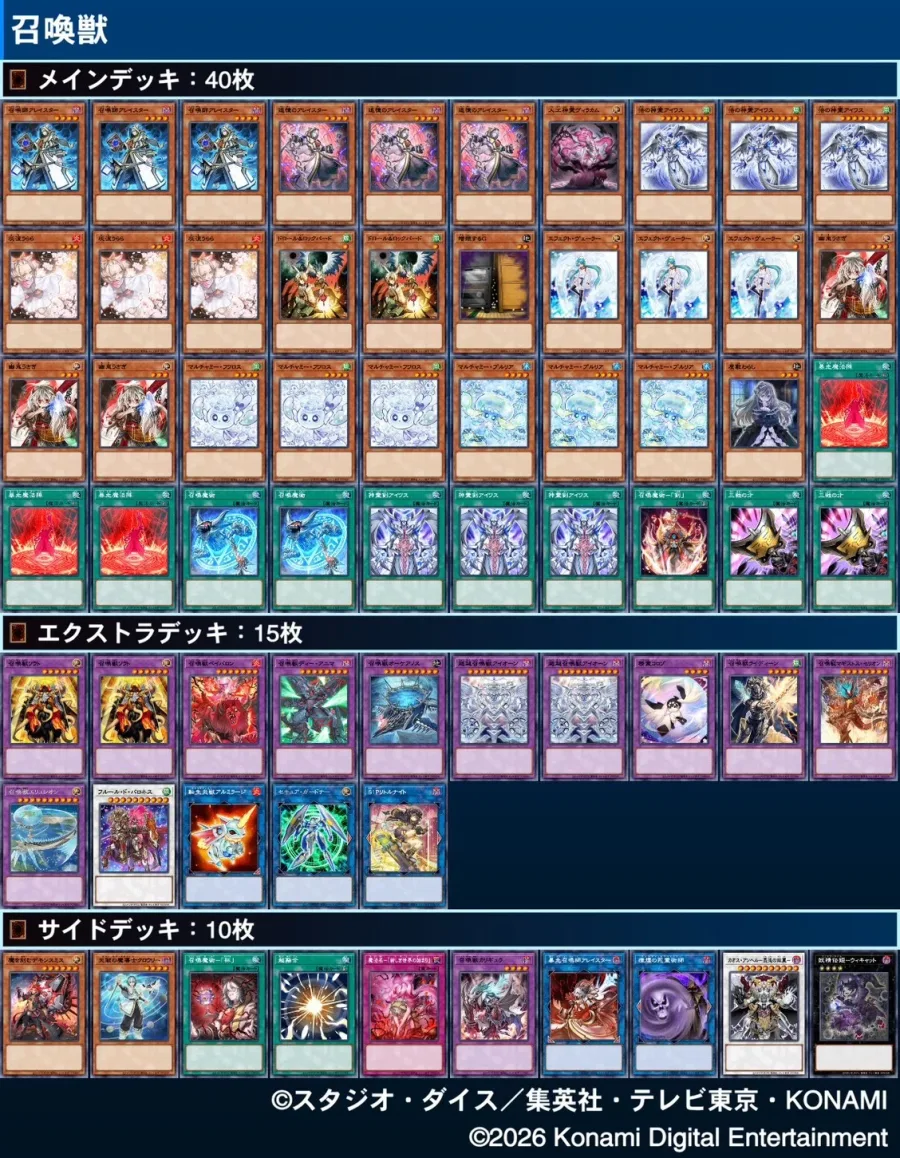
【Deck Recipe】
This deck is built with the intention of omitting unnecessary gimmicks and keeping it as simple as possible.
Even so, with 15 one-card starters, 9 of which can also act as breakthrough cards, the combo potential is sufficient.
It is true that the number of moves and the explosive power when a combo goes through are higher with other gimmicks, but the quality of your fallback options when you can't combo due to Mulcharmy or Droll drops.
Therefore, I increased the number of hand traps to make it easier to fight even if the combo is stopped.
When the combo goes through, you gain information advantage by peeking with Aion and are in a very favorable position where you have disrupted the opponent's plan, so it is easier to win if you are holding hand traps to avoid losing immediately to board-breaking cards that are easy to draw into.
Also, a serious problem when building a hybrid deck is that Invoked monsters consume the Extra Deck very heavily.
The main gimmick cycles, but the Extra Deck has no way to recover resources, so the number of Invoked monsters adopted in the Extra Deck is directly linked to your ability to sustain the fight.
Therefore, even if you are building a hybrid, I recommend adopting gimmicks that consume little of the Extra Deck or gimmicks that allow you to cycle resources while fighting.
Now, I will explain the cards within the theme that were not adopted.
This is an option for the search effect of Baibalon.
Basically, it is better to aim for Virakam -> Tsurugi to summon Aion on the opponent's turn.
Even if you summon Aion with World, you can't do anything because there are no Fusion Materials.
Therefore, the targets to summon are stationary monsters like Caliga or Ocean, or simply monsters with disruption effects like Elysium, Mechaba, or Raidjin.
Since the situations where it can be active are limited, such as when you are stopped by draw-based hand traps or have drawn multiple copies, it is not adopted this time.
The monster summoned by the first effect is banished at the end of the turn,
but it can be revived by the second effect. Or so you'd think, but you can only summon cards that meet their summoning conditions.
Be careful if you decide to adopt it.
It cannot be searched (Important).
From the perspective of being a breakthrough or board-breaking card that you assume you will draw into, there are too many powerful rivals like Triple Tactics Talent or Super Polymerization.
If it were a searchable card, it would have the performance to justify a one-of adoption, but it is not adopted this time.
Next, I will explain the cards that are candidates for adoption as a splashable gimmick.
You can connect to Invoked from the move of landing Crowley and activating its Special Summon effect.
If you adopt Runaway Aleister, it is also possible to combo from the Magistus side through Baronne + Therion to Remembrance.
However, the fact that it doesn't function when you draw Crowley, and the conflict between Zoroa or Sandrillon and the original Aleister for the Normal Summon, is concerning.
It is not adopted for a pure Invoked deck.
The explosive power when Lacrima, Therion, and Zoroa are involved is tremendous, so I recommend it for those who like solitaire.
If you really want to mix it with Magistus, I recommend reducing the number of copies of Magical Meltdown and the original Aleister so that the interference is milder if you draw them together.
Alternatively, I recommend keeping the Magistus side limited to only Spoon and Crowley.
Since Aion is a Fiend-type, you can summon it with Sequentia.
Also, from Sequentia to Aerial Eater → send Aiwass to the Graveyard via effect → send Aerial to the Graveyard appropriately → revive with Aiwass effect...
This sequence leads to a play that is effectively the same as a Holy Sword starter.
I suppose after peeping with Aion on your own turn,
if you change its attribute to Light, you can branch into Demonsmith from a Light Fiend...
There was a time when I, Surimi, thought that was possible.
Aion's effect is properly a hard once-per-turn.
Therefore, to cycle from the Invoked side to Demonsmith, you also need to include Saros Nanna or Exciton Knight.
Aerial Eater is a Wind-attribute Fusion, so it has good synergy for matching the colors of Aion's Fusion materials.
However, even the minimum gimmick of Lacrima, Sequentia, and Aerial requires 3 slots.
It reduces the depth of the Invoked side's plays, and its resistance to Maxx
C
and Fuwaross is significantly low.
If you start from Lacrima or Tractus, just a Droll will prevent you from connecting to Invoked plays.As such, it was not adopted because it takes heavy hits from disruptions that a pure Invoked deck would not take heavily.
Since Oceanus is a living Dimensional Fissure, it has good synergy with Kaguya.
You can reach Invoked via Magistus from Fairy, and even from Invoked starters, you can summon Machiryl or Regulus from Therion, or if you summon Wicckid with Memories + Level 4, a play cycle is possible.
Also, from the Fairy perspective, Memories is a Level 4 Spellcaster and has a Special Summon effect, so it is great as a breakthrough card; from the Invoked perspective, it has good synergy in that it is a deck that relies less on the Extra Deck and can cycle resources.
I am planning to explain this in a separate video after considering it a bit more deeply.
I'm waiting for requests.
As I have said many times, the Extra Deck slots are extremely tight, so I am choosing the cards to include very strictly.
Therefore, for this time, please keep in mind that these cards were not excluded because they are completely useless, but rather they are cards that were reluctantly cut after scrutinizing the reasons for not including them, even though there is an option to include them normally, because there are no slots.
This is a card that can extend your plays when you run out of the original Aleister, such as in Memories starters.
The material requirement of two monsters with different attributes and types is difficult.
Despite being hard to summon, there is little it can do other than becoming a Fusion material as an Aleister.
The Spell search effect also has difficult activation conditions and requires a cost, so actively aiming for it is questionable.
I think the opportunities to contribute to winning are limited because play routes based on Invoked Augoeides have high requirements and are fragile with poor resistance to hand traps.
You can increase Aleister's Normal Summon right by using a Spell as a cost.
If you adopt Souls and Gold Sarcophagus Girl,
With this, you can secure the Spell cost (Gold Sarcophagus) for Miasma.
Since it becomes a means to supply Level 6, using it as material for Baronne or simply including the Ruin Dragoon is an option.
However, since MD does not have the new Dark Magician support like Curtain, it might be questionable.
As I said with Invoked Augoeides, plays based on such acrobatic moves are fragile and have poor resistance to disruption.
Because the requirements are high, I think the opportunities to contribute to winning are limited.
I have explained Invoked when the new Dark Magician support arrived in a past video.
Please check it out.
You can easily summon it with Sorat + Corozo or Aleister.
It has decent performance as a landing spot for going second or compromised plays.
However, it is hard to trust because many meta decks have answers to Angel, such as Super Polymerization, Virtuous, Elfenotes, and Rhapsodia.
I miss the days when everyone was like, 'I have no choice but to use Imperm on the fully powered Angel, what should I do...'
It is quite a candidate for the Magistus build.
If you do it well and equip Artemis, you can cycle to Magistus, and if you adopt it together with Miasma, you can secure the cost for the additional Normal Summon with the Equip Card.
It is not adopted because there are few opportunities for it to be active in a pure build.
Bonus: Demonsmith build
Seeing Yugura-san doing something interesting, I, Surimi, also thought about it, so I will share it.
Since Nanna can be used in MD, plays that were not possible during the OCG era have been realized.
It might be good because it increases the number of moves for starters.
Here is what's good:
・Memories ⇔ Aleister cycle without using Therion
・Sequentia → Aion for resource recovery
・Lacrima is strong (Hand trap absorption & endurance & board processing ability)
・Maximum output of plays increases
The downsides
・It looks like it adds more plays, but in reality, it just increases the number of copies of Magical Meltdown & Invocation
・There is no room to include Aleister or Cocytus, so it cannot function independently from the Invoked engine
Conclusion
Thank you for watching until the end.
If you liked this, I would appreciate it if you could like and share.