There is a monster that eats everything.
Taotie, which appears in Chinese mythology, is a monster with such an intense image.
It has a wide, gaping mouth with sharp fangs, and no matter how much it eats, it is never satisfied.
Its appearance is terrifying and somewhat eerie.
However, the appeal of Taotie is not just that it is a "gluttonous monster."
In ancient China, Taotie was also spoken of as a being that symbolizes human desire and greed.
In this article, we will introduce Taotie, known as one of the "Four Perils" in Chinese mythology.
Taotie, one of the Four Perils
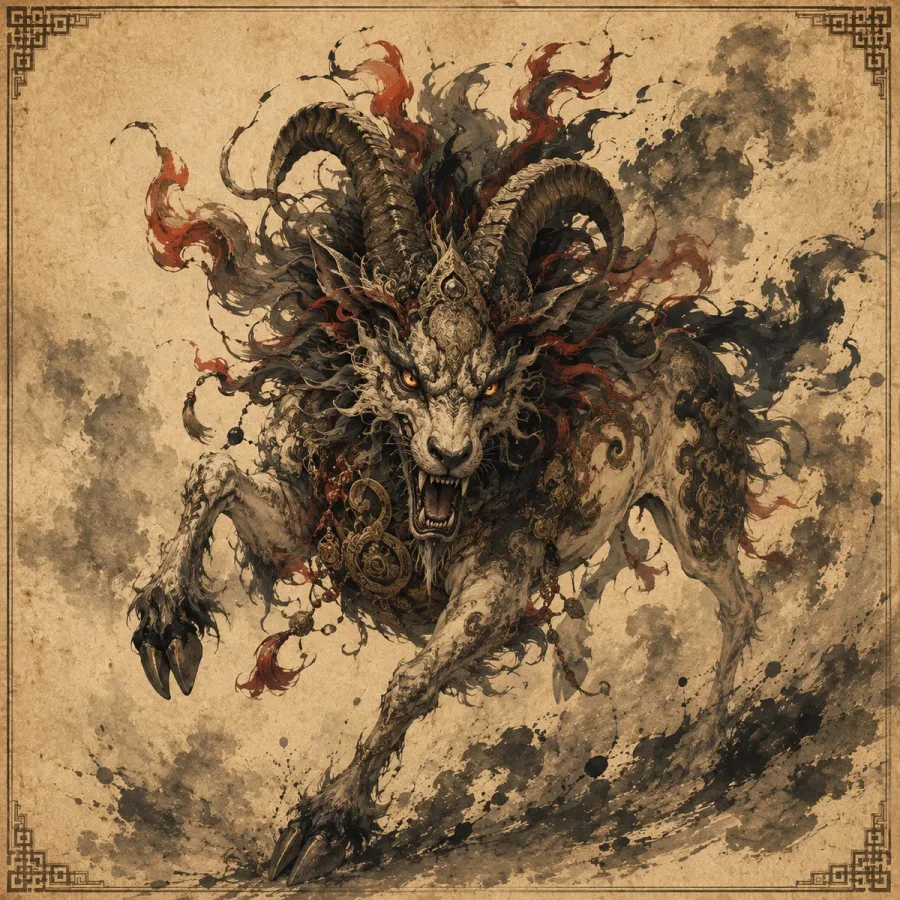
Taotie is one of the "Four Perils" that appear in Chinese mythology.
The Four Perils is a collective name for the wicked beings that appear in ancient Chinese folklore, and generally refers to the four entities:
Hundun
Qiongqi
Taowu
Taotie
.
Among these, what characterizes Taotie above all else is its "obsession with eating."
It is never satisfied no matter how much it eats, and it devours everything in front of it one after another.
For this reason, Taotie is also considered to be a being that represents desire that expands without limit.
Its appearance is actually quite eerie
Taotie does not have a fixed appearance like the dragons or lions of today.
Although depicted in various forms depending on the era and tradition, later legends sometimes describe it as having a sheep-like body with a human face, curved horns, and tiger fangs.
Furthermore, it is sometimes described in quite bizarre terms, possessing human hands, a wide, gaping mouth lined with sharp fangs, and eyes located under its armpits.
A body reminiscent of a sheep-like animal, with a human-like face.
By adding an abnormally large mouth and sharp fangs to that, it becomes a grotesque monster completely different from any ordinary animal.
The fact that the act of "eating," which is so familiar to humans, is transformed into such an eerie form is also what makes Taotie interesting.
The "Desire" Symbolized by Taotie
Taotie is not a monster that eats simply because it is hungry.
No matter how much it eats, it cannot be satisfied and continues to crave more.
This can be seen as an extreme representation of the human desire to "want more."
It is not just about food.
Money, power, honor, status—the more you acquire, the more you want.
Taotie may be the manifestation of such desire pushed beyond its limits.
And there are legends that symbolize the terror of this desire.
During the Zhou Dynasty, when the image of Taotie was depicted on bronze vessels called ding, it was said to have "only a head and no body."
It is said that while Taotie possesses a desire so strong it would devour people, that insatiable appetite eventually destroys itself.
In other words, the desire to devour others ultimately leads to one's own destruction.
The terror of Taotie lies not only in its massive mouth or sharp fangs,
but also in the fact that it embodies the fear that "desire has no end,"
a fear that is relevant to humans themselves.
It feels as though such irony is embedded within the monster known as Taotie.
The face of the 'Taotie' remaining on bronze vessels
When discussing the Taotie, one cannot overlook the bronze vessels of ancient China.
Many patterns resembling the terrifying, forward-facing face of a beast can be found on bronze vessels made from the Shang to the Western Zhou dynasties.
Large eyes, horns, a nose, and a mouth.
Through complex lines arranged symmetrically, a face is depicted that looks as if a monster is glaring at you from within the vessel.
Today, these patterns are often called 'Taotie patterns' and are known as one of the representative motifs of ancient Chinese art.
However, this pattern was not necessarily called 'Taotie' during the Shang and Zhou dynasties.
It is believed that in later ages, the ancient beast-face patterns were linked to the legendary Taotie, and thus came to be called 'Taotie patterns'.
Therefore, there is still debate today as to whether the patterns on the bronze vessels were truly the legendary Taotie itself.
Even so, it is very interesting that the image of the terrifying beast face and the Taotie overlap.
Is it different from the Taotie of the Nine Sons of the Dragon?
There is a slightly complicated matter here.
In China, there is a tradition called the 'Nine Sons of the Dragon,' and there are lineages that include the Taotie among them.
However, what I am introducing here is the Taotie as one of the Four Perils.
In Chinese mythology and folklore, it is not rare for beings with the same name to appear in different stories, or for their appearance and lineage to change according to later books.
Therefore,
the 'Taotie as a child of the dragon' and the 'Taotie as one of the Four Perils'
do not necessarily need to be considered the same entity.
Perhaps it is more characteristic of Chinese mythology to think that the current image of the 'Taotie' has been formed through the overlapping of various traditions.
What the Taotie represents is likely not unrelated to us humans.
"I want just a little bit."
"I want more."
"Now that I've gotten this, I want that next."
If such desires continue to swell, you might one day find yourself unable to control them.
Taotie can be said to be the embodiment of such human desire and greed in the form of a monster.
And by using this Taotie as a starting point to look at the remaining Four Perils, the "human terror" depicted in Chinese mythology will become even clearer.
Next time, we will take up Hundun, who is depicted as a "being that does not distinguish between good and evil."