I love British baked goods made with plenty of flour and butter.
Scones are especially special. The aroma of butter and that unique texture—crispy, fluffy, and crumbly. When served fresh from the oven with jam and clotted cream, it makes me feel incredibly happy.
Although this is now a quintessential British treat essential for afternoon tea, I found something that didn't quite add up when I looked into its history.
The roots of the scone and a sense of unease
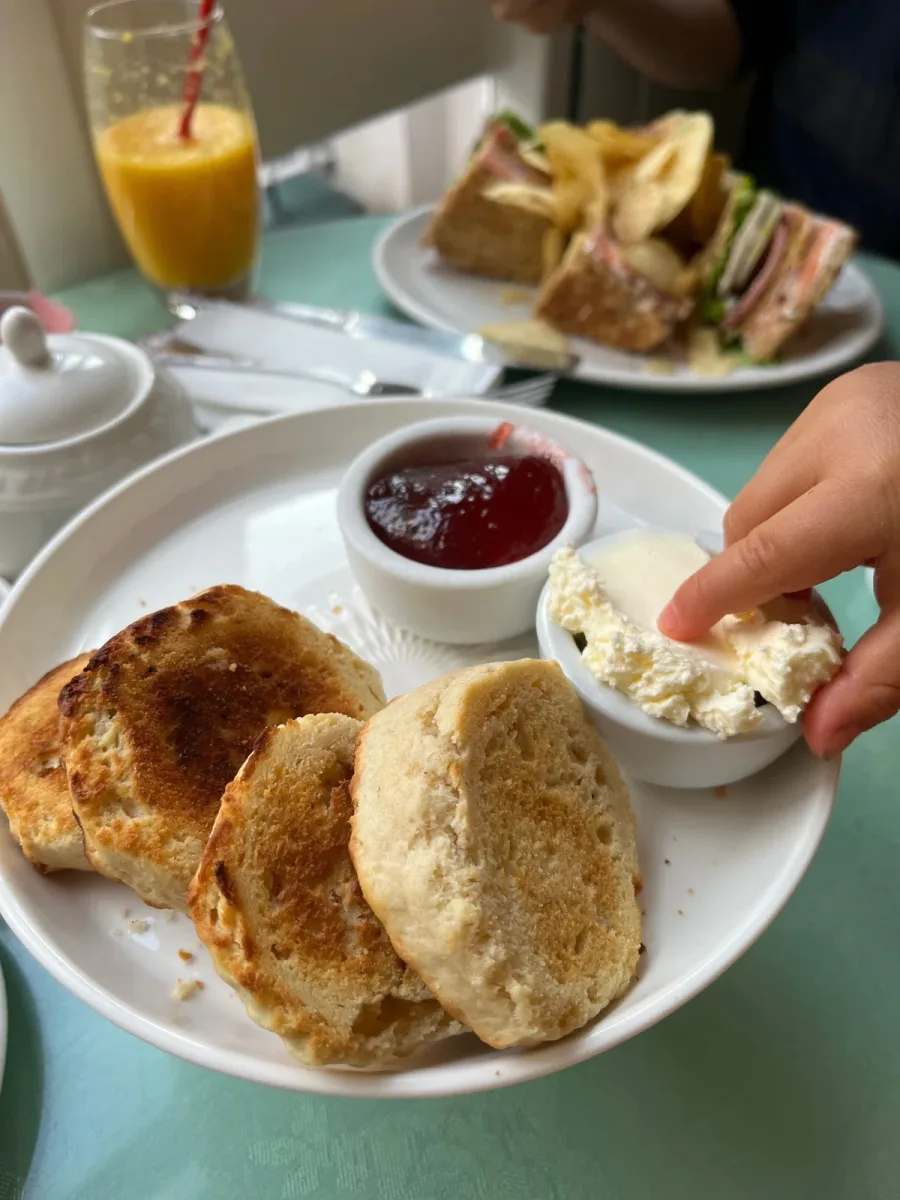
It is said that scones were originally flat breads eaten in Scotland. The word "scone" first appeared in literature in the early 16th century. For a long time after that, they were simple items made by binding barley or oats with water or milk, rolling them thin, and baking them on a griddle.
That they expanded in the 19th century due to the advent of baking powder and became the form they are today—
This is the history often told, but it feels like a significant leap.
Flat barley bread and light afternoon tea pastries. They look so different that I start to doubt whether they are truly connected in history as the same food.
I searched in both Japanese and English and read various articles, but I could hardly find any explanation that specifically shows the "in-between" period.
Therefore, I decided to trace the evolution of the scone using late 19th-century cookbooks and handwritten recipe notebooks from Scottish households as clues, a time when baking soda and baking powder began to spread widely.
1878: Scones that still retained traces of "simple flat bread"
I examined a handwritten recipe notebook owned by the mistress of a Scottish landowner (gentry) that I found on the National Library of Scotland's website.
Mary Malcolm Palmer-Douglas' recipe book
This 1878 notebook contains five recipes titled "Scones".
The first one that appears is "Barley meal scones". It involves heating barley flour, salt, and milk into a paste, rolling it flat on a floured surface, and baking it on a griddle. It contains no leavening agents and is considered the oldest type of scone.
In the three recipes titled "Scones," "Barley Scones," and "Branxholm Scones," baking soda and acidic ingredients (buttermilk, cream of tartar, tartaric acid) are all used as leavening agents, but they contain no fat, sugar, or eggs, and there is no mention of how to bake them. It is thought that they were likely also the type that was rolled flat and baked.
Only one recipe, "Scotch Scones", was significantly different from the other four scones. In addition to baking powder, it used butter and eggs, and it was noted to be "baked on a griddle or in a quick oven." While it is highly likely that the shape was still that of a large, flat scone, it is a recipe with more modern elements, such as the richness of the dough and the ability to be baked in an oven.
At this point, it is believed that flat scones baked on a griddle were still the mainstream. On the other hand, transitional recipes like the richer "Scotch Scones," which could also be baked in an oven, were beginning to appear.
1881: Signs of change—the enrichment of the dough
A scone recipe is also included in "Cassell’s Dictionary of Cookery" (1881 edition) published in London.
One is a simple version made by adding water and salt to barley flour, similar to the scone in the 1878 handwritten notebook.
The other is "Scones, soda," which includes baking soda. Both are described as being rolled thin and baked on a griddle or frying pan.
What is interesting is that it mentions, "You may rub in a small amount of butter to the barley flour if you like," and as a richer scone, it also shows a method of "using wheat flour and melting butter or lard into the milk or water beforehand to make the dough," which shows that the trend toward "enriching the dough" was already visible.
The scones were still flat, but the contents were beginning to change little by little.
1890s: The elements of modern scones are present, but the shapes are inconsistent
By the 1890s, scones began to show a wide variety of forms all at once.
1892 "Pastrycook and confectioners' guide"A recipe for "Scotch scones" appears in a professional cookbook published in London. This Scotch scone contained:
• A rich dough using butter, sugar, and eggs
• Baked in an oven after brushing the surface with egg
These were elements close to modern scones. However, it was written that they were large circles and cut later, so the shape still had remnants of the old Scottish type of scone. The content is quite similar to the "Scotch Scones" noted in the 1978 handwritten notebook, but with the addition of sugar and the process of brushing the surface with egg, it gives the impression of being more refined and closer to a "confectionery."
Furthermore, this book also contains a recipe for "Girdle scones" baked on a griddle. There were two types of girdle scones: a simple, old-fashioned recipe adding only leavening agent, milk, and salt to wheat flour, and a rich type adding lard, sugar, and eggs to the dough.
1892 Mary Malcolm Palmer-Douglas handwritten recipe notebookMeanwhile, a handwritten notebook from a Scottish gentry family of the same period. It belongs to the same owner as the 1878 notebook. A recipe named "Cream or butter scones" appears.
• Ingredients: wheat flour + butter + baking powder + milk
• Rub butter into the dough
• Cut into rounds and bake (0.5 inches (approx. 1.3 cm) thick, 3.5 inches (approx. 8.9 cm) in diameter)
It includes the process of rubbing butter into the flour, which is essential for modern scones. Furthermore, the method of baking is to cut them into individual rounds after rolling them out. Although they are large and thin at 1.3 cm thick and just under 9 cm in diameter, the way the dough is made can be said to be almost the same as modern scones.
In summary, in the 1890s,
• Simple ones with only wheat flour and leavening agent
• Rich doughs that are still baked on a griddle
• Those baked in an oven but still large and flat in shape
• Those cut and baked in individual rounds
Various types of scones coexisted.
What was happening at this pointBy the 1890s, already,
• Flour
• Rubbing in butter
• Leavening agent
• Oven baking
• Round shaping
These “elements of the modern scone” were all present. However, they had not yet come together, and instead
coexisted in separate forms.
Interestingly, this change appears simultaneously not only in London cookbooks but also in Scottish household notebooks.
I tried making scones in the middle of their evolution
What were scones actually like at the end of the 19th century? I recreated three types.
① Barley scones (from an 1878 notebook)Barley flour, salt, and milk only. Fresh out of the oven, they are surprisingly soft and easy to eat; while simple, the grain flavor is clearly present. They are quite delicious when served with butter and jam.
② Rich scones baked on a griddle (from the 1892 'Pastrycook and confectioner's book')A type made by adding butter, eggs, and sugar to flour and baking powder, then rolling it out flat to bake. Although fluffy, the texture is closer to bread, and the impression is quite different from what we call a scone.
③ Scones cut with a round cutter (from an 1892 handwritten notebook)Dough with butter rubbed in, cut into shapes and baked in the oven. Although they look a bit thinner and larger, the outside is crisp and the inside is fluffy. The finish is quite close to modern scones. Since the proportion of butter is lower than in modern ones, they are lighter.
When lined up, you can see the evolution in progressThe 'Scottish flat barley bread' and the 'small, round, fluffy afternoon tea scone' seemed unrelated. I realized that scones in the middle of their evolution existed between them, and they were indeed connected.
Why did scones become their 'current form'?
For hundreds of years, the scone was a simple Scottish flat bread.
In the latter half of the 19th century, it underwent a major change in just over a decade.
During this period,
• The spread of leavening agents (invention of the Solvay process in the 1860s, enabling cheap, mass production)
• Regional interaction via railways (major Scottish cities connected to London in the 1850s)
• The spread of white flour via roller milling (white flour became mass-producible after 1870)
• Victorian-era Scottishness (the rise of interest in Scottish culture, starting with the Royal Family)
It is believed that these factors combined to drive the evolution of the scone.
Amidst this, numerous variations of scones were born, and it is thought that the "scone made by cutting out butter-rich dough into rounds and baking it in an oven" was chosen as the most suitable form for teatime and eventually became standardized.
Around 1900: Becoming a refined teatime pastry
An example showing the culmination of this change is Claude Monet's cooking notebook.
Monet's cooking notebook contains a recipe for "Scones". It uses flour, butter, baking powder, and milk, and is made by cutting the dough into rounds and baking it in an oven. While it is a simple mixture without sugar or eggs, both the shape and the method are almost identical to modern scones.
Monet stayed in London several times around 1900, including stays at the Savoy Hotel. Perhaps, having encountered scones during these stays, Monet was drawn to their deliciousness, asked for the recipe, and brought it back to France.
It is believed that in London during this period, scones had already become established as a refined tea pastry served in luxury hotels and tearooms.
Summary
Scones did not suddenly become what they are today overnight.
From a flat Scottish bread to a refined London tea food.
We were able to trace a part of that change through late 19th-century cookbooks and handwritten notebooks.
The late 19th century was, for scones, an era of rapid evolution, mixing, and trial and error.
The elements of the modern scone were already present, but they had not yet been integrated, and scones of various shapes existed simultaneously.
From among them, the one that best fit British tea culture—"cutting out butter-rich dough into rounds and baking it in an oven"—was refined as the "standard scone", and it is thought that it eventually spread throughout the UK.
※ I plan to compile the documents and original recipes I researched this time in a separate article as a reference section
I am writing an article about Claude Monet's cooking notebook, which appeared briefly this time. For those who love history and gourmet food!
Monet who cooks? Clearing up that misunderstanding
Examining Monet's dining table from the recipes written in his cooking notebook
Making strawberry mousse with a recipe from the Monet family over 100 years ago
Did Monet like bananas? Monet's banana dessert