I played Magical Girl Witch Trial, commonly known as 'Manosaba'.
It's a highly satisfying work that you can probably clear in a little over 10 hours.
I played it at the beginning of January, but I've been swamped with work and haven't been able to get around to writing about it, so I'll write this up quickly.
Well...
• Those who like cute girl characters
• Those who like a gothic worldview
• Those who want to start playing ADVs from now on
• Those who want to encounter a death game that's a little different
Congratulations. You were born in an era that has 'Magical Girl Witch Trial'.
Introduction
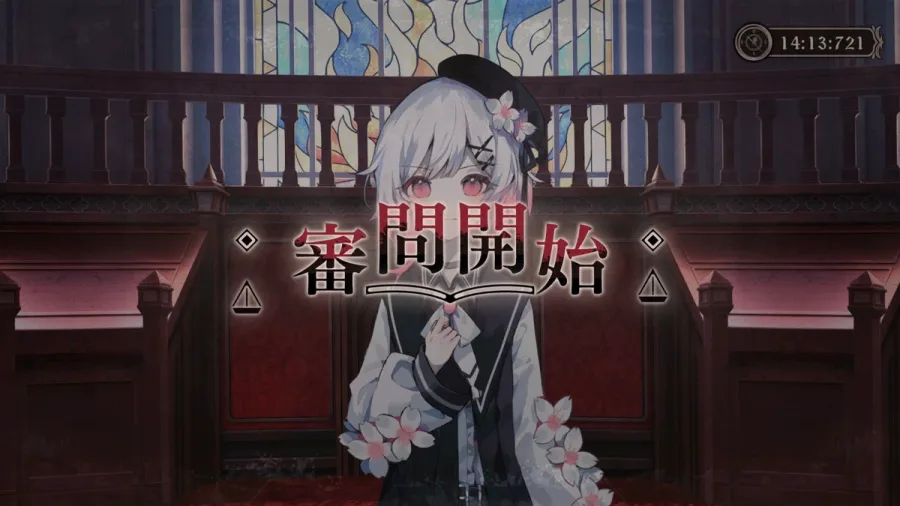
This 'Manosaba' is a so-called death game ADV, or more specifically, a style labeled as a debate-based game. To put it bluntly, it's Danganronpa-like.
・In other words, a locked room! Girls! Killing each other! Finding the culprit! Execution!
・So, you might ask, what is the unique flavor of this 'Manosaba'? It is, after all, the 'magic' and the 'girls' aspect.
・Regarding 'magic', because it is a murder committed by a witch, magic is involved in the entire case, including the tricks and motives. Its unique worldview and the impossible murder mysteries that only magic can provide are one of its charms.
・Next, regarding the 'girls'. It's great that they are cute, of course, but works featuring only girls aren't exactly rare these days. A common trope in death games is to involve romance, like 'Let's escape together -> It was a honey trap' or 'A sleazy guy shows up and it's annoying to read', which often feels like noise. So, having the gender unified allows me to focus on the main plot, which is a plus.
Good points
Music and visuals・As with all ADVs, it's basically a slideshow, so there is little movement on the screen. Therefore, how much the music and the power of the art can immerse you in the work is a very important point. In that regard, this work is flawless!
・From the title screen, the illustrations and BGM that evoke the worldview are so well-crafted that you want to press start quickly, but you also want to keep looking at the title screen—a perfect, contradictory experience.
・Also, it's fun to play because it's full of great songs and stills that highlight the unique worldview, which is both gothic and modern-cute. The so-called 'pursuit' or 'debate' BGM during the trial also has a solid, heated climax, and the cut-in standing pictures and the heavy, bell-tolling BGM are also good. Debate-based games are all about making your brain juice flow with the exhilaration of breaking through testimony.
・No matter how good the scenario is, it would be a shame if the foundation of the art was weak, so I'm sure they put a lot of effort into this intentionally. ※The pursuit BGM 'AccUhEarts-Hatsu-' is especially worth a listen.
・The thing that gave me the chills the most was the voting button. The 'Name the culprit!' choice is common and necessary as a climax, so it's naturally exciting. But in this work, for a magical girl whose crime has already been exposed and whose execution is certain, a vote for execution is held even though it's already decided. Instead of just letting this play out in the text, they make the player press the button. And you have to hold it down. This direction, which makes you realize you are an accomplice, wasn't in other works. It brings your brain, heated by the catharsis of cornering the culprit, back to reality. This bad-taste direction is exactly what makes a death game, and it plays a role in the good 'bad aftertaste' that is the real thrill of the genre.
It was a game with quite a few gimmicks, and I thought the direction that highlighted them was also good. It's a golden rule that the first person to be eliminated in a death game is a key person, but I didn't expect the protagonist to change right then and there.
There are ADV games where branches happen without explanation, and others where branching and looping are part of the setting due to a character's looping ability. It was novel that someone other than the protagonist (Emma) possessed that ability.
Also, the way the final scenario was handled, taking the important setting of 'Witchification' and swinging it around, was superb. The way it stayed focused on the biggest mystery while using it as a production element, the 'Witchification' cut-ins, and the way it broke away from the original 'debate-style' gameplay—where you use magic to advance the trial—and turned into something resembling a battle of abilities, really got my adrenaline pumping and kept me leaning into the screen as I played.
The 'Refute!' cut-in changing when witchified, and the fact that Emma-chan and Hiro-chan became dual protagonists who helped each other refute accusations against them in the first and second loops, was also super intense.
Furthermore, the finale, where every character becomes both a victim and a perpetrator within the loops, and they all share each other's pain and trauma, is beautiful.
In addition, there were many scenes where the scenario went beyond the player's imagination. I thought the development where Emma, who had become an ally to the protagonist Emma at the end of the first loop, would rush to the protagonist Ressai's trial, only for her to appear as a corpse—and then using that corpse to escape a pinch—was an incredibly good episode that showed the resolve of each character.
And above all, the pacing is great. The daily life parts are just the right volume, striking a perfect balance between the incidents and the girls' everyday lives.
In conclusion
Isn't this an incredibly good game?
I think both men and women will get hooked on the appealing visuals and world-building.
It feels like a great entry point for ADV games.
It seems like it could get an anime adaptation.
I heard they are also making sister works like 'Inshu Village's Inshu Trial?' and 'Streamer Trial.' It seems Nikaido Hiro-chan will appear in those as part of a star system. They're good at business! It makes me curious.
I'm busy with work, but I'm playing the game bit by bit, so I hope I can write my next impressions soon.