Starting with this article, I will be re-listening to AFUL's IEMs as a cohesive series.
I have owned several AFUL earphones for some time, and it has personally been a brand that left a good impression on me.
High-quality low-end texture.
A sense of volume supported by a hybrid design.
Mid-to-high frequencies that are not harsh on the ears.
And, their approach of not churning out new products at short intervals, but rather developing each model with careful consideration for the lineage.
These are the aspects where I felt the 'AFUL-ness'.
Because of this, I decided to repurchase models I had previously let go and review the major AFUL models all over again.
After the Juzear series, I would do AFUL.
I announced this on X, but since then, new products I wanted to cover individually kept arriving, and I was also refining my own review writing and listening methods, so some time passed before I could actually start.
However, through my recent articles, I feel I have become better organized than before in how I connect measurements with actual listening, how I choose comparison units, and how I put the characteristics of the sound into words.
If I can re-listen to AFUL in that state, there is meaning in starting now.
I plan to proceed with this AFUL series by dividing it into three main flows for now.
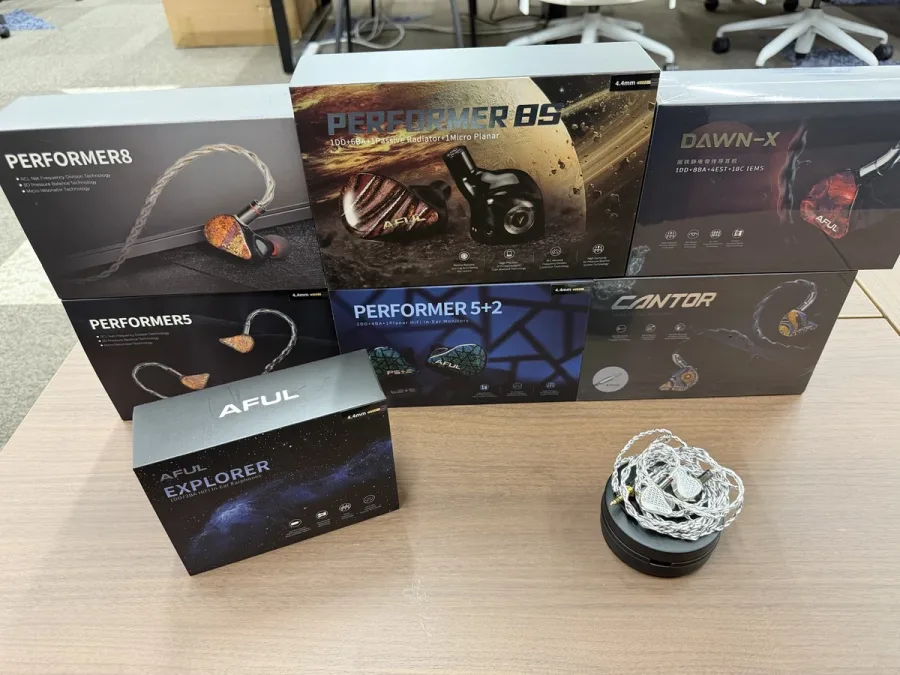
First, I will start with the Explorer and follow the hybrid line that continues to the Performer 5, Performer 8, Performer 5+2, and Performer 8S.
Next, I will cover the 1BA configuration MagicOne and the full-BA flagship, the Cantor.
Finally, I plan to move on to the DAWN-X, a multi-driver hybrid that includes bone conduction.
In the second and third chapters, I want to look at how AFUL crafts its sound, including comparisons with units I gathered specifically for this purpose and the bone conduction flagship I own.
Since this will likely be a long series, I will probably take short breaks along the way, but I would appreciate it if you could stay with me until the end.
However, I feel that AFUL is a brand worth looking at not just for its new products, but for the connections between models and its sound philosophy as a brand.
The first one I will take up is the AFUL Explorer.
The AFUL Brand and the Positioning of the Explorer
AFUL is a brand backed by AfulAcoustics, established in 2018, and is introduced by its official Japanese account as a brand that focuses on developing high-performance earphones at affordable prices.
Among the Chinese IEM brands in recent years, I believe AFUL occupies a somewhat unique position.
Rather than simply increasing the number of drivers or showing off with flashy, easy-to-understand tuning, they have a strong reputation as a brand that brings acoustic structure and the connection between drivers to the forefront.
I believe the Performer 5 and Performer 8 were what made this approach widely known.
The Performer 5 is a hybrid IEM with a 1DD+4BA configuration, and AFUL highlights features such as a 3D-printed acoustic tube structure, a high-damping air pressure balance system, and RLC network frequency division correction technology.
With the Performer 8, the configuration was expanded to 1DD+7BA, demonstrating a direction aimed at higher perfection and information density, building on the technology shown in the Performer 5.
The important point here is that I don't think AFUL is a brand that has shown itself to be impressive just because it has many drivers.
Rather, it's about how they connect multiple drivers.
How they separate the low, mid, and high frequencies and connect them naturally.
How they make the entire IEM work, including the pressure on the ears and the fit.
The appeal of AFUL lies in those aspects.
Since then, AFUL has expanded to the 1BA MagicOne, the full-BA Cantor, the Performer 5+2, the Performer 8S, and higher-end multi-driver models like the DAWN-X.
In that context, I think it is natural to view the Explorer as the entry point to AFUL.
The Explorer is a 3-driver hybrid IEM with a 1DD+2BA configuration, and at $119.99, it is quite accessible among AFUL's main hybrid line.
However, it is a bit off to view the Explorer merely as a budget version.
The significance of the Explorer lies in the fact that AFUL has distilled the acoustic philosophy it built up in its higher-end models into a smaller driver configuration and a more realistic price range.
The Performer 5 and Performer 8 are easily seen as mid-range models focused on technology integration.
In contrast, the Explorer is a model that asks how well it can reproduce the AFUL-like low-frequency texture, band connectivity, and mid-to-high frequency comfort with a relatively simple 1DD+2BA configuration.
If the Explorer succeeds, it demonstrates that AFUL's strength does not lie in the multi-driver configuration itself, but in the 'way of building sound' itself, including acoustic structure, crossover design, and air pressure control.
In that sense, the Explorer is both an entry point to AFUL and a model that makes the core of the AFUL brand easy to see.
This is also the reason why I am starting with the Explorer this time.
If I were to follow the timeline strictly, I think it would be more natural to start with the Performer 5.
However, in this series, I want to check AFUL's hybrid line starting from the entry point, rather than looking at the high-end or core models right away.
Does it have that signature AFUL low-end texture?
Are the mid-to-high frequencies well-balanced and easy to listen to?
Is there any awkwardness in the transition between the BA and DD?
And finally, is the Explorer just a cheap AFUL, or is it a meaningful model that serves as a proper entry point into the brand?
After confirming these points, I will move on to the Performer 5, Performer 8, Performer 5+2, and Performer 8S in future articles.
In this article, I will first listen to the Explorer as the gateway to the AFUL series.
Unboxing and Fit | A Blue Entry Model That Creates Its Own Unique World
The Explorer has some differences in its package contents compared to the Performer series that I will be covering later.
The first thing that catches the eye is the case.
While some models in the Performer series come with a metal case, the Explorer includes a light blue leather-style soft case.
This light blue color matches the theme of the Explorer unit and its packaging, giving the impression that it was chosen to fit the overall atmosphere of the model rather than just being a cost-cutting measure.
Although the Explorer is in an accessible price range for AFUL, there is little sense of cheapness when opening the package.
The cable is the same.
Instead of a braid where multiple thin wires are visible, it comes with a cable wrapped in a pale gold coating.
It looks clean and is easy to match with the blue-toned design of the Explorer unit itself.
In this regard, I get the impression that it was put together with an awareness of how the Explorer model should look, rather than simply cutting back on accessories as a low-cost version.
Even though the Explorer is an entry-level AFUL model, the world-building upon unboxing is well-crafted.
There is also an abundance of ear tips.
In the renewed set, a total of 9 pairs of ear tips are included, with 3 types in S, M, and L sizes.
Clear type.
Clear type with a blue inner core.
All-gray type.
Each has a different stem stiffness and bore width, making it easy to test not only the fit but also the changes in sound.
Since the Explorer features a 1DD+2BA hybrid configuration, you should be able to notice changes in how the low end is produced and how the high end breathes depending on the ear tips used.
Being able to test multiple directions with just the included ear tips is a welcome feature for an entry-level model.
The body design also maintains a worldview that fits the theme.
The faceplate features a finish that looks like fine glitter scattered over a black and blue gradient base.
Combined with the blue of the box and case, it has a slightly fantastical atmosphere that suits the name Explorer.
In this price range for IEMs, it is not uncommon for models to have only a flashy faceplate with little consistency with the packaging or accessories.
In that regard, the Explorer has a sense of unity as a single model, including the colors of the case, cable, and the unit itself.
The housing size is compact, as expected of a 3-driver configuration.
It fits well in the ear, and there is little feeling of it protruding significantly when worn.
Compared to large multi-driver models, the ease of wearing is a clear advantage of the Explorer.
I believe the regular price is around 20,000 yen, and it can drop to around 15,000 yen during sales.
It is by no means just a cheap model.
However, compared to the Performer series and AFUL's higher-end models, it is in a position that is easy to pick up as an entry point to experience AFUL's sound design.
So, does the Explorer produce a sound worthy of that price?
Next, I will confirm the direction of the sound through measurements.
Prediction from measurements | A design that keeps the low end thick and shifts the mid-to-high range toward ease of listening rather than stimulation
First, regarding the left-right balance, there are no major deviations.
Overall, I have never personally encountered issues with individual differences in AFUL's quality control, and I feel secure because the distributor support in Japan is also reliable.
Looking at the measurements of the Explorer, the lift on the low-end side catches the eye first.
There is a solid amount from 20Hz to around 100Hz, and it drops gently toward the mid-range.
It looks like it has given leeway to the entire low end rather than just adding a little bit of sub-bass.
With this shape, the Explorer's low end should not sound light.
It is easy to produce the support of the kick and the volume of the bass, and one can expect it to firmly build the foundation of the song.
On the other hand, since it is not sharply cut from 100Hz to 300Hz, the low end may have some thickness to support the music rather than being tightened up.
This also connects to the impression I have of AFUL.
Rather than inflating the low end excessively, it leaves texture and volume on the lower side of the music.
The Explorer also appears to be in that direction based on the measurements.
The mid-range does not have a shape that pushes significantly forward from around 300Hz to 800Hz.
It settles down once from the low end toward the mid-range, and then gradually rises again after passing 1kHz.
Looking at this shape, it doesn't seem to be the type that pushes vocals or the resonance of instrument bodies forward in a dense way.
Rather than pushing with vocal thickness or proximity, it is highly likely to be a balance that places a slightly organized mid-range on top of a low-end foundation.
However, the mid-range is not significantly scooped out.
Therefore, rather than the vocals becoming extremely distant, I would expect them to be presented naturally while keeping the density in check.
If this works well, the Explorer will be an earphone that possesses low-end volume without muddying the mid-range.
After 1kHz, it rises gradually toward the 2kHz to 3kHz range.
This part is the frequency band related to vocal presence and melody lines such as guitar and piano.
However, the rise is not extreme.
Therefore, rather than pushing vocals strongly to the front, it appears to be just enough to keep voices and melodies from being buried within the thickness of the low end.
This seems to be directly linked to the Explorer's ease of listening.
If this band is pushed too strongly in a model with low-end presence, voices can become harsh and fatiguing.
Conversely, if it is too restrained, voices will sink into the thickness of the low end.
Based on measurements, the Explorer appears to be aiming for the middle ground.
The 4kHz to 6kHz range does not fluctuate wildly, and while it goes up and down a little, it suppresses irritation.
If this area is too strong, vocal sibilance, snare hardness, and guitar edges tend to come forward.
Since the Explorer does not push that area strongly, it is possible that the mid-high range prioritizes ease of listening over flashiness.
There is another peak around 6kHz to 8kHz, so cymbals, hi-hats, and the entry to the sense of air should come through to some extent.
However, it drops significantly after 10kHz.
Because of the influence of the measurement environment and coupler, the very top of the high range cannot be definitively concluded as is, but at least based on the measurements, it does not look like the type that expands the space significantly with ultra-high frequency extension.
I think the high range is directed toward suppressing sibilance and hardness while retaining the necessary airiness, rather than extending it in a glittering way.
Looking at it as a whole, the Explorer does not seem to be a bright and sharp hybrid.
It builds a solid foundation in the low end, keeps the mid-range from being too dense, and rounds off the high end to be easy to listen to by suppressing irritation.
If I were to predict from the measurements, the Explorer does not seem to be a model that surprises with resolution or flashy airiness, but rather one that lets you enjoy music through the thickness of the low end and the manageability of the mid-high range.
What I want to confirm here is the following point.
Does the low end have not only volume, but also texture and tightness?
Do the vocals emerge in a natural position without being buried by the thickness of the low end?
Do the mid-high frequencies have sufficient clarity and detail, rather than just being easy to listen to?
Is there any awkwardness in the transition between the BA and DD drivers?
Is the Explorer more than just a low-priced AFUL, and does it stand as a proper entry-level model for the brand?
Looking at the measurements alone, the Explorer is not a flashy hybrid.
Rather, it appears to be a model that builds on a foundation of low-end thickness while smoothing out the upper frequencies to be easy on the ears.
So, how does that balance translate into music when actually listening?
Next, I will confirm this through actual listening tests.
First Impressions | Warmly tuned, yet capable of capturing all the necessary details
In the measurements, the Explorer appeared to be the type that builds a solid foundation in the low end while keeping the mid-high frequencies controlled and free of harshness.
First, I will check how that balance manifests with actual tracks.
The first thing I notice is the overall balance.
The guitar arpeggios, the spread of the bass, and the positioning of the vocals are all well-integrated without any single element becoming too sharp.
The low end has enough thickness to support the bottom of the track, the guitar sounds soft, and Jessie Reyez's voice does not sound unnaturally thin.
The Explorer makes this song very easy to listen to.
However, it is not the type that just stops at being easy to listen to.
Jessie Reyez's voice feels more substantial rather than dissolving into the air.
There is a sense of proximity to her mouth and a core to her voice, ensuring the vocals stand firmly at the center of the track.
This is likely related to the presence range, but the vocals come forward a bit.
Rather than the high frequencies being piercing, it feels more like the vocals themselves step forward, approaching the threshold of being piercing.
I think this is an important characteristic of the Explorer's midrange.
This is not an earphone that pushes vocals into the distance and relies only on low-end and airiness.
The voice comes forward properly.
However, that forwardness is not defined by sharp contours or hard edges, but rather sits naturally atop a warm foundation.
Because of this, the texture of Jessie Reyez's raspy voice remains intact.
Even when her voice shifts toward a whisper, the breathy components and the subtle tremors in her throat are not completely smoothed over.
I can hear the fine nuances, and I don't feel that the vocal expression is lacking.
This is where the Explorer shines.
Overall, it leans toward a warm sound, possessing that characteristic AFUL composure.
However, being warm doesn't mean the details of the sound become vague.
The guitar arpeggios, the low-end support, and the rasp in the vocals are all captured just as much as needed within the music.
I think the Explorer is the type of earphone that retains necessary information while maintaining listening comfort, rather than dissecting the sound into fine pieces.
In this track, that character came through quite clearly.
Rina Sawayama — “Hold The Girl”In “Hold The Girl,” you can see how the Explorer handles modern pop music with its dense sound count.
From the intro, the sound spreads out with a moderate sense of air.
However, that expansion isn't the type that reaches out flashily toward the highs.
Rather than making the space feel vast, it softens the area around the sounds, connecting the whole naturally.
The kick drum doesn't push forward excessively.
Instead of overwhelming with low-end quantity, it supports the rhythm with a tight texture.
The impact points are visible, and the tempo of the song remains steady.
This left a better impression than I had imagined from the measurements.
Models with thick low ends can sometimes cause the kick to bloat in songs like this, making the rhythm feel heavy before reaching the chorus.
With the Explorer, while there is a low-end foundation, the kick doesn't push too far forward.
When the chorus hits, the bass sound emerges as pressure on the lower end.
However, it doesn't feel like the bass is pushing forward to cover the vocals or the higher-frequency elements.
Rina's voice, the strings entering from the left and right, the drum beat, the guitar, and the harmonies are all audible.
Fine sound separation is also achieved.
However, it is not the type that emphasizes resolution by sharpening the outlines.
The Explorer doesn't carve out each sound with hard lines; it organizes them within a range that keeps the music cohesive.
Because of this, it doesn't sound thin even in the chorus.
On the other hand, there is no sense of the sound becoming a single wall or turning into a muddy mess.
I think this is where the Explorer's ability to balance sound is truly excellent.
It doesn't make the sound contours overly sharp, yet you can still distinguish the necessary parts within the track.
This presentation is different from flashy resolution.
However, it rarely feels like you're missing information while listening.
In the final build-up, I wanted a bit more airiness.
Because the Explorer leans toward a warmer sound, the sense of exhilaration where the music opens up toward the top in grand moments is somewhat restrained.
I think if there were a bit more high-frequency extension and brightness in the soundstage, the sense of openness at the end would have been even better.
However, as an entry-level hybrid in this price range, the balance is quite well-achieved.
The low end supports the track.
Vocals are not buried.
You can pick up subtle sounds.
And yet, the sound doesn't become piercing or cluttered.
My first impression of the Explorer was that it delivers a hybrid-like performance that is more refined than its price suggests, centered around thick low frequencies and easy-to-listen-to mid-highs. I felt.
Low End | Skillful control of the frequency band while maintaining thickness
In the low end, I will check whether the Explorer is simply a type that produces volume, or if it can deliver the organized low end characteristic of AFUL.
KAYTRANADA — “Lite Spots”“Lite Spots” is a track with intense filter effects and pass-filter movements, featuring significant dynamics where sounds appear and recede.
What I felt first with this track was that the Explorer doesn't just inflate the low end, but controls the frequency band quite clearly.
In parts where the sound drops out, the silence sinks into a proper black.
The low end doesn't linger constantly to muddy the whole track; it provides thickness where needed and pulls back firmly when it should.
Around the main chorus, both the kick and bass sound with a thick texture.
I don't feel any lack of volume at all.
However, it's not a presentation where the low end spreads out roundly to cover everything.
The kick hits come through clearly as pressure, and you can follow the movement of the bass within the rhythm.
This was a part where the Explorer's low end made a very good impression.
The amount of low end is substantial.
Yet, the textures of the kick and bass are distinct.
It is a low end that can move as a groove without blurring the contours of the sound too much.
In this way of crafting, I feel the calculated low end that is typical of AFUL.
There are moments where the percussion is intentionally pushed to the background due to the production of the source material.
However, it remains firmly present where it should be, and there is little sense of it being erased by the low end.
The Explorer manages to keep the low end thick while maintaining a clear separation from the mid-high frequencies.
Rather than simply pushing with low-end quantity, I think it is the type that collectively controls the thickness of the low end, the pressure of the hits, the movement of the bassline, and the blackness of the silence.
Sudan Archives — “NBPQ (Topless)”In “NBPQ (Topless),” I checked the depth of the lower frequencies and how much the other sounds are pulled toward them.
With the Explorer, even when the bass dips low, there is little sense of other sounds being dragged into the low end.
The low-end foundation is solid, but voices and higher-pitched elements do not recede excessively.
In this regard, I feel the band separation is handled well relative to the amount of low end.
You can also hear the deeper sub-bass that enters around 1:47.
Of course, it is not the type that sinks deep into your body like a dedicated low-end machine.
However, the presence of the sub-bass itself comes through clearly.
My impression is that the Explorer is not an earphone that prioritizes ultra-low-end depth above all else.
Mid-bass and kick drums have more impact and quantity than the sub-bass.
Therefore, it is closer to building a solid foundation and rhythmic thickness for the track rather than enjoying earth-shaking lows.
However, that does not mean the sub-bass is discarded.
While retaining the sense of deep low frequencies, it uses the mid-bass and kick to create the center of gravity for the music.
I believe this balance is the defining characteristic of the Explorer's low end.
It is not an earphone to enjoy ultra-low frequencies as the main attraction.
However, if you are looking for a strong foundation and thick rhythm while still retaining sub-bass depth, the Explorer's low end is quite satisfying.
Including the tuning of the upper frequencies, the Explorer is balanced toward a natural sound.
Personally, I feel the balance and sound delivery are closer to the Performer 5 than the Performer 8, which I will review later.
It adds thickness to the low end without causing the overall sound to fall apart.
Even as an entry-level model for AFUL, I think the way the low end is crafted clearly shows the brand's identity.
Midrange/Vocals | Warm but not muddy, with a natural connection between voices and instruments
In the midrange, I will check whether the Explorer's warm-leaning balance leads to natural-sounding voices and instruments.
In models with a thick low end, the midrange can sometimes sound a bit muddy, or the contours of voices can become too rounded.
Does the Explorer head in that direction?
Or can it maintain ease of listening while properly preserving the substance of voices and the positioning of instruments?
In “Eugene,” the distance between the guitar and the vocals is quite easy to perceive.
First, the guitar sounds quite natural.
The thick, warm, mid-range-leaning picking characteristic of this song remains firmly intact.
Rather than thinning out the lines to create clarity, it plays the track while maintaining its overall softness and warmth.
I think the warmth of the Explorer works quite well for this song.
The vocals don't sound like they are floating in the air.
The voice is close, not the type that is placed far away.
However, that proximity doesn't feel unnaturally pushed forward; instead, it contributes to creating a sense of presence and impact within the song.
Even in the whisper vocals of the chorus, the brightness of the voice remains.
It delivers a voice with substance where needed, while also providing a natural sense of airiness.
I believe this is the strength of the Explorer's mid-range.
It is not an earphone that forces the voice forward by over-emphasizing brightness.
On the other hand, it doesn't lean so far into warmth that the nuances of the voice get buried.
In a song like this, with its slightly slow pace and soft touch, it even captures the darkness and silence of the gaps.
The space between notes doesn't float in white; the background is calm, and the voice and guitar are naturally placed within it.
This presentation suits the Explorer quite well.
Also, there is no sense of awkwardness in the transition between the DD and BA.
There is little feeling of the texture changing abruptly from the low to mid-range, and the guitar, voice, and low-end support are all unified with the same sense of warmth.
The Explorer is not the type to isolate vocals with extreme clarity.
However, it possesses a mid-range that naturally connects the core of the voice, the warmth of the guitar, and the silence of the space.
In “Sonatine,” I checked the clarity when the voice, guitar, synth, and low-end overlap.
This song has a psychedelic texture where the sounds tend to melt together.
Because of this, depending on the earphone, it can create atmosphere but often makes the positions of the voice and instruments ambiguous.
With the Explorer, you can clearly distinguish those layers.
The voice, guitar, synth, and low-end can each be heard.
However, it doesn't emphasize separation so much that it cuts off the flow of the song.
This, too, is characteristic of the Explorer.
The contours of the sound and the positions of the instruments are visible.
Yet, it doesn't sharpen them unnaturally, instead connecting the whole piece smoothly.
Even psychedelic electronic sounds do not come across as piercing to the ears.
The character of the strange sounds remains intact.
However, since only the sharp components are not emphasized, it does not ruin the atmosphere of the song.
At the same time, it is not so rounded off that it loses its distinctiveness.
This balance is quite good.
The Explorer keeps the midrange warm, but there is not much of a sense that the sound is cloudy.
The contours of voices and the positions of instruments are visible to the necessary extent.
The clarity of the midrange is by no means bad.
Of course, it is not the type that breaks down and displays space in detail like higher-priced hybrid or BA models.
However, I do not think the Explorer is aiming for that direction.
In this song, the balance of smoothness, clarity, and sound cohesion came out well.
Looking at the midrange as a whole, the Explorer is warm and easy to listen to, but does not overly cloud voices or instruments.
While adding thickness to the low end, it naturally connects the textures of vocals and instruments.
This part felt more like AFUL's signature sound design than just the 1DD+2BA configuration.
High Range | Retaining necessary brightness and graininess while suppressing harshness
In the high range, I will check how much graininess and brightness the Explorer can retain while prioritizing ease of listening.
According to measurements, it did not look like a type that strongly sharpens the high range.
Therefore, what I want to see here is not simply whether it is piercing or not.
While suppressing the high range, how much of the song's brightness, the contours of electronic sounds, and the graininess of the hi-hats can it retain?
Little Dragon — “Ritual Union”In “Ritual Union,” the hi-hat rhythm is clearly audible first.
The crisp, metallic sounds do not come forward excessively.
However, it does not feel like the metallic sounds are suppressed too much and pushed to the back either.
The graininess and spread of the hi-hats are properly retained.
I think this is a part where the high-range balance of the Explorer is easy to understand.
This is not an earphone that makes the high frequencies flashy.
However, it is not so dark that it hides the necessary sounds.
The electronic sounds faintly playing around the upper right of the ear are not emphasized enough to clearly float to the front.
Therefore, I do not think the Explorer is the type that plays all frequency bands with the same intensity or brings fine details to the forefront.
There is an intentional restraint here.
However, the main instrumentation and rhythm sounds can be clearly distinguished.
The necessary details and contours are preserved.
Although it is a warm-leaning sound, there is no sense of the center of gravity dropping too low and staining the brightness of the song with darkness.
While there is thickness in the low frequencies, the lightness and rhythmic bounce of the song remain.
The Explorer's high frequencies do not push all fine details to the front, but rather organize and retain only the necessary sounds while maintaining ease of listening.
Wednesday Campanella — “Edison”The impression is similar with “Edison”.
Both the electronic sounds and the vocals have plenty of brightness.
Although the Explorer is a warm-leaning earphone, it does not make this song feel dark or heavy.
The brightness of the vocals, the playfulness of the electronic sounds, and the bounce of the rhythm are properly preserved.
The bass and kick are not light either.
It has a thickness and volume that will satisfy bass lovers, yet the foundation of the song is not compromised.
The low frequencies do not come forward too much to cover the vocals or electronic sounds.
Even in the rap section starting at 0:48, the core of the vocals is not lost.
There is no sense of the vocals being too detached, and they sound with a solid sense of presence.
At the same time, there is no lack of brightness in the upper range.
The part with strong reverberation starting at 1:00 does not feel overly emphasized.
However, it is by no means weak, and it can be heard clearly as a resonance.
Here too, rather than flashily expanding the space, the Explorer keeps the reverberation and spread within a natural range.
The electronic sounds in the interlude at 1:30 are not sharp enough to be piercing.
I think this tuning makes it difficult to get tired even when listening for long periods.
On the other hand, it is not rounded off so much that the characteristics of the electronic sounds disappear.
The contours of the sound are captured.
The brightness remains.
However, it does not push only the stimulation to the front.
Overall, the Explorer's high frequencies are quite well-balanced.
It is not the type to strongly emphasize high-frequency extension or resolution, but for listening purposes, you are unlikely to feel it is lacking.
It avoids harshness while retaining the necessary brightness and contour.
I think this is a major reason why the Explorer feels like an easy-to-use earphone for daily life.
Technicalities | There is separation, but it is not the type that emphasizes contours.
In terms of technicalities, I will check how well the Explorer can deliver soundstage, imaging, separation, and speed.
From the impressions I have gathered so far, the Explorer is not the type to sharply slice and present sounds.
However, it is not the type to blur sounds together either.
In this section, I will look at how that balance manifests in songs with many instruments or wide spatial arrangements.
Khruangbin — “Time (You and I)”In “Time (You and I),” I checked the soundstage and the sense of distance between instruments.
I have written so far that the Explorer depicts vocals relatively closely.
However, in a song like this, which is recorded with a naturally wide sound, it is also capable of depicting voices and instruments at an appropriate distance.
The soundstage is wide to the left and right.
The bass maintains a sense of downward expansion as a foundation, while the guitar and drums are naturally placed to the left and right.
The sense of openness where the upper end feels like it is opening up significantly is not that strong, but it does not feel narrow either.
The Explorer is not an earphone with incredible three-dimensional sound.
I do not think it is the type to depict deep depth or finely separate front-to-back layers.
However, it does not lack depth to the point where it sounds flat.
In this song, the depiction of each instrument is natural.
The textures of the bass, guitar, drums, and voice are each clearly separated.
Because there is also expansion to the left and right, it feels close to separating instruments through both differences in timbre and positioning.
I think this is a strong point of the Explorer.
Rather than hardening the contours of the sound to emphasize separation, it shows the position and role of the instruments while maintaining a natural texture.
Therefore, it is better suited for a listening style that follows each part while maintaining musical cohesion, rather than a detailed analytical approach.
black midi — “Welcome To Hell”I listened to “Welcome To Hell” as a stress test for the Explorer.
This track has a high density of sound, with guitars, drums, and vocals intertwining quite intensely.
Depending on the earphones, the sound can suddenly become muddy, or conversely, the high frequencies can become too prominent, leading to listening fatigue.
With the Explorer, even when the number of sounds increases significantly, the vocals remain well-separated.
The voices are never completely buried.
The core of the vocals remains clearly defined amidst the drums and guitars.
However, this is not the type of earphone that presents every single sound in minute detail.
You can distinguish the sounds if you focus on them.
But it does not have the kind of resolution that sharply cuts out outlines and lines up each part individually.
Overall, the sound settles in a way that feels natural.
That does not mean it becomes muddy.
It is just that in passages with many sounds, the way they blend requires a bit of concentration to distinguish them.
I think this is where the Explorer's character clearly emerges.
If you are looking for earphones with clear separation of outlines or high resolution that finely carves out sounds, the Explorer is not a model that prioritizes those aspects.
Earphones with sharper edges that clearly define the boundaries of sounds would be more suitable.
On the other hand, it is quite easy to listen to for casual enjoyment.
The impact of the sound is solid.
The energy of the drums and guitars does not get lost.
There is no sense of the low frequencies lagging and dragging down the speed of the track.
The graininess of the sound is also sufficiently preserved where needed.
Therefore, while the Explorer is not the type to emphasize high resolution, it has the performance to play music without it falling apart.
Considering that it balances low-end thickness, ease of listening, and natural separation at this price point, I believe it has the performance to be a strong candidate for listening purposes.
Comparison | Juzear Defiant
I used the Juzear Defiant for the comparison.
The Explorer is 1DD+2BA and the Defiant is 1DD+3BA, so their configurations are similar.
I think both are models where the focus is not on showing off special drivers, but on how the sound is crafted through the combination of DD and BA.
Since the price ranges are also close, this is an easy comparison to see how well the Explorer stands as an entry-level model for AFUL.
Jordan Rakei — “Trust”Listening with the Explorer first, the bass and drum parts create a foundation that is more than sufficient.
The low end is not light.
In fact, it is prominent enough that those who are sensitive to bass might find it a bit excessive.
However, it is not just about having a large quantity.
Unlike the unnatural fill-in issues I mentioned in my previous ITO review, the drum transitions in the Explorer sound clean.
There is little sense of the low-end movement being strangely interrupted or the kick drum feeling detached.
Vocals are on the warmer side and lean toward having a solid presence.
It is not that there is a lack of airiness, but rather than making the voices float, it is the type that places them forward as voices with physical substance.
In the chorus, you can hear both the ethereal quality of the female parts and the languid, tangible presence of the male parts separately.
The bassline also has well-defined contours and is easy to follow.
In terms of the low end, I think the strength of the Explorer lies in the power of the kick and the clarity of the bassline.
It picks up most sounds without issue, and while it retains clear contours, the texture is rounded off to be softer.
In this regard, it strikes a good balance between the warmth typical of AFUL and the organized sound characteristic of a hybrid.
On the other hand, the Defiant clearly produces more airiness in the clap sounds than the Explorer.
The extension in the high frequencies and the attack of the percussion are more forward in the Defiant.
Because of this, it is easier to perceive the crispness and brightness of the sound with the Defiant.
However, the low end is not as emphasized as it is in the Explorer.
It is not exactly light.
The kick has texture and provides the necessary rhythm.
However, compared to the Explorer, the weight and depth of the low end are more restrained.
I think the tuning of the vocals on the Defiant is also quite close.
However, because the high-frequency emphasis and percussion attack are a bit stronger, the overall impression feels lighter and brighter than the Explorer.
The bassline is not impossible to follow, but it does not come forward as clearly as it does on the Explorer.
The vocals in the chorus are a bit more airy.
Even so, it is not to the point where the physical presence is lost and the main vocals disappear.
The Defiant has the advantage in terms of crispness and brightness.
The Explorer surpasses it in terms of impact, weight, and depth of sound.
In this track, the Explorer supports the music with the thickness of the low end and the tangible presence of the vocals, while the Defiant creates clarity in the soundstage with its brightness and openness.
Both work well, but the center of gravity of the sound is quite different.
Men I Trust — “Show Me How”In “Show Me How,” that difference is even easier to understand.
For this track, the depth of the sound and the soft sense of atmosphere are quite important.
The Explorer delivers that quite well.
The bassline is easy to follow from the high notes down to the low ones.
It doesn't just play; it properly contributes to the groove of the song.
Emma's soft voice also sounds like it has a solid sense of spaciousness.
The distance of the vocals is a bit close, but there is also a sense of the reverberation spreading out laterally from there.
It spreads the atmosphere along with the synths, gently coloring the entire song.
Here, the Explorer's warm orientation meshes well with the style of the song.
There is plenty of softness in the atmosphere.
At the same time, the clarity of the silence is also strong.
Even though there is thickness in the low end, there is little sense of the background becoming completely clouded.
The silence between the sounds remains, so it doesn't ruin the mood of the song.
When switching to the Defiant, the impression changes significantly from the opening intro.
Overall, it feels brighter, and the sound feels a bit thinner.
It's not that the bass can't be heard.
It's just that compared to the Explorer, it lacks a bit of impact and thickness.
The way the vocals come through also changes with the Defiant, moving toward a sound that is a bit more distant and fleeting.
Rather than giving the voice a strong sense of physical presence, it lets it ring out faintly within a bright space.
The overall sound is definitely brighter with the Defiant.
The clarity is also better.
However, while the Explorer draws a contrast between the weight of the low end and the brightness of the high end, the Defiant supports the song with a lighter rhythm while keeping everything bright.
In this song, the Explorer creates a more dramatic and airy atmosphere.
The Defiant enhances the sense of poignancy and lightness.
The warm-toned Explorer.
The cool-toned Defiant.
This difference is quite easy to understand.
The texture of the low end itself is tight and the contours are easy to see in both.
Therefore, it's not a matter of which one is clearly superior.
If you value low-end thickness, vocal presence, and the depth of the song, choose the Explorer.
If you value brightness, openness, airiness, and lightness, choose the Defiant.
Neither are earphones that leave you feeling like something is missing in their respective price ranges, but the Explorer, in particular, clearly delivers that AFUL-like low-end texture and warm listening experience.
Through this comparison, I felt that the Explorer is not just an entry-level machine, but a model that properly brings AFUL's sound design down to a lower price range.
General Review | A timeless entry point into the AFUL sound
The Explorer is a very well-crafted model that serves as an entry point into the AFUL lineup.
Looking solely at the 1DD+2BA configuration, it lacks the premium feel of the Performer 5 or Performer 8.
The price is also positioned as one of the more accessible options within the AFUL range.
However, once you listen to it, the impression that it is merely a budget version fades away.
The low end has solid thickness, creating a foundation for tracks with the pressure of the kick and the clarity of the bassline.
While it is not the type to make sub-bass the star, the texture of the mid-bass and kick is strong, providing enough volume to satisfy even bass lovers.
The midrange is warm, and vocals are presented with a sense of substance.
It is not the type to push voices into the distance; rather, they come through close and with a solid core.
At the same time, the connection with guitars and synths is natural, and the difference in texture between the DD and BA drivers is not particularly noticeable.
The high end is not the type to extend in a flashy way.
It is also not an earphone that brings every minute detail to the front to emphasize resolution.
However, the crispness of hi-hats and electronic sounds, as well as the brightness of voices, remain within the necessary range.
It does not pierce, it does not get too dark, and it is easy to listen to for long periods.
In terms of technicality, it is not the type to sharply delineate outlines.
Even so, the soundstage is wide to the left and right, and the separation is sufficient for listening purposes.
While there are moments in tracks with many instruments where you might need to focus to distinguish sounds, it does not result in a muddy, chaotic mess.
Overall, I think the Explorer is an earphone that creates a warm foundation while retaining the necessary outlines and separation.
Rather than being tuned to enjoy analytically breaking down the sound, it is tuned in a way that allows you to simply keep listening to music.
The thickness of the low end, the substance of the vocals, the non-piercing high end, and the natural connection.
This balance is the charm of the Explorer.
If you are looking for strong airiness, hard outlines, or a vast three-dimensional soundstage, the Explorer might feel a bit subdued.
If you prefer a bright and sharp direction, a model like the Defiant might be a better fit.
However, for those who want a warm, cohesive sound with a solid low-end foundation, the Explorer is a very easy fit.
Even now, some time after its release, I think it remains a very strong candidate as a low-to-mid-range hybrid.
And above all, the Explorer has significance as an entry point into AFUL.
AFUL's strength is not simply in increasing the number of drivers.
It lies in low-end control, band connection, crossovers, and acoustic structure.
The Explorer shows the core of the brand through a simpler configuration and a more accessible price range.
It is not just a model that lets you experience AFUL cheaply, but a piece that demonstrates that AFUL's sound philosophy holds up even in lower price ranges.
Recently, I have seen posts suggesting that AFUL has new models in the low-to-mid price range in the works. Listening to the Explorer makes me look forward to seeing what direction AFUL will take next in this price segment.