Hello, this is Nakahata from STORAGE.
I will continue to write about the tag era series on this note as well.
This time, it's the king of vintage clothing, "Champion".
And it's the "Reverse Weave," which is also in a king-like position.
In recent years, the price has skyrocketed like crazy, but the more you research Reverse Weave, the more interesting it becomes, so please use this as a reference.
*This article is reprinted from the official online shop "STORAGE UNLIMITED" article.
The Reverse Weave needs no introduction.
The recent surge in the price of vintage clothing is truly astonishing.
Champion has many products, but this time I would like to focus on this Reverse Weave.
Also, I will focus only on how to determine the era.
For those who already know about Reverse Weave, I would be happy if you could read this as a review.
First of all, Champion has a very long history and many super rare items, so it was quite difficult to obtain reference materials. Therefore, most of it was sourced from "Lightning" magazine's "YouTube channel video", which we have also featured in our store's VINTAGE CHAMPION." *For copyright reasons, we will not post products this time, only tags.
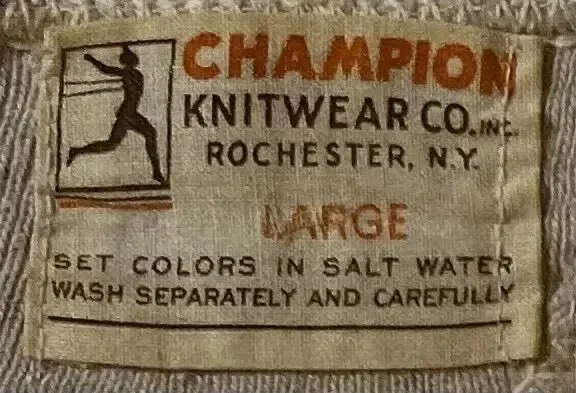
Commonly known as the "Big Ran Tag" (Large Runner's Tag) among early Champion tags.
The history of Champion tags is very incremental, so I think many people get confused.
By the way, the sweatshirts with this earliest tag were called dolman style, where the collar and sleeves were integrated.
The side action rib unique to Reverse Weave was not yet attached at this time.
More than that, I was surprised by "SET COLORS IN SALT WATER WASH SEPARATELY AND CAREFULLY".
They say you should use salt water to prevent color fading.
Hmm, deep. lol
And then there is another large running tag, likely from the mid-1940s, which was not documented in Lightning.
This tag has space to write a name and address, perhaps reflecting Champion's roots in training wear.
It is said that this tag is extremely rare because it was during World War II.
1947-1950The address field disappears, and the details of the large running tag change slightly.
Commonly known as the lowercase running tag.
Personally, I have seen this when sourcing in Thailand.
Actually, there are many reproductions of this tag in circulation, so if you are looking for vintage items, I think you should be careful not to be fooled by low prices.
Depending on the condition, the current market price is likely at least 30,000 yen.
Commonly known as the 'Tataki' tag.
This year, '52, is also a bit of a milestone for Champion.
Reverse Weave received its first patent in '38, but after making improvements, it re-patented the design in '52.
When experts sometimes refer to the 1st and 2nd models of Reverse Weave, it stems from these '38 and '52 designs.
This solid red Tataki tag was discontinued in '67.
A famous feature of this '70s Tataki tag is that it is made of a 10% polyester blend material.
Commonly known as the 'Single Color' tag.
This tag, where the Champion 'C' has become an eye, is now quite familiar, but it definitely has the characteristics of items from this era.
The three photos show the earliest type among what are called the 'early' single-color tags, characterized by an underline in different colors at the bottom of the tag.
There is a reason for these colors: the color changes by size, with XS = green, S = blue, M = red, L = maroon, and XL = gold.
This is the early single-color tag without an underline.
This is the 'late' version of the single-color tag.
Noteworthy points are that polyester was changed to acrylic, and from this late period onwards, the tag colors were limited to red and blue only. *Only XL is available in 4 colors.
Also, for gray bodies only, the composition is indicated as a blend of 82% cotton, 12% acrylic, and 6% rayon, as shown in the second photo.
Commonly known as the 'Trico tag'.
Regarding this Trico tag, it underwent minor changes three times: 'early', 'mid', and 'late' periods.
This is the 'early' version, and the difference is that the 'MADE IN U.S.A.' text is on the back.
Also, the blend ratio for the fabric is the same as in previous products.
Tricolor tag "mid-period".
As mentioned earlier, you can see that it includes the "MADE IN U.S.A." label.
It also comes with a paper tag containing washing instructions.
This is the "late-period" tricolor tag.
At first glance, it is hard to distinguish from the mid-period, but starting from this late period, the material composition was changed to 89% cotton, 8% acrylic, and 3% rayon.
Commonly known as the embroidery tag.
This is likely the tag you are most familiar with.
Vintage shops often carry many items from the 90s, and this era is actually one of our specialties.
Also, a characteristic of Reverse Weave is that its popularity remains high regardless of how many years pass, so the price does not drop.
ConclusionWell, how was it?
There are so many types of tags just for Reverse Weave, but Champion's history is truly amazing, and as a vintage shop, there is a lot about Champion that we need to keep in mind.
I love the roots and history of fashion, so I enjoyed writing this, but what about you?
That concludes the middle part, but for the final part, I would like to write an article about the appeal of Champion in a different way.
Thank you to everyone who read until the end.