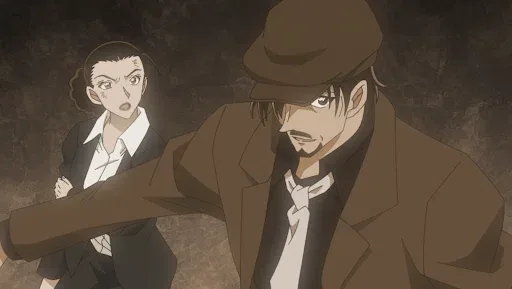
Casually starting to play Season 30 of the anime 'Detective Conan' on Netflixwas how it all began. (The title image is a citation from the anime 'Detective Conan' Episode 1148, The Detective Boys and the Two Chaperones (Part 2).)
Episodes 1148-1149, 'The Detective Boys and the Two Chaperones.' At first, I watched it with a light heart, thinking, 'Is this just the usual heartwarming episode where the Detective Boys and their teachers go to the beach?' But as the story progressed, I felt a chill run down my spine.
Teitan Elementary substitute teacher, Ms. Rumi Wakasa. She is supposed to be a clumsy and slightly unreliable teacher, but isn't the gaze she directs at that apartment resident, Subaru Okiya (Shuichi Akai), too sharp?
Rumi Wakasa, who refuses to take off her long sleeves even on a midsummer beach, and Subaru Okiya, who keeps his neck hidden. The sight of the two probing each other's intentions and keeping each other in check went beyond the framework of a conversation between mere 'chaperones,' exuding a tense atmosphere. Especially that momentary expression when she superimposed the image of her former benefactor, Tsutomu Akai, onto Subaru Okiya's back. I felt that 17 years of 'obsession' and 'sorrow' were condensed into that moment.
In the 'RUM Arc,' Rumi Wakasa is not just a supporting character. She is the strongest assassin released onto the board to corner the Black Organization's No. 2, RUM, and the 'shadow protagonist' who moves this story from behind the scenes.
Why is she lurking in Teitan Elementary School, a paradise for children? What does the 'shogi piece' gripped in her pocket signify? And is she an ally, or is she an enemy of Conan and his friends?
In this article, we will integrate the psychological warfare depicted in the latest anime broadcast with the 'truth of 17 years ago' revealed in Volume 104 of the original manga to completely dissect the spectacular 'board of revenge' drawn by Rumi Wakasa = Asaca. From here on is a 'spoiler' territory from which there is no turning back. Only those prepared to touch the pain of the old wounds she hides should try to peer into that abyss.
1. Introduction: Positioning as the 'Shadow Protagonist' in the RUM Arc
In the ongoing investigation of unsolved cases, commonly known as the 'RUM Arc,' Rumi Wakasa, who is lurking as the substitute teacher for Class 1-B at Teitan Elementary School, plays an extremely important role that can be called the 'shadow protagonist' who holds the key to the story, going beyond the framework of a mere citizen or collaborator.
Her existence is the missing link connecting the 'Koji Haneda Murder Case' that occurred in America 17 years ago with the ongoing conflict with the 'Black Organization.' On the surface, she plays the role of a clumsy and timid elementary school teacher, but in reality, she is a specialist with extremely high combat ability and insight, harboring an extraordinary obsession and murderous intent toward the organization's No. 2, RUM.
This report conducts a thorough profiling of Rumi Wakasa's true identity, past, purpose, and complex correlations with Shuichi Akai (Subaru Okiya) and Ai Haibara, based on the latest contact case in anime episodes 1148-1149, 'The Detective Boys and the Two Chaperones,' and the 'truth of 17 years ago' disclosed in original manga Volume 104. In particular, we will elucidate her current strategy through an analysis of the psychological warfare regarding 'mentions of the neck' and 'scars on the body' confirmed in the latest contact.
2. True Identity and Past: The Truth of 17 Years Ago and Profiling 'Asaca'
2.1. Identified True Identity: 'Rachel Asaca'Rumi Wakasa, who has been monitored as one of the 'RUM candidates' along with Hyoe Kuroda of the Metropolitan Police Department and sushi chef Kanenori Wakita for a long time,has been determined to be 'Rachel Asaca,' the bodyguard who is internationally wanted as the most important suspect in the incident 17 years ago, also known as 'Asaca (ASACA)'.
Her background is that of a second-generation Japanese-American with an American father and a Japanese mother. Her father also served as a bodyguard for Amanda Hughes, an American wealthy individual who had connections to the CIA and FBI. After her father's death, she inherited his will and took on the duty of guarding Amanda. It has been confirmed from multiple recollection records that the relationship between Amanda and Asaca went beyond the framework of mere employer and employee, bound by deep trust and affection like that of a real parent and child.
2.2. Direct Involvement in the Koji Haneda Murder CaseThe 'Koji Haneda Murder Case' that occurred 17 years ago is the turning point that decisively distorted the life of Rumi Wakasa (Asaca). Reconstructing the timeline of the incident and her actions reveals the following facts.
At that time, the day before the chess tournament, RUM, the No. 2 of the Black Organization, infiltrated the hotel where Amanda Hughes was staying. It is speculated that RUM's purpose was to murder Amanda or erase the information she possessed. At this time, the shogi player Koji Haneda, who sensed something unusual, invited Asaca, who happened to be there or had fled there, into his room and saved her life by hiding her in the back of a bookshelf.
Koji Haneda confronted the organization member (RUM) with a resolute attitude, but was murdered after being administered APTX4869. Asaca witnessed the whole sequence of events from her hiding place, or the aftermath of the tragedy,and faced the deaths of two people: her benefactor Amanda and Koji Haneda, who lost his life protecting her. This experience is the source of her tremendous desire for revenge against RUM.
2.3. Analysis of Physical Characteristics: Denial of the Artificial Eye Theory and the Truth of the ScarsRegarding Rumi Wakasa, information that 'her right eye cannot see' has been circulating, which was a factor confused with RUM's characteristic 'artificial eye.' However, based on the latest medical and situational evidence,it has been revealed that the malfunction of her right eye is not a physical loss of the eyeball (artificial eye).
It is highly probable that her right-eye vision impairment is caused by 'amaurosis fugax.' This is a condition where extreme stress or trauma triggers a blood flow obstruction in the ophthalmic artery, causing the field of vision to temporarily darken or disappear. In the series, the scenes where she clutches her right eye in agony when she senses RUM's presence or recalls past trauma suggest episodes of this condition.This is proof that she is not RUM, while simultaneously serving as evidence that the terror of 17 years ago still haunts her.
As pointed out by Subaru Okiya (Shuichi Akai) in episode 1148 of the anime, Rumi Wakasa wears long sleeves even in midsummer and goes to great lengths to avoid exposing her skin. This is because her body is covered in countless scars. Based on depictions in flashback scenes such as in Volume 104 of the original manga, it has been confirmed that these are not burn marks, but rather traces of lacerations from sharp blades, puncture wounds from gunfire, or tears from severe blunt force trauma. These are the 'battle scars' she sustained on the day of the incident 17 years ago, and during the 17 years of fleeing and fighting against the organization that followed, telling the story of a warrior who has survived hell.
2.4. The multi-layered meaning of the Shogi piece 'Bishop'The Shogi piece that Rumi Wakasa always keeps hidden in her pants pocket or desk, and sometimes grips tightly, is one of the most important pieces of evidence in this case.
17 years ago at the Juke Hotel in America. The genius Shogi player Koji Haneda, while standing on the brink of death from an attack by the organization, tried to save Asaka (Rumi Wakasa), who happened to be there. It is a 'charm' that Koji Haneda entrusted to Asaka just before his death.
In Shogi, the 'Bishop' is a powerful piece that can move any distance diagonally, but on the flip side, it also has many 'blind spots.' Perhaps Koji Haneda entrusted his favorite piece to her with the wish that there would be a 'good move' in her life as a future fugitive, and above all, that she could 'hide where no one would find her (= hide in the blind spots of the board).' However, the fact that his kindness resulted in forcing her to live as an 'avenger' is a cruel irony. To her, this piece is proof that her life was saved, and at the same time, it is the very cross she bears, knowing that 'her benefactor died to keep her alive.'
When she glares at RUM (Kanenori Wakita), the piece she grips in her hand will likely become the detonator that elevates her from 'just an avenger' to a 'joker who will destroy the organization,' much like how a Bishop promotes to the powerful 'Dragon Horse' in Shogi. On Rumi Wakasa's board of revenge, will this 'Bishop' be the decisive move to checkmate the 'King' that is RUM, or will it be the final move that leads to her own destruction?
3. In-depth analysis of human relationships and hostilities
3.1. Against the Black Organization: The composition of hostility and revengeThe relationship between Rumi Wakasa and the Black Organization is one of total 'hostility,' and the depth of her hatred transcends the realm of personal revenge.
Relationship with RUM / Kanenori Wakita
RUM (Kanenori Wakita) is the greatest target for Rumi Wakasa. 17 years ago, RUM murdered Amanda and Koji Haneda, but failed to eliminate Asaka (Wakasa).For the organization, Asaka is an 'inconvenient witness they failed to finish off 17 years ago' and remains a top-priority target for elimination. Meanwhile, Rumi Wakasa has been setting traps to flush out RUM's true identity while hiding in the 'forest' that is Teitan Elementary School. The fact that she was periodically uploading information about the Koji Haneda case to the internet was a provocative act intended to elicit a reaction from the organization and lure RUM out.In the latest developments in the original work, she has already sensed that Kanenori Wakita is RUM and is in a state of tension, on the verge of taking direct assassination action.
Relationship with Gin and Vermouth
Since Rumi Wakasa does not hold an organization codename (she is not a NOC or an infiltrator), it is believed that she has no past acquaintance or history of fighting alongside Gin or Vermouth. However, her combat and information-gathering capabilities are at a level that could be a threat even to Gin and his associates. In particular, Vermouth may have been involved in the cover-up of information related to the incident 17 years ago, making it highly probable that she will become a second or third target for Wakasa.
3.2. Against the Akai family (Tsutomu and Shuichi): Past debt and current suspicionThe depiction in anime episodes 1148 and 1149, 'The Detective Boys and the Two Chaperones,' is extremely important in unraveling the connection between Rumi Wakasa and the Akai family.
Past connection with Tsutomu Akai
17 years ago, in New York immediately after the incident, it was Shuichi Akai's father, Tsutomu Akai, who rescued Asaka (Wakasa) when she was surrounded by the organization's pursuers and in a desperate situation. At the time, Tsutomu had traveled to the U.S. at the request of the Haneda family to conduct an independent investigation into the incident. He shielded the injured Asaka and faced RUM (the monster) alone, leaving behind the words, 'Back off!! The monster you're about to see... is not an opponent for a young girl with a future... Someone like me is just right...' Because of this event, Tsutomu Akai went missing (status unknown), and for Wakasa, he is remembered as the 'second man who sacrificed himself to protect her' after Koji Haneda. Her longing for and sense of loss regarding 'strong and reliable men' stem from this memory of Tsutomu.
Aggression toward Subaru Okiya (Shuichi Akai) and obsession with his 'neck'
In File 1148, Rumi Wakasa makes the following provocative remarks toward Subaru Okiya.
Mentioning the neck and seeing through the voice changer: Despite it being a midsummer beach, Rumi emphasized and mentioned Subaru's 'neck' while he was wearing a high-neck shirt. This is a check to see if she has realized he is wearing a 'choker-type voice changer,' or a sign that she is certain he has 'a secret he must hide on his neck (a disguise).' Her behavior is not mere curiosity, but an expression of defensive instinct and aggression, as she is wary of the possibility that he is a 'disguised assassin from the Organization' and is attempting to peel off his mask.
Projecting the image of Tsutomu: On the other hand, she superimposes the image of the late Tsutomu Akai onto the Jeet Kune Do moves and demeanor that Subaru Okiya displays. It is speculated that her aggression toward Okiya stems from a complex psychological state where her suspicion that 'he might be a member of the Organization' is mixed with the expectation that 'he might be someone related to the Tsutomu of that time (or the man himself).' Subaru Okiya, for his part, guesses that the reason Rumi Wakasa wears long sleeves in midsummer is to hide 'scars carved into her body,' and he has realized that she is someone who has been through hell. This high-level probing of each other's intentions shows that both parties possess equal levels of combat and insight capabilities.
The interest Rumi Wakasa directs toward Ai Haibara is closer to a fated obsession than the compassion of a guardian.
Recognition as the daughter of 'Hell Angel'
Rumi Wakasa accurately understands that Ai Haibara's true identity is Shiho Miyano, the daughter of Elena Miyano, a scientist once called 'Hell Angel' (the angel who fell into hell) in the Organization. In the original work's time capsule episode and others, she monologues to herself while looking at Ai, 'The daughter of Hell Angel... who took over the research of that poison and betrayed the Organization...' This suggests that she is well-versed in the Organization's internal information (code names and the circumstances of the drug's development) while also meaning that she has completely identified Ai's background.
Ambivalence of hatred and utility
To Rumi, Elena Miyano and her daughter Shiho are the family of the developer of the poison 'APTX4869,' which killed her benefactors, Koji Haneda and Amanda. Logically speaking, it would not be strange for her to harbor intense hatred toward Ai. However, at present, she has shown no moves to kill Ai, and has instead taken actions to protect her from the Organization's threats (e.g., rescuing her during the burning tent incident). The following reasons are speculated for this.
Use as a source of information: She believes that by keeping Ai alive, she can extract information about the drug and the current state of the Organization.
Bait to lure out RUM: By letting Ai, who is 'Sherry (the traitor),' roam free, she can sense the movements of RUM and the Organization targeting her, and aim for a counterattack (a 'long-range bishop').
Empathy as a victim: The possibility that she harbors unconscious empathy as someone whose life was also ruined by the Organization.
Ai Haibara herself, while terrified of the 'aura of the Organization' and the 'scars' emanating from Rumi Wakasa, also harbors complex feelings, unable to definitively conclude that she is a complete villain.
4. Purpose and Strategy: The true intent behind infiltrating Teitan Elementary School
4.1. Elementary school as a strategic base: Practicing the 'long-range bishop'The reason Rumi Wakasa chose the public face of a teacher at Teitan Elementary School is based on a high-level strategic judgment to practice the shogi tactic of the 'long-range bishop' in the real world.
'If you want to hide a leaf, hide it in a forest': An elementary school is a highly public space where children, parents, and local residents come and go, making it a 'sanctuary' that even the Organization cannot easily interfere with. For her, a lonely fugitive, an environment under the eyes of the public acts as the strongest shield to prevent attacks from assassins.
A hub of information: Incidents frequently occur around Conan (Shinichi Kudo) and the Detective Boys, and police officials, and sometimes even the FBI and Public Security Police, get involved. By placing herself at this 'singularity of information,' she can grasp the movements of the Organization and the trends of investigative agencies while staying put.
Rumi Wakasa is one of the few people who understands, at a near-certainty level, that the true identity of Conan Edogawa is the high school detective Shinichi Kudo.
Confirmation of the APTX4869 administration list: She possesses the organization's 'APTX4869 administration list,' knows that 'Shinichi Kudo's' name is on it, and that his status is listed as 'deceased.' However, when rumors of Shinichi Kudo's survival spread during the school trip arc, she looked at that list and wore a fearless smile. This was the moment she verified the hypothesis that 'a person who should be dead is alive = has shrunk' and reached a conviction.
Testing abilities: Through incidents at the school warehouse, the professional golfer case, and the camping trip, she intentionally gives hints to Conan or pretends to be clumsy to make him solve the mystery. This is an act of measuring Conan's ability as a detective (= intelligence capable of opposing RUM) and determining if he can be used as her 'piece'.
Building a complicit relationship: Wakasa treats Conan not as a 'student to be protected,' but as 'a fighting force to battle the organization together' or 'a trap for RUM.' The trust she shows toward Conan is based solely on cold, calculated mutual interest.
5. Conclusion and Prediction: The Role of 'Asaka' for the Final Chapter
Based on the investigation and analysis above, the profiling results for Rumi Wakasa (Rachel Asaka) and the predictions for the final chapter are as follows.
Conclusion: Who is Rumi Wakasa?
She is a 'lonely shogi player' whose entire life was stolen by the tragedy 17 years ago and who has survived solely for the sake of revenge. She is not a member of the Black Organization, nor is she a public champion of justice like the FBI, CIA, or Public Security Police. She is a 'revenger' of a third force, prepared to use any means necessary, exploit others, and even treat her own life as a 'sacrificial pawn' to carry out her own justice and revenge.
Prediction of her role in the final chapter: The 'life-risking game' played by Rumi Wakasa
The character Rumi Wakasa (Asaka) is not just a simple revenger. She lives in the 'time that stopped' 17 years ago, and it is predicted that her final role will be to set that time in motion and become a 'sacrificial stone' to entrust the future to the next generation (Conan, Haibara, and the Detective Boys).
5.1. The Final Battle with RUM: The Moment the 'Long-Range Bishop' is FormedHer greatest goal is the elimination of RUM (Kanenori Wakita). This is not just revenge, but also the final destination of her journey to find a 'place to die'.
Transition from 'concealment' to 'assault' The 'Long-Range Bishop' lies in wait deep within its own territory at the beginning, but the moment the battle reaches its boiling point, it leaps deep into enemy territory and transforms into a powerful 'Dragon Horse (Promoted Bishop).' In the climax of the story, when Conan or the FBI corner RUM, or conversely, in a desperate situation where they are cornered, she will unleash the overwhelming combat ability (martial arts) she has kept hidden and all the weaknesses of RUM she has collected over 17 years. It will be a chilling moment where the person everyone thought was 'clumsy Ms. Wakasa' returns to being 'Asaka' with the face of a demon.
A 'suicide attack' of cutting flesh to sever bone Rumi Wakasa has no 'future to protect (her own life).' This is the greatest advantage she has against RUM. Exploiting the moment RUM (Wakita) thinks about self-preservation or maintaining the organization, it is highly likely she will launch a suicide attack, exposing her own body to RUM and biting into his throat while suffering a fatal wound. For her, falling into hell with RUM may not be a terror, but a 'ticket' to go to the place where Amanda and Koji Haneda are waiting.
Her relationship with Subaru Okiya (Shuichi Akai) is the point that will cause the most dramatic chemistry in the story.
The thaw from 'suspicion' to 'conviction' Currently, she suspects Subaru Okiya might be 'a dog of the organization' while simultaneously feeling the 'shadow of Tsutomu' in him, causing her confusion. However, the moment it is confirmed that he is 'Tsutomu Akai's son,' all the pieces will fall into place for her. 'The son of the man who sacrificed himself to let me escape that day is now fighting the organization in front of my eyes.' This fact will be the greatest heat source to melt her ice-cold heart.
Inheritance and completion of 'father's words' 17 years ago, Tsutomu left Asaka with the words, 'Back away... the monster you see ahead... is not an opponent for a young girl with a future to risk her life against.' Rumi Wakasa failed to keep that promise and has continued to shave away her life on the bloody path of revenge. In the final phase, it is predicted that she will return the same words her father once said to Shuichi Akai (the son), saying, 'Back away... I will handle this.' Alternatively, Shuichi, inheriting his father's will, might save her from the 'monster (RUM)' this time, and by saving the 'soul that his father could not save 17 years ago,' he might bring an end to the fate of the Akai family.
The conclusion of Rumi Wakasa, and the ethical stance of the work 'Detective Conan' itself, will be questioned in how she treats Ai Haibara (Sherry).
Hatred and conflict toward 'Hell Angel' Even if her reason understands that 'the developer's daughter is not to blame,' her emotions are not so simple. Every time she sees Haibara's face, the shadow of the poison that killed Koji Haneda flickers. The cold calculation of using Haibara as 'bait' to lure out RUM also certainly exists within her. Until the moment RUM closes in on Haibara, Rumi Wakasa may not show any sign of helping her, watching from the sidelines until the very last second.
The choice to be a 'shield': The memory of Amanda Hughes However, the trigger for her final decision is the 'unconditional love' she herself received 17 years ago. Amanda loved Asaka like a daughter, and Koji Haneda risked his life to protect her. When Ai Haibara, facing a desperate crisis, overlaps with her former self (a helpless girl), Rumi Wakasa's body will likely move before her thoughts. Her instinct as a bodyguard (protection) will prevail over her desire for revenge (hatred), and she will throw herself in front of the bullets or blades aimed at Haibara. 'Those eyes... they look just like his (Koji Haneda's)...' As she falls after saying those words, her right eye will not hold the flames of revenge, but the light of relief from having protected the next generation. Isn't that the one and only greatest 'salvation (checkmate)' prepared for the tragic chess player that is Rumi Wakasa?
Thank you for reading until the end! Please let me know your thoughts and theories about 'Detective Conan' in the comments. If you enjoyed this article, please hit the 'Like' button!