August 15, 2026
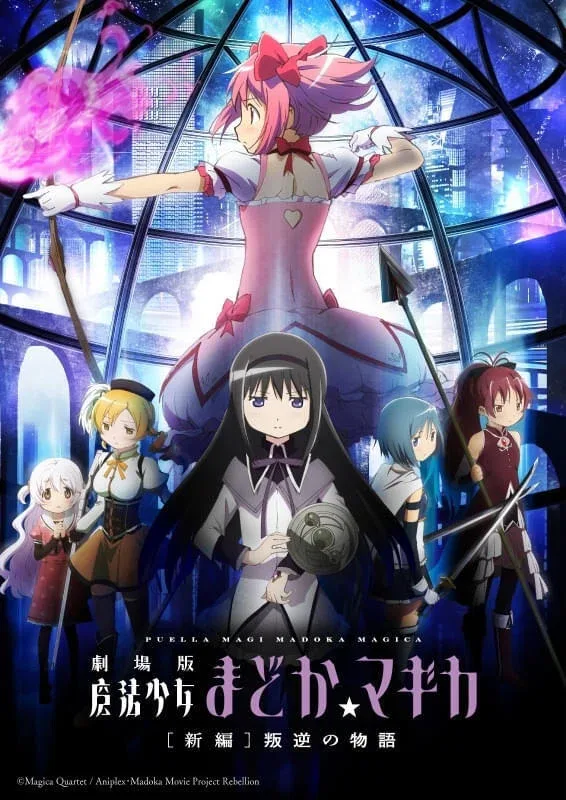
With the new film 'Walpurgisnacht: Rising' about to be released, I took the opportunity to rewatch the entire series after a long time, as Amazon Prime began streaming the TV series, the two-part compilation films, and 'Rebellion' all at once.
Honestly, I had convinced myself that the story concluded when Madoka became the Law of Cycles, so almost all the details of 'Puella Magi Madoka Magica the Movie: Rebellion' had slipped from my memory. Thanks to that, I was able to watch it with a freshness almost like a first-time viewer.
Unlike watching it at home with a projector, the sound pressure in a theater is truly something else.
On this day, I watched 'Puella Magi Madoka Magica the Movie: Rebellion' after seeing 'The Incident on Oak Street,' and despite both being on their opening days, there was a stark difference in attendance.
While 'The Incident on Oak Street (Subtitled)' was in a smaller room and was nearly empty, 'Puella Magi Madoka Magica the Movie: Rebellion' was in a room nearly twice the size and was quite full, even with empty seats left between patrons. It was a moment where I felt the enduring strength of the Madoka Magica franchise in person, rather than just through numbers.
The following contains spoilers, so please be careful if you have not seen it.
I will omit the content itself as it has already been discussed thoroughly, but I would like to write again about the setting aspects that impressed me when I first saw it.
Kyubey's line,
'In this country, don't you call growing females "girls"? Then, shouldn't we call you who will eventually become witches "magical girls"?'
is a line that gives me chills no matter how many times I watch it. The structure where wishes—the price of the contract, which are hope—turn into despair over time, accumulating until they become a witch.
Honestly, I haven't fully grasped the logic behind the relationship between entropy and witch-transformation energy, but I accept it as just how things are.
This design of 'the target you are hunting will eventually become yourself'
reminded me of Anakin Skywalker's fall to the dark side, and when I traced the source of that sense of déjà vu, it was 'Claymore.' Half-human, half-yoma girls hunt yoma, but if they use too much power, they themselves fall into becoming yoma—even though the genres and works are completely different, the sadness of the composition where 'you eventually become the enemy' is common to both.
Among the magical girls living in a peaceful timeline, only Homura feels a sense of discomfort. A world that consists of only one town, where you can never go to the neighboring town—this is likely because it is an unknown world, so it has not been created. The structure where, while chasing this discomfort, she realizes that the culprit is herself.
Regarding Gen Urobuchi (the central figure of the original Magica Quartet, who handled the script alone), he has a background where he hovered between life and death due to an infectious disease at the age of 24, and by viewing his recovery period as being 'like a dead person who was socially erased,' he became able to kill off characters without hesitation. Because of his poor health, he had a desire to 'have a mechanical body,' and it seems that this repeatedly appears in the motifs of 'obtaining a body different from one's current flesh' in PSYCHO-PASS and Madoka Magica. It is said that he does not necessarily affirm the theme of remaking the world, but rather positions it as one of the methodologies for characters to confront the world (Source: Gen Urobuchi - Wikipedia). I felt that this sense of distance is strangely linked to the bitter aftertaste of the ending of Rebellion.
The visual beauty of Gekidan Inu CurryThe intricate detail of the witch's labyrinth and the world-building is truly a masterpiece when viewed on a large theater screen with high-quality sound. That bizarre texture, which looks like a mix of paper cutouts and collages, is even more immersive in a theater. Incidentally, the transformation scenes are strangely long in the movie version.
My realization upon re-watching this time is that perhaps the production intentionally emphasizes that cuteness to force the audience to face the tragedy of the story itself head-on.
Repeating the loop alone and unable to rely on anyone
Unable to stop Madoka's sacrifice
Unable to share that sorrow with anyone
On the verge of becoming a witch without realizing it
Having to give up on meeting her again to protect Madoka
Her Soul Gem being worn down by the Incubator's experiments
—With all these hardships piling up, Homura's emotions finally break.
The deciding factor was likely the true feelings Madoka revealed.
Being all alone and going to a distant place where she can never meet anyone again is actually lonely and scary
She cannot bear the separation of never being able to talk to Homura, Sayaka, Mami, or her family again
And
“There is no way I could make such a painful choice; if I were about to do so, I would want you to stop me with all your might”
—this true intention.
This is the moment when Madoka, who became the Law of Cycles (a god) at the end, reveals her human heart for the first time, admitting that it wasn't that she didn't find it painful.
Having heard this tearful admission of weakness, Homura solidifies her resolve to
“drag Madoka down from the throne of godhood and save her as a human.”
From there, it is a straight path to her becoming a devil in the final act.
Rather than a sudden breakdown, it feels convincing when viewed as the conclusion resulting from years of repression combined with this final trigger.
The final development is easy to understand if you view it as
Homura becoming something other than a witch →
stealing a part of the deified Madoka →
becoming a devil due to her rebellion against Madoka, who is a god.
The “Rebellion” in the title refers not to fate or being a witch, but to Madoka herself, who became a god.
Meanwhile, the Incubator who had set up this barrier also had their own agenda.
They were trying to capture the form of Madoka (the Law of Cycles), who had become a concept and could no longer be observed, by isolating and sealing Homura's Soul Gem just before she turned into a witch, thereby attempting to prove her existence.
They wanted to revive the system for harvesting witch-transformation energy, which had been erased by Madoka, in order to maintain the lifespan of the universe.
And they were trying to place Madoka's power under their control, rebuilding a management system that could conveniently collect energy even in the new world.
In short, Homura's transformation into a witch was an "observation device" and a "stepping stone for restoration" for the Incubators.
However, they underestimated Homura's "feelings for Madoka" as mere emotional energy. The treatment meted out by Homura, who had become a devil, is merciless. The Incubators, who had previously been the ones exploiting human emotions, are relegated to the position of being forced to eternally process the curses and impurities that spring up in the world. There is even a scene where they, who had no emotions and only perceived things through logic, tremble before Homura's terror and are implanted with the emotion of "fear" for the first time. As a punishment for those who disregarded emotions, it is poetic justice at its finest.
The aftermath of this world, built upon such twisted happiness, finally leads into 'Puella Magi Madoka Magica the Movie: Walpurgisnacht: Rising'.
According to the official synopsis, the "Madoka Kaname" in this new world is an existence that shouldn't be there. It is a false space fabricated by Homura herself, who was on the verge of becoming a witch, in order to regain her daily life with Madoka. The magical girls, knowing this secret, set out to crush Kyubey's plot to exploit that fact—or so the plot seems to go.
Judging by the trailer currently being shown, this happiness is already beginning to fray. Among the girls of Mitakihara, a disturbing rumor is spreading that "wishes are granted in exchange for curses," and a mysterious girl without a Soul Gem is hunting Nightmares, a phenomenon that should be impossible under the original system. There are also signs that the magical girls who have regained their memories are raising a flag of rebellion, declaring that they
"will not forgive Homura Akemi," so the daily life Homura has desperately protected likely won't last much longer. The unease drifting through the cuts in the trailer alone is enough to stoke anticipation for the next installment. It seems this is one film that made the re-watch well worth it.
3.5
It is a 2013 film, so it is a bit late, but as a review before the new movie's release, it yielded more than enough. The precision of the setting and the perfection of the script have not faded.
August 28
'Puella Magi Madoka Magica the Movie: Walpurgisnacht: Rising' release