On July 21, 2026,
[Monochrome GM] Rulership
was implemented in Uma Musume.
To begin with, the name means "the status of a ruler, sovereignty, or reign" in English.
ruler: a person who rules or governs
-ship: status, condition, or position
Therefore, as a racehorse name, it implies:
He loves board games in general and is an intellectual type who devises strategies to dominate the board.
His signature line is,
"Checkmate—this board is already in the palm of my hand."
Cool.
If there were a ranking of lines you'd want to say once in your life, this would be quite high up. However, there is never an actual situation to say it.
If you said it at an izakaya when you secured the last piece of fried chicken, it wouldn't be checkmate, but rather the end of your personal relationships.
That is Rulership, but his official profile continues.
Despite having an intellect capable of dominating the board, his mental state is extremely fragile. If his strategy fails, he immediately gets crushed and shuts himself in his room.
I'm not sure if he's strong or weak.
Life is unpredictable. But he's cute, so I guess it's fine.
However, when you learn about the racehorse Rulership who served as his model, this setting makes a lot of sense.
The real horse was also a horse who, despite having the ability to overpower his opponents, was plagued by one problem until the end.
That problem was the start.
No matter how well you read the race development, if you can't get out of the gate properly, your strategy will fall apart.
Why did he become such an extreme character?
Looking back at the racing life of the racehorse Rulership, the reason becomes clear.
Sire King Kamehameha, Dam Air Groove
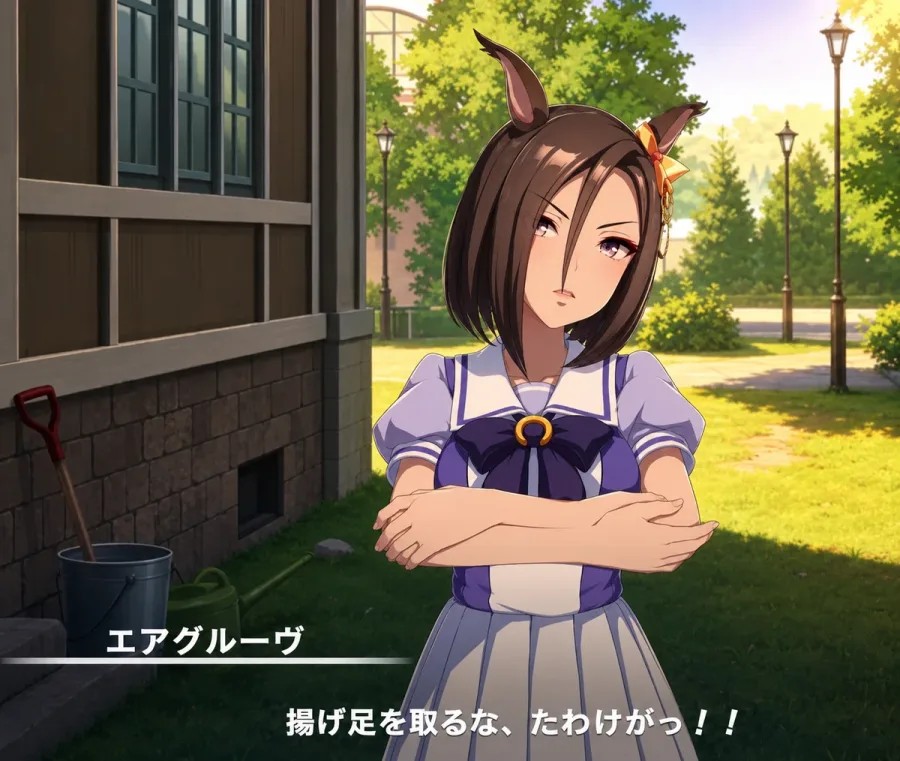
When talking about racehorses, the topic of pedigree is unavoidable.
To those who are not familiar with horse racing, a pedigree chart is just a family tree filled with the names of horses they don't know.
Even at a relative's wedding, there are more people who know me.
However, Rulership's pedigree is easy to understand.
His sire is King Kamehameha.
He is a legendary stallion who won the 2004 NHK Mile Cup and the Japanese Derby, and went on to sire greats like Lord Kanaloa and Duramente.
His dam is Air Groove.
She won the 1996 Oaks and defeated the colts in the 1997 Tenno Sho (Autumn). She was also named JRA Horse of the Year that same year.
His sire is a Japanese Derby winner.
His dam is an Oaks winner and Horse of the Year.
It is a breeding combination that looks like the realization of a fantasy written in the corner of a notebook by a horse racing fan who thought, 'A horse with this pedigree would be strong.'
His half-sister is Admire Groove, who won the Queen Elizabeth II Cup twice.
Rulership was not a horse whose success would come as a surprise.
In fact, he was a horse with such high expectations that if he hadn't succeeded, the stakeholders might have had to hold a meeting.
The overly luxurious 2010 classic generation
Rulership was born in 2007.
He is from the generation that competed in the 2010 classics.
Currently, there are five horses from that same generation who have become Uma Musume, including Rulership.
Eishin Flash
Victoire Pisa
Rose Kingdom
Curren Chan
Rulership
Because Curren Chan followed the sprint route, she never faced Rulership directly.
On the other hand, in the middle-to-long distance route, the remaining three became his main rivals.
Eishin Flash won the Japanese Derby and the Tenno Sho (Autumn).
Victoire Pisa won the Satsuki Sho, the Arima Kinen, and even the Dubai World Cup.
Rose Kingdom is a winner of the Asahi Hai Futurity Stakes and the Japan Cup.
And Rulership would later win the Queen Elizabeth II Cup in Hong Kong.
They all stood at the top in different places.
It was not a generation where one absolute champion took everything.
Eishin Flash and Rose Kingdom win in Tokyo, Victoire Pisa wins in Nakayama, and when they go to Hong Kong, Rulership wins.
Every time the board changes, the ruler changes too.
For Rulership, who loves board games, this is quite a troublesome batch of peers.
Moreover, among his peers who have not yet become Uma Musume, there were also Hiruno d'Amour, who won the Tenno Sho (Spring), Big Week, the Kikuka Sho winner, and Eishin Apollon, who would later win the Mile Championship.
If they held a class reunion, it would be nothing but overseas G1 winners and domestic G1 winners.
It is a generation where the 'catch-up' portion of the meeting would be painful.
When he wins, he is strong. But he doesn't win every time.
Rulership made his debut at Hanshin Racecourse on December 27, 2009.
Supported as the favorite in a 2000-meter turf maiden race, he won easily, finishing 0.6 seconds ahead of the rest of the field.
He got off to a start befitting a horse with a fine pedigree.
However, he finished 2nd as the favorite in the following Wakagoma Stakes.
Although he won the next race, the Almeria Sho, he was defeated in 5th place as the favorite again in the Mainichi Hai.
After that, he won the Principal Stakes by a 0.7-second margin and finished 5th in the Japanese Derby.
If you line up his first six races, they look like this.
1st, 2nd, 1st, 5th, 1st, 5th.
He wins and loses in turns.
If someone says, 'That's just how horse racing is,' then that's that.
However, the way he wins is strangely powerful.
It's not that a weak horse is winning by chance. His ability is clearly high, but he cannot display that ability in the same way every time.
His race record is like black and white pieces flipping back and forth.
Perhaps that is the reason why the Uma Musume version of him loves Reversi.
Of course, the official source has not explicitly stated this.
Half of the speculation about the source material is based on data, and the other half is made up of the human 'desire to say something clever.'
In the autumn of his three-year-old year, Rulership won the Naruo Kinen, achieving his first graded stakes victory.
The following year, in 2011, he conquered the Nikkei Shinshun Hai.
He defeated Japanese Derby runner-up Rose Kingdom and Hiruno d'Amour, who would later win the Tenno Sho (Spring).
He also won the subsequent Kinko Sho.
On a heavy track, he used his long stride from the rear to overtake Captain Thule, who had broken away earlier.
Winning a graded stakes race at 1800 meters.
Winning at 2400 meters as well.
Running on both firm and heavy turf.
Capable of racing from both mid-pack and the rear.
He checked quite a few boxes when it came to describing a racehorse's ability.
With this, it seemed he could win a G1.
However, he just couldn't quite reach it.
He finished 5th in the 2011 Takarazuka Kinen.
In the Arima Kinen that same year, he finished 4th despite being the 11th favorite. The gap to the winner, Orfevre, was a mere 0.2 seconds.
It wasn't that he was weak.
It wasn't that he was performing poorly.
Time and again, he would get to a position where it looked like 'he'll win next time,' only to fall just a little bit short.
He was a horse that was quite good at giving horse racing fans hope.
Hope might be free, but betting tickets are not.
Strength that cannot be measured by a single G1 win
The first time Rulership won a G1, it wasn't in Japan.
April 29, 2012.
The Queen Elizabeth II Cup held at Sha Tin Racecourse in Hong Kong. It is an international G1 race over 2000 meters on turf.
Rulership made a clean start that day.
He tracked the leaders in about 3rd place during the race.
Entering the home stretch, he pulled away from the inside in one burst and left the rest of the field behind.
The winning margin was 3 and 3/4 lengths.
It wasn't a close race.
He was running alone at the end.
Also running in this race were California Memory, who had won the Hong Kong Cup the previous year, and the Irish Derby winner Treasure Beach.
These were not horses that had gathered while on an overseas trip. They were talented horses from various countries.
Rulership made light work of those opponents.
Nailing the start, racing in a good position, and unleashing his full ability in the stretch.
When everything clicked, Rulership was strong enough to win an overseas G1 by a landslide.
And his G1 record for that year is as follows.
In the G1 races he entered in 2012, he finished in the top three in all five starts.
He never once finished outside the money.
Moreover, his opponents included Orfevre, Gentildonna, Eishin Flash, and Gold Ship.
I am being made to run through the pages of the 'great horses' textbook in order.
Rulership's only G1 victory is the Queen Elizabeth II Cup.
On paper, he is a 'one-time G1 winner'.
Of course, that is not incorrect.
However, describing Rulership with the single phrase 'one-time G1 winner' is like grouping Curren Chan and Gold Ship together simply because 'both are G1 winners.' Their preferred distances, personalities, and even their meeting places don't align.
In the Takarazuka Kinen, he finished 2nd, 0.3 seconds behind the Triple Crown winner Orfevre.
In the Tenno Sho (Autumn), he finished 3rd, 0.3 seconds behind his contemporary Eishin Flash.
In the Japan Cup, he finished 3rd, behind Gentildonna and Orfevre.
In the era when Rulership raced, there were quite a few monsters.
The figure of one G1 win is a fact.
But you cannot explain his strength with that number alone.
The final Arima Kinen—the strategy collapsed before the start
One thing that cannot be avoided when talking about Rulership is the issue of his starts.
Especially in the autumn of 2012, he became restless inside the gate, and scenes of him falling behind at the start became noticeable.
It wasn't simply that his reaction at the start was slow.
The problem was that he couldn't maintain the correct starting posture inside the gate.
He would stand up just before the doors opened.
If the gate opened in that state, he couldn't start running immediately. While he was putting his front legs back on the ground and regaining his balance, the other horses were already accelerating.
The stable staff hadn't just been sitting around doing nothing, either.
They conducted careful gate practice leading up to the 2012 Arima Kinen.
They even tried a 'tail rope,' which involves lifting the horse's tail inside the gate to prevent them from standing up.
Trainer Katsuhiko Sumii even accompanied him to the back of the gate himself.
They took every measure they could.
Even so, he stood up during the actual race.
He was the 2nd favorite with odds of 3.7.
He won a Hong Kong G1, placed 2nd in the Takarazuka Kinen, 3rd in the Tenno Sho (Autumn), and 3rd in the Japan Cup.
People thought, 'Maybe this time he'll finally win a domestic G1.'
In his final race, where such expectations were high, Rulership broke about 6 to 7 lengths behind the field.
Normally, that would be the end of it.
However, for Rulership, it wasn't the end.
He gradually closed the gap from the rear, and in the final stretch, he charged fiercely from the far outside.
The result was 3rd place.
The gap between him and the winner, Gold Ship, was a mere 0.3 seconds.
After the race, trainer Sumii remarked, 'It's not getting any better. It's become something I can't control. It's a serious case.'
The starting gate was the one thing he could never master until the very end.
Uma Musume did not pretend the poor start never happened.
Looking back at the real horse's racing career, the setting for the Uma Musume version becomes clear.
The name Rulership comes from the English word 'Rulership'.
It means dominion or governance.
In the Uma Musume version, he is depicted as a board gamer who reads his opponent's moves and dominates the board.
On the other hand, he gets deeply depressed when his plans go awry.
Precisely because he is an intellectual who calculates every possible scenario, he is vulnerable to events he cannot calculate.
For the real horse, that incalculable event was the starting gate.
No matter how much he thought about the race strategy, if he stood up at the moment of the start, the plan would fall apart.
Moreover, there was no issue with his ability once he started running.
Even in his final Arima Kinen, he charged from a significant delay to finish 3rd.
He was strong during the race.
Only the moment the race began was unstable.
This contradiction is likely what was incorporated into the personality of the Uma Musume version.
This characteristic is also reflected in his game performance.
His unique skill, 'Peerless Tactics,' keeps him slightly ahead for a long time if the start goes well.
On the other hand, if he gets a poor start and is in the rear at the halfway point, his speed increases significantly.
Furthermore, his evolved skill, 'Clever Gambit,' causes him to be delayed longer on turf tracks of 2000 to 2500 meters, but in exchange, it greatly increases his speed in the middle stages that follow.
For an ordinary Uma Musume, a poor start is a negative factor they would want to erase.
However, Rulership is different.
She incorporates even the developments after a poor start into her strategy.
They didn't rewrite the history of the actual horse to make her a character who is good at starting.
They left the weakness that plagued the actual horse intact, and gave her a way to win from that weakness.
They are not depicting a world where she didn't get a poor start.
They are trying to depict a world where she can win even if she gets a poor start.
I think that is a quite beautiful interpretation for an Uma Musume adaptation.
The name is Kiseki
After retiring from racing, Rulership became a stallion.
Her representative offspring includes Kiseki, who won the 2017 Kikuka Sho.
Kiseki also only had one G1 victory, the Kikuka Sho.
However, even after that, he remained active for a long time on the big stages both domestically and internationally, such as finishing 2nd in the Japan Cup and 2nd in the Takarazuka Kinen.
In addition, she has also produced:
Mer de Glace, who won the Caulfield Cup
Dolce More, who won the Asahi Hai Futurity Stakes
Soul Rush, who was active in the mile division
and others.
In the training events for the Uma Musume version of Rulership, there is also an event titled "The name is Kiseki".
For a coincidence, that is a quite specific name.
The strength she left behind as a racehorse did not end with her own G1 title.
That ability is being passed on to the next generation.
Beyond the board
Rulership could not win a domestic G1.
Even in her final Arima Kinen, she fell far behind at the start.
Even so, she did not stop running and chased all the way to 3rd place.
[Monochrome GM] Rulership.
What she challenges is not a convenient board where flaws have been erased.
It is a new board where even the unexpected is turned into victory.
It lies beyond the move that the horse himself could not read until the very end.
This time, it is checkmate.
Thank you for reading until the end.
Whether you learned about Rulership through Uma Musume or were a fan of the actual horse, please let me know in the comments if there are any races that left an impression on you or things you like about him.
If you found this article interesting, I would be happy if you could also click the 'like' button.