Hey everyone. How are you doing!
The compact leverless controller is currently being improved.
Whenever I find the time, I work on it bit by bit, thinking, "What on earth is the point of this?"
I find that question itself quite interesting while I work.
Anyway, I wanted to jot down some thoughts that came to mind while working.
I don't know if it's because I'm a bottom-tier fighting game player, but the fighting game genre seems to be doing pretty well.
That's a good thing. A very good thing.
I'm a "fighting game old-timer" who returned after over a decade.
As I wrote before, I never even thought about tinkering with arcade sticks, and I was like, "What the heck is a leverless controller?!"
It seems a lot happened during those blank dozen years.
Well, two years have passed since then.
I think there's still the question of... "Which input device is actually the best!"
Probably... though I don't really know...
I'm open to dissenting opinions. Actually, this is just something I've been imagining on my own.
This one.
I think it's the most standard.
For us fighting game old-timers, it feels like we really can't do without this, and it's the kind of option you buy without even thinking.
Since I come from an arcade background, the stick-based one is my benchmark.
Here are my personal pros and cons at the moment:
< Pros >
・Intuitive and easy to handle with various buttons for up, down, left, and right.
・Easy to input "lever-mashing" at insane speeds.
・You can slam the table.
< Cons >
・It's bulky.
・Expensive (depends on the model, but decent ones are usually pricey).
・If you don't mind the tilt to the left or right, your directional inputs will get messed up.
・Noisy (there's a limit to how quiet you can make it).
・You end up slamming the table.
I guess that's about it.
What really bothers me is that I play with it on my lap, and if the placement shifts left or right, I end up inputting a 3 when I'm trying to input a 6. It makes me so mad.
It was a pain to have to reposition or adjust it every time.
The resistance of the lever can cause accidental inputs, or it can be hard to hit diagonals, and so on...
Leverless controllers are a supernova that appeared during my decade-long hiatus from fighting games.
I was completely like, "Oh! What's this! I want to try it!!!!" and I dove in and got completely hooked.
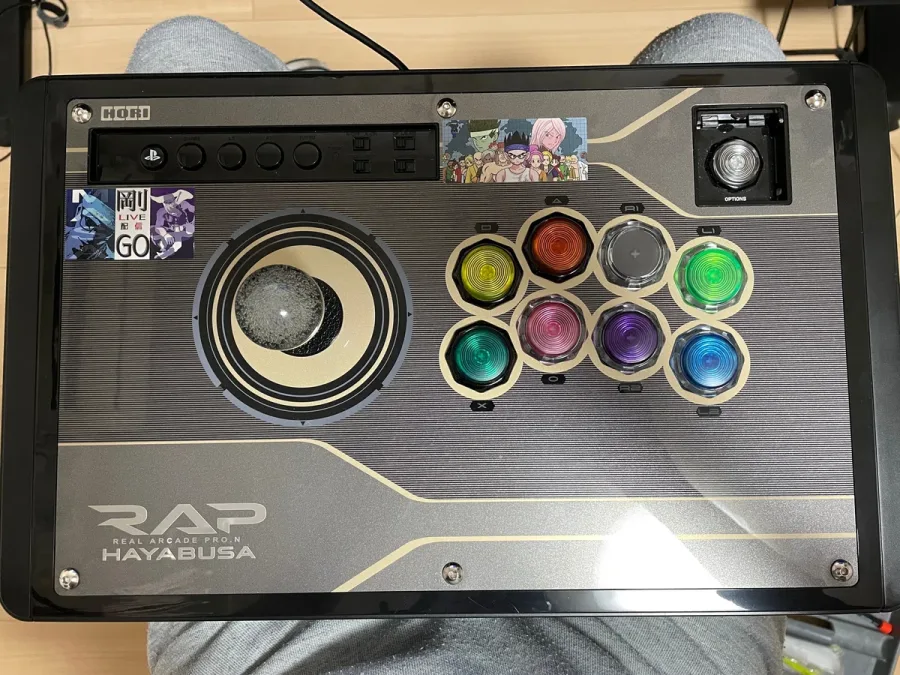
I initially thought about buying a HitBox, but it looked fun to tinker with, so I ended up buying a junk RAP SA3 and modifying it.
I ended up doing something nonsensical where it cost more than a HitBox.
< Pros >
・Directional inputs can be entered incredibly cleanly.
・Command inputs become easier depending on the game.
・It looks cool. You can ride the big wave.
・Pressing left and right simultaneously results in neutral.
・You can even perform inputs without passing through neutral.
・Compact and lightweight is totally fine too.
・No need to worry about left/right tilt.
・Switches are replaceable, making it easy to fine-tune settings.
・You can slam the table.
For me, "neutral via simultaneous left/right press" is a huge advantage.
The "KBD" (Korean Back Dash) in Tekken 7 is super easy.
The KBD command is "4N414N4..."
Doing that with a lever makes my brain bug out, it's a nightmare...
Since a leverless controller can be set to neutral by pressing left and right together, it's super easy; you just hold 4 (starting with 44 or holding 4 then 66) and tap 26262626... and you're doing a KBD.
All you budding leverless Tekken players, give it a try!
< Cons >
・Switching from a lever is hell (it took me a year).
・The up/down buttons are super confusing.
・Lever-mashing is slow.
・Expensive.
・Bulky depending on the model.
・Noisy depending on the model.
・You end up slamming the table.
Personally, I think there are two types of leverless controllers:
① Box-type (like HitBox)
Same structure as a traditional arcade stick.
Because it's a box, the inside is hollow, and the key-press sounds echo inside, making it noisy.
Even with silent buttons, the sound of hitting them echoes and makes a clacking noise.
② Layered-type (like the B1-PC I have)
The structure is completely different from a traditional arcade stick.
It's structured by sandwiching a large circuit board (including controls) between acrylic plates.
It's characterized by being thin, about 2cm thick.
Unlike the box-type, there's no hollow space, so key-press sounds don't echo and it's quiet even without modifications.
The switches you choose will affect the sound.
That's about it.
It's gotta be a pad!Sorry, this is a path I'm just starting to walk, but when I was playing Street Fighter II in middle and high school (nearly 30 years ago), I used a Super Famicom pad.
I'm speaking based on that memory, but...
< Pros >
・No need to buy one (if you have the original).
・Cheap (it's already there).
・Intuitive and easy to handle.
・You can't slam the table.
・You can throw it.
< Cons >
・If you play seriously, it breaks constantly (apparently).
・Sometimes there aren't enough buttons (due to simultaneous press button requirements).
・You can't slam the table.
・You end up throwing it.
Sorry, I'm just about to start my journey on the pad.
I'm going to play SF6 with Modern controls!
I'm planning to modify it and have some fun with it eventually.
It might sound blunt, but it really comes down to preference... or rather, where you're coming from.
And it also depends on your age group.
Fighting game veterans grew up during the arcade golden age, right in the middle of the fighting game boom, so they naturally gravitate toward sticks.
They feel like they can't play fighting games on a pad, and for the same reason, leverless controllers are tough for them.
Many people try out pads because they're standard, or because of family circumstances (a certain number of fighting game veterans are married with kids!) and decide to do their best with a pad.
I wonder if leverless users are trained fighting game veterans, or if some came from pads? It's a bit unclear.
I think there are a lot of leverless users among the 2D fighting game crowd.
There's definitely an advantage to using special input methods, and I'm sure Daigo Umehara's influence plays a part too!
By the way, for those rare, absolute beginners who say, 'I want to play fighting games with an arcade stick!', you should buy a leverless controller.
This is just my personal opinion, but I truly believe that.
The benefits are definitely greater.
I apologize to the pad players, but I had the image that they were mostly casual fighting game players... until now.
Thanks to the 'Modern' input method in SF6, I expect their numbers have increased significantly.
(Or rather, the total number of fighting game players has increased.)
In fact, maybe some fighting game veterans who used to hold a lever have started using pads because they can't keep up with the controls anymore?
That's my plan.
Depending on the fighting game title, there might be advantages to using a stick or a leverless controller (though this is strictly within the realm of top-tier players with extreme skills).
What about pads? I'm sure the Modern controls in SF6 will make a strong case for themselves. I'm looking forward to it! Wooooo!!
I'm looking forward to seeing pad pros, wooooo!!
Next time, I'll finally do the improvements for the Takkyubin Compact leverless controller.
See you again!