Recently, I wrote an article comparing the cost of living and wages between Arkansas, USA, and Niigata.
I went straight from a high school in Niigata to a university in Arkansas. That is why I have always been curious about "how much money someone born in a rural area has, and how far they can go."
So, the next thing I became curious about was the disparity within Japan.
I understand that salaries in Tokyo are higher than in Niigata. But the rent is also high.
So, does more money remain in Tokyo even after deducting rent?
When I looked up the numbers, the answer was not just one.
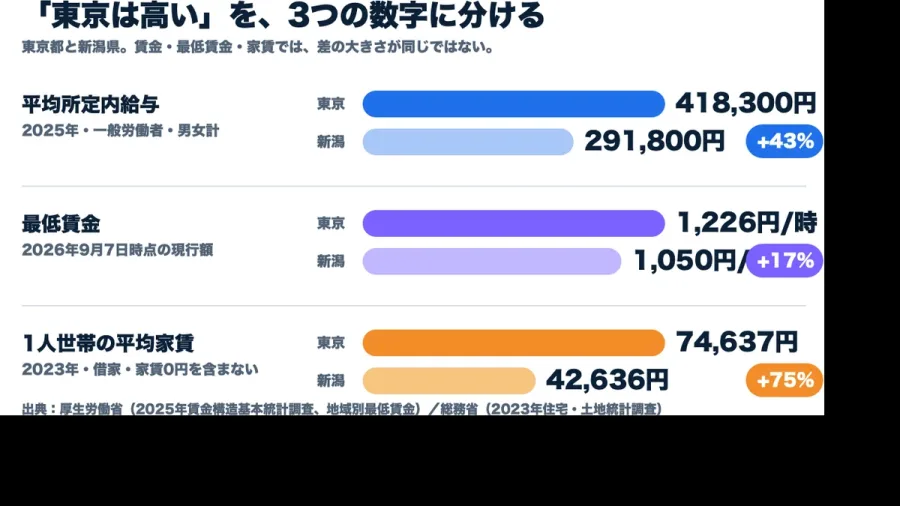
First, let's break down the three "differences"The first things I looked at were average wages, minimum wages, and the average rent for a single-person household.
According to the 2025 Basic Survey on Wage Structure by the Ministry of Health, Labour and Welfare, the average scheduled cash earnings for general workers (total for men and women) were 418,300 yen per month in Tokyo and 291,800 yen in Niigata.
The difference is 126,500 yen per month. Tokyo is about 1.43 times that of Niigata.
That is quite large.
However, these figures do not compare the same age, the same company, or the same job. The composition of industries, company sizes, and ages differs between Tokyo and Niigata. It is not the individual's take-home pay, but the average scheduled cash earnings for June 2025.
Next, let's look at the minimum wage.
As of September 7, 2026, the current hourly rate is 1,226 yen in Tokyo and 1,050 yen in Niigata. The difference is 176 yen, with Tokyo being about 17% higher.
Furthermore, it has been decided that from October 1, 2026, it will rise to 1,280 yen in Tokyo and 1,108 yen in Niigata. The difference after the revision will be 172 yen.
For average wages, it is about 43%. For minimum wages, it is about 17%. Even though it is the same "wage gap," the magnitude is already different.
And then, rent.
Looking at the 2023 Housing and Land Survey by the Ministry of Internal Affairs and Communications for the average rent of a single-person household living in a rental property, excluding 0 yen rent, it was 74,637 yen per month in Tokyo and 42,636 yen in Niigata.
Tokyo is about 75% higher.
I didn't know this... or rather, the difference was even greater than I had imagined.
However, the housing area, building age, and location are not uniform. This does not mean that 'the same room is 75% more expensive in Tokyo'.
When you deduct rent, the answer flips.Here, I will perform a calculation that is quite rough but easy to understand.
Subtract the average rent for a single-person household from the pre-tax wage.
When you subtract rent from the average scheduled earnings of general workers, it looks like this.
Tokyo: 418,300 yen - 74,637 yen = 343,663 yen
Niigata: 291,800 yen - 42,636 yen = 249,164 yen
In this calculation, Tokyo is 94,499 yen higher per month.
Even after subtracting the rent difference, a significant difference in average wages remains.
On the other hand, assuming you work 160 hours a month at minimum wage, it looks like this.
Tokyo: 1,226 yen × 160 hours - 74,637 yen = 121,523 yen
Niigata: 1,050 yen × 160 hours - 42,636 yen = 125,364 yen
This time, Niigata is 3,841 yen higher.
Even after the minimum wage revision on October 1st, if we use the same rent, Tokyo is 130,163 yen and Niigata is 134,644 yen, making Niigata 4,481 yen higher.
Of course, this is not take-home pay. Working hours are also fixed at 160 hours per month, and the rent figures are just averages from different years.
Even so, it is clear that neither 'Tokyo is advantageous because salaries are high' nor 'Niigata is advantageous because rent is cheap' is sufficient on its own.
The answer changes depending on which wage bracket you are looking at.
Not all prices in Tokyo are equally high.I also looked at things other than rent.
The Ministry of Internal Affairs and Communications' 2024 Retail Price Survey (Regional Difference Index) compares regional prices with the national average set at 100.
Overall, Tokyo is 104.0 and Niigata is 98.0. For food, Tokyo is 103.0 and Niigata is 98.8.
However, for housing, the gap widens to 127.2 for Tokyo and 85.4 for Niigata. On the other hand, for utilities, Tokyo is 96.2 and Niigata is 101.0, making Niigata more expensive.
It is not the case that all prices in Tokyo are uniformly higher. The main factor driving the difference is, as expected, housing.
Looking at it this way, the shape of life becomes much clearer than just looking at prefecture rankings based on average wages.
Cars and taxes are not yet included.However, there is a big hole in this comparison.
If you live in Niigata, depending on the location, you will need money for a car purchase, gasoline, insurance, vehicle inspection, and parking. Even in Tokyo, there are commuting costs and the issue of small living spaces. If you deduct taxes and social insurance, the difference in gross income does not remain as it is.
Furthermore, average wages also include the fact that Tokyo has many high-wage industries and companies. It is not the case that anyone who moves from Niigata to Tokyo will automatically see their income increase by 126,500 yen per month.
Since I am from Niigata, I cannot fully commit to an answer that ends with "life in the countryside is richer," nor one that ends with "moving to Tokyo will solve everything."
What I found this time is that for the average wage bracket, Tokyo remains higher even after deducting the rent difference, while for the minimum wage bracket, they are quite close, and in this rough estimate, Niigata is slightly higher.
So, what happens when you include cars and taxes?
Only by doing that do I feel I can get a little closer to "where it is easier to live."
Reference MaterialsMinistry of Health, Labour and Welfare, "2025 Basic Survey on Wage Structure: Summary of Results"
Ministry of Health, Labour and Welfare, "Wages by Prefecture"
Ministry of Health, Labour and Welfare, "National List of Regional Minimum Wages"
Tokyo Labour Bureau, "Minimum Wage and Various Subsidy Awareness Enhancement Period (TOKYO1280)"
Niigata Labor Bureau "Niigata Prefecture Minimum Wage Information"
e-Stat "2023 Housing and Land Survey Table 123-1-2"
Statistics Bureau of Japan "2024 Consumer Price Regional Difference Index"