↓ The original video for this article is here
Introduction
My name is KANJIHOLIC. Since 2022, I have been running a YouTube channel focused on Kanken Level 1.
I took the Kanken Level 1 exam for the first time in the first session of the 2023 fiscal year and passed it on my first attempt. I had secretly aimed to pass on my first attempt, so my joy was immense.
Taking this opportunity, I decided to leave a record of what kind of study I did until I passed, also serving as a memorandum. Many people have already shared information under the title of "Kanken Level 1 Study Method," but since there is no fixed correct answer regarding study methods, I hope my experience will serve as one reference material and help those who are about to start studying for Kanken Level 1.
Article Structure
This series is composed of 5 parts in total. The first part is this article, where I will talk about the overall path and the materials to be used.
In the second article, I will express my personal opinion on where and what someone who has just started studying for Kanken Level 1 should start with.
In the third article, I will express my opinion on the study content to reach the so-called "140-point wall." Kanken Level 1 is an exam where you pass with 160 points or more out of 200, but I think that what a learner who has gained some ability should aim for first is to reach the level where they can get 140 points. It is often called the "140-point wall," and I will describe the method to reach this score of 140 in the third article.
In the fourth and fifth articles, I will describe my own experience regarding the study content to get the remaining 20 points from the point of crossing the 140-point wall to the passing score of 160. Raising these 20 points is really difficult and requires a huge amount of study. I will introduce all the study content I actually did until passing Kanken Level 1 in the fourth and fifth articles.
Introduction of Materials
First, I will introduce the materials I used. These are the materials I purchased until I passed Kanken Level 1.
Kanken Kanji Dictionary (2nd Edition)
Kanken Four-Character Idiom Dictionary (2nd Edition)
Selection Exercises
Past Questions
You might think, "Is that all?" but there is actually a trick to this. I used blog articles and online problem sets for the majority of my study. The two major strategy sites for Kanken Level 1 (it is safe to call them that)
Kanken Level 1 Mock Exam Warehouse http://spacepluskk.blog.fc2.com/
Kanji Teihitsu https://hagunn2525.wixsite.com/kanji-teihitsu
I studied mainly using the problems and mock exams posted on these sites. Therefore, the paper publications I used are limited to the four mentioned above.
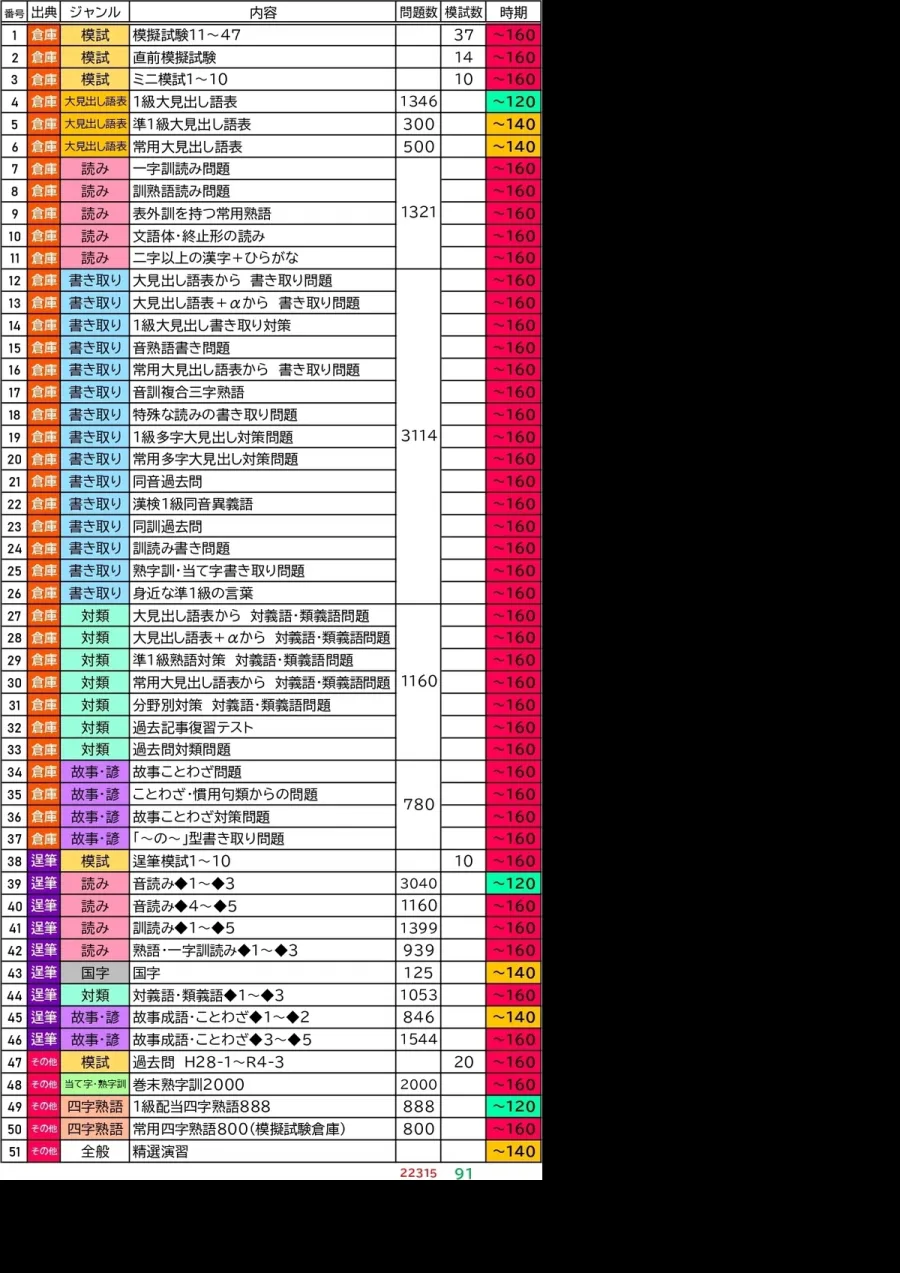
Here, please take a look at the list of all the study content I worked on until I passed.
I apologize for the detail, but to put it simply, it means I mainly worked hard on the articles of "Kanken Level 1 Mock Exam Warehouse" and "Kanji Teihitsu." When I counted the number of problems I worked on, it was roughly about 20,000 problems and 91 sets of mock exams and past questions combined. Since one set of mock exams/past questions is 130 problems, 130 x 91 = 11,830, so I worked on a total of about 30,000 problems. From this, it might be safe to say thatthe number of problems required to pass Kanken Level 1 is 30,000.
By the way, I actually have no experience taking the Level Pre-1 exam. So, those who have already completed studying for Level Pre-1 might be able to get by with a slightly smaller study range. In the next article and beyond, I will touch in detail on the order in which it is recommended to work on these study materials.
Kanken Kanji Dictionary
From here, I will introduce the materials used one by one. There is no reference book for Kanken Level 1 that says, "If you just do this, you can pass!" This is because the scope of the questions is too vast, so one reference book is not enough. Therefore, you could say that the reference book for Kanken Level 1 is this entire "Kanken Kanji Dictionary." (If you master all the contents of this dictionary, you can definitely pass!) However, memorizing the whole dictionary is very difficult, and there are many contents that I haven't memorized at all. (There is also an amazing study method called "dictionary dredging" that covers the dictionary from beginning to end, but I am not doing dictionary dredging at this moment.) If you are at a level aiming for your first pass, it is fully possible to reach a passing score by firmly grasping so-called frequently occurring problems. It is better for people who want to master knowledge as repeaters after passing for the first time to do dictionary dredging.
There are two main uses for the Kanken Kanji Dictionary.
Use 1: Looking up the reading and meaning of kanji
For example, when you see the idiom "蝟集 (ishu)," suppose a question arises: what are the kun-yomi (native Japanese readings) for the kanji "蝟" used there? If you look it up in the dictionary immediately, you will find that there is a kun-yomi "muraga-ru" with the okurigana "ru," and also a kun-yomi "harinezumi" for the single character. You can understand that "ishu" means to gather in a swarm because the needles of a hedgehog gather together. In this way, if you study while looking up the dictionary, focusing on the kun-yomi and meanings of each kanji that makes up an on-yomi idiom, vocabulary acquisition will not just be a pile of memorization, but will be established as three-dimensional, living knowledge.
Use 2: Judging the difficulty of idioms
The difficulty of Kanken Level 1 problems varies from basic level problems to so-called difficult problems, and it is very important not to miss basic level problems when aiming for your first pass. However, when you have just started studying, you cannot distinguish at all which problems are basic and which are difficult.
To put it simply, the criteria for judging the difficulty of idioms should be judged by
A: Whether it is a "past question" (whether it has appeared in the past)
B: Whether it is listed in the "Kanken Kanji Dictionary"
The difficulty (importance to grasp) of a problem is determined in the order of A > B > (others), and it is important for beginners to first study mainly idioms and problems of A and B.
Idioms listed in the Kanken Kanji Dictionary (B mentioned above) specifically refer to "idioms listed as headwords," which are called"major headwords"in the community. Major headwords are more likely to appear on the exam than other idioms. In other words, a sense is shared among examinees that if it is a major headword, it cannot be helped if it appears on the exam. Therefore, when you encounter an idiom you don't know while studying, checking whether that idiom is a "major headword," and if it is a "major headword," actively memorizing it, and if not, not pursuing that idiom too deeply, will increase your study efficiency until you pass.
For the uses described above, I personally think the Kanken Kanji Dictionary is an indispensable item for Kanken Level 1 study.
By the way, there is an app version of the Kanken Kanji Dictionary, which is also highly recommended.
If you are an Apple user, you can use it on smartphones, tablets, and PC devices. While paper dictionaries cost over 3,000 yen, the app version can be purchased for around 1,500 yen, making it quite reasonable. Furthermore, looking up kanji and idioms is overwhelmingly faster with the app, which makes it highly efficient for studying. Additionally, there are attractive features not found in paper dictionaries, such as cross-dictionary search and bookmarking, and since all of these work offline, it is, to put it mildly, the best app.
I purchased both the paper dictionary and the app version, but my personal view is that if you are not too unfamiliar with devices, the app version alone is sufficient for the stage of aiming for your first pass. (For Android users, if you want to master Kanken, it is worth considering switching to an iPhone just for this app. It is that good.)
Kanken Four-Character Idiom Dictionary
The four-character idioms that appear on the Kanken exam are listed in Japanese alphabetical order. To pass Kanken Level 1, you must memorize all the four-character idioms listed in this dictionary that are assigned to Level 1. Since you need to understand not only how to read and write the idioms but also their meanings, this dictionary is a very important resource.
However, in reality, there are many materials summarizing four-character idioms published online, so it is possible to study without this dictionary. You could say that those aiming to pass without spending money do not need to purchase it. However, four-character idioms often have stories behind their formation, and the dictionary itself is interesting to read like a book, so I don't think you will lose anything by purchasing it in the long run.
* Click here for my materials summarizing Level 1 four-character idioms with meanings. Please download and use them if you need them.
Selected Exercises
The 'Selected Exercises' is a problem collection published by the official Kanken organization, but the content is essentially past exam questions compiled into a single book by category. As mentioned above, all past questions correspond to the 'basic level' of Kanken Level 1, so all the questions in this book, which is composed of past questions, are 'basic level' questions. Since this 'Selected Exercises' is the only reference book released by the official Kanken organization at this time, some people who don't know any better might think, 'Couldn't I pass Level 1 if I perfect this one book?', but that is a huge mistake. You won't stand a chance with just this one book.
Honestly, I feel like you would be fine without it, but it is not that expensive, and the kanji list in the appendix is somewhat useful, so I think it is a book you won't regret buying.
Past Exam Questions
Past exam questions are highly important materials for aiming to pass Level 1. They are periodically issued by the official Kanken organization, but since only the most recent questions are included, it is actually quite difficult to obtain past questions going back many years. (As of 2025: The latest past questions are not on sale! Association, please put them on sale...)
The main ways to obtain them are:
A: Purchase used copies on mail-order sites, etc.
B: Use the copying service of the National Diet Library
There are these two patterns. I used the National Diet Library's copying service. I got carried away and obtained about 20 years' worth of past questions, but I think 6 to 7 years' worth from 2017 onwards is actually sufficient. This is because questions from 2016 and earlier are clearly easier in difficulty compared to those from later years, and most of the questions from 2016 and earlier are included somewhere in the many materials you will be working on. Also, since the aforementioned 'Selected Exercises' is a collection of past questions, many questions from 2015 and earlier overlap with the 'Selected Exercises'. From the above perspective, I recommend obtaining the most recent 6 to 7 years' worth.
Summary
In this article, I introduced the structure of the 'Kanken Level 1 Study Method' series and the materials used for learning. Actually, many Level 1 problem collections are published by various publishers, but I only bought a total of three books: the two official dictionaries and the 'Selected Exercises'. There are two reasons for this:
1. I wanted to keep expenses as low as possible.
2. I frequently saw information that the content of each problem collection did not correspond to the difficulty of the actual exam (the actual exam is many times more difficult than the problem collections).
I decided that it would be more effective to do many problem collections and mock exams created by volunteers on the web instead of buying publications. As a conclusion, this decision was a great success, and the collection of materials that volunteers are now making available for free is very substantial, and it is truly
a situation where it is fully possible to pass Kanken Level 1 without buying anythingcan be said. (In the goodwill of the 'free publication' by volunteers, I feel a sense of pride in wanting to liven up the Kanken Level 1 community together. I am also publishing various study materials to repay that kindness.)
(In the next article and beyond, I will finally introduce specific learning content. Continued in Part 2 ↓)