Connecting a fourth pillar, perovskite, to the three pillars of housing, infrastructure, and materials: A thorough dissection of the reality during the transition period of the medium-term management plan
[Please read this first]
This article is content for informational and educational purposes, written based on publicly available information. It does not recommend or solicit the buying or selling of any specific securities, and does not constitute an act that falls under investment advisory or agency business (Article 28, Paragraph 3 of the Financial Instruments and Exchange Act).
The corporate analysis, figures, and outlooks described are the author's views based on publicly available information at the time of writing and do not predict or guarantee future performance or stock prices. Please make final investment decisions at your own responsibility and judgment.
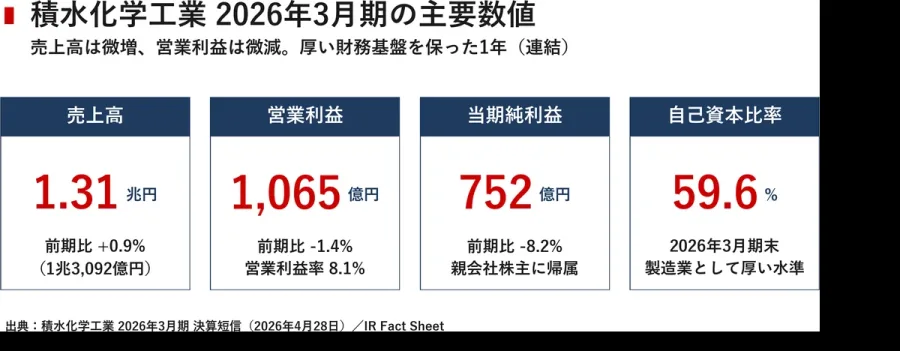
Net sales of 1.3092 trillion yen and operating profit of 106.4 billion yen. These are the consolidated results recorded by Sekisui Chemical (Tokyo Stock Exchange Prime: 4204) for the fiscal year ended March 2026. Net sales increased by 0.9% compared to the previous fiscal year, and operating profit decreased by 1.4%. Looking only at the numbers, it is a year that could be summarized as "flat."
However, immediately following that flat year, this company announced a new medium-term management plan to increase net sales to 1.6 trillion yen and operating profit to 150 billion yen over three years. That is an increase of 43.5 billion yen in operating profit, or a 41% boost. At the same time, it raised its shareholder return benchmark from a DOE (Dividend on Equity) of 3% or more to 3.5% or more and introduced progressive dividends. Furthermore, it is attempting to launch a mass production line for film-type perovskite solar cells at the former Sharp Sakai plant in Sakai City, Osaka Prefecture. The total investment is 90 billion yen, and in the government's support project, 157.25 billion yen out of a total cost of 314.5 billion yen is eligible for subsidies.
Flat financial results, a bullish medium-term plan, and a 90-billion-yen new business. These three things exist simultaneously in Sekisui Chemical today. This article aims to organize the company's business structure, profit center, growth drivers, and risk factors based on public information, providing material for readers to understand the company for themselves.
1. Who is Sekisui Chemical?
Sekisui Chemical Co., Ltd. is a comprehensive chemical manufacturer established in March 1947. Its securities code is 4204, and it is listed on the Prime Market of the Tokyo Stock Exchange. As of the end of the fiscal year ended March 2026, the number of consolidated employees is 26,752, and there are 3,156 non-consolidated employees. Keita Kato serves as Representative Director and President, and Teiji Koge serves as Chairman of the Board.
Although it calls itself a "chemical manufacturer," the reality of this company is quite different from the image of a typical chemical company. The largest segment, accounting for 40% of net sales, is the housing business centered on the unit house "Sekisui Heim." In other words, it has the face of a company that builds and sells houses.
On the other hand, the greatest source of profit is not housing. The High Performance Plastics Company, which handles interlayer films for automotive laminated glass and materials for semiconductors and displays, earns around 45% of segment profit. This is a typical high-performance materials business.
Furthermore, there is the Environmental and Lifeline Company, which has infrastructure piping such as water and sewage pipes and technology to rehabilitate aging existing pipes without digging them up, and a medical business that handles in vitro diagnostics and contract development and manufacturing of pharmaceuticals.
Building houses, repairing pipes under roads, inserting films into automotive glass, and making blood test reagents. One company is doing all of these at the same time. This "lack of cohesion" is the first entry point to understanding Sekisui Chemical, and at the same time, it is the reason why investors are confused about how to evaluate this company.
The company explains its business domains as "Housing and Social Infrastructure Creation" and "Chemical Solutions." These are highly abstract terms, but when broken down into actual product groups, it can be organized as a company that provides the "forms" and "materials" for people to live and for society to function.
2. History since 1947: A company that expanded from the single point of plastic molding and processing
Sekisui Chemical was established in 1947, centered on engineers from the Nippon Nitrogen Fertilizer (Nitchitsu) group. The company's history began when it started its business with the molding and processing of plastic, a new material at the time, shortly after the war.
The fact that the starting point was not "manufacturing the material itself" but "molding and processing the material" determined the company's character thereafter. It is not a company that makes raw materials, but a company that processes raw materials to create applications. That is precisely why there was room to expand indefinitely into downstream application areas.
Entry into housing: The idea of houses made in factoriesAmong the company's business developments, the most daring was its entry into the housing business. In 1971, it released the "Sekisui Heim M1," which assembled factory-produced units on-site. Instead of building houses on-site, they are made in a factory and transported. It brought the idea of "stabilizing quality as an industrial product," cultivated through plastic molding and processing, into the field of housing, which is the area furthest from industrialization.
This decision determined the current sales composition of Sekisui Chemical. In the segment sales for the fiscal year ended March 2026, the Housing Company accounted for 536.2 billion yen, the largest of the four businesses. The structure where 40% of a chemical manufacturer's sales come from housing originates from this choice in 1971.
Deep Dive into the Materials Business: The Global Market for Interlayers for Laminated GlassAnother pillar is the interlayer used in automotive laminated glass. A windshield has a structure where a resin film is sandwiched between two sheets of glass, and this film prevents the glass from shattering when it receives an impact. Sekisui Chemical holds a world-leading share in these interlayers and has evolved its products into high-value-added items with enhanced sound insulation and heat shielding, as well as products compatible with head-up displays.
As the glass area per vehicle increases and the functions required of glass grow, the value-added of this film rises. This is a prime example of how the company competes in the global market as a "materials manufacturer."
Infrastructure Renewal Demand: The Long-term Theme of Pipeline RehabilitationAt the core of the Environment and Lifeline Company are water and sewage pipes, as well as conduits for power and communications. Japan's water and sewage pipes were intensively laid during the period of high economic growth, and the number of pipes exceeding their legal service life continues to increase nationwide.
This is where pipeline rehabilitation technology, which forms a new pipe inside an existing one without digging up the road, comes into play. Compared to full-scale replacement involving excavation, the construction period is shorter and the impact on traffic is smaller. For local governments that must maintain infrastructure under fiscal constraints, this is a realistic construction method. Even if the population decreases, underground pipes continue to age. This is why this business holds long-term demand.
The Fourth Pillar: MedicalSince the late 2000s, the company has fully entered the medical field by acquiring in vitro diagnostic manufacturers. Currently, in vitro diagnostic pharmaceuticals used for blood tests and the like, as well as contract development and manufacturing organizations (CDMO) for pharmaceuticals, are the pillars of the business. Although sales for the fiscal year ending March 2026 were 93.7 billion yen, which is small overall, the operating profit margin is high at the 11% level, and it is positioned as a target area for growth investment.
Looking back, Sekisui Chemical's 79 years can be organized as "a history of continuously expanding applications from the single point of plastic molding and processing into housing, materials, infrastructure, and medicine." It does not look cluttered as a result of diversification; rather, its current form is the result of pursuing the applications of its processing technology.
3. Overview of Business Segments: The Structure of 3 Companies + Medical
Sekisui Chemical's business consists of three companies and one business unit. The segment results for the fiscal year ending March 2026 are as follows.
Housing Company: Sales of 536.2 billion yen, operating profit of 37.1 billion yen (operating profit margin 6.9%)
Environment and Lifeline Company: Sales of 240.4 billion yen, operating profit of 23.2 billion yen (operating profit margin 9.7%)
High Performance Plastics Company: Sales of 456.5 billion yen, operating profit of 59.3 billion yen (operating profit margin 13.0%)
Medical Business: Sales of 93.7 billion yen, operating profit of 11.1 billion yen (operating profit margin 11.8%)
Adding these four together, sales total 1.3268 trillion yen and operating profit is 130.7 billion yen. However, consolidated sales are 1.3092 trillion yen and operating profit is 106.4 billion yen. The difference is due to the elimination of internal transactions between segments and company-wide expenses (costs for headquarters functions, basic research expenses, etc.). There is a difference of about 24.2 billion yen on an operating profit basis.
The existence of this difference is a point that must be understood when reading financial statements. The question, "Why is the consolidated operating profit only 106.4 billion yen when High Performance Plastics is earning 59.3 billion yen?" can be explained by these company-wide expenses and eliminations. Conversely, it also means that the company has a structure that carries company-wide costs on the scale of 24 billion yen per year.
The Center of Gravity for Sales and the Center of Gravity for Profit are MisalignedLooking at the composition ratio of segment sales, Housing is 40.4%, High Performance Plastics is 34.4%, Environment and Lifeline is 18.1%, and Medical is 7.1%.
On the other hand, the composition ratio of segment operating profit is 45.4% for High Performance Plastics, 28.4% for Housing, 17.8% for Environment and Lifeline, and 8.5% for Medical.
Housing is the leader in sales, while High Performance Plastics is the leader in profit. This "twist" is the most significant characteristic of Sekisui Chemical's earnings structure.
From an investor's perspective, this structure has two implications. First, while fluctuations in the housing market significantly impact sales, the effect on profit is not as large as the sales composition ratio would suggest. Second, conversely, if the market conditions for High Performance Plastics deteriorate, profit will be eroded more than the impact on sales would imply.
When tracking the company's performance, the volume and price of High Performance Plastics have greater explanatory power for profit than housing order trends. This point is worth remembering.
4. High Performance Plastics Company: The Center of Gravity for Profit
With sales of 456.5 billion yen, operating profit of 59.3 billion yen, and an operating profit margin of 13.0%, the High Performance Plastics Company generates the highest profit margin among the four business segments.
The content of this business is broadly composed of the following areas:
Mobility-related: Interlayers for automotive laminated glass, various automotive tapes and components
Electronics-related: Materials for semiconductor and display manufacturing processes, conductive fine particles, thermal management materials
Industrial and Infrastructure-related: Fire-resistant materials, non-combustible materials, functional components for construction and plants
In particular, interlayers for laminated glass are products for which the company has built a position in the global market over many years. They have increased unit prices by adding functions such as sound insulation, heat shielding, light control, and head-up display compatibility, moving beyond simple "films that prevent glass scattering."
The automotive industry is in the midst of electrification, and there is an increasing demand for vehicle weight reduction and quietness. As engine noise disappears, wind noise and road noise become relatively more noticeable, increasing the value of interlayers with sound insulation performance. The major shift toward electrification acts as a tailwind for this business.
On the other hand, the electronics-related business is linked to the capital investment cycle of semiconductors and displays. This is an area with high volatility. While it serves as a tailwind when data center investment for generative AI boosts semiconductor demand, volumes drop rapidly during inventory adjustment phases. It is necessary to understand that the 13% operating profit margin level includes this volatility.
In the new medium-term management plan, areas such as high-performance interlayers, thermal management materials, and semiconductor/display materials are designated as priority areas for growth investment. It can be inferred that the company recognizes this as the main battlefield for profit growth.
5. Housing Company: How to Fight in a Shrinking Market
With sales of 536.2 billion yen, it is the largest segment, yet its operating profit margin is 6.9%, the lowest among the four businesses. This is the Housing Company.
The number of new housing starts in Japan is on a long-term downward trend. Considering the declining population and the plateauing number of households, it is unlikely that this trend will reverse. In other words, this business is fighting in a structurally shrinking market.
So why continue this business? There are three points of discussion here.
Point 1: Transition to a Stock-based BusinessEven if the number of new homes sold decreases, the houses already built remain. Sekisui Chemical has supplied hundreds of thousands of Sekisui Heim units to date. There is room to provide services such as renovations, retrofitting solar power generation and storage batteries, and equipment upgrades to this existing housing stock.
From a business of selling one new house at a time to a business of continuously selling services to an existing customer base. If this transition progresses, the decline in housing starts and the decline in business performance can be decoupled. In fact, the company's housing business is now being discussed in terms of both new construction and renovation/real estate.
Point 2: Urban Development and Real EstateThe company identifies "urban development," which includes not only individual housing but also the development of residential land and energy management at the block level, as a growth area. It is a model that earns revenue based on the scale of development projects rather than the unit price per house.
Point 3: An Outlet for In-House Energy ProductsThis is the structurally interesting part. Sekisui Chemical is attempting to launch perovskite solar cells as a new business. At the same time, it is a housing manufacturer that supplies thousands of homes annually and possesses a stock of existing residential properties.
A materials manufacturer with new solar cell technology owns the housing business that serves as its outlet. This is a condition that other materials manufacturers do not have. Whether the company can use its own housing as an initial sales channel for perovskite will affect the speed of its business launch.
If you look only at the operating profit margin of 6.9%, housing appears to be a "low-earning business." However, when you consider the customer base and the outlet for energy products, the positioning of this business looks different.
6. Environmental and Lifeline Company: Long-term Demand from Aging Infrastructure
Sales of 240.4 billion yen, operating profit of 23.2 billion yen, and an operating profit margin of 9.7%. While it is the third largest of the four businesses in terms of scale, it is the most stable in terms of demand predictability.
The core of this business is water and sewage pipes, conduits for power and communications, rainwater storage systems, and pipeline rehabilitation.
Japan's water infrastructure was developed intensively during the period of high economic growth. The legal useful life of water pipes is 40 years, and many of the pipes laid by the 1970s have already exceeded that limit. Statistics from the Ministry of Health, Labour and Welfare and the Ministry of Land, Infrastructure, Transport and Tourism show that the ratio of pipes exceeding their useful life is increasing year by year.
However, it is not realistic to replace everything with new pipes from a financial perspective. In municipalities with declining populations and shrinking water revenue, there is limited financial capacity to proceed with full-scale pipeline renewal.
This is where the option of pipeline rehabilitation comes in. Instead of digging up existing pipes, a new resin pipe is formed from the inside. The construction period is short, and the impact on traffic and residents due to excavation is minimal. Costs are also lower than full-scale replacement.
"Even if the population declines, pipes still age." The demand driver for this business is not the economy or population, but the passage of time itself. This is why it has high resistance to economic fluctuations.
On the other hand, there is an upper limit to the growth rate of this business. Since demand related to public infrastructure is determined by municipal budgets, it will not grow explosively. In the medium-term management plan, areas such as pipeline rehabilitation, fire-resistant and non-combustible materials, building and plant piping materials, and railway sleepers are listed as investment targets, positioning the business for steady accumulation.
7. Medical Business: How to Cultivate the Fourth Pillar
Sales of 93.7 billion yen, operating profit of 11.1 billion yen, and an operating profit margin of 11.8%. While it accounts for only 7.1% of segment sales in terms of scale, its profit margin is second only to High Performance Plastics.
The business content is broadly divided into two parts.
The first is in vitro diagnostics. The company develops and manufactures reagents and testing systems used for blood tests and biochemical examinations. Because these are consumed daily in medical institutions, this area has the characteristics of a typical consumables business. Once a device is installed, reagents are sold continuously thereafter.
The second is Contract Development and Manufacturing Organization (CDMO) for pharmaceuticals. This is a business that undertakes the manufacturing of active pharmaceutical ingredients and formulations from pharmaceutical companies. In recent years, the trend of pharmaceutical companies outsourcing rather than owning their own factories has been strengthening, and the market is on an expansionary trend.
In the medium-term management plan, overseas testing systems and medical (CDMO) are listed as priority areas for investment allocation. The judgment is likely that while the domestic in vitro diagnostics market is mature, there is room for growth in overseas markets and contract manufacturing.
However, this business currently has a small sales scale of 93.7 billion yen, and even if it grows at an annual rate of 10%, the incremental increase after three years would only be around 30 billion yen. The scale is still insufficient to drive profit growth for the entire company. It is appropriate to view the medical business not as a 'business that generates profit now,' but as a 'business to be nurtured as a pillar for 10 years from now.'
8. Review of Financial Results for the Fiscal Year Ended March 2026: The Details of Increased Revenue and Decreased Profit
Let us re-examine the consolidated financial results for the fiscal year ended March 2026 (fiscal year 2025).
Net Sales: 1,309.281 billion yen (+0.9% year-on-year)
Operating Profit: 106.477 billion yen (-1.4% year-on-year)
Ordinary Profit: 117.215 billion yen (+5.6% year-on-year)
Profit Attributable to Owners of Parent: 75.174 billion yen (-8.2% year-on-year)
Net sales increased slightly, operating profit decreased slightly, ordinary profit increased, and net profit decreased. The fact that these four profit indicators are not moving in the same direction is a characteristic of these financial results.
The Divergence Between Operating Profit and Ordinary ProfitAlthough operating profit decreased by 1.4%, ordinary profit increased by 5.6%. This means that non-operating income and expenses improved. Sekisui Chemical has many overseas businesses, and non-operating items such as equity in earnings of affiliates, foreign exchange gains and losses, and dividend income affect ordinary profit.
This divergence means that while the core earning power (operating profit) remained flat, non-operating factors boosted profits. It is necessary to use operating profit to look at the performance of the core business and net profit to look at the profit ultimately attributable to shareholders.
How to Interpret the Decrease in Net ProfitAlthough ordinary profit increased by 5.6%, net profit decreased by 8.2%. Extraordinary income/losses and corporate taxes are included in between. It is natural to assume that the recording of extraordinary losses and fluctuations in tax burdens had an impact.
What is important here is that the decrease in net profit does not mean a 'deterioration of the core business.' Operating profit is almost flat, and ordinary profit has increased. Concluding that there is a 'deterioration in performance' by focusing only on the decrease in net profit is not an appropriate way to read these financial results.
The Level of 8.1% Operating Profit MarginWith an operating profit of 106.4 billion yen against net sales of 1,309.2 billion yen, the operating profit margin is 8.1%. This fell slightly short of the 8.2% operating profit margin target set for the final year of the previous medium-term management plan, 'Drive 2.0.'
As a comprehensive chemical manufacturer, an operating profit margin in the 8% range is by no means a low level. However, the new medium-term management plan, which will be described later, aims for the equivalent of 9.4% in the fiscal year ending March 2029, and it is necessary to raise it by a further 1.3 percentage points from here.
9. Review of the Previous Medium-Term Management Plan 'Drive 2.0': Three Years of Unmet Targets
The fiscal year ended March 2026 was the final year of the previous medium-term management plan, 'Drive 2.0' (from fiscal year 2023 to fiscal year 2025). Let us confirm the achievement status of the plan.
The numerical targets for the final year (fiscal year 2025) set by Drive 2.0 are as follows.
Net Sales: 1.41 trillion yen
Operating Profit: 115 billion yen
Operating Profit Margin: 8.2%
ROIC: 8.5%
ROE: 11%
EBITDA: 175 billion yen
In contrast, the actual results for the fiscal year ending March 2026 were net sales of 1.3092 trillion yen, operating profit of 106.4 billion yen, and an operating profit margin of 8.1%.
This represents a shortfall of 100.8 billion yen in net sales and 8.6 billion yen in operating profit. In terms of percentages, the achievement rate was 92.9% of the target for net sales and 92.6% for operating profit.
Do not over- or under-evaluate the significance of this shortfall.A shortfall of around 7% over a three-year plan is not a catastrophic failure. During this period, factors such as fluctuations in raw material prices, sudden changes in exchange rates, a slump in domestic housing starts, and inventory adjustments in the semiconductor and display markets overlapped.
On the other hand, the fact remains that 'a plan was issued but not met.' When evaluating the numerical targets of the next medium-term management plan, the fact that this company has experienced a failure to meet its plans in the past is a factor that should be taken into account with a discount.
For reference, the actual results for the fiscal year ending March 2023, which was the final year of the previous medium-term management plan 'Drive 1.0,' were net sales of 1.2425 trillion yen, operating profit of 91.6 billion yen, an operating profit margin of 7.4%, ROIC of 7.6%, and ROE of 10.0%. Over the three years from the fiscal year ending March 2023 to the fiscal year ending March 2026, net sales increased by 66.8 billion yen (+5.4%) and operating profit increased by 14.9 billion yen (+16.3%).
Although the plan was not met, the actual figures have steadily accumulated. This is the reality of the three-year period.
10. New Medium-Term Management Plan 'Accelerate 2028': Blueprint for 1.6 Trillion Yen
In April 2026, Sekisui Chemical announced its new medium-term management plan 'Accelerate 2028' (from fiscal year 2026 to fiscal year 2028). An explanatory meeting was also held on May 21, 2026.
The numerical targets for the final year, fiscal year 2028, are as follows.
Net Sales: 1.6 trillion yen
Operating Profit: 150 billion yen
Operating Profit Margin: 9.4% (calculated from target values)
ROE: 11%
ROIC: 8% or higher
EBITDA: 226 billion yen
Starting from the results for the fiscal year ending March 2026 (net sales of 1.3092 trillion yen, operating profit of 106.4 billion yen), the required increases over the next three years are as follows:
Net sales: +290.7 billion yen (+22.2%)
Operating profit: +43.5 billion yen (+40.9%)
Converted to an annual rate, this requires annual growth of 6.9% in net sales and 12.1% in operating profit.
The 6.9% annual growth in net sales is a significantly higher hurdle compared to the actual performance of the last three years (1.8% annually). The 12.1% annual growth in operating profit is more than double the actual performance of the last three years (5.2% annually).
What will bridge this gap? From the medium-term management plan, the following three points can be identified.
The first is strengthening the profitability of existing businesses. This centers on shifting high-performance plastics toward high-value-added products, transitioning housing to a stock-based business model, and expanding pipeline rehabilitation in the environment and lifeline sectors.
The second is expanding the business portfolio through strategic investment. According to media reports, an investment framework of 700 billion yen, more than double that of the previous medium-term plan, has been indicated. However, since it could not be confirmed whether this figure is explicitly stated as a total framework in the snippets of official IR materials that the author was able to verify, it is necessary to confirm this in primary sources, including the breakdown.
The third is the launch of new businesses, including perovskite solar cells. We will look at this in detail in the next chapter.
The weight of the 11% ROE targetThe ROE target remains unchanged at 11%, the same as in the previous medium-term plan. This means 're-challenging the level that was not reached in the previous medium-term plan.'
As will be described later, the company's equity ratio is high at 59.6%, and this thick equity base inflates the denominator, which structurally pushes down ROE. To achieve an 11% ROE, it is necessary to either increase net profit, compress equity, or both. Changes to the shareholder return policy relate to the latter.
11. Perovskite solar cells: A 90 billion yen bet and 157.2 billion yen in subsidies
At the heart of Sekisui Chemical's medium-term story is the film-type perovskite solar cell. It is worth carefully grasping the facts here.
Business structureOn January 6, 2025, 'Sekisui Solar Film Co., Ltd.' was established as a subsidiary responsible for the product design, manufacturing, and sales of perovskite solar cells. The investment ratio is 86% by Sekisui Chemical and 14% by the Development Bank of Japan (DBJ).
The plan is to acquire the former Sharp head office factory building in Sakai City, Osaka Prefecture, and introduce a new production line by utilizing the existing building, power supply equipment, and cooling equipment. The composition is to repurpose the massive factory infrastructure originally developed for liquid crystal panels for the production of next-generation solar cells.
RoadmapThe announced timeline is as follows:
January 2025: Establishment of Sekisui Solar Film
March 2026: Business launch as "SOLAFIL." Start of limited production using existing facilities and commencement of delivery for 1m-wide products
Fiscal Year 2027: Launch of a 100MW-scale production line at the former Sharp Sakai plant
Fiscal Year 2028: Aiming for a return to profitability. Full operation of the 100MW line is also expected in 2028
By 2030: Aiming for expansion to a 1GW scale
According to the explanation as of December 2024, the total investment, including the acquisition of the former Sharp Sakai plant and the construction of the new 100MW line, is 90 billion yen.
Furthermore, the project has been selected for the Ministry of Economy, Trade and Industry's "GX Supply Chain Construction Support Project," with 157.25 billion yen—approximately half of the total cost of 314.5 billion yen—being eligible for subsidies.
Let us confirm the scale of this subsidy. 157.25 billion yen exceeds Sekisui Chemical's operating profit of 106.4 billion yen for the fiscal year ending March 2026. This means an amount larger than the company's annual core business profit is being injected into the project as public support. The commitment to fostering perovskite solar cells as a national policy is reflected in this figure.
Technical StandardsInitial mass-produced products are targeting a conversion efficiency of 15% and an outdoor durability equivalent to 10 years. The plan is to manufacture 30cm-wide film using a roll-to-roll process.
When compared directly with existing silicon-based solar cells, these figures appear inferior. The conversion efficiency of commercially available silicon-based panels exceeds 20%, and product warranties are generally around 25 years. In terms of both efficiency and lifespan, perovskite has yet to catch up.
So, why is it significant? The value of perovskite solar cells lies not in their efficiency or lifespan, but in the "places where they can be placed." Because they are film-type, lightweight, and flexible, they can be installed on factory and building roofs, walls, and curved surfaces that cannot support the weight of silicon-based panels. The ability to turn places where conventional solar cells could not be placed into power-generating surfaces—this is the axis of competition.
In a country like Japan, where flat land is limited and suitable sites for large-scale solar power plants are decreasing, the value of being able to use building walls and existing roofs becomes significant. This is likely the reason why the company is rushing to commercialize the technology domestically.
Points for Investors to ConsiderThere are three key points to keep in mind when evaluating this business.
The first is whether the launch of the 100MW line in fiscal year 2027 will proceed as planned. Launching a mass-production line is a typical hurdle where laboratory performance does not easily translate to factory throughput.
The second is whether the return to profitability in fiscal year 2028 will be realized. Whether a business with a 90 billion yen investment can reach single-year profitability depends on pricing and yield rates.
The third point is the trend of competitors. For perovskite solar cells, not only Japanese companies but also Chinese manufacturers are preparing for mass production. Considering the history of Japanese manufacturers withdrawing from the silicon-based solar cell market due to price offensives by Chinese firms, this issue cannot be ignored. Even if they lead in technology, there remains a possibility of being overtaken in terms of mass production scale and cost.
For the company, this business is a project that will become a new pillar of earnings if successful, and carries an impairment risk if it lags behind expectations. It is worth tracking independently, separate from the achievement of the medium-term management plan.
12. Shift in Capital Policy: Introduction of DOE of 3.5% or more and Progressive Dividends
In the new medium-term management plan, the shareholder return policy has also been changed.
The shareholder return policy of the previous medium-term plan, 'Drive 2.0', was a dividend payout ratio of 40% or more, a total return ratio of 50% or more (when the D/E ratio is 0.5 or less), and a DOE of 3% or more. A policy of retiring acquired treasury shares in principle was also stated. As for the actual results, in the fiscal year ending March 2025, the company acquired 4 million shares for 8.9 billion yen and retired all of them.
In 'Accelerate 2028', the DOE was raised from 3% or more to 3.5% or more, and a progressive dividend was introduced.
Meaning of Progressive Dividends and DOEA progressive dividend is a policy of maintaining or increasing dividends without reducing them in principle. It is a commitment that dividends will not be reduced even if business performance temporarily deteriorates.
DOE (Dividend on Equity) is an indicator obtained by dividing the total dividend by shareholders' equity. While the dividend payout ratio is the 'ratio of dividends to profit,' DOE is the 'ratio of dividends to shareholders' equity.'
This difference is important. If only the dividend payout ratio is used as a standard, dividends will automatically decrease in years when profits fall. On the other hand, if DOE is used as a standard, the stability of dividends increases because shareholders' equity does not fluctuate as rapidly as profits.
In other words, the increase in the DOE standard and the introduction of progressive dividends are both changes in the direction of 'suppressing the downside of dividends.' It can be read that the company has promised shareholders returns that are less susceptible to fluctuations in business performance.
The Issue of a 59.6% Equity RatioThe equity ratio for the fiscal year ending March 2026 is 59.6%. This is a very solid financial foundation for a manufacturing company.
However, in relation to the goal of an 11% ROE, this thickness becomes a burden. Since ROE is an indicator obtained by dividing net income by shareholders' equity, the thicker the shareholders' equity, the larger the denominator, and the lower the ROE.
Calculating backwards from the stock price and market capitalization, the company's shareholders' equity is estimated to be roughly 850 billion yen. Applying the net income of 75.2 billion yen for the fiscal year ending March 2026 to this level, the ROE is approximately 8.8%. There is a gap of about 2.2 percentage points to the target of 11%.
There are two ways to bridge this gap: increase net income or reduce shareholders' equity. The former is business growth, and the latter is the acquisition of treasury shares. Having set a target of 11% ROE, the scale of future treasury share acquisitions will be a point of attention.
Note that regarding the announcement of treasury share acquisitions for the fiscal year 2026 and the amount, it could not be identified from public information that the author was able to confirm. It is recommended to check this point directly through the company's IR disclosures.
13. Stock Price and Valuation: How to Read a PBR of 1.28x
Stock price information based on the closing price on August 13, 2026, is as follows.
Stock price: 2,676 yen
Market Capitalization: Approximately 1.0923 trillion yen
P/E Ratio: 14.74x
P/B Ratio: 1.28x
Dividend Yield: 3.00%
Dividend per Share: 80 yen (FY2025 actual)
Since the Tokyo Stock Exchange requested improvements from companies with a P/B ratio below 1x, the P/B ratio has become a key management indicator for listed companies in Japan. While Sekisui Chemical's P/B ratio of 1.28x is above 1x, it is not at an exceptionally high level.
Theoretically, the P/B ratio is a function of ROE and growth expectations. The more ROE exceeds the cost of capital, the further the P/B ratio rises above 1x. The company's estimated ROE of 8.8% is only slightly higher than the generally assumed cost of shareholders' equity (around 8%). This level of profitability is considered the background for the P/B ratio remaining at 1.28x.
Conversely, if the 11% ROE targeted in the medium-term management plan approaches realization, there is room for the P/B ratio's valuation to change. This is because an 11% ROE is a level that clearly exceeds the cost of capital.
P/E Ratio of 14.74x and Dividend Yield of 3.00%A P/E ratio of 14.74x is a standard level for a large Japanese manufacturing company. Calculating backward from the stock price, earnings per share are approximately 182 yen, and the dividend payout ratio for the 80 yen dividend can be calculated at approximately 44%. This level is consistent with the policy of a dividend payout ratio of 40% or more from the previous medium-term plan.
A dividend yield of 3.00% is higher than the average for the TSE Prime Market. Given that the risk of dividend cuts has been suppressed by the introduction of progressive dividends, the stability of income can be evaluated as having increased.
What the market has not priced inIt is impossible to judge from the outside to what extent the perovskite solar cell business is priced into the current stock price. However, the 1.28x P/B ratio level appears closer to a valuation based on an extension of existing businesses.
This can be read in two ways. One is that the success of the new business is not reflected in the stock price, so there is room for upside if it succeeds. The other is that the market has not yet been able to evaluate the feasibility of the new business, so it is being viewed cautiously. Which interpretation one takes depends on how one estimates the progress of the perovskite business.
14. Shareholder Composition and Governance
The top major shareholders as of March 31, 2026, are as follows.
The Master Trust Bank of Japan, Ltd. (Trust Account): 14.78%
Custody Bank of Japan, Ltd. (Trust Account): 5.30%
Sekisui Chemical Group Employee Shareholding Association: 3.04%
Dai-ichi Life Insurance: 3.00%
Sekisui House: 1.97%
Zenkyoren (National Mutual Insurance Federation of Agricultural Cooperatives): 1.80%
STATE STREET BANK AND TRUST COMPANY 505001: 1.70%
JP MORGAN CHASE BANK 385781: 1.37%
STATE STREET BANK AND TRUST COMPANY 505103: 1.05%
STATE STREET BANK AND TRUST COMPANY 505223: 1.04%
The top two shareholders are trust accounts of trust banks, and the actual exercise of voting rights lies with the pension funds and investment trusts behind them. Even combined, these two account for only 20.08%.
The major corporate shareholders are Dai-ichi Life Insurance (3.00%) and Sekisui House (1.97%), but neither holds a controlling stake. The structure is not one where a specific parent company or owner family controls management.
The absence of a controlling shareholder means that management is subject to discipline from institutional investors. The setting of ROE targets and the strengthening of shareholder return policies can be read as moves against the backdrop of this shareholder composition.
Note that since multiple accounts under the name STATE STREET and the name JP MORGAN CHASE BANK appear at the top, it is presumed that there is a significant holding by overseas institutional investors. However, the exact figure for the foreign shareholding ratio could not be determined within the scope of public documents the author was able to confirm. It is recommended to check the Annual Securities Report.
Relationship with Sekisui HouseThe fact that Sekisui House is listed as a major shareholder is interesting to readers familiar with Japanese industrial history. Sekisui House was spun off from the housing division of Sekisui Chemical in 1960 and has now become a house manufacturer larger in scale than Sekisui Chemical.
Although both companies are competitors in the housing business, a capital relationship remains. When looking at Sekisui Chemical's Housing Company, it is helpful to keep in mind this structure where 'the sibling company is the largest competitor' to deepen one's understanding.
Board StructureThe Representative Director, President and Executive Officer is Keita Kato, and the Chairman of the Board is Teiji Koge. Hiroyuki Oeda, Haruko Nozaki, Miharu Fuiizuka, Machiko Miyai, and Yoshihiko Hatanaka serve as Outside Directors. The Board of Directors is composed with a certain number of outside directors.
15. Summary of Risk Factors
As material for investment decisions, I will summarize the risk factors that should be kept in mind.
Risk 1: Market fluctuations in high-performance plasticsHigh-performance plastics, which account for 45% of segment operating profit, are linked to automobile production volume and the capital investment cycles of semiconductors and displays. Both are highly volatile markets. If the profit of this business declines by 20%, it would result in a profit decrease of nearly 12 billion yen for the segment as a whole.
Risk 2: Structural contraction of the housing marketThe decline in the number of new housing starts is a long-term trend, and a turnaround is unlikely. If the transition to a stock-based business does not proceed as expected, the segment, which accounts for 40% of sales, will continue to shrink.
Risk 3: Delays and impairment in the perovskite businessNew businesses involving 90 billion yen in investment are always accompanied by risks such as delays in launching mass production, failure to meet yield targets, and intensifying price competition. If the return to profitability in fiscal year 2028 is not realized, the possibility of impairment will emerge. The entry of Chinese companies into mass production is the greatest external risk to this business.
Risk 4: Risk of failing to meet the medium-term management planThe previous medium-term management plan, 'Drive 2.0,' ended without achieving its sales or operating profit targets. The new medium-term plan assumes a higher growth rate than that. Given past performance, one should be cautious about incorporating the targets as they are.
Risk 5: Foreign exchange and raw material pricesFor a company with a significant overseas sales ratio, exchange rates affect non-operating income and expenses as well as translation. Furthermore, fluctuations in raw material prices, including resin materials, directly affect the profitability of high-performance plastics and the environment and lifeline businesses.
Risk 6: Dependence on public budgetsDemand for the Environment and Lifeline Company is determined by local government budgets related to water and sewage. If the financial situation of the national or local governments deteriorates, there is a possibility that renewal work will be postponed.
16. Summary of this stock's characteristics: Materials for investors to make their own judgments
Business strengths (factors that can be evaluated positively)Possesses four businesses with low correlation—housing, infrastructure, high-performance materials, and medical—creating a structure with high resistance to fluctuations in a single market
Holds a world-leading position in interlayer films for laminated glass, and the rising need for sound insulation and heat shielding accompanying electrification could be a tailwind
The environment and lifeline business, centered on pipeline renewal, has demand driven by 'passage of time' rather than demographics, offering high long-term predictability
Has a strong financial foundation with an equity ratio of 59.6%, capable of absorbing new investments on the scale of 90 billion yen on its own
For perovskite solar cells, 157.25 billion yen out of a total cost of 314.5 billion yen is eligible for subsidies under the government's GX supply chain construction support project, representing a large scale of public support
Possesses a housing business that serves as an outlet for new businesses, providing sales channel conditions not available to material manufacturers alone
The introduction of a DOE of 3.5% or more and progressive dividends has suppressed the risk of dividend downside
The previous medium-term management plan, 'Drive 2.0,' ended with both sales and operating profit falling short of targets (achievement rate in the 92% range), and the new medium-term plan assumes a growth rate that exceeds that.
The housing business, which accounts for 40% of sales, is in a structurally shrinking market, and its operating profit margin is 6.9%, the lowest among the four businesses.
45% of segment operating profit is dependent on high-performance plastics, making it susceptible to the semiconductor and display market conditions.
The estimated ROE of 8.8% is 2.2 percentage points away from the 11% target, and the structure is such that a large equity base suppresses ROE.
Perovskite solar cells have a conversion efficiency of 15% and durability equivalent to 10 years, which is inferior to silicon-based cells, and they face competitive risks from Chinese manufacturers entering mass production.
There is a burden of approximately 24 billion yen annually in company-wide expenses and internal eliminations, meaning the sum of segment profits does not directly translate to consolidated profit.
Stock price of 2,676 yen, market capitalization of approximately 1.0923 trillion yen.
A PER of 14.74x is a standard level for a large Japanese manufacturing company.
A PBR of 1.28x exceeds 1x, but remains at a level corresponding to the estimated ROE of 8.8%.
A dividend yield of 3.00% is higher than the Tokyo Stock Exchange Prime Market average.
The dividend payout ratio is calculated at approximately 44%, which is consistent with the 40% or higher policy of the previous medium-term management plan.
The company has the character of a 'large-cap stock that combines stable existing businesses with large new business options' rather than a growth stock. With a dividend yield of 3.00% and the introduction of progressive dividends, it falls into the interest area of income-oriented investors. On the other hand, if perovskite solar cells take off as planned, there is a possibility of a valuation change that cannot be explained by an extension of existing businesses.
Conversely, for investors seeking large price movements in the short term or those who do not tolerate the uncertainty of new businesses, it can be said that it is a difficult stock to target.
17. Summary: 5 points to keep in mind
Point 1: The center of gravity for sales and the center of gravity for profit are misalignedIn terms of sales, the Housing Company is the leader at 40.4%, but in terms of segment operating profit, the High Performance Plastics Company is the leader at 45.4%. When tracking performance, the volume and price of high-performance plastics have higher explanatory power for profit than housing order trends. Keeping this point in mind will help you decipher the reasons for fluctuations in financial results.
Point 2: The 'increase in sales but decrease in profit' for the fiscal year ending March 2026 is not a collapse of the core businessNet sales increased by 0.9%, operating profit decreased by 1.4%, ordinary profit increased by 5.6%, and net profit decreased by 8.2%. While the direction varies by indicator, operating profit is largely flat, and ordinary profit is increasing. It is not appropriate to conclude that performance is deteriorating by focusing solely on the decline in net profit.
Point 3: The new medium-term management plan sets a higher hurdle than the previous one"Accelerate 2028" aims for net sales of 1.6 trillion yen and operating profit of 150 billion yen in fiscal year 2028. The required increase from the fiscal year ending March 2026 is 6.9% per year for net sales and 12.1% per year for operating profit. This growth rate significantly exceeds the actual results of the last three years (1.8% per year for net sales and 5.2% per year for operating profit). This must be evaluated in conjunction with the fact that the previous medium-term management plan was not achieved.
Point 4: Perovskite is worth tracking independentlyWith a total investment of 90 billion yen, 157.25 billion yen in subsidies, a 100MW line in fiscal year 2027, a return to profitability in fiscal year 2028, and 1GW by 2030. This business is on a separate axis from the achievement of the medium-term management plan, and it is worth tracking the progress of mass production ramp-up. If successful, it will become a new pillar; if delayed, it will become an impairment risk. It is an option with a wide range of potential outcomes.
Point 5: Four KPIs to monitorIf you are going to continuously watch the company, it is efficient to track the following four items.
First is the operating profit of the High Performance Plastics Company. This is the center of gravity for profits.
Second is the progress of the 100MW line ramp-up for the perovskite business and the milestones toward achieving profitability in fiscal year 2028.
Third is the actual ROE value. How the gap of approximately 8.8% against the 11% target will be narrowed.
Fourth is the presence and scale of any announcements regarding share buybacks. This serves as an indicator to measure the commitment to achieving the ROE target.
ConclusionSekisui Chemical is a company that has expanded its business from plastic molding and processing to housing, infrastructure, materials, and medical care over 79 years. As a result, it has acquired a structure that is resilient to fluctuations in any single market.
What the company is now attempting to do is to stack a high-uncertainty bet called perovskite solar cells on top of that stable structure. The financial strength of a 59.6% equity ratio is also a condition that makes this bet possible.
Flat financial results, a previous medium-term plan that was not met, a new medium-term plan with higher targets, and a 90 billion yen new business. Only by looking at these four things simultaneously can one understand the current Sekisui Chemical. I hope this article serves as useful material for readers to make their own judgments.
References and Sources
[Sekisui Chemical Official IR Materials]
Sekisui Chemical Co., Ltd. "Management Strategy (Medium-term Management Plan)"
https://www.sekisui.co.jp/company/philosophy/medium_term/Sekisui Chemical Co., Ltd. "Long-term Vision and Medium-term Management Plan Briefing"
https://www.sekisui.co.jp/ir/event/vision/Sekisui Chemical Co., Ltd. "Medium-term Management Plan Briefing Materials (May 21, 2026)"
https://www.sekisui.co.jp/ir/pdf/event/20260521kg.pdfSekisui Chemical Co., Ltd. "Investor Fact Sheet"
https://www.sekisui.co.jp/ir/management/fact_sheet/Sekisui Chemical Co., Ltd. "Stock Information"
https://www.sekisui.co.jp/ir/stocks/irinfo/Sekisui Chemical Co., Ltd. "Shareholder Returns (Dividends/Share Buybacks)"
https://www.sekisui.co.jp/ir/stocks/dividend/Sekisui Chemical Co., Ltd. "Towards Further Growth"
https://www.sekisui.co.jp/ir/investor/growth/Sekisui Chemical Co., Ltd. "Notice Regarding Perovskite Solar Cells"
https://www.sekisui.co.jp/news/PSC/Sekisui Chemical Co., Ltd. "Perovskite Solar Cell Business Briefing Materials (January 7, 2025)"
https://www.sekisui.co.jp/ir/event/other/icsFiles/afieldfile/2025/01/07/20250107PVK.pdfSekisui Chemical Co., Ltd. Integrated Report 2025
https://www.sekisui.co.jp/ir/document/annual/pdf/SC_IR2025_J_02.pdf
[Financial Results Related]
Sekisui Chemical Co., Ltd. Financial Results for the Fiscal Year Ending March 2026
https://f.irbank.net/pdf/20260428/140120260427511507.pdfJapan IR "Sekisui Chemical Co., Ltd. Financial Results Summary for the Fiscal Year Ending March 2026"
https://japanir.jp/company/company-4204/ir/4204-20260428-01_wp_financial_summary/Kabuyoho "Sekisui Chemical Co., Ltd. Financial Information"
https://kabuyoho.ifis.co.jp/index.php?action=tp1&sa=consNewsDetail&nid=4204_20260428_act_20260428_153014_1irbank "Sekisui Chemical Co., Ltd. Segment Information"
https://irbank.net/E00820/segment
[Stock Price & Market Data]
minkabu "Sekisui Chemical Co., Ltd. (4204)"
https://minkabu.jp/stock/4204Japan Company Handbook Online "Sekisui Chemical Co., Ltd. (4204)"
https://shikiho.toyokeizai.net/stocks/4204Kabutan "Sekisui Chemical Co., Ltd. (4204) Stock Price and Basic Information"
https://kabutan.jp/stock/?code=4204Yahoo! Finance "Sekisui Chemical Co., Ltd. (4204)"
https://finance.yahoo.co.jp/quote/4204.T
[Perovskite Solar Cell Related]
Development Bank of Japan Inc. "Regarding Investment in Sekisui Solar Film Co., Ltd. (December 26, 2024)"
https://www.dbj.jp/news/20241226_205096.htmlPR TIMES "Announcement of the Start of Sekisui Chemical's Film-type Perovskite Solar Cell 'SOLAFIL' Business"
https://prtimes.jp/main/html/rd/p/000000291.000099121.htmlCabinet Secretariat "GX Implementation Council Expert Working Group 14th Meeting, Document 5"
https://www.cas.go.jp/jp/seisaku/gx_jikkou_kaigi/senmonka_wg/dai14/shiryo5.pdfNikkan Kogyo Shimbun "Sekisui Chemical to Mass-Produce Perovskite Solar Cells"
https://www.nikkan.co.jp/articles/view/00735640PV EYE "Sekisui Chemical's Perovskite Solar Cell Mass Production Plan"
https://www.pveye.jp/eye_sight/view/6127/
[Medium-Term Management Plan & Corporate Information]
PR TIMES "Sekisui Chemical Co., Ltd. Release Regarding New Medium-Term Management Plan"
https://prtimes.jp/main/html/rd/p/000000312.000099121.htmlJutaku Shinpo "Sekisui Chemical Co., Ltd. New Medium-Term Management Plan"
https://www.housenews.jp/house/36280Shareholders' Meeting Materials "Sekisui Chemical Co., Ltd. Business Report"
https://p.sokai.jp/4204/report/FISCO Corporate Information "Sekisui Chemical Co., Ltd."
https://web.fisco.jp/platform/companies/0420400
[Notes]
The figures in this article are based on the publicly available information confirmed as of the time of writing (August 17, 2026). The approximate ROE value (approx. 8.8%) was calculated by the author based on the estimated equity derived from the stock price, market capitalization, and PBR, as well as net income; it is not a value officially announced by the company. Some operating profit margin figures are also calculated from target values. Additionally, the investment framework for the new medium-term management plan (700 billion yen scale) is based on media reports and requires verification through official documents. Share buybacks for the 2026 fiscal year could not be identified within the scope of publicly available information confirmed. For accurate figures, please refer to the Securities Reports, Financial Results, and Financial Results Briefing materials of Sekisui Chemical Co., Ltd.