*(Disclaimer) This report is for analytical reference purposes only; please make investment decisions at your own risk.
February 27, 2026 Stock Market and Macroeconomic Trends Comprehensive Analysis Report
Market Overview and Major Index Trends: Historical Highs and Qualitative Shifts in Market Structure
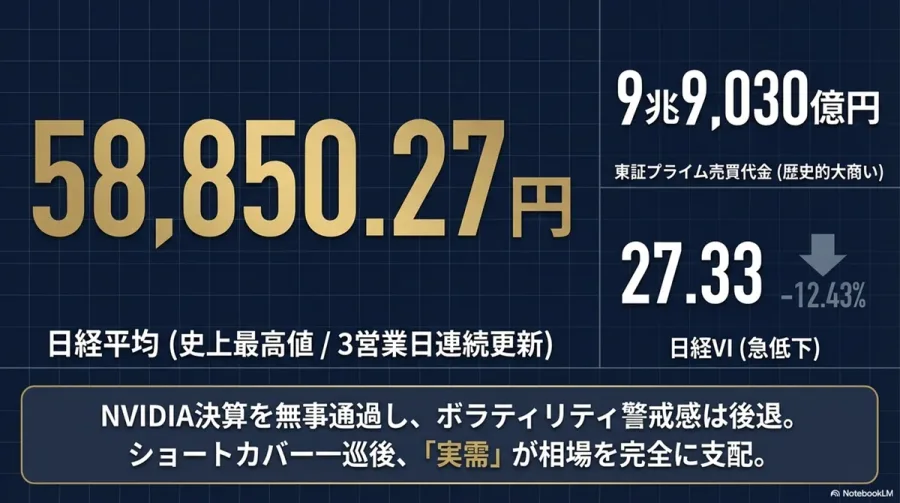
The Japanese stock market on February 27, 2026, was a historic day where, following the major event of the NVIDIA earnings announcement in the US market the previous day, uncertainty was cleared while a powerful paradigm shift progressed in the depths of the market. The Nikkei Stock Average closed at 58,850.27 yen, up 96.88 yen (+0.16%) from the previous day, marking a record high for the third consecutive trading day 1. However, hidden behind this modest rate of increase is a dramatic change in the risk appetite of market participants.
Most noteworthy is the fact that the NT ratio plummeted to 14.94 1. This signifies a large-scale rotation of funds from high-priced semiconductor stocks with high Nikkei contribution, which had been driving the market alone, to a broad range of domestic demand stocks, value stocks, and cyclical stocks that make up the TOPIX. The number of advancing issues on the Tokyo Stock Exchange Prime Market reached 1,443, presenting a "broad-based rally" where approximately 90% of all stocks rose 1. The sharp rebound of the Growth 250 Index by +3.83% also confirms that investors' risk tolerance has expanded and the shift of funds to lagging small-to-mid-cap stocks has become clear 1.
The fact that the Nikkei VI (Volatility Index) plunged 12.43% from the previous day to 27.33 is evidence that the market is welcoming the "removal of event risk" following the successful passage of the NVIDIA earnings 1. The 25-day moving average-based advance-decline ratio is 136.16, significantly exceeding the 120 level generally considered to be in the overheating zone, but this is a phenomenon unique to the early stages of a new uptrend, indicating a structure supported by sustained capital inflows from investors who missed the rally (institutional investors fearing the risk of not being invested). The decline in the short-selling ratio to 35.0% also confirms that speculative short-covering has already run its course and the current market rise is being led by actual demand-backed cash buying 1.
Supply-Demand Structure and Derivatives Market Dynamics: The Depths of SQ Battles and Massive Cross-Trading
Supporting today's historic trading value (9.9 trillion yen) is not just cash trading, but extremely dynamic capital movement through the derivatives market and arbitrage trading 1. Looking back at trading trends by investor type (3rd week of February 2026), overseas investors were net buyers of 542.6 billion yen, and individual investors also turned to net buyers in both cash (131.7 billion yen) and margin (414.8 billion yen). This intense buying pressure was absorbed by trust banks (presumed to be pension fund portfolio rebalancing) which were net sellers of 951.5 billion yen, representing a very healthy metabolism of supply and demand 1.
In the futures and options market, fierce position building was observed ahead of the March major SQ (Special Quotation) calculation. In futures trading, active business was conducted throughout the day and night, centered on European brokers such as ABN AMRO Clearing, Société Générale, and Barclays, with the total notional principal in the market exceeding 15 trillion yen 1. Analyzing the open interest trends of Nikkei 225 options (NK225E), strong support lines are formed at the P58000 and P58500 put options on the downside, functioning as protection against sudden negative news. On the other hand, on the upside, sell orders from foreign securities firms are concentrated at the C59000 call option, standing as a solid resistance line 1.
However, the biggest surprise in the derivatives market was the massive cross-trading observed in the individual stock options (EQOP) of the "NF Nikkei 225 ETF (1321)." With的光世 (Kosei) Securities and ABN AMRO Clearing as the parties involved, calls with a strike price of 61,000 yen (C2603-61000) were executed at an extraordinary volume equivalent to approximately 10,000 Nikkei Large contracts, and C62000 at approximately 6,000 contracts 1. This super-large transaction with a notional principal of 1.5 trillion yen is presumed to be either a sophisticated financial technique where a specific global macro fund or other institutional investor has built a strong long position against the "upside tail risk" that the Nikkei Average will break through the 60,000 yen mark by the March SQ, or a covered call strategy structured against a huge cash portfolio to monetize volatility premiums 1.
In addition, the trend of arbitrage trading cannot be ignored. As of February 25, arbitrage buying positions have expanded to 1.25146 billion shares (+85.12 million shares from the previous day) 1. This indicates a mechanism where futures buying, backed by expectations of higher prices, has induced mechanical cash arbitrage buying, pushing up the market. However, the level of 1.25 billion shares is high even from past ranges, and once the futures market turns into a downward trend, the unwinding of these accumulated cash buying positions carries the potential risk of creating chain-reaction selling pressure and rapidly amplifying market volatility. The frequent occurrence of cross-trades on the scale of hundreds of billions of yen in ToSTNeT (off-auction trading), such as approximately 42.7 billion yen in 1308 (Listed TOPIX), 18.5 billion yen in Bridgestone (5108), and 15.3 billion yen in Oriental Land (4661) 1, indicates that the unwinding of arbitrage trades and fiscal year-end rebalancing by passive funds are pushing market liquidity to the limit.
Sector Performance and the Massive Impulse of MSCI Periodic Rebalancing
The market's thematic shift drew a clear contrast in sector performance. The top of the rising segments included petroleum and coal products, non-ferrous metals, services, and banking 6. The rise in non-ferrous metals was driven by the upward revision and dividend increase announcement of Mitsui Mining & Smelting (5706), reflecting expectations for a global economic recovery 10. On the other hand, the top of the declining segments was precision instruments, followed by a portion of the electric appliances sector 6.
The weakness in the semiconductor sector acted as a drag on the entire market. Leading stocks such as Advantest, Tokyo Electron, and Disco all fell, pushing down the Nikkei Average 1. Behind this is the spread of "sell the fact" sentiment, where it is believed that the pricing in of growth has reached its limit despite NVIDIA's strong earnings announcement 11. Furthermore, news that the Chinese Ministry of Commerce has added Japanese companies and universities to a "concern list" that tightens export controls on dual-use (military and civilian) products also acted as a psychological weight on high-tech stocks as a supply chain fragmentation risk 12.
And what swept the market close today into a vortex of excitement was the rebalancing trade accompanying the periodic review of the MSCI (Morgan Stanley Capital International) index. This stock replacement, announced on February 11, Japan time, is reflected in the index based on today's closing price, so mechanical rebalancing trades by passive funds were concentrated just before the close 4.
Newly adopted stocks: Ibiden (4062) closed at 9,537 yen (+238 yen, +2.55%), recording abnormal trading where 12.45 million shares were executed at the close alone out of a total volume of 19.24 million shares 4. Shimizu Corporation (1803) also closed at 3,493 yen (+77 yen, +2.25%), with 28.79 million shares executed at the close out of a volume of 34.22 million shares 4.
Excluded stocks: Kobe Bussan (3038), SG Holdings (9143), Tokyo Metro (9023), and Trend Micro (4704) were excluded from the index 13.
This MSCI rebalancing provides insights that go beyond mere passive capital movement. Usually, excluded stocks fall due to selling pressure and adopted stocks rise, but there are many active hedge funds (event-driven strategies) in the market that build positions in anticipation of this event. The huge volume at today's close is the result of intense intersection between passive fund buying (selling) and active fund profit-taking (short-covering). The fact that Ibiden and Shimizu Corporation closed in significantly positive territory proves that strong actual demand buying, more than enough to absorb the selling pressure of rebalancing, is supporting the entire Japanese market.
The Anthropic Shock and the Tectonic Shift in the AI/Software Market
In the high-tech field, what is shaking the foundation of medium-to-long-term investment themes even more than NVIDIA's earnings is the "Anthropic Shock" caused by the US AI startup Anthropic. The new AI agent "Claude Cowork" announced by the company in early February 2026 is equipped with the ability to autonomously perform professional computer tasks such as legal, financial, and data analysis 18.
This technological innovation has brought a severe paradigm shift concern to global financial markets that "AI will render existing SaaS (Software as a Service) platforms obsolete." As a result, the stock prices of global software and service-related companies such as Relx, Thomson Reuters, Salesforce, and Workday plummeted by around 10% in a single day 20. This wave has also spread to the Japanese market, where Sansan (4443), a major business card management and sales support service, has seen its closing price hover around 1,160 yen today, forcing a very heavy upward trend due to fundamental doubts about the superiority of its business model 22.
The insight gained from this event is that the phase of AI investment has shifted from "hardware (semiconductor/GPU) development" to "redefinition of software and business processes." Until now, SaaS companies earned high subscription revenue by digitizing business processes and providing interfaces for human use. However, if AI agents begin to automatically execute the processes themselves, the value of SaaS as an intermediary tool will rapidly erode. Investors are being forced to dramatically restructure their portfolios from mere tool providers to "AI-native companies" that possess unique proprietary data and can self-evolve by embedding AI into their core systems.
Furthermore, a critical conflict has emerged surrounding Anthropic at the forefront of technology and national security. U.S. Secretary of Defense Hegseth has demanded the complete removal of "safety guardrails"—such as prohibitions on the diversion to autonomous lethal weapons and restrictions on mass surveillance of U.S. citizens—in the military use of the company's AI model, "Claude," and has issued an ultimatum with a deadline of 5:01 PM Eastern Time on February 27 (early morning on the 28th in Japan) 25.
Anthropic CEO Dario Amodei has clearly refused, stating that he "cannot comply with the request in good conscience" and will not cooperate in uses that undermine democratic values 29. In response, the Pentagon has hinted at strong retaliatory measures, such as designating the company as a "supply chain risk" to exclude it from government contracts, or invoking the Cold War-era "Defense Production Act (DPA)" to forcibly lift the restrictions 30.
This conflict will have a profound impact on the governance and corporate value of the entire AI industry moving forward. If Anthropic is excluded, companies like Elon Musk's xAI, which are more tolerant of ethical constraints, will monopolize the core of military systems 32. Conversely, if force is exercised through the Defense Production Act, the independence of private technology companies will be lost. For institutional investors, a new dilemma has been posed regarding how to evaluate ESG (Environmental, Social, and Governance) criteria and reputation risk when investing in AI companies, and maximum caution is required as a factor for intense volatility in related stocks over the weekend.
Japan's Fundamentals: The Intersection of Inflation Indicators, Politics, and Monetary Policy
Domestic fundamentals and policy trends in Japan are key pillars that fundamentally support stock market valuations. The macroeconomic indicators released today suggested both a cooling of inflation and the resilience of the real economy.
The February Consumer Price Index (CPI, mid-month preliminary value) for the Ku-area of Tokyo, released by the Ministry of Internal Affairs and Communications at 8:30 AM today, showed that the general index excluding fresh food (core CPI) was +1.8% year-on-year (index 110.5), a 0.2 percentage point decrease from the previous month's growth, falling below the 2% threshold for the first time in one year and four months since October 2024 33. The main reasons for this decline are the resumption of government subsidies for electricity and city gas bills starting from the February payment, and a significant 9.2% drop in energy prices due to the abolition of the provisional gasoline tax rate 34. On the other hand, while food excluding fresh food remains at a high level of +5.5%, the rate of increase has slowed for six consecutive months, and historical price hikes are beginning to regain a certain level of stability, including through policy interventions 35.
Additionally, the preliminary Industrial Production Index for January, released by the Ministry of Economy, Trade and Industry at 8:50 AM, was +2.2% month-on-month (index 104.0), marking the first increase in three months 36. It was confirmed that manufacturing production activities are remaining firm, supported by a recovery in exports from the automotive industry 36.
The future of the Bank of Japan's monetary policy in light of these indicators is the market's greatest concern. Governor Kazuo Ueda maintains his basic stance of "adjusting the degree of monetary easing (additional rate hikes)" if the certainty of achieving the 2% price stability target increases, and has suggested that if wage increases in the spring labor-management negotiations and their pass-through to prices are strong, there is a possibility of achieving the target ahead of schedule 38. Furthermore, Policy Board member Hajime Takata delivered a hawkish signal in a speech on the 26th, emphasizing the need for a gradual increase in the policy interest rate with an eye on "upside risks" from price spillovers from overseas 39.
Meanwhile, on the political stage, Prime Minister Takaichi is facing tough parliamentary deliberations with opposition parties to ensure the passage of the fiscal 2026 budget within the fiscal year 40. The Takaichi administration is aiming to realize a two-year limited consumption tax cut on food products and a "tax credit with benefits" to reduce the burden on citizens suffering from high prices, and is leading the launch of a cross-party "National Council on Social Security" 42.
The insight derived from this is that the very process of the Japanese economy searching for the optimal solution for a policy mix of finance and fiscal policy at a historical turning point of "complete escape from deflation" is the driving force behind foreign investors buying Japanese stocks (re-rating). The market has priced in that the CPI falling below 2% is largely due to temporary factors such as government subsidies, and that the Bank of Japan will continue a gradual rate hike cycle while gauging the entrenchment of underlying inflationary pressure. For this reason, Japan's 10-year government bond yield is hovering around 2.15% 44, confirming the sustained inflow of funds into the banking and financial sectors that benefit from rising interest rates (the factor behind today's sector rise). If the Takaichi administration's expansionary fiscal policy is realized, it will become a powerful support for domestic demand and a factor that will further extend the value stock market.
Global Macro and Geopolitical Risk: U.S. Trade Policy and the Middle East Situation
In the external environment surrounding the Japanese market, policy shifts originating from the U.S. and geopolitical risks in the Middle East stand as two major tail risks that are causing volatility to surge.
Trump Administration's Additional Tariff Policy and Trade UncertaintyThe fact that the "reciprocal tariffs" based on the International Emergency Economic Powers Act (IEEPA), which the Trump administration had touted as a signature policy, were judged illegal by the U.S. Supreme Court brought temporary relief and new confusion to the global trade order 53. President Trump strongly opposed this judicial decision and immediately invoked "Section 122 of the Trade Act" as an alternative measure, signing an executive order on February 24 to impose a uniform 10% additional tariff on imports from countries and regions around the world 55. Furthermore, he expressed his intention on social media and other platforms to raise this tax rate to 15% and has also initiated an investigation under Section 301 of the Trade Act, which stipulates sanctions against unfair trade 54.
Section 122 of the Trade Act is an emergency evacuation authority originally invoked with a 150-day time limit to deal with "serious balance of payments deficits" 56. The Trump administration's use of this clause is seen as a "time-buying" tactic to fill the policy vacuum caused by the illegal ruling. However, by shifting from reciprocal tariffs targeting individual countries to uniform tariffs on the entire world, the impact on supply chains has become more complex. While it may reduce the burden for Brazil and China, which were subject to relatively high tariffs, it could potentially increase the actual burden for the UK, Japan, and the EU 58.
The Japanese government and the business community are heightening their sense of caution regarding this significant decline in predictability 55. In the summit meeting with President Trump during Prime Minister Takaichi's first visit to the U.S. scheduled for March 19, the top priority will be to appeal for the continuation of Japanese investment in the U.S. and to minimize the negative impact of tariffs 59. As an insight for the stock market, this opacity in trade risk is acting as a constant discount factor that weighs on the upside of valuations for export-related companies (automobiles, machinery, etc.), and is the rationale justifying the flight of capital to domestic demand and value stocks, which are relatively less susceptible to the external environment.
Furthermore, regarding the U.S. government budget for fiscal year 2026, which had been a concern, the House of Representatives passed the budget bill (funding package) for defense, labor, education, etc., so the worst-case irregular schedule of a partial government shutdown is expected to be avoided, providing a sense of relief to the market 60.
U.S.-Iran Nuclear Talks and Geopolitical TensionGeopolitical risk in the Middle East remains the biggest spark plug fueling volatility in the crude oil and stock markets. On February 26, indirect talks between high-ranking U.S. and Iranian officials were held in Geneva, Switzerland, mediated by Oman 63. International Atomic Energy Agency (IAEA) Director General Grossi also participated in these talks, which Iranian Foreign Minister Araghchi described as the "most serious and longest talks to date," lasting over six hours 65.
Although both countries agreed to continue the dialogue and hold expert meetings in Vienna on March 2, the gap between their positions remains unbridged: the U.S. is demanding an immediate halt to uranium enrichment activities and the dismantling of nuclear facilities, while Iran is conditioning its cooperation on the total lifting of economic sanctions 65. President Trump has repeatedly hinted at the possibility of launching military strikes against Iranian nuclear facilities if there is no progress within 10 to 15 days, creating a game of chicken 66.
Because the talks resulted in "continuation" rather than a "breakdown," concerns about an immediate escalation to all-out war have receded slightly, which contributed to today's sharp drop in the Nikkei VI (Volatility Index). However, the fact that WTI crude oil futures remain firm in the $65 range 48 and gold futures remain at a historic high of $5,195 50 means that the market continues to fully price in the risk of a disruption to the Middle East's crude oil supply network. Should a military conflict break out, the stagflation scenario of "reignited inflation" and a "prolonged global interest rate hike cycle" due to a surge in oil prices would become a reality, leading institutional investors to continue strict risk hedging by incorporating defense and energy stocks into their portfolios.
Conclusion and Action Insights for Investors
The stock market on February 27, 2026, saw the Nikkei Stock Average hit a record high for the third consecutive day, with a record-breaking 9.9 trillion yen in trading value on the Prime Market. Underlying this frenzy is a sense of relief following NVIDIA's strong earnings, the inflow of massive passive funds due to the MSCI rebalance, and above all, a "grand shift of funds toward domestic demand and value stocks" that evaluates Japan's corporate governance reform and macroeconomic transformation (the establishment of inflation and a world with interest rates), moving away from a market dominated solely by AI and semiconductors.
As for the future economic schedule, there are a series of important events that could suddenly change the tide of the market, including the announcement of the U.S. January Personal Consumption Expenditures (PCE) deflator tonight, the conclusion of the conflict between Anthropic and the U.S. Department of Defense over the weekend (deadline February 27, 17:01), and the U.S.-Iran expert meeting next week on March 2 65.
The current market environment facing individual investors is one where, contrary to the superficial record highs of the indices, intense sector selection and risk reassessment are taking place beneath the surface.
Continuation of the Value Shift and Portfolio Restructuring: The decline in the NT ratio and the high level of arbitrage buying suggest that the inflow of funds into lagging value stocks (finance, trading companies, construction, etc.) will continue. Against the backdrop of expectations for fiscal stimulus from the Hagiuda administration, diversified investment in small-to-mid-cap domestic demand stocks will be an effective strategy.
Adapting to the Next Phase of AI Investment: As the Anthropic shock proved, "SaaS companies that only provide AI tools" face the risk of rapid obsolescence. Thorough stock picking is required to identify "companies that can integrate proprietary data with AI and self-innovate their business processes."
Thorough Hedging Against Tail Risks: Supply chain disruptions due to Trump tariffs, ESG risks brought about by the conflict between the Pentagon and AI companies, and the risk of military conflict in the Middle East. To prepare for these black swans, incorporating gold, energy-related assets, and defensive stocks into a portion of the portfolio to maintain a robust asset composition capable of withstanding a sharp expansion in volatility is the most important proposition for surviving this market environment as it eyes the unknown "60,000 yen" mark.
References
20260227 JPX Market Conditions, Major Indices, Futures/Options, Arbitrage Trading, ToSTNeT.docx
Nikkei Average closes at a record high for the third consecutive day... up 96 yen to 58,850 yen, accessed February 27, 2026, https://www.yomiuri.co.jp/economy/20260227-GYT1T00256/
[Japanese Stocks] February 19, 2026 (Thu) Closing Price Gains - note, accessed February 27, 2026, https://note.com/anokicon/n/nb9648e2189fe
Ibiden Co., Ltd. [4062]: Stock Tweets - Yahoo! Finance, accessed February 27, 2026, https://finance.yahoo.co.jp/quote/4062.T/post
2023 – Page 4 - STOCKVOICE, accessed February 27, 2026, https://www.stockvoice.tv/2023/page/4/
Today's [Industry] Ranking of Gains and Losses = Closing [Top Gainers] Oil & Coal, accessed February 27, 2026, https://finance.matsui.co.jp/news/549576/index
Today's [Industry] Ranking of Gains and Losses = Afternoon Session Opening [Top Gainers] Services, accessed February 27, 2026, https://kabutan.jp/news/marketnews/?b=n202602260675
Weekly Ranking [Sector Performance] (February 20) - Yahoo! Finance, accessed February 27, 2026, https://finance.yahoo.co.jp/news/detail/532c3bd72ae65da1b8820232b64d89c3ebedf4ab
Today's [Sector] Performance Ranking = Morning Close [Top Gainer] Non-ferrous Metals, accessed February 27, 2026, https://kabutan.jp/news/marketnews/?b=n202602240489
While Yomiuri 333 rose 0.6%, the Nikkei 225 and TOPIX fell. Capital is shifting to mid-cap and small-cap stocks, and Yomiuri 333 performance is strong... Yomiuri 333 Analysis for the week of February 16, accessed February 27, 2026, https://www.yomiuri.co.jp/economy/20260224-GYT1T00001/
2/26 Stock Market Review | Akira / Market Lighthouse - note, accessed February 27, 2026, https://note.com/studystock/n/n1899f5a4e945
China adds 20 companies and universities, including SUBARU and TDK, to its 'Concern List' for stricter export screening... Some express confusion, calling it a 'bolt from the blue', accessed February 27, 2026, https://www.yomiuri.co.jp/economy/20260226-GYT1T00050/
MSCI adds 63 stocks including Ibiden and Shimizu Corporation to the ACWI Index, accessed February 27, 2026, https://finance.yahoo.co.jp/news/detail/0761276e1ac56b0b0c3eda23f13e2197d07c114a
Ibiden and Shimizu Corporation newly adopted, Kobe Bussan and others excluded - Minkabu, accessed February 27, 2026, https://minkabu.jp/news/4439059
Ibiden Price Information | Mizuho Securities, accessed February 27, 2026, https://ot32.qhit.net/mizuhosc/page/quote.cgi?F=market/kakaku&QCODE=4062&MKTN=T
Shimizu Corporation (1803): Stock Tweets - Yahoo! Finance, accessed February 27, 2026, https://finance.yahoo.co.jp/quote/1803.T/post
Ibiden and Shimizu Corporation newly adopted, Kobe Bussan and others excluded - Livedoor News, accessed February 27, 2026, https://news.livedoor.com/topics/detail/30565036/
Considerations regarding the Anthropic Shock and the SaaS collapse theory - Stock Forecast Column, accessed February 27, 2026, https://column.ifis.co.jp/toshicolumn/smam-01/173043
What happens with the Anthropic Shock? 8 US 'Software' stocks, accessed February 27, 2026, https://media.paypay-sec.co.jp/cat5/jisha260205_2
Reasons why the AI replacement fear 'Anthropic Shock' is an overreaction - Nomura, accessed February 27, 2026, https://www.nomura.co.jp/wealthstyle/article/0613/
What is the Anthropic Shock that hit US SaaS stocks in February 2026? - note, accessed February 27, 2026, https://note.com/snowflake_note/n/n0f3bf503fbd3
Sansan - Significant continued decline following the release of new technology by a US AI development company, accessed February 27, 2026, https://jp.investing.com/news/stock-market-news/article-1408473
Sansan - Significant continued decline following the release of new technology by a US AI development company, accessed February 27, 2026, https://finance.yahoo.co.jp/news/detail/f472a0ffda1509f7e8342d3517e386ba2db5dc11
Sansan Inc (4443) Historical Data - Investing.com, accessed February 27, 2026, https://jp.investing.com/equities/sansan-inc-historical-data
Anthropic declines Pentagon bid for unrestricted military use of Claude AI, accessed February 27, 2026, https://www.indiatoday.in/world/us-news/story/anthropic-rejects-pentagon-requests-in-ai-safeguards-dispute-ceo-says-2875137-2026-02-27
Pentagon hardens its ultimatum to Anthropic in feud over AI use, accessed February 27, 2026, https://www.communicationstoday.co.in/pentagon-hardens-its-ultimatum-to-anthropic-in-feud-over-ai-use/
Pentagon sets Friday deadline for Anthropic to abandon ethics rules, accessed February 27, 2026, https://subscriber.politicopro.com/article/2026/02/hegseth-sets-friday-deadline-for-anthropic-to-drop-its-ai-red-lines-00795641
Why did Anthropic refuse? Hegseth's ultimatum and 3 scenarios after the deadline, accessed February 27, 2026, https://reaitimenews.com/entry/hegseth-anthropic-claude-pentagon-ultimatum
US Department of Defense vs. Anthropic. Ultimatum, strictly 'AI autonomous weapons', accessed February 27, 2026, https://smhn.info/202602-anthropic-pentagon-ai-dispute
Anthropic vs Pentagon: 5 Big blows Claude now faces after rejecting US military’s ‘final offer’, accessed February 27, 2026, https://www.financialexpress.com/world-news/us-news/anthropic-vs-pentagon-5-big-blows-claude-now-faces-after-rejecting-us-militarys-final-offer/4156254/
Hegseth sets Friday deadline for Anthropic to drop AI safeguards or face Pentagon action, accessed February 27, 2026, https://www.livemint.com/news/us-news/pete-hegseth-sets-friday-deadline-for-anthropic-to-drop-ai-safeguards-or-face-pentagon-action-11771976281709.html
Elon Musk's xAI sends 'throw Anthropic' message to 'angry' Pentagon; says: We will, accessed February 27, 2026, https://timesofindia.indiatimes.com/technology/tech-news/elon-musks-xai-sends-throw-anthropic-message-to-angry-pentagon-says-we-will-/articleshow/128749853.cms
Foreign Exchange (FX) Report, Morning Flash (2026.2.27) Exceeding expectations, accessed February 27, 2026, https://note.com/bca_m/n/nce39165cf465
Consumer prices in Tokyo's 23 wards, 'growth rate falls below 2%' for the first time in 16 months... utility costs drop due to resumption of electricity and gas subsidies, accessed February 27, 2026, https://www.yomiuri.co.jp/economy/20260227-GYT1T00101/
Takahide Kiuchi's Global Economy & Policy Insight | Nomura Research Institute (NRI), accessed February 27, 2026, https://www.nri.com/jp/media/column/kiuchi/index.html
January industrial production up 2.2%, supply recovery of popular car models - Economy - Excite, accessed February 27, 2026, https://www.excite.co.jp/news/article/Economic_0000107977/
[Indicator] January industrial production, preliminary value (month-on-month) +2.2%, forecast +5.5%, etc., accessed February 27, 2026, https://myforex.com/ja/news/dzh260227586.html
BOJ Governor Ueda: New US tariffs will have 'no major impact'... additional rate hikes to be decided after checking information by April, accessed February 27, 2026, https://www.yomiuri.co.jp/economy/20260225-GYT1T00348/
BOJ Policy Board Member Hajime Takata: Idea that policy interest rates should be raised gradually... price stability target 'generally achieved', accessed February 27, 2026, https://www.yomiuri.co.jp/economy/20260226-GYT1T00190/
Ruling and opposition parties in a war of nerves over 'passing the budget within this fiscal year'... opposition party demanding sufficient deliberation also says 'if it looks like obstruction, it could invite criticism', accessed February 27, 2026, https://www.yomiuri.co.jp/politics/20260220-GYT1T00456/
New fiscal year budget proposal enters substantive deliberation on the 27th... question time for basic questioning is '20% ruling party, 80% opposition party', accessed February 27, 2026, https://www.yomiuri.co.jp/politics/20260225-GYT1T00258/
National council to discuss consumption tax cuts, etc., holds first meeting... Prime Minister Takaichi: 'I want to proceed carefully and with a sense of speed', accessed February 27, 2026, https://www.yomiuri.co.jp/politics/20260226-GYT1T00368/
Constitution 'should be updated in response to changes', Imperial House Law revision 'cannot be postponed due to the decrease in imperial family members'... Prime Minister Takaichi eager to pass budget within the fiscal year, accessed February 27, 2026, https://www.yomiuri.co.jp/politics/20260224-GYT1T00243/
February 26, 2026 (Thu) Market Overview | Non-chan's Reflection Diary [Stocks], accessed February 27, 2026, https://ameblo.jp/fm892mhz/entry-12957982537.html
[Currency] Tokyo Forex: Dollar-Yen resists decline, moves to recover value, accessed February 27, 2026, https://kabutan.jp/news/marketnews/?b=n202602271138
Japan 10-Year Government Bond Yield - Sumitomo Mitsui Trust Bank, accessed February 27, 2026, https://fund.smtb.jp/smtbhp/qsearch.exe?F=market3
US 10-Year Bond Yield | 1912-2026 Data | 2027-2028 Forecast - Economic Indicators, accessed February 27, 2026, https://jp.tradingeconomics.com/united-states/government-bond-yield
Continued decline, US and Iran to hold 4th round of talks = NY Crude Oil Overview - Minkabu, accessed February 27, 2026, https://s.minkabu.jp/news/4454467
NY Crude Oil: Weak at $65.21, US-Iran nuclear talks continue, accessed February 27, 2026, https://www.moneypost.jp/1374004
Gold Futures Historical Price Data - Investing.com, accessed February 27, 2026, https://jp.investing.com/commodities/gold-historical-data
Copper Outlook, 2026, 2027–2030 - Economic Forecasting Agency, accessed February 27, 2026, https://jpyforecast.com/copper
Bitcoin - Bitcoin Historical Data - Investing.com, accessed February 27, 2026, https://jp.investing.com/crypto/bitcoin/historical-data
Trump to use 'other legal means' to continue tariffs, announces 10% flat additional tariff on all countries... refuses to return 20 trillion yen already collected for now, accessed February 27, 2026, https://www.yomiuri.co.jp/economy/20260221-GYT1T00162/
Trump raises new tariffs to 15%... changes policy in one day, says 'it is the result of a thorough and detailed review', accessed February 27, 2026, https://www.yomiuri.co.jp/economy/20260222-GYT1T00075/
Trump's new tariffs, impact on Japanese economy uncertain... some companies have filed lawsuits seeking refunds, accessed February 27, 2026, https://www.yomiuri.co.jp/economy/20260224-GYT1T00423/
US 'reciprocal tariffs' to end after one year, new additional tariffs at 10%... Trump says 'countries that exploit the ruling will face even tougher tariffs', accessed February 27, 2026, https://www.yomiuri.co.jp/economy/20260224-GYT1T00107/
Trump administration to impose 10% flat tariff on imports from the 24th, also investigating further measures... following ruling that 'reciprocal tariffs' were illegal, accessed February 27, 2026, https://www.yomiuri.co.jp/economy/20260222-GYT1T00009/
President Trump's new additional tariffs, will fortunes vary by country and region?... China and India see reduced burden, UK sees increased burden, accessed February 27, 2026, https://www.yomiuri.co.jp/economy/20260224-GYT1T00015/
Confusion over US tariffs, business community concerned about being 'unable to move'... LDP Policy Research Council Chairman Kobayashi says 'analyze the impact on the economy and companies', accessed February 27, 2026, https://www.yomiuri.co.jp/politics/20260223-GYT1T00084/
Progress toward avoiding US government shutdown = FY2026 budget bill passes House (Jiji Press), accessed February 27, 2026, https://finance.yahoo.co.jp/news/detail/20260123-00000032-jijf-bus_all
US government shutdown temporarily lifted, but some issues postponed - JETRO, accessed February 27, 2026, https://www.jetro.go.jp/biznews/2026/02/0508a6534b78fbfa.html
US government agencies to partially shut down again as 'stopgap budget' expires (January 31, 2026), accessed February 27, 2026, https://www.youtube.com/watch?v=u2Y40HDFeLA
US-Iran nuclear talks, Wittkoff and others attend in Geneva on the 26th = US officials, accessed February 27, 2026, https://vovworld.vn/ja-JP/%E3%83%8B%E3%83%A5%E3%83%BC%E3%82%B9/%E7%B1%B3%E3%82%A4%E3%83%A9%E3%83%B3%E6%A0%B8%E5%8D%94%E8%AD%B0%E3%82%A6%E3%82%A3%E3%83%83%E3%83%88%E3%82%B3%E3%83%95%E6%B0%8F%E3%82%89%E5%87%BA%E5%B8%AD%E3%80%8026%E6%97%A5%E3%82%B7%E3%83%A5%E3%83%8D%E3%83%BC%E3%83%95%E7%B1%B3%E5%BD%93%E5%B1%80%E8%80%85-1469996.vov
Third round of high-level talks on US-Iran nuclear issue, held in Geneva on the 26th, accessed February 27, 2026, https://www.yomiuri.co.jp/world/20260223-GYT1T00186/
US and Iran hold over 6 hours of 'most serious and longest talks' on nuclear issue and sanctions relief... positions remain far apart, accessed February 27, 2026, https://www.yomiuri.co.jp/world/20260227-GYT1T00206/
Trump 'considering' attack on Iran, accessed February 27, 2026, https://www.yomiuri.co.jp/world/20260221-GYT1T00175/
Decision on military attack on Iran, Trump says 'we will know in the next 10 days'... even if the deadline is extended, '15 days at most', accessed February 27, 2026, https://www.yomiuri.co.jp/world/20260220-GYT1T00488/
A Timeline of the Anthropic-Pentagon Dispute, accessed February 27, 2026, https://techpolicy.press/a-timeline-of-the-anthropic-pentagon-dispute