1. Introduction
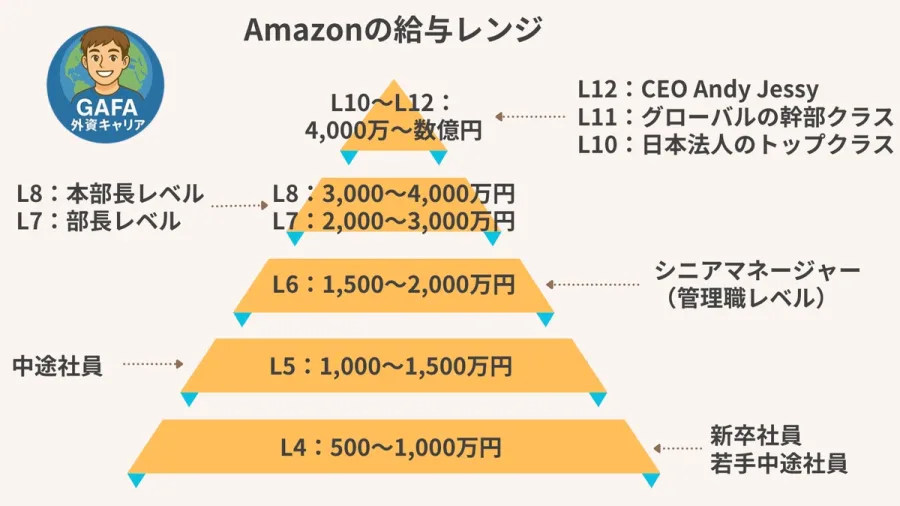
For those considering a career change to Amazon, information regarding compensation and evaluation mechanisms—such as "What is the annual salary?", "How do promotions work?", and "How much RSU (stock compensation) can I receive?"—is extremely important.
While compensation systems centered on seniority, bonuses, and retirement benefits are common in Japanese companies, a completely different philosophy is rooted in foreign-affiliated companies like Amazon.
RSU (Restricted Stock Units) grants for long-term contributions, and changes in discretion and compensation through promotions—there is a lot of information you should know before considering a job change.
In this article, we will explain Amazon's job levels, compensation systems, and the reality of promotions in an easy-to-understand manner.
2. What does Amazon do in Japan?
In Japan, services are primarily operated by two companies: Amazon Japan G.K. and Amazon Web Services Japan G.K.. Strictly speaking, there are other group and affiliated companies such as Twitch Japan G.K., but these two are the main ones conducting recruitment activities.
Amazon Japan G.K. is primarily responsible for the EC (e-commerce) business in Japan, with core operations including the sale of products offered on "Amazon.co.jp," marketplace management, logistics management, and customer service. In addition to business for general consumers, it also develops support for sellers and B2B e-commerce services (Amazon Business), and focuses on product strategies and customer experience improvements specialized for the Japanese market.
On the other hand, Amazon Web Services Japan G.K. (AWS Japan) plays the role of developing and expanding cloud computing services (AWS) in the Japanese market within the Amazon group. It provides a wide range of solutions including infrastructure (IaaS), platforms (PaaS), AI/ML, data analytics, and security to customers in various industries such as government agencies, large enterprises, and startups. It is also characterized by having many roles with a strong technical focus, such as sales, technical support (Solutions Architects), and customer success.
Since the salary system, job level structure, recruitment flow, and selection methods are basically the same for both Amazon Japan G.K. and Amazon Web Services Japan G.K., this article will explain Amazon Japan G.K. (hereinafter referred to as Amazon) for convenience.
3. Amazon's Job Structure (Job Levels)
To deepen your understanding of Amazon's compensation, you first need to understand Amazon's job structure. This is the job level system, which is often introduced in foreign-affiliated companies, especially foreign-affiliated IT companies.
Amazon has a job rank system called "L (Level)," where the higher the number, the greater the responsibility, discretion, and compensation. L1 to L3 are job levels for part-time, contract employees, and operational tasks, while L4 and above are the regular employee positions for white-collar jobs.
For example, L4 is the entry level for new graduates, second-year graduates, or those who joined mid-career in an inexperienced field, while L5 and above are expected to be "immediate assets." At L6, the role as a manager increases, involving coordination with other departments and management of subordinates. Furthermore, L7 and above are management layers that oversee multiple teams and become involved in departmental decision-making and budget management.
Positions corresponding to L8 to L10 are those close to the management team, such as directors and vice presidents. Note that "L99" is a job level assigned to temporary employees and does not mean an executive position.
By the way, Amazon CEO Andy Jassy and founder and current Chairman Jeff Bezos are at the highest level, L12.
3. Salary Tables and Compensation Models by Job Level
Amazon's compensation consists of two pillars: "Base Salary" and "RSU (Stock Compensation)", and as the job level rises, the weight of RSU increases. (We will explain RSU in detail in the next chapter.)
For example, at L4, the base salary is around 5 to 10 million yen per year, and the RSU is very small. On the other hand, when promoted to L5, the annual salary reaches 10 to 15 million yen, and RSU accounts for 20-30% of the total compensation. Furthermore, at L6, the RSU grant amount increases significantly, and in many cases, the total annual salary jumps to 15 to 20 million yen. At L7 and above, an annual salary of 20 million yen or more is common, and depending on stock price movements, total compensation can increase significantly.
The reason why the salary range is wide even within the same job level is that it varies depending on the job type and experience..
4. The Mechanism of RSU (Restricted Stock Units)
One of the most distinctive features of Amazon's compensation is RSU (Restricted Stock Units) . This is a compensation system in which the company promises to transfer shares to employees in the future, and they are VESTED (rights confirmed) in stages over a certain number of years.
For mid-career hires, it is common for a certain number of shares to be GRANTED at the time of joining, and they are VESTED according to the following schedule:
1st year: 5% of the GRANTED RSU is VESTED
2nd year: an additional 15% is VESTED
3rd year: 40% is VESTED
4th year: the remaining 40% is VESTED
VESTED shares can be SOLD = converted to cash at the stock price at that time. Although it is necessary to be aware that income tax is levied on capital gains, they hold great value as assets.
The jump in compensation due to stock price increases
The greatest appeal of RSUs is that the compensation amount is not a "fixed sum" but is "linked to the stock price". The actual amount you receive fluctuates significantly depending on the stock price at the time of vesting.
In fact, it is not uncommon at Amazon for the stock price to rise to two or three times the expected value at the time of joining, effectively doubling the initial expected annual income. For example, if stock granted at $100 per share becomes $200 three years later, the value of the compensation has simply doubled.
In this way, Amazon's RSUs function as "asset building" while being "compensation", creating a system where you can directly enjoy the company's growth as your own compensation.
5. Example of Salary Structure from Year 1 to Year 4
The salary system at Amazon Japan G.K. is designed based on a concept called "Total Compensation." This is a system designed based on "total remuneration," which includes not only base salary but also RSUs (stock-based compensation) and sign-on bonuses.
As explained earlier, a certain number of RSUs (Restricted Stock Units) are granted upon joining and vest in stages over four years. Since the amount received from RSUs is low in the first and second years, a "sign-on bonus" is provided only for the first and second years to ensure that the compensation level remains consistent.
The actual annual salary composition is as follows:
Year 1: Base Salary + Sign-on Bonus + RSU (5% VEST)
Year 2: Base Salary + Sign-on Bonus + RSU (15% VEST)
Year 3: Base Salary + RSU (40% VEST)
Year 4: Base Salary + RSU (40% VEST)
With this design, while ensuring a certain level of cash compensation from the beginning of employment, the ratio of RSUs increases sharply from the third year onwards, creating a structure where long-term commitment is rewarded.
6. Amazon's Promotion and Evaluation System
At Amazon, promotions are based on clear achievements and scope of impact, not just "years of service." For example, to be promoted from L4 to L5, in addition to being able to perform tasks independently, contributions to projects and influence on the team are emphasized.
The evaluation process is highly institutionalized, incorporating evaluations by direct supervisors, peer reviews from colleagues, and 360-degree reviews by stakeholders in other departments. Additionally, "career discussions" held every six months provide a formal venue to discuss promotion potential and current performance.
At Amazon, evaluations are conducted every six months based on results and Leadership Principles, providing opportunities for promotion. Upon promotion, new RSUs are often additionally granted, which creates a cycle of compensation re-growth.
In other words, by getting promoted, the flow of GRANT → VEST → SELL begins again, making it possible to design a structure where compensation continues to increase over the medium to long term.
7. Next Steps: To the Amazon Interview Breakthrough Guide
So far, I have systematically introduced Amazon's annual salary, job level structure, RSU mechanism, and promotion and evaluation systems.
However, to use this information to join Amazon, "passing the interview" is an absolute requirement. Amazon's interviews are deeply rooted in Leadership Principles, and both the questions asked and the expected answers differ significantly from those of typical companies, requiring special preparation.
In my paid note, which summarizes not only interview preparation methods but also the "resume template," "past interview questions," and "concrete examples of usable STAR frameworks" that I used when I actually received an offer, I have packed all the preparation and know-how truly necessary to pass the selection process.
Click here for the complete interview strategy guide to win an Amazon job offer
If you found this article helpful, I would appreciate your support with a "Like" and a "Follow"!
I will continue to share career strategies and selection breakthrough know-how for foreign-affiliated companies, including Amazon.