This weekend, I observed a phenomenon where sites that appeared to have plummeted on rank tracking tools showed no drop at all when searched on actual smartphone devices.
When I searched for "recommended credit cards" by simulating the tool's environment, there was an extreme discrepancy where not a single URL matched in the top 10 results between desktop and mobile. It seems that since last week, based on my verification, there have been significant differences in search results depending on the retrieval environment. I have not been able to confirm the cause or whether there have been any specification changes on Google's side.
Although we are in the middle of a spam update period, there is a risk in taking the tool's ranking data at face value right now.
In this article, I will explain these verification results, reported cases from overseas, and future approaches to rank tracking. (*As of September 29, 2026)
This weekend, rankings appeared to collapse simultaneously across multiple tools
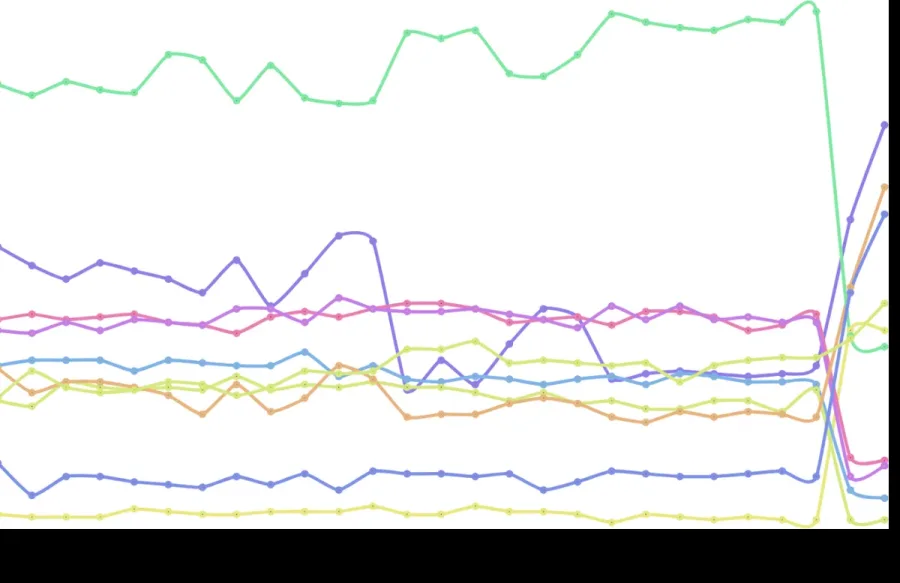
When I checked the rank tracking tools over the weekend, I saw that from a certain day, there was a ranking fluctuation more severe than a core update.
Since the timing coincided with the spam update that Google started on September 24, 2026, I initially thought it might be the impact of that. However, when I checked the actual search results using private browsing on a smartphone, I could not confirm the decline of the sites that were plummeting on the tools.
When I re-checked several overseas tools I subscribe to, I found that an increasing number of them were showing abnormal data starting 3 to 4 days ago.
From this, within the scope of what I have confirmed, there was a discrepancy between the rankings on the tools and the search results on actual smartphones.
When retrieved on desktop, not a single one of the top 10 results matched
Even for the same keyword, changing the retrieval conditions returned completely different search results. To verify what kind of results the tools are retrieving, I am also retrieving them in an environment similar to the tools.
I do not know which proxy the tools are using. When I retrieved them via a proxy, the results were different for the desktop user agent, while the mobile results were close to those of a general user I see on my smartphone.
The number one result on desktop was "[2026 Latest] 5 Recommended Credit Card Stocks!" in the stock investment category of gfs.tokyo. This is an article for people looking for credit card-related stocks, not for those wishing to apply for a card.
On the other hand, the number one result on mobile was Diamond Online's "[Credit Card Recommendation Comparison] Experts compare popular credit card reward rates and annual fees...", and the second was Kakaku.com.
Comparing the domains in the top 10 makes the difference even clearer.
Out of the 10, there is not a single identical URL.
The only domains that match are SMBC Card and Kakaku.com, and even those are different pages or bulletin boards.
If the tools were retrieving results like the desktop version, the rankings of Diamond Online and Kakaku.com would appear to have plummeted.
However, there are two points to note here.
One reason is that this is a result for only one keyword in my verification environment.
Another is that it cannot be concluded whether the difference in search results is caused by the desktop environment.
What I can say for sure is that "if you change the conditions, the same keyword will return different search results."
Reports of discrepancies between tools and actual results also emerged overseas during the same week
This is not just a story in Japan; many SEO practitioners overseas also noticed it during the same week.
A post on September 29th stated that while all of the sites managed by a certain rank tracking tool showed a "sharp drop," spot checks showed that the rankings were normal.
On September 28th, a UK-based SEO practitioner posted that almost all trackers, including famous tools, were significantly different from actual search results. It included a comparison with images showing that the first page on the tool side was filled with UGC and YouTube videos, and the pages that should have been ranking were not appearing.
A post on September 25th reported that in addition to incorrect rankings and large sharp drops, "?page=3" was randomly being appended to the ranked URLs.
I examined X posts from overseas between September 22nd and 29th. There were several independent reports, mainly in English-speaking countries, and the symptoms can be divided into four categories.
1. The tool and actual search results do not matchThe most common report was that the tool's results did not match the search results seen by humans in a logged-out state. Since the same discrepancy appears across multiple accounts, some have suggested that this should be viewed as noise rather than a ranking fluctuation.
2. The first page on the tool side is filled with UGCThis is a symptom where the first page on the tool is filled with UGC or YouTube. There was also a post stating that a certain Q&A site appeared to have four slots on the first page, but that was not the case in the actual search results.
3. "?page=3" is appended to the URLThis is a symptom where parameters like "?page=3" are randomly appended to ranked URLs, resulting in incorrect URLs being recorded.
4. 429 errors are also returned for custom scrapersReports from people using custom scripts indicate that they are receiving 429 errors or empty "phantom DOM wrappers." They cannot retrieve raw text, and rank tracking is effectively broken.
To summarize the overseas reports, they are as follows:
The time it started varies by person, ranging from around September 26th to several months ago
There was also a post saying, "The only correct answer right now is Search Console"
One overseas SEO tool announced on its official status page dated September 26th that "Google is currently returning incomplete or distorted search results in some cases." They explained that they are only publishing verified data and will reduce the number of keywords updated daily until things settle down
There are no official statements from Google representatives addressing this matter. The causes remain speculative, ranging from strengthened bot detection and countermeasures against scraping lawsuits to the protection of AI Overviews.
There is one point that differs from my observations. Reports of "discrepancies between desktop and mobile results" have not been found in English or any major European languages over the past seven days.
What has been reported overseas is limited to the gap between bot-derived results and what humans see, and it has not been determined whether the split I observed is a different symptom of the same cause.
Acquisition was difficult starting in August, but the content has changed since last week.
Talk of rank tracking becoming difficult has been popping up since around August. However, until now, the issue was that data could not be retrieved; since last week, it has shifted to a problem where data is retrieved, but the content is different.
On August 26, Google responded to inquiries from overseas media regarding the change to route search result links through google.com/goto. Their response stated, "We have a long history of taking technical measures against evolving abuse, and we regularly take steps to protect our services and users."
Previously, the problem was visible in the form of missing data where rankings could not be retrieved.
Since last week, it appears that rank retrieval itself is working. However, the content retrieved differs from the search results seen by general users.
Measure your own site's rankings using primary data from Search Console.
One option is to measure your own site's rankings using Search Performance in Google Search Console. Since it is Google's primary data, it is not affected by the success or failure of scraping.
However, since the data is difficult to handle directly in the management console, I recommend taking this opportunity to turn on bulk data export to BigQuery.
The key points from Google's help documentation are as follows:
All performance data, excluding anonymized queries, is exported to BigQuery daily.
Settings can be configured via Search Console under 'Settings' > 'Bulk Data Export'.
In advance, ensure BigQuery is enabled in a Google Cloud project with billing information set up.
The first export will occur within 48 hours of configuration. Past data from before the setting is not exported, so it is better to turn it on sooner rather than later.
It seems likely that your own site's rankings will be measured by treating queries that do not appear in Search Performance as being outside the ranking. However, since anonymized queries are not included in the export, queries that do not appear are not necessarily all outside the ranking.
Verify data from last week onwards with human eyes before using it in reports.
For data from last week onwards, it is advisable to perform manual random sampling to confirm it is reliable before using it.
I also recommend performing this verification before conducting analysis of your own site or creating reports for your boss or clients.
It appears that Google has changed its specifications not to block rank acquisition, but rather to allow it while returning different data.
While we can only speculate on the true intent, I believe that for the time being, we cannot skip the effort of verifying with our own eyes whether the tool's figures are accurate.