This time, I traveled a bit further to Taipei, Taiwan.
In Taiwan, the culture of eating out is more deeply rooted than cooking at home, and in urban areas, there are overwhelmingly more restaurants and food stalls than supermarkets.
In particular, night markets are a symbol of this dining-out culture.
In this first part, I will introduce Taiwan's night market culture and the Ningxia Night Market.
The Origins of Taiwan's Street Food Culture
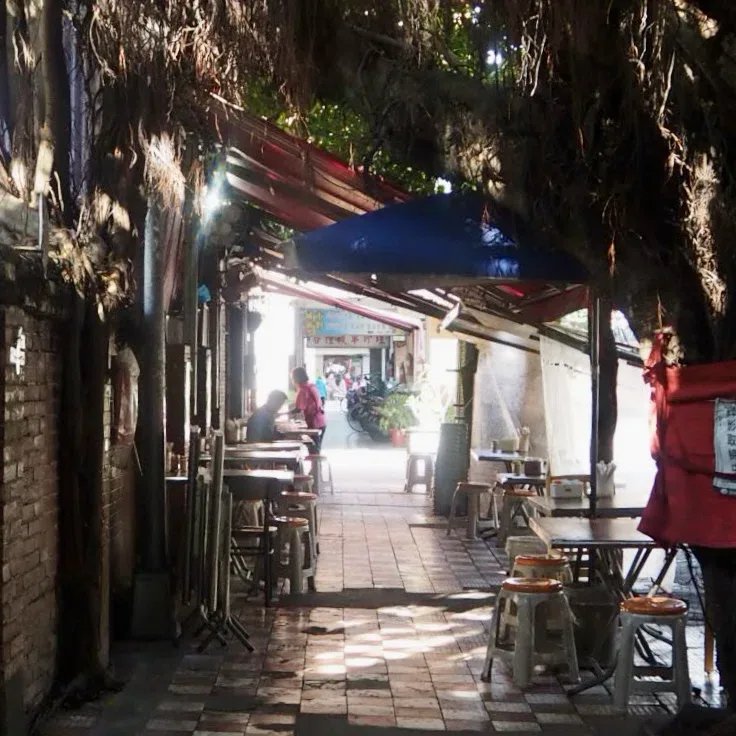
In Taiwan, there is a habit of eating meals at street stalls, and these stalls are at the heart of the food culture.
If you walk through the city, you can see scenes everywhere where chairs and tables for dining spill out onto the streets.
To begin with, how did Taiwan's night market culture come to be?
Taiwan's night market culture began during the Tang Dynasty in China (836 AD) and developed through the Song Dynasty (960–1279 AD). During this period, night markets were operated in urban commercial districts and entertainment areas, and it was common for them to be accompanied by restaurants and entertainment facilities.
After World War II, immigrants who moved from mainland China settled in Taiwan and began operating street stalls as a means of earning a living and income.
Also, with the rapid industrialization after the war, the population became concentrated in urban areas, leading to an increase in workers.Night markets expanded as places to provide cheap and convenient meals for people who did not have time to cook for themselves.
However, these naturally established street stall districts faced problems such as hygiene issues and traffic obstruction. Therefore, the government attempted to develop "public markets" nearby to guide the stall owners.
However, it was difficult to change a form that had taken root through custom, and the strategy of guiding stalls into public markets ended in failure.
Therefore, the government shifted its policy to recognize night markets as "quasi-public markets." They improved the environment for stall operations, maintaining the stall culture while attempting to resolve hygiene and traffic issues. Furthermore, in recent years, they have also been supporting them as "tourist night markets."
Visiting Ningxia Night Market
On this trip, I visited the "Ningxia Night Market," which is particularly famous as a tourist night market in Taipei.
Ningxia Night Market is located about an 8 to 10-minute walk from Zhongshan Station on the MRT Tamsui-Xinyi Line.
It seems Ningxia Night Market is open from 6:00 PM to midnight.
During operating hours, traffic is restricted in the night market section, and stalls are lined up in the center of the road. It is said there are about 100 shops and it stretches for about 400 meters...
As you go further in, there are also stalls like shooting galleries and ring toss games that you often see at Japanese festivals.
The items vary, including Taiwanese specialties like Lu Rou Fan (braised pork rice) and Yu Bing (taro mochi), as well as meat skewers, squid, and fruit juice. While Taiwanese cuisine is the focus, I also saw a few Japanese-style shops selling things like takoyaki.
Occasionally, there is a strong, distinct fermented smell from stinky tofu.
I ate a classic Taiwanese dish called Ji Rou Fan (chicken rice), which had a simple seasoning similar to Lu Rou Fan and was easy to eat.
I also tried stinky tofu, but it didn't suit my palate, so I gave up after one bite...
I analyzed the spatial composition of Ningxia Night Market
The area around Ningxia Night Market is extremely crowded, but the flow and seating areas are zoned, maintaining order.
I will unravel the spatial composition of the food stalls.
The center of the road serves as a walkway for the night market, with stalls lined up on both sides. Tables and chairs are placed behind the stalls, allowing you to eat at the tables behind them after buying food. It's a great space where you can eat while watching the night market.
Also, the space behind the stalls is where the stall operators keep their luggage and infrastructure-related items. Behind that is a pedestrian walkway, allowing people who are not visiting the night market to pass through as well.
This multi-layered arrangement is what keeps the space orderly.
What is particularly interesting is that the public road where the night market is held is equipped with infrastructure such as water, electricity, and sewage systems.
It seems that because the government has developed the space for the night market, it has such an orderly spatial composition.
However, it seems there were problems in the past, such as pedestrians and vehicles mixing, and infrastructure being managed with buckets of water and car batteries.
Therefore, in the early 2000s, the Taipei City Government led a redevelopment of the road space.
The redevelopment mainly consisted of the following three points.
Moving the stalls that were on the west side of the road to the center of the road, allowing scooters and cars to pass more smoothly through the area that was congested with pedestrians. (It seemed that traffic is now restricted at night.)
Introducing water facilities and an oil drainage system (to prevent grease from entering the sewage system), and installing an electricity supply system to improve hygiene standards.
Improving aesthetics and durability through road paving, landscaping, and the installation of lighting equipment.
As a result, safety and hygiene have been significantly improved, and its value as a tourism resource has also increased. Today, it has become a place visited by many tourists.
By the way, rent is required to set up a stall, and it costs 15,000 to 20,000 New Taiwan Dollars (60,000 to 90,000 yen) per month to the city. It's surprisingly expensive...
Historically, stall culture was rooted in Japan as well, such as in the bustling districts of the Edo period and the black markets after the war, but from the perspective of urban aesthetics and hygiene management, strict crackdowns on street-level operations began in the 1960s. Nowadays, we only have the opportunity to see stalls at festivals.
It is easy to ban street stalls, but I felt it is extremely important to inherit street food culture and enhance the charm of a city by guiding them to maintain urban aesthetics and public health, as the government does in Taiwan.
In the first part, I summarized the history of Taiwan's street food culture and the spatial composition of Ningxia Night Market.
In the second part, I will introduce the aspects of Taiwan's morning markets.
▼ Continue reading here.