When I searched for 'what is generative AI'
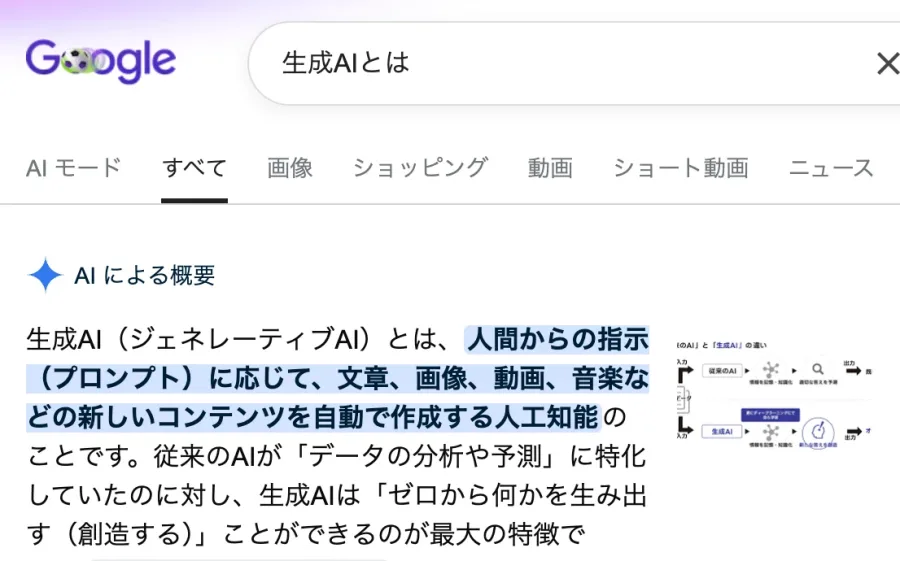
Earlier, I casually searched for 'what is generative AI' on Google and was a little surprised. The top of the search results, the familiar 'AI Overview,' explained generative AI as being able to 'create something from scratch'.
The recommendation that appeared below it, 'What does "generative" mean?', was in the same vein. 'Generation means that something new is born from a state of nothingness'.
Of course, this 'AI Overview' is not 'creating something from scratch,' but was 'generated' from explanations on many web pages.
In other words, it is not the original work of Google's AI, but rather that many Japanese explanations about generative AI are written with the implication that it can 'create'.
The original name is not 'Creative AI'
Although it is not familiar to those of us living in Japan, 'generative AI' in the English-speaking world is Generative AI. In news and other media, you often see the abbreviation GenAI.
If its characteristic were 'creating,' it wouldn't be strange to use a different term, such as Creative AI, but I don't think it's a coincidence that they chose Generative.
But the people who named it avoided the word creative/create and went out of their way to choose the word generative/generate.
A concrete example to grasp the nuance of generate is a generator.
A generator certainly 'produces' electricity, but it is not 'creating' it. It is just 'converting' kinetic energy extracted from combustion or potential energy into electricity.
The fact that generative AI uses learned language patterns to probabilistically 'spin out' the next word, starting from a given prompt, is exactly the same function.
The essence of generative AI is not from nothing, but 'derivation from a seed'.
Even in the 'AI Overview' introduced at the beginning, it properly captures what needs to be captured by saying 'automatically creates... in response to instructions from humans'.
Japanese speakers who tend to associate 'generation' with 'creation'
Even though the English name is Generative AI, when explaining generative AI in Japanese, 'creating from zero' gets mixed in. Why is that?
One reason is the appearance of the translated term 'seisei' (generation).
The word 'seisei' is not originally a daily word. It is a word (translated term) that has long been used in academic fields, such as 'water is generated' in chemistry or 'generative grammar' in linguistics. There, it is used in a sense faithful to 'generate,' meaning 'there is a source, and something else is produced from it'.
However, this unfamiliar technical term suddenly became a hot topic as 'generative AI' after the appearance of ChatGPT at the end of 2022.
Perhaps we (the general public) who saw it for the first time read into it a 'feeling of something rising from nothing' from the combination of the characters for 'seisei' (to become/to be born).
Even when I actually tried it, the AI would build up and reply with things I hadn't written. There was a genuine surprise there that exceeded the experience of interacting with computers until then. The association (hypothesis) of creation was confirmed by actual experience.
On the other hand, for people who are exposed to the word 'generate' in English every day, it is easier to internalize the feeling that it is a more detached 'producing' that is different from 'create'.
In fact, George Lucas, who first 'shaped' (created) the world of Star Wars, is recognized as a Creator, and is never called a Generator. (A brief digression)
Even in Japanese, the word 'creator' is commonly used as a katakana loanword these days. However, only a limited number of people were familiar with 'generate/generative'.
Perhaps that is why there is a high possibility that many Japanese speakers unknowingly got the first button wrong.
Getting the buttons wrong creates a misalignment in how it is used
I believe this misalignment of buttons is actually distorting how we interact with generative AI.
By assuming that AI is an entity that will create something for us, we unconsciously behave in the following ways.
Reluctant to sow seeds. Because we think it will create from nothing, the idea of carefully providing the background or conditions for the task to the AI doesn't even occur to us. We just throw a single word at it. We are disappointed when it doesn't return the answer we expected. But since 'generate' originally means deriving from seeds, you cannot harvest anything if you don't sow anything. It is also natural that you cannot generate electricity without any fuel. Much of the low evaluation (disappointment) seen in workplaces, schools, and homes that 'AI is useless or not a big deal' is based on this structure. It is not that the tool is bad, but that the perception is off. The way it is being put to work is wrong in the first place.
Giving up immediately.Even if you ask for the same thing, generative AI returns something slightly different each time (that is where it differs from a generator). As long as it derives calculation results probabilistically from seeds (source material), this is a natural behavior.
However, if you think of it as 'create' (a one-time creation from nothing), it looks like something 'unpredictable,' 'unstable,' or 'useless.'
Even though it might have worked if you had provided different material or repeated the dialogue with the AI a few more times in response to its reply.
Taking what comes back at face value. If you think of it as a 'work' created by a creator, people end up on the receiving end, the side that gratefully accepts it.
What is generated is merely one proposal derived from the source material you provided. Choosing, questioning, and correcting it is your job.
Taking it at face value is giving up control. The moment you let go, it is no longer 'a harvest you generated.'
The point is that all three of these are happening because 'generation and creation have been mixed up.'
A hypothesis that the nuance of the translated term also affects the generative AI usage rate
It is pointed out that Japan has a lower usage rate of generative AI in the workplace compared to other countries.
The reasons often cited for this are things like 'because we are perfectionists' or 'because we are conservative and don't take risks,' which are, so to speak, discussions about national character.
The above report also emphasizes the importance of 'leadership initiatives' to transform 'employee awareness' and 'organizational culture.'
But is that really the case?
I think the order might be reversed. Perfectionism and conservatism may certainly exist.
But those are just secondary factors that come later. Isn't there a simpler, overlooked cause remaining before that?
That is the very impression that the name 'Generative AI,' which I have been repeatedly pointing out, gives to Japanese speakers.
If many people are mixing up generation and creation, the expectations for actual generative AI will be misaligned. Naturally, the way it is used will also be misaligned. (Japanese-speaking sphere)
On the other hand, if its essence is correctly grasped as 'generative' (the role of deriving material), expectations and usage are less likely to be misaligned. When given as a tool in the workplace, ingenuity in how to use it works appropriately. (English-speaking sphere)
Of course, there must be multiple other differences between other countries and Japan, such as whether the AI's own training data is advantageous to the English-speaking sphere, trends in corporate IT investment, and job descriptions.
But isn't this 'getting the first button wrong' being taken too lightly?
The prescription for promoting AI utilization is to re-button the first button
So, what should we do?
Whether for adults or children, at home or in the workplace, the first thing we should do is not to call for caution against 'hallucinations' or to memorize 'god-tier prompts,' but to re-button the first button correctly.
Replace the perception deeply embedded in your mind that generative AI is a 'tool that creates from nothing' with the understanding that it is a 'tool that nurtures (draws out) the material you provide.'
This alone will change the landscape.
You will stop being stingy with the seeds (source material) you provide. You will stop getting frustrated by the fluctuations in the answers (harvest) that come back and start trying again a few times. You will start to carefully select what comes back with your own eyes.
You can shift from the passive side of 'having things created for you' to the side of proactively 'drawing things out.'
With just one word, the initiative in using AI returns to you.
And the fact that the initiative returns to you also means that no matter how high-performance generative AI becomes in the future, there will still be things left for us to do.
What material will you provide? Which of the things that have sprouted will you harvest? In the first place, what kind of generation will you entrust to that AI? Even if you entrust the generation to it, it is always the human side that decides 'what' and 'which' before that point.
Generative AI does not create from nothing. However, if you provide the seeds (material) skillfully, it will draw out various things with surprising richness. No matter how high-performance it becomes, that relationship will not change.
If that is the case, you, who decide what to sow and what to harvest, will continue to be the master of that field forever.
Just as George Lucas was called a Creator rather than a Generator, those who choose, decide, and take responsibility will continue to be creators.
Once you realize this, you should not be able to return to the way you saw things before. And this realization, from which there is no turning back, will likely remain your ally longer than any 'tips for mastery.'