[Free Newsletter] Are you struggling with structures for the First-Class Architect exam? ⇒Go from struggling with structures to "understanding"! Receive easy explanations of Q&A and calculation problems for free.
Hi, I'm Director Zero!
Today, the theme is a fundamental term in structural mechanics: "strain".
Strain is not just the amount of deformation, but a value representing how much it stretched (or compressed) as a ratio to the original length.
Even though the formula is simple, it's easy to get confused about whether it has units or not, and how it relates to stress.
Here, I will organize everything from the meaning of strain, its formula, units, measurement methods, and its relationship with stress all at once.
After reading this article, you should clearly understand "what exactly is strain?"!
Recommended study materials
[Manager's Recommendation!] Save 50% with this set! Explanations for all 90 calculation problems from the past 15 exams ⇒Understand the flow of calculations and how to solve them! First-Class Architect [Structure] Calculation Problem Explanation Collection
Definition of strain | What is strain?
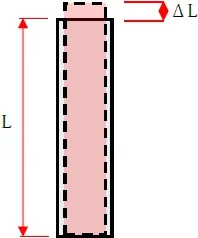
Strain is the ratio of the deformation amount ΔL divided by the original length L.
In other words,
when a member of original length L
stretches or compresses by ΔL due to an external force,
that "rate of deformation" is expressed as strain ε
.
Generally, the strain we deal with here is called "engineering strain".
As the deformation of the material becomes larger, the concept of "true strain" also appears, but in the basics of structural mechanics, it is sufficient to first grasp only engineering strain.
Also, strain is written with the kanji "歪 (hizumi)" and is used with almost the same image even if read as "yugami" (distortion).
It is a quantity that represents "how much the shape of a member has changed".
Image of the relationship between load and strainAs you apply a load to a member,
the internal stress σ of the member increases
and along with it, the strain ε also increases
Within the linear elastic range, stress and strain have a proportional relationship (I will show the formula later).
Conversely, if there were an ideal object that did not deform at all (zero strain), no stress would be generated inside it.
This kind of ideal "non-deforming object" is called a rigid body.
Strain formulas and calculation methods
The basic formula for strain is very simple.
Basic strain formulaε = ΔL / L
ε: strain
ΔL: amount of deformation relative to the original length
L: original length of the member
For example, when a rod of length L is pulled, if the amount of deformation in the longitudinal direction (tensile direction) is ΔLy, the longitudinal strain can be calculated as
εy = ΔLy / Ly
.
Longitudinal strain, lateral strain, and Poisson's ratioWhen a rod is pulled in the longitudinal direction (Y-axis),
it elongates in the longitudinal direction (Y-direction)
and it becomes thinner (contracts) in the lateral direction (X-direction)
It undergoes a deformation like this.
The strain in each direction is
εx = ΔLx / Lx (lateral strain)
εy = ΔLy / Ly (longitudinal strain)
expressed as. The ratio at this time,
ν = −(εx / εy)
is called Poisson's ratio.
Poisson's ratio is determined for each material, such as steel or concrete, and it is an indicator that represents the 'character' of a material's deformation.
We are selling a set of all PDF teaching materials related to structural mechanics (5350 yen ⇒ 3480 yen)
[Value Set] Structural Mechanics Teaching Materials (13 files in total)
Units and Characteristics of Strain
Strain has no units.
Since strain is defined by the ratio of 'length ÷ length' as
ε = ΔL / L
it becomes,
-
e.g., when ΔL = 1.0 cm, L = 300 cm
ε = 1.0(cm) / 300(cm) = 0.00333
.
Because the units of the denominator and numerator are the same, the units cancel each other out, becoming 'dimensionless'.
In practice,
ε = 0.001 → 0.1%
ε = 0.003 → 0.3%
it is often converted to a percentage display like this.
How to Measure Strain | What is a Strain Gauge
Next, let's look at "how to actually measure strain."
Measurement using strain gaugesA typical measurement method is the strain gauge.
A strain gauge is a device that works by:
A sensor with thin electrical resistance wires arranged in a zigzag pattern
This is attached to the surface of a member using a special adhesive
When the member expands or contracts, the gauge itself also expands or contracts
As a result, the electrical resistance changes slightly
This change in electrical resistance is measured to
indirectly determine the amount of strain ε.
In student experiments and material testing, it is common to attach these strain gauges to test pieces and perform tensile tests.
Why are gauges necessary?The amount of deformation in architectural structural members is often only a few millimeters in reality.
Member lengths of several hundred mm to several m
Deformation of a few mm
At this scale, it is difficult to measure accurately with the naked eye or calipers.
Although the definition of strain is "ΔL / L," in field measurements and tests, it is common to
not measure ΔL directly, but rather measure the strain ε with a strain gauge and determine the necessary quantities from there.
It is good to remember this as a gap between theory and the textbook formulas.
[Recommended by the administrator!] Save 50% with the set! All 90 calculation problems from the past 15 exams explained ⇒Understand the flow and methods of calculation! First-Class Architect [Structure] Calculation Problem Explanation Collection
Relationship between strain and stress (Hooke's Law)
The relationship between strain ε and stress σ is expressed by Hooke's Law within the elastic range of the material.
Proportional relationship between stress and strainWithin the elastic range,
σ = E ε
the relationship holds true.
σ: Stress
ε: Strain
E: Young's modulus (modulus of longitudinal elasticity)
From this formula, we can interpret the following properties:
For the same strain ε, a material with a larger E will have a larger σ.
For the same stress σ, a material with a larger E will have a smaller ε (it is harder to deform).
that can be read from this.
However, keep in mind that for materials like steel, in the plastic range (after yielding), a region where σ and ε are not proportional appears, so this formula should only be used within the elastic range.
We are selling a set of all PDF teaching materials related to structural design (3550 yen ⇒ 2480 yen)
[Value Set] Structural Design Teaching Materials (12 files total)
Calculation example of axial deformation | ΔL = N L / (E A)
Using the relationship between strain and stress, you can also calculate the deformation amount ΔL of a member subjected to axial force.
Deformation formula for a member subjected to axial forceFor members subjected only to tension or compression, the following formula can be used:
ΔL = N L / E A
Here,
ΔL: Axial deformation amount of the member
N: Axial force (positive for tension, negative for compression, etc.)
L: Original length
E: Young's modulus
A: Cross-sectional area
This formula can be derived by combining:
Stress: σ = N / A
Relationship between stress and strain: σ = E ε
Definition of strain: ε = ΔL / L
From σ = N / A and σ = E ε = E (ΔL / L),
we get:
N / A = E (ΔL / L), which leads to ΔL = N L / (E A).
Stiffness (resistance to deformation) is also a fundamental formula that often appears when considering it.
Summary
Strain is the ratio of 'amount of deformation ÷ original length'
The formula is ε = ΔL / L. It is a dimensionless quantity representing 'what percentage it deformed' rather than the amount of deformation itself.Strain is proportional to stress and connected by Young's modulus
In the elastic range, σ = E ε holds true. The greater the material stiffness (E), the greater the stress generated for the same strain.It is common to use a strain gauge for actual measurements
Since deformation is often on the order of a few millimeters, it is measured using a 'strain gauge' that reads strain from changes in electrical resistance.
FAQ
Q1: Is a structure weak if the strain is large?
Conclusion: It is dangerous for a state of high strain to persist.
The greater the strain, the more likely the stress will also increase, and based on the relationship σ = E ε, there is a high possibility of exceeding the material's allowable stress level or yield point. In design, we select cross-sections and materials so that they remain within the range of allowable strain and allowable stress.
Q2: Is the treatment of strain different between RC and S structures?
Conclusion: The definition of strain itself is the same.
Whether it is an RC or S structure, the concepts of strain ε = ΔL / L and σ = E ε are common.
However, be aware that 'which part of the strain you look at' changes, such as considering the strain distribution of concrete and reinforcing bars (composite section) in RC, or the strain of the steel material alone in S.
A closing word from Director Zero
In today's notes, draw the length of the bar L and the deformation ΔL, and add the formula ε = ΔL / L.
If you can visualize strain as a 'ratio,' it will become much easier!
[Information on Free Email Newsletter]
Apart from the note articles, I distribute a free email newsletter titled 'Easy to Understand for Beginners! Architect Exam (Structure) & Easy Talk on Architectural Structures'.
・One-by-one explanations of 1st-class architect structural text problems in true/false format
・The flow of how to solve calculation problems
will be delivered to your email twice a week.
Recommended for people like this:
・Those aiming to obtain 1st-class or 2nd-class architect qualifications
・Students studying in the department of architecture
・Those with these concerns:
'I cannot understand calculation problems (structural mechanics)...'
'I am self-studying, so I don't know how to study'
'I have been bad at structural mechanics since I was a student'
'The explanations in commercially available problem books are too short to understand'
You can register simply by entering your email address in the form below and sending it. Registration is free, and of course, you can unsubscribe at any time.
Recommended Study Materials
[Manager's Recommendation!] Save 50% with the set! Explanations for all 90 calculation problems from the past 15 exams⇒Understand the flow of calculations and how to solve them! 1st-Class Architect [Structure] Calculation Problem Explanation Collection
Reference
#1stClassArchitectExam
#1stClassArchitectSubjectExam
#2ndClassArchitectExam
#1stClassArchitectExamSelfStudy
#1stClassArchitectExamPastQuestions
#2ndClassArchitectSubjectExam