Notes
This article contains many spoilers for the conclusion of the original work, so it is recommended that only those who have finished reading the original work continue reading.
Please understand that everything written in this article is not a proven fact, but merely the analysis of a fan.
To maintain consistency, all characters appearing in the work will be referred to without honorifics.
Sunlight
Demons disintegrate and vanish when exposed to sunlight, so they only act at night.
Because Nezuko overcame sunlight while remaining a demon in the story, she became hunted by Muzan.
Decapitation with a Nichirin Sword
Nichirin swords are made using a special ore harvested from Mt. Yoko, a mountain closest to the sun that is sunny all year round.
Nichirin swords absorb a lot of sunlight, and demons can be defeated by decapitating them with these swords.
Wisteria Flower Poison
Since demons dislike the scent of wisteria flowers, the Demon Slayer Corps, the Kakushi, and related personnel are distributed wisteria scent sachets.
Also, Mt. Fujikasane, where the final selection for the entrance exam is held, is a mountain where wisteria flowers bloom wildly all year round. Applicants are thrown into the wisteria prison where demons who cannot escape are kept, and those who survive for 7 days can join the Demon Slayer Corps.
The Insect Hashira, Shinobu Kocho, is a swordsman who cannot decapitate demons, but she defeats them by injecting them with wisteria flower poison.
Wisteria is a vine plant that prefers direct sunlight.
However, if it were just a plant that prefers direct sunlight, there are many others like sunflowers and morning glories.
In particular, wisteria prefers sunlight but is weak to dryness, so it will wither if not managed properly. If a plant that absorbs a lot of sunlight were sufficient, there should be plants that are easier to manage or easier to mass-produce.
For the above reasons, I do not think wisteria flowers are effective against demons simply because they are plants that incorporate the power of sunlight.
Sunflowers are non-toxic plants, but morning glories are poisonous.
It contains three types of toxins: lectin, wisterin, and cytisine, so the 'composition' can be changed with a single plant.
This was the greatest secret and strength of Shinobu Kocho's Insect Breathing.
Associated with immortality
Prosperity of descendants because the flower clusters grow in bunches
Has the meaning of protecting human prosperity by avoiding things that are bad for humans
A plant that has been cherished as a talisman since ancient times
Giving wisteria flowers to a sick person is a no-go because it is associated with incurable diseases
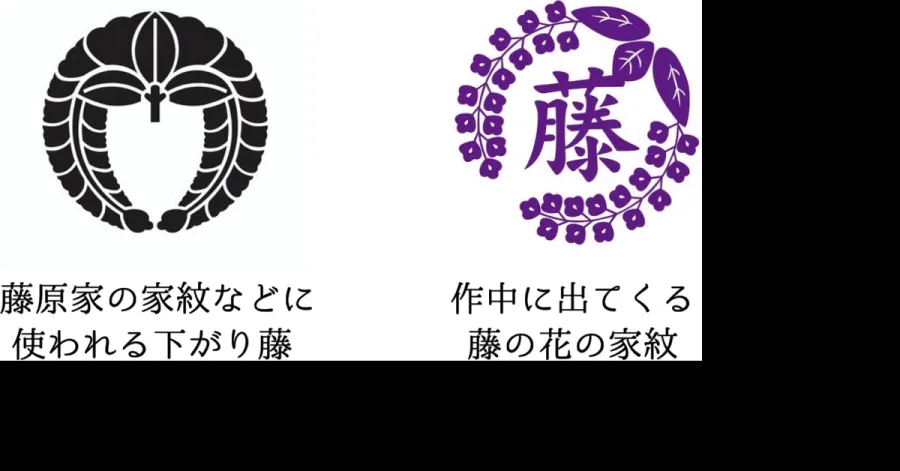
Families with wisteria flower family crestsResembles the shape of the Fujiwara family's crest, the 'Sagari Fuji' (hanging wisteria), tilted diagonally
The most famous person from the Fujiwara clan is Fujiwara no Michinaga, known for the poem, 'This world, I think, is indeed my world. Like the full moon, I find nothing lacking.'
One of Fujiwara no Michinaga's close aides was a man named Minamoto no Yorimitsu. Yorimitsu was famous for slaying yokai and, leading his retainers known as the Four Heavenly Kings, defeated Shuten-doji.
Shuten-doji and Muzan share many similarities.
Shuten-doji lived in a palace within a dark cave and had retainers like Ibaraki-doji.
Muzan also disliked sunlight, lived in the Infinity Castle, and had retainers like the Twelve Kizuki.
Shuten-doji was weakened by drinking a special poisoned sake before being decapitated, but there is a story that even as a severed head, he bit into Yorimitsu's helmet.
In the final battle, Muzan was weakened by Tamayo's human-reversion drug before being decapitated by the Demon Slayer Corps. Then, as a final struggle, he tried to turn Tanjiro into the Demon King.
The end of Shuten-doji can be directly applied to the composition of the final battle between Muzan and the Demon Slayer Corps.
If Muzan is Shuten-doji, then Minamoto no Yorimitsu and the Four Heavenly Kings are the Demon Slayer Corps.
Since Minamoto no Yorimitsu's superior was Fujiwara no Michinaga, I think Fujiwara no Michinaga corresponds to Ubuyashiki.Since Ubuyashiki and Muzan are relatives, this would mean Muzan was a member of the Fujiwara clan.
Muzan is described in the story as a nobleman from 1,000 years ago, which makes him a Heian aristocrat. Since the aristocrats of the Heian period included the Fujiwara, Minamoto, Taira, and Tachibana clans, it does not contradict the idea that Muzan was from the Fujiwara clan while he was alive.
Muzan resented his parents for not birthing him in good health.
Given his personality, it wouldn't be strange for him to resent the Fujiwara bloodline itself.
Furthermore, wisteria flowers are such a symbolic presence for the Fujiwara clan that they are even used in their family crest.
To be killed by wisteria flowers is to be killed by one's own blood.For Muzan, 'blood' was extremely important; he gave power by bestowing blood, became stronger by obtaining blood, and sought to become the invincible Demon King by connecting blood.
Perhaps it was blood that killed such a Muzan.
While 'demon' (oni) can mean yokai or monster, it can also refer to vengeful spirits or plagues.
There is a theory that Shuten-doji is a legend that took the form of a plague that was rampant at the time.
If we interpret Shuten-doji not as a monster that appeared spontaneously, but as someone who 'became Shuten-doji,' it is quite possible that he was originally human.
Also, since 1,000 years ago was a rigid class society, I believe one had to be a person of high status to become a high-ranking demon. Therefore, it is not unnatural for a member of the Fujiwara clan—the most powerful family at the time, excluding the Imperial family—to have fallen into being a demon and become Shuten-doji.
The relationship between the Japanese people and wisteria is ancient, and it certainly existed in the Heian period.
In fact, the color wisteria was called the 'color among colors' and was treated as the most noble color, serving as a symbolic presence for the powerful Fujiwara clan.
It was common to plant wisteria in the gardens of mansions, and I suspect that Muzan, while on his sickbed, often looked at the wisteria in the garden.
Also, clothing called 'wisteria cloth' is sometimes made from wisteria vines, but for Heian aristocrats, wisteria garments were a material used only for mourning clothes.
Wisteria flowers blooming wildly as if mocking him from his sickbed, and mourning clothes that evoke the death Muzan feared most.For Muzan, weren't wisteria flowers something both hateful and terrifying?
The Blue Spider Lily does not exist in reality.
There is a plant related to the spider lily called the Agapanthus.
It is a perennial plant native to South Africa that was introduced to Japan around the middle of the Meiji period.
Since it should have been a plant that didn't exist in Japan when Muzan was human, I think the Blue Spider Lily is a fictional plant, but if it were an Agapanthus, how did that doctor get his hands on it?
The following is about red spider lilies: the spider lilies that exist in Japan are triploid, so they do not produce seeds and propagate via bulbs, meaning they are all clones.
Even if a Blue Spider Lily were born by mutation, it wouldn't increase unless someone with horticultural knowledge found it and dug up the bulbs to propagate it, so I think it would have been extremely difficult to obtain enough quantity to use as a drug to overcome sunlight.
Flower clusters blooming in bunches represent the prosperity of descendants.Wisteria flowers are the very embodiment of the Demon Slayer Corps, connecting their will to children and grandchildren.However, just as the first copy keeps increasing,the spider lily is also Muzan himself, who increases demons by giving his own blood.I thought about that.
Conclusion
What Muzan fears most is death, and since he is a nobleman from the Heian period, wisteria flowers are the hateful plants he gazed at from his sickbed, and they evoke death, as they are only worn as mourning clothes.
Also, considering the culture that one should not give wisteria to sick people because it leads to incurable diseases,for Muzan, wisteria flowers are a symbol of incurable disease and death.And, when we consider Muzan as a member of the Fujiwara clan,
the curse of being killed by one's own blood.Above all,
it prefers direct sunlight,and one plant contains three types of poison..I don't think any one of these is the sole reason.
When thinking about it comprehensively, it makes a lot of sense that wisteria poison is effective against demons, and I can understand why only wisteria poison works.
I wrote this because I came up with the relationship between demons and wisteria flowers while analyzing the battle between Doma and Shinobu Kocho in the Demon Slayer movie.
If you have any other ideas, please let me know in the comments.
I would be very happy if you would also read my analysis of the movie.