History is such that sometimes, just by taking a little detour on a business trip, you end up visiting the grave of someone you never expected.
Chacha, later known as Yodo-dono, is played by Nagisa Inoue in the Taiga drama 'Toyotomi Kyodai!'.
About ten years ago, during the summer, I was wandering around the Umeda area during some free time at work, and at a temple I happened to stop by, I found, to my surprise, the grave of Yodo-dono.
Wait, Lady Chacha, why are you in a place like this?
Encountering Yodo-dono's grave at Taiyu-ji Temple in Umeda
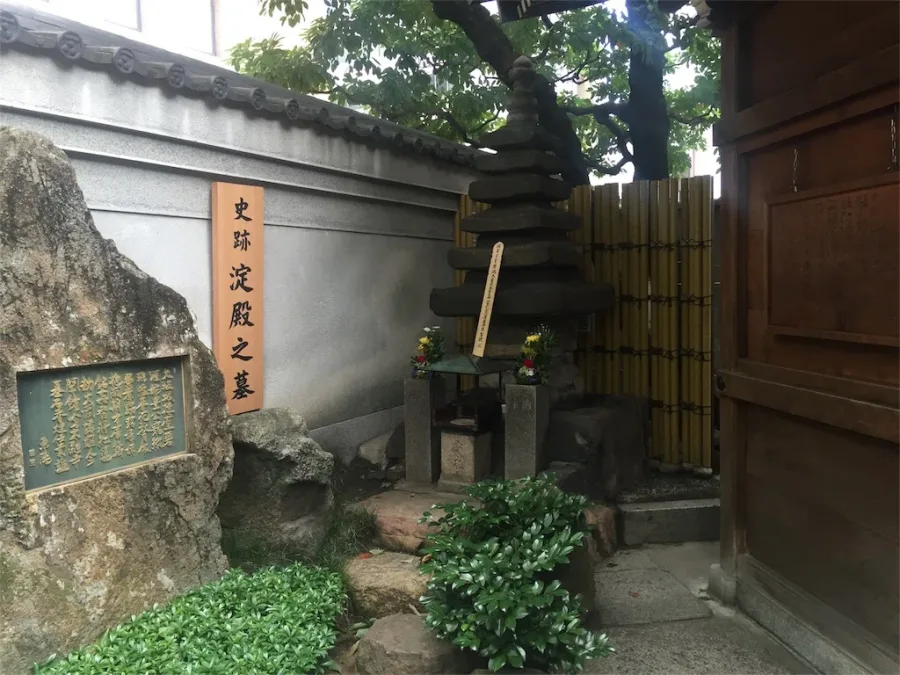
Taiyu-ji Temple, of the Koyasan Shingon sect, is a short walk from Umeda. It is said that the temple was founded by Kobo Daishi at the request of Emperor Saga, and that the Emperor's son, Minamoto no Toru, established the seven-hall temple complex. Although it is surrounded by the bustling streets of Osaka, once I stepped into the temple grounds, the streets I had been walking on just moments before felt strangely distant.
In fact, this temple also burned down during the Siege of Osaka in the summer. Later, during the Genroku era, the main hall and the South Gate were rebuilt, and it became affectionately known as 'Taiyu-ji of Kitano.' So, had Yodo-dono's grave been here since the fall of the castle?
I thought so, but it turns out the grave only came to Umeda during the Meiji era.
It is said that Yodo-dono was originally enshrined on Benten Island in Shigino, north of Osaka Castle. However, in 1877 (Meiji 10), the area was designated for the construction of an army parade ground, and the gravesite was moved to Taiyu-ji. The stone pagoda, which originally had nine rings, was damaged in air raids and now only six remain.
So, with so many temples in Osaka, why was Taiyu-ji chosen? Chief Priest Hiromichi Aso of Taiyu-ji shares an interesting story. Apparently, Shitenno-ji Temple was also considered as a potential relocation site at first.
However, near Shitenno-ji is Chausuyama, the site of a fierce battle during the Summer Siege of Osaka. They thought Yodo-dono might not like being taken to such a place. That is why it became Taiyu-ji.
They even considered whether Lady Chacha herself would like the new location when deciding where to move her grave. I like this story.
The bell of Hoko-ji Temple, the bell of Taiyu-ji Temple
Beside the gravesite, there is a monument inscribed with Fujimi Toyo's Chinese poem, 'Mourning the Grave of Yodo-dono at Taiyu-ji.' It is a poem composed about Yodo-dono's grave, but the first thing that comes to mind is Osaka Castle before it burned down.
“The towers of Osaka Castle rise up, looking down over the lush, green waters. Chacha, the eldest of the three Asai sisters, received the favor of Hideyoshi and enjoyed prosperity behind jeweled curtains. Both the flowers of spring and the moon of autumn are beautiful only because you are there. Graceful and beautiful, she held her heir to her breast and placed her hopes in his future.
A general who weaves cunning schemes into the inscription on the bell of Hoko-ji. A pitiable princess wrapped in the flames of the crimson lotus. A general who weaves cunning schemes regarding the inscription on the bell of Hoko-ji. A pitiable princess wrapped in the flames of the crimson lotus. How sad the sound of the bell I hear now, here at Taiyu-ji. Smoke from incense rises from the gravestone. Who is it that offers chrysanthemums?”
What caught my attention was the line, “holds her heir and hopes for the future.” The one Lady Chacha holds in her arms is the heir the Toyotomi family had long awaited, and to her, he is her own child. The poem jumps in a single breath from the hopes she placed in her child’s future to the bell of Hoko-ji in the very next line. The poem skips over the years the mother and child spent together.
The “casting inscription of Hoko-ji” refers to the infamous inscription on the bell at Hoko-ji Temple in Kyoto, which read “Kokka Anko” (May the nation be peaceful) and “Kunshin Horaku” (May the lord and his subjects enjoy prosperity). It was that incident where the Tokugawa side took issue with the characters for “Toyotomi” (豊臣) being split, claiming it was an insult to the Tokugawa.
Even so, calling him a “general of cunning schemes” is quite a harsh thing to say about Ieyasu. Since this is a monument to mourn Yodo-dono, it would be rather boorish even for Ieyasu to talk back to a Toyotomi sympathizer here. Well, though it is not my place to say, being a Hojo sympathizer myself.
What is interesting is that there are two bells in this short poem. The bell of Hoko-ji had its characters read in various ways and became the spark for war. The bell of Taiyu-ji rings out before the grave of someone who died in that war. And in the end, the poet sings not of Ieyasu or Hideyori, but of the person who comes there to offer chrysanthemums.
The Winter Siege of Osaka: Was Yodo-dono to be taken hostage to Edo?
By the way, when it comes to Yodo-dono, what I have often seen in dramas and novels of the past is a woman of high pride who is always raising her voice. I recall a plotline where, even during the Winter Siege of Osaka, she only decided to agree to peace after cannons were fired into the castle.
Well, if cannons were fired at me, I would be scared too. If I were to lose my nerve there, I would be quite troubled if the cowardice of a governor were to be cited as the reason for the fall of the Kamakura Shogunate.
So, what kind of talk was actually going on during the peace negotiations? According to the “Sunpu-ki,” on December 15 of the 19th year of Keicho (1614), the peace proposal conveyed to the Tokugawa side by Oda Urakusai and Ono Harunaga contained some rather unexpected conditions.
The proposal was that Yodo-dono would go to Edo as a hostage. In exchange, they asked for the Toyotomi family’s territory to be increased so that they could provide stipends to the ronin who had gathered in the castle.
From Ieyasu’s perspective, it was a matter of why he should provide rewards for the very people who had fought against him. On the other hand, it was difficult for the Toyotomi side to say to the people who had defended the castle, “We have made peace, so good luck to you.”
Whether Yodo-dono herself offered to go to Edo, we do not know that far. And the conditions that were actually settled were different from this proposal.
On December 19, it was Yodo-dono’s younger sister, Ohatsu (Jokoin), who went to the camp of Kyogoku Tadataka as an envoy for the Osaka side and concluded the peace with Acha no Tsubone and Honda Masazumi of the Tokugawa side. The following day, the two families exchanged written oaths.
Yodo-dono remained in Osaka Castle, and the ronin were not held responsible for the crime of defending the castle. The Toyotomi side accepted terms such as the filling in of the moats, but the increase in territory they had sought was not granted. Even though the war was settled for the time being, the problem of what to do with the ronin who had gathered in the castle remained.
Here, I find myself thinking a little. If Lady Chacha had gone to Edo, would Hideyori have been able to fight the Tokugawa once more while his mother was held hostage? Or perhaps there might have been a path for the Toyotomi family to survive as a great daimyo.
Well, whether Lady Chacha or Hideyori would have been satisfied with that is another matter entirely.
Her final moments at the Summer Siege of Osaka and the image of Yodo-dono thereafter
As you know, the peace between the Tokugawa and the Toyotomi did not last long. On May 8, 1615 (the 20th year of Keicho), Osaka Castle fell during the Summer Siege of Osaka. For Yodo-dono, this was the third time in her life she had experienced the fall of a castle, following Odani and Kitanosho. Yodo-dono committed suicide along with her son, Hideyori.
In the Edo period, when the Tokugawa ruled the land, Yodo-dono did not have a very good reputation among later generations. After a family is destroyed, there are many people who talk about them, but the person in question never has a chance to retort. Perhaps it is because I, too, have been written about extensively as the man who destroyed the Kamakura Shogunate, that I feel like saying a word or two on behalf of Lady Chacha.
In that regard, I quite like Lady Chacha as played by Nagi Inoue in the Taiga drama 'Toyotomi Brothers!'. It was his younger brother Hidenaga who encouraged Hideyoshi to take Lady Chacha as his wife, while Hideyoshi himself was actually strongly opposed to it. For some reason, Nene and Lady Chacha end up settling the matter with bows and arrows.
No, really, bows and arrows? The agreement was that if Lady Chacha won, she could refuse the marriage proposal. And it was Lady Chacha who won. Furthermore, she chose for herself the path of becoming Hideyoshi's wife. Nagi Inoue's archery movements were good, but I was impressed by the fact that they let Lady Chacha win that match.
Now, the stone monument at Taiyuji Temple read, 'Who is it that offers chrysanthemums?' On May 8, the anniversary of Yodo-dono's death, a memorial service is held at this temple, and it is said that people have even come to pay their respects by chartering several buses from her hometown of Nagahama.
I, who happened to wander in while walking through Umeda, came completely empty-handed. At the very least, I put my hands together in prayer, then stopped by the Ichigan Fudo-sama, and cheekily made my own wish before leaving.
Next time I have some free time in Umeda, I will buy a chrysanthemum before I visit, Lady Chacha.
Also, I have written this gossipy article about Yodo-dono, so please read that as well.