ARTTI is an IEM brand that focuses primarily on the low-to-mid price range.
Rather than being a completely unknown startup brand, it is a brand whose relationship with LETSHUOER is frequently mentioned.
In fact, each ARTTI model is listed as part of the ARTTI collection on the official LETSHUOER website, and the R1 product page is also hosted on the official LETSHUOER domain.
In overseas reviews, ARTTI is often treated as a sub-brand of LETSHUOER or a brand within the LETSHUOER ecosystem.
Given this background, it is easy to understand ARTTI as a brand that releases experimental configurations at a lower price point under a different name than the main LETSHUOER brand.
The lineup also reinforces this impression.
ARTTI's lineup includes the T10 / T10 Pro featuring a 14.2mm planar magnetic driver, the R2 / R3 with 10mm beryllium-based DDs, the TR1 with a 1DD+1BA configuration, and the R1 with its 3DD configuration.
The price range also reflects this, with the R3 at $35, TR1 at $39, R2 at $59, R1 at $79, T10 at $89, and T10 Pro at $119, showing a detailed rollout of different configurations within the low-to-mid price range.
In other words, ARTTI is not a brand that competes with just one standard configuration.
With Planar, single DD, 1DD+1BA, and 3DD, I think it is a brand that tests sound tuning for each configuration in the low price range.
Among them, the R1 is a model that clearly stands out even within ARTTI.
The reason is that it is a 3DD configuration equipped with three dynamic drivers per side.
On the official page, the R1 is described as a "2+1" configuration combining two 6mm titanium dome DDs and one 8mm beryllium-based composite diaphragm DD.
A 3DD configuration in this price range is enough to draw interest for an article on its own.
The official price of the R1 is $79.
It can sometimes be found in the $60 range during sales, making it easy to handle as a model that falls into the low price range of under $100 or around $100.
In low-priced IEMs, there are various configurations such as 1DD, 1DD+1BA, Planar, and multiple BAs.
Among them, the R1, which uses three dynamic drivers of different diameters, is actually a rare existence today.
And LETSHUOER also has a triple DD model called the DZ4.
Therefore, the R1 can be seen not just as a "cheap model with 3DD," but as a model that brings the design philosophy surrounding LETSHUOER down to the low price range.
That is the reason why I chose to feature this model.
How did ARTTI, a brand surrounding LETSHUOER, handle 3DD in the $79 price range?
Will it produce the thickness and impact typical of 3DD?
Or will it use multiple DDs to create separation, airiness, and a soundstage?
The Twistura Delta I listened to just before was a low-priced 1DD model with strong sound cohesion and low-frequency texture.
By listening to the R1 after that, I can see where the "meaning of increasing the number of drivers" appears in the low price range.
Having a large number of drivers does not in itself guarantee good sound.
What is important is how the multiple DDs connect the low, mid, and high frequencies and what kind of sound personality they create.
I think the R1 is a perfect model to confirm that answer.
Appearance and Accessories: A distinct presence created by the green metal shell
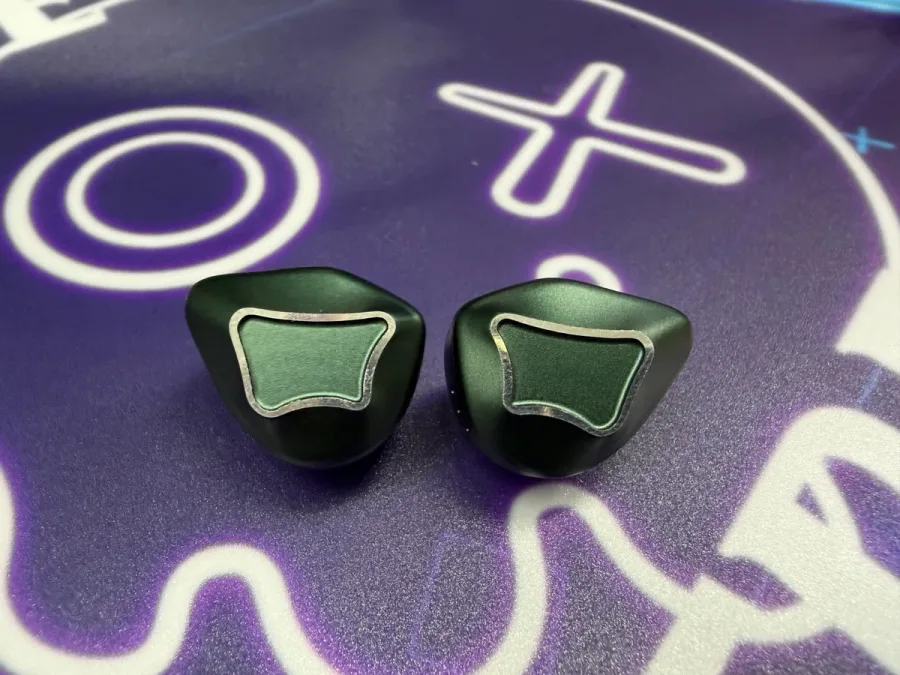
The first thing that leaves an impression about the R1's appearance is the green metal housing.
When you hear "green metal housing," some people might think of the Campfire Audio Andromeda or the CVJ Freedom.
Looking at earphones as a whole, green is not a standard color.
Because of that, I think it will be a welcome option for those who love green.
The green of the R1 has a presence just like in the photos.
It's not flashy, but combined with the hard texture typical of a metal housing, it has a distinct visual personality for a budget-range IEM.
As for the unboxing experience, it's not the type that is particularly luxurious.
The box is on the larger side, and you feel a certain scale in its size.
However, the included accessories are close to the bare minimum.
It comes with 6 sets of ear tips, so you won't have any trouble using it for the first time.
But if you are particular about ear tips, I think it's better to use your own.
On the other hand, the cable left a better impression than I imagined.
It's a calm, brownish color that goes well with the green housing.
It's thin and light, making it easy to handle.
It has a balance that makes it hard to stick or tangle, and I think it's a cable that is easy to use on a daily basis.
The splitter is small and light.
The chin slider has a plastic-like texture that doesn't strongly exude a sense of luxury, but it is sized to fit the thin cable and doesn't slide down easily.
The holding power is high, and it's not bad in terms of practicality.
The housing feels larger than it looks in photos.
The shape is chunky, and if you have small ears, the housing might protrude significantly outward.
The nozzle is short, and it seems designed for a shallower fit rather than deep insertion.
Because of this, it's less likely to cause pressure.
However, for those whose ears it doesn't fit, the hold might be weak, and there is a possibility it might feel like it's going to fall out.
Despite its visual impact, the housing is light.
After handling heavy metal housings like the Li Zhi or Delta, it feels so light that you might want to check if it's really metal.
The lightness is a strength that reduces the burden when worn.
However, personally, I find that heavier IEMs convey a sense of luxury more easily, so the lightness of the R1 is a point where opinions might be divided.
I had no issues with the fit in my ears.
However, I cannot say that it is a shape that is easy for everyone to accommodate.
A larger housing, a shorter nozzle, and a shallower fit.
I think this is a clear point of caution for the R1.
Measurement: A 3DD with a U-shaped to V-shaped tendency that has low-end and presence
Looking at the measurements, the R1 appears to have a U-shaped to V-shaped balance with added thickness in the low end.
The low end is boosted from around 20Hz to 80Hz.
Rather than just boosting the sub-bass, it has volume on the mid-bass side as well, forming a foundation with the entire low end.
From the preconception of a 3DD configuration, this low-end boost looks natural.
From there, it slopes gently toward the mid-range.
It doesn't seem to be shaped to significantly bloat the mid-low range, but rather to ensure clarity in the mid-range after creating volume in the low end.
The area around 1kHz is calm, and the contours of vocals and main melodies are created around 2-3kHz.
Because of this band, the presence of vocals, guitars, and snares is likely to come out easily.
On the other hand, since the low end is also boosted, a key point to check during actual listening is whether the vocals are pushed by the low end or if they come forward due to the presence.
The area around 5-8kHz is not shaped to protrude sharply.
There is a possibility that direct metallic irritation from cymbals and hi-hats will be suppressed.
However, since there is volume in the upper-mid to high range itself, it is difficult to judge the presence of sibilance simply by the peak.
An accent is visible around 9kHz.
This is a band that is easily related to airiness, reverberation, and the lingering sound of metallic tones, but since it is a part where the appearance changes depending on the measurement environment and ear shape, it is necessary to check the balance between high-frequency extension and irritation during actual listening.
As for the left-right difference, the general framework from the low end to the mid-range is consistent in my unit.
Small differences can be seen on the high-frequency side, but as a budget-range 3DD configuration, it does not look like a deviation that would significantly ruin the musical experience.
At least in terms of measurements, I think it is more important to look at the direction of the tuning itself than the left-right balance.
The highlights in the measurements are the lift in the low end, the presence at 2–3kHz, the suppression at 5–8kHz, and the airiness around 9kHz.
From this graph, it looks like a 3DD that provides both low-end and clarity, rather than a type that pushes only with deep bass.
In actual tracks, I will check how deep the low end sinks, where the vocals stand, and whether the high end comes out as airiness or as presence close to the ears.
First impression: It's not heavy despite being 3DD. It's bright and spreads horizontally.
With Metric's "Help I’m Alive," the direction of the R1 became clear at an early stage.
The sound is modern, and the overall center of gravity is on the brighter side.
It has the volume characteristic of multiple DDs, and there is a sense of sound being pushed toward the ears.
However, this is in the direction of presence from the upper-mid to high range reaching the ears, rather than pushing heavily with the low end.
Female vocals stand in the center.
The kick sounds tight rather than sinking deep.
Because the bright components around the guitar and vocals come to the front, the push of the sound is noticeable before the depth of the low end.
It is not the type that pierces with metallic cymbal sounds.
The hi-hat rhythm is audible, but it is not a direct metallic irritation.
However, there is a lot of presence in the upper-mid range, and depending on the song, there are moments where it feels close to the ears.
In the drum solo around 3:48, the expansion of the sound was impressive.
There is a sense of the stage opening up the moment the volume drops, which revealed the R1's lateral expansion.
With Portugal. The Man's "Feel It Still," it became even clearer that the R1 is not a heavy 3DD.
The mid-bass is warm and round.
However, it is not the type that sinks heavily.
The falsetto-like vocals have an airy quality and sound bright and pleasant.
The kick sounds tight on the surface here as well.
Rather than sinking deep and heavy, it is directed toward maintaining the lightness of the song.
The metallic resonance like a saxophone in the middle comes out with a sense of three-dimensionality.
The filter effect around 1:57 is also natural, and the changes in sound are easy to follow.
At this point, I realized that the R1 is not the heavy, profound type one might imagine from 3DD.
It has volume.
But it is not a machine that punches with the low end.
Rather, I think it is a type that lets you listen through lightness, brightness, airiness, and lateral expansion.
Low end: There is volume, but it is more about tightness and lightness than depth.
In Massive Attack's "Teardrop," the low end becomes clearly stronger.
However, the drum attack is not the type that sinks heavily.
The center of gravity is high.
The sub-bass itself is ringing deep, but it is not a volume that pushes to the front; it is more of a sound that rings deep in the distance.
Because of that, the way the vocals float is good.
The low end does not bury the voice, and it maintains the floating sensation of the female vocals.
I think the R1 is a type that excels at keeping the voice floating in the air while balancing the low end and vocals.
In Anderson .Paak's "Come Down," the character of the mid-bass became clear.
The bassline is grooving.
However, it is not heavy.
The volume is there, but the thickness of the low-mid range is suppressed, and the way it sounds is light.
Because of this, there is a sense of speed.
There is little feeling of the bass lagging or the low end bloating.
What stood out most in this song was the precise beat articulation.
Each individual sound is clearly defined.
I think some people might perceive this as resolution.
On the other hand, those with sensitive ears might find this upward push fatiguing.
The R1's low end is strong but not heavy.
It is thick but not dark.
It delivers sound through tightness and agility rather than deep sub-bass rumble.
Those who want the low end to be the star might find it lacking.
However, in the sense that the low end does not muddy the entire track and leaves a bright, airy atmosphere, the R1's design intent is clear.
Midrange: Air over core. Floating voices and guitars widely
In Florence + The Machine's "Dog Days Are Over," the characteristics of the R1's midrange were clearly evident.
The air around the voice comes forward more than the core of the vocal.
The sound spreads out, and the stage feels wide.
There is a sense of sound coming from slightly distant positions on the left and right, and the imaging is good.
The center of gravity is always high.
It is not the type that extends deeply in the vertical direction, but rather the type that expands horizontally with a sense of air.
Among the things I have listened to recently, it is somewhat close to the direction of expanding air found in the Moondrop Setsuna.
However, the R1 has more low end than the Setsuna and is not the type to wash the entire sound in white.
In John Mayer's "Slow Dancing in a Burning Room," I could see the R1's strong suit.
The guitar entry, the way the notes sustain, and the spread are close to ideal.
The bass is not overly emphasized and functions as a support for the song.
It is not the type to add thickness to John Mayer's voice.
However, the airy vocal delivery suits this song, and the vocals sound beautiful.
The backing vocals also contain a sense of air and spread out softly.
The guitar has a solid core, and the chokes and vibrato sustain beautifully.
The R1 is not an IEM that brings out a thick, physical sense of the voice.
However, it suits airy vocals, expansive guitars, and bluesy ballads.
As for the midrange evaluation, air over thickness, spread over density.
This is typical of the R1.
High range: Strong sense of air. Depending on the song, the amount entering the ears can also be strong
In Animals As Leaders' "The Woven Web," the brightness in the upper direction and the weaknesses in the low end were visible at the same time.
This artist is characterized by creating music with Japanese guitars and drums, and what sounds like bass is actually a bass-like guitar sound with emphasized low frequencies, but it lacks contour and grain, and it feels like it connects too smoothly.
On the other hand, the contour of the drum beats is good.
Sounds that play finely and intensely are easy to see, and the rhythm articulation is easy to understand.
The whole is wrapped in a sense of air.
I think the R1 is better suited for songs that express brightness rather than dark minor-key songs.
In Nils Frahm's "Says," the synth sounds were very good.
The expansion of the piano, the sustain, and the reverberation of the sound bouncing back are heard clearly.
Unlike the heavy sound I imagined from a 3DD setup, the R1 has a tight low end and high-frequency expression with a strong sense of air.
The soundstage expands quite widely.
It may particularly resonate with those who value lateral expansion and the presentation of reverberation.
However, in Amon Tobin's "Kitchen Sink," there were moments where the high notes were piercing to the ears.
It's not so much that the metallic sound of the cymbals is piercing, but rather a sharpness where the volume of sound seems to push into the ears.
This track itself is unique and contains sounds that are inherently uncomfortable, but I felt that the R1's upward presence emphasized that.
The R1's high frequencies are not dark.
Rather, they have the power to create airiness, reverberation, and detailed expansion.
However, since there are bands that come out close to the ear, I think those sensitive to piercing sounds will need to be selective with their music.
Technicality: A three-dimensional effect created by lateral expansion and air
In GoGo Penguin's "Raven," the technical aspects of the R1 were well-displayed.
The separation is good.
Even with the piano, bass, and drums standing out, each individual sound does not get crushed.
It has enough resolution to pick up fine details.
It can also bring out the texture of live recordings.
Because the R1 has a strong sense of air, it is easy to convey the size of the room and the reverberation.
In this track, the R1's soundstage expression worked in its favor.
In Amon Tobin's "Kitchen Sink," the localization was also good.
The sound spreads left and right, flowing from various directions.
The movement and scattering of the fine electronic sounds are also easy to follow.
However, the R1's three-dimensional effect is different from the depth-oriented three-dimensionality of the Delta, Noah, and Li Zhi that I have highly rated recently.
The R1 is not the type that shows depth by sinking downwards or through vertical scale.
It is the type that makes you feel three-dimensionality through lateral expansion, airiness, left-right localization, and reverberation expression.
I think this distinction is important.
The soundstage is wide.
Localization is also visible.
Fine details can be picked up.
But that three-dimensional effect does not sink deep; it expands sideways.
For those who like this direction, the R1 is interesting.
Comparison 1: Twistura Delta - R1 expands brightly, Delta sinks darkly and pulls things together
As a comparison, I brought in the Twistura Delta, which I reviewed just before this.
The Delta is a budget-friendly 1DD that can be praised for its low-end texture, the blackness of its silence, and its cohesive sound.
Even within the same budget range, its direction is quite different from the R1.
In Caribou's "Never Come Back," the R1 brings out the airiness of the synths and male vocals beautifully.
The kick is light and tight.
The bassline is present enough to be noticed, but it doesn't come forward enough to support the track.
The overall sound is bright, and fine details are audible and well-separated.
Rather than building a foundation with the low end, it is the type that lets you listen through airiness and a sense of cleanliness.
Switching to the Delta, the center of gravity of the sound drops, and the entire track shifts toward a darker, more immersive direction.
The airiness and extension of the high frequencies are not as prominent as in the R1.
However, the Delta creates a more intense atmosphere.
The kick drum has a stronger presence, and the deep low end in the background is easier to hear than on the R1.
On Men I Trust's "Tailwhip," the R1's low end is also enjoyable.
The bassline is easy to follow, the vocals and background synths have an airy quality, and the whole soundscape expands ethereally.
I think this is a track where the R1's brightness works to its advantage.
On the other hand, with the Delta, the weight of the bassline and the center of gravity of the entire track clearly drop.
The female vocals also become darker, sounding the complete opposite of the R1.
Or rather, because the R1 brightens the track, the difference between the two seems extreme.
What this comparison revealed is that the R1 and Delta are aimed in quite different directions, even within the budget price range.
The R1 focuses on airiness, brightness, and lateral expansion.
The Delta focuses on center of gravity, low-end texture, and immersion.
The R1 is for those who want to spread the sound out lightly.
The Delta is for those who want to sink deeply into the music.
Comparison 2: KZ Vader Pro - The clear and tight Vader Pro vs. the R1, which wins with personality and punch
The Vader Pro was compared using the bass-focused setting with switches 1 and 2 ON.
On Queens of the Stone Age's "No One Knows," it's not that the R1 lacks low-end impact.
The bass riffs are audible, and the male vocals come through naturally.
However, the first thing that hits the ears is the high-frequency component of the guitar riff.
The R1's characteristic brightness and presence come to the fore.
There is also an expansion in the hi-hats, making it listenable as an easy-to-understand V-shaped sound.
However, it doesn't feel like it's pushing with just unnatural sharpness like old V-shaped gear; it also has a modern, relaxed ease of listening.
The Vader Pro's low end was lighter than I imagined.
The vocals are beautiful, and the overall sound is more clearly organized than the R1.
However, the vocals don't have added thickness, and the punch of the guitar riffs isn't as strong as the R1.
It was surprising that even with the bass-focused setting, the R1's emphasis on both the low and high ends was more apparent.
On Royal Blood's "Out of the Black," the R1 shows more personality.
The bass riffs are heavy, have contour, and do not lack thickness.
It has the punch expected of rock music.
The Vader Pro is tighter and not the type where the low end sinks heavily.
The overall sound is clear and doesn't get easily colored.
However, by comparison, the R1 leaves a stronger impression as a sound.
The Vader Pro is a clear and tight balanced model.
The R1 is characterized by its brightness, low-end punch, airiness, and V-shaped character.
For versatility and clarity, choose the Vader Pro.
For a personality that leaves a lasting impression, choose the R1.
General Review: Not a heavy-bass 3DD, but a unique model that lets you listen through airiness
The ARTTI R1 was an IEM with a sound different from what I imagined from its 3DD configuration.
This is not a model that sinks heavily in the low end.
It is also not the type to darken the entire sound with a thick low-mid range.
The R1's personality lies in its brightness, sense of air, lateral width, and a low end that asserts itself more than expected.
The low end is tight, and depending on the track, it can deliver the impact of rock music.
However, it is not the type to shake the room with sub-bass.
The sub-bass can be heard deep in the distance at times, while the mid-bass moves with agility.
The midrange emphasizes the sense of air over the core of the vocals.
It does not aim to make female or male vocals thick and dense, but rather brings out the air and spaciousness around the voice.
The reverberation of guitars and backing vocals also extends beautifully.
The high end is both a charm of the R1 and a point to be aware of.
It has the power to expand the sense of air and soundstage, revealing echoes and fine details.
On the other hand, depending on the track, the presence from the upper-mids to the highs can feel close to the ears.
Those sensitive to sibilance may find themselves selective about tracks and volume levels.
The technicalities are strong for this price range.
In particular, the lateral width, left-right positioning, reverberation expression, and live feel are the R1's weapons.
However, it does not have the depth-oriented three-dimensionality of the Delta or Li Zhi.
The R1's sense of depth is created by air and width.
Even when compared to others, the R1's position is clear.
The Delta impresses with its low-end texture, depth, and silent black background.
The Vader Pro is clearer and more tightly tuned.
The R1 is different from both; it is bright, expansive, and while it scatters sound with a sense of air, it also shows a push in the low end for rock music.
It is not an all-rounder.
If you expect the volume or low-end weight typical of 3DDs, you might be disappointed.
I also think some people may not like the upper presence.
Even so, the R1 has a distinct character.
At a low price, it has the appeal of a 3DD configuration, and it successfully creates a unique identity through its soundstage and sense of air.
It is not too heavy despite being a 3DD.
It surprises more with its sense of air than its low end.
I believe that unexpectedness is the true charm of the ARTTI R1.