I am fighting against AI fatigue every day. This is Tamura.
Andgate Inc. I am the representative of this company that is all about pushing AI to its limits.
This text does not use AI at all; it is sent with love, 100% hand-typed by me, Tamura.
This time, I will talk about "AI in organizations."
I am also talking about the same topic on YouTube, so if you prefer videos, please watch it there.
(And please subscribe to the channel and give it a like)
The history of Andgate is the history of project promotion
Our company, Andgate, is a company that performs IT system development and maintenance/operation with a focus on "project promotion."
As a former IT engineer, there was a time when I thought, "If you have technical skills, work will go well," and "What an IT system needs is technical skills."
However, in actual practice, the success or failure of a project is often determined by areas other than technical skills, and I shifted to becoming a PM after being devastated by that reality.
The PM profession is profound; it is a field that requires personal skills and a mindset that adjusts to the situation on the ground, while being based on systematic knowledge such as PMBOK.
If the PM is excellent, the project succeeds, and if the PM lacks the skills and mindset, the project fails. Despite it being the most important role in moving work forward, the reality on the ground is that you have no choice but to gamble on the "PM gacha."
With the power of technology, we want to increase the reproducibility of such a personal and unstable PM profession, allow anyone to utilize the power of an excellent PM, and eliminate project failures from this world!
The company created with that desire is Andgate.
Of course, company management has had its ups and downs, but thanks to everyone's support, we have reached our 10th term. Thank you.
How does Andgate provide reproducibility for the PM profession?
We have been developing a group of tools called PROMIS, advocating as a "PM Tech Company" that realizes PM through technology.
※PROject Management Intelligent System
However, to be honest, we have attempted to turn it into a product many times, but none of them have gotten on track.
The theory already exists. Even if you can convey it to people, the moment you turn it into a tool or AI, the effect diminishes.
That is how difficult the PM profession is, and it is also closely related to human psychology.
For the past 10 years, we have developed value provision by experts (solution business) and have provided driving force to projects of all sizes, from large companies to startups.
As a solution business, I feel that it has converged into one solution.
However, the goal at the time of founding has not been achieved!
I want everyone to be able to obtain the power of a PM without even thinking about it, and to reduce project failures in this world by even one.
That desire remains in the depths of my heart and in the corner of my mind.
The AI era has arrived
While challenging the productization of PM, a technological innovation occurred.
As you all know, it is the AI era.
Requesting work from AI in a dialogue format and getting responses at 20 times the speed of a human.
Linking with various tools via MCP, AI operates them without human intervention.
We are now able to handle several to dozens of times the amount of work as before, and it is at a momentum that could even change the concept of labor.
Regarding the parts involved in the PM profession, it has become mainstream to introduce bots into meetings to transcribe them and create minutes from those transcriptions.
Minutes that used to take a person half a day to organize can now be done in just 3 minutes, and there is no longer even a need to remember the content of the meeting.
Regarding task management, it is now possible to read the progress of tasks from the minutes created by AI, automatically update task management tools, and even perform necessary communications to various places.
Until now, the PMO supporting the PM played this role and spent most of the week on task management.
However, because AI now performs task management in almost real-time, communications are made without delay, and it even sends reminders, I at least have almost no work left to ask the PMO to do.
By running PMO AI, daily management tasks are almost entirely automated.
PROMIS was originally a group of tools with functions such as "project diagnosis," "task management automation," and "cross-organizational know-how."
As it is said that "SaaS is dead," in the AI era, the tools themselves have lost their meaning.
PROMIS, which was just a group of tools, was quietly shut down, and the plan was returned to a blank slate.
Projects are not promoted even in the AI era
AI improves the speed and quality of work, and you will be able to lead a comfortable project life.
When you believe that and proceed with AI utilization, you notice something.
Even if individual work accelerates, project activities do not accelerate.
Rather, information is increasing due to AI, causing confusion in project activities.
There is a limit to the speed of human decision-making.
However, by presenting a number of options that exceed that decision-making speed, expectations rose that there should be a better plan, and it became a state where time was required to align expectations.
It can also be said that AI is becoming noise.
Why do project activities slow down even though such convenient tools have appeared?
I have formed a hypothesis about organizations in the AI era.
Its name is the "5-Stage Theory of Organizational Growth in the AI Era"
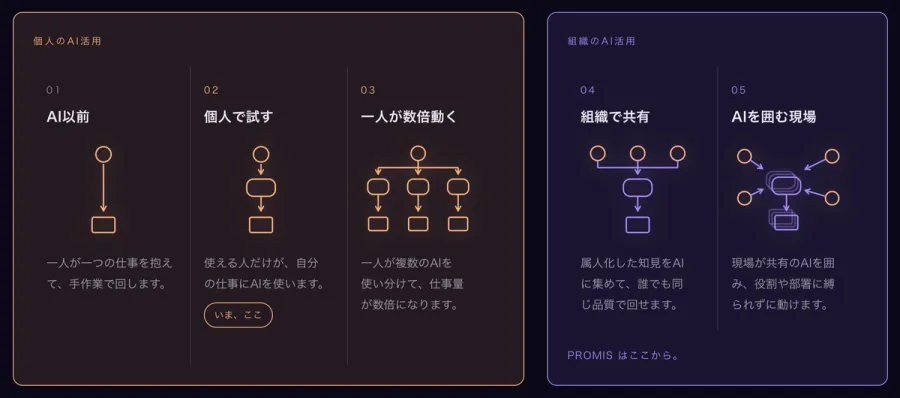
Stage 1: Before AI - A stage where there is no AI and people execute work as is.
Stage 2: Utilization in one role - A stage where people utilize AI in their own work.
Stage 3: Utilization in multiple roles - A stage where AI is utilized for work other than one's own.
Stage 4: Sharing one AI - A stage where one AI is utilized by multiple people.
Stage 5: Sharing multiple AIs - A stage where multiple AIs are utilized by multiple people.
Information on AI utilization is circulating on social media and elsewhere, but it all remains at the 'third stage,' which is individual use.
Often called 'surprise merchants,' many of those providing information on AI utilization do not have an organization.
Even though AI should be utilized for organizational warfare, no one is even in that environment.
In the first place, organizations and projects are human endeavors, and there are as many solutions as there are combinations of people.
What should be done to utilize AI in an organization?
This is where 'Organizational AI,' in which multiple people nurture a single AI, comes into play.
Person B uses an AI that contains Person A's knowledge, and after incorporating Person B's knowledge, Person C also uses the same AI.
As a result, Person C can utilize the knowledge of Person A and Person B without having to learn it themselves.
If this state can be created, compound interest will take effect for every person in the organization, and the meaning of belonging to the organization will be strengthened.
Also, as a company, even in a highly fluid talent market, you can expect to turn knowledge into assets by reliably accumulating it as your own company's knowledge.
By the time you reach the fifth stage, it is not people who do the work, but AI, and people become the ones who nurture the AI.
AI for people, AI for projects.
I have explained the importance of 'Organizational AI,' but what is important is the implementation method.
Usually, AI is customized by individuals and has a structure different from others' AI.
This is a factor that hinders 'Organizational AI.'
However, if you ask whether you should just distribute an AI with the same structure to everyone, that would lose the flexibility of individual AI.
Individual AI is, so to speak, that person's alter ego, and it is imbued with that person's soul.
Since organizational and project activities are born between people, it seems better to avoid mixing souls.
However, since organizations and projects have unique information and have properties different from other organizations and projects, I think they have something like a personality.
Does a soul exist in the personality of this 'Organizational AI'?
In creating 'Organizational AI,' I thought of several patterns.
Pattern A: Extracting data from individual AI
This is a method of handling only the data submitted from individual AI and treating that data as collective intelligence.
It is a simple architecture by separating personality and knowledge, but it is influenced by the interpretation of the AI of the people participating.
Pattern B: Creating collective intelligence from objective data
This is a method of collecting data in a form that does not include interpretation by anyone, such as meeting transcripts or chat tools, and treating it as collective intelligence.
It has fairness like a judge, but it is not suitable for accumulating know-how because there is no subjectivity.
Should 'Organizational AI' be an 'aggregate of individual AI' or an 'objective certification body'...
I was worried about the pros and cons when it flashed on me.
I should just combine both!
Create collective intelligence by combining data provision by individual AI and objective data, and return knowledge from the collective intelligence to individual AI.
When in doubt, it was a decision that perfectly matched the company name of AND Gate (AND = both), taking the best of both worlds.
What to make Organizational AI do
In the modern age, where the value of tool groups has become zero due to the AI era and PMBOK-like answers can be taught for project management know-how, what should be the core value?
In project sites, the following troubles are occurring.
'Why did this specification end up like this?'
'The predecessor decided it, so I don't really know.'
'Handover' due to change of person in charge never goes well.
Person A: 'I asked Person B to do this task'
Person B: 'I thought Person A would do it'
~And another week delay~
The 'he said, she said' controversy is happening again today.
Project troubles like the above are small things, but they not only become the seeds of a fire, but also affect the engagement of project members and lead to organizational weakening.
A project is a 1000-knock drill of decision-making.
The more you decide, the more you move forward, but if you don't properly record and manage what you have decided, the project will fail.
Therefore, the new PROMIS decided to leave 'Architecture Decision Records (ADR)'.
'Architecture Decision Record (ADR)' is like a memo that leaves behind 'why it was decided that way'.
No matter how well-equipped the tools are, you cannot promote a project correctly without the content.
Where are you now? Where are you heading? Who is doing what?
Until now, tools and AI played the role of setting the situation by framing it, but I pivoted to a state where AI can track the situation itself.
If there is an Architecture Decision Record (ADR), even if the person in charge changes, you can trace back past decision records and check the background and premises at that time.
You will be able to investigate whether the person in charge of the task is Person A or Person B from the meeting transcript.
Project activity is a human endeavor.
I am convinced that if people can nurture project AI like their own children, project fires will decrease.
Who will input it
There is a point I was careful about when making PROMIS.
That is 'to make it so that decision records are naturally accumulated'.
Even if you are enthusiastic about creating an "organizational AI," it will not grow if no one does anything.
Sadly, it takes a considerable amount of effort and time to incorporate it into behavioral habits.
Therefore, we created a system where decision-making records accumulate without project members even having to think about it.
All people have to do is hold meetings and chat.
When a meeting ends, it automatically obtains a transcript, reads and analyzes the content of the chat tool, and incorporates it into the organizational AI.
In the AI era, labor-saving and personnel-saving will progress.
As a result, information that was originally necessary for project decision-making may be lost, which can even lead to project failure.
Instead of assuming that "records exist," we should appropriately leave human actions as records.
That is the most important point for an "organizational AI."
Eradicating project failure with "organizational AI"
We are also thinking about and building various mechanisms, such as naming the project's AI personality "MAIA" and making it a "gyaru," incorporating a gate mechanism that promotes only appropriate data from individual AIs, providing prompts on what should be discussed during meetings, and having AI handle facilitation.
We are currently conducting demonstration experiments within andgate and in the environments of several clients, and PROMIS is evolving every day.
It will likely take a little more time to roll it out as a product service, but if you are interested, please feel free to contact us.
We will continue to devote ourselves to ensuring that everyone can acquire the power of a PM through "organizational AI," and to reducing the number of people who shed tears over project failures by even one.