If you ask the AI considered the smartest in the world for the name of a certain person, it returns almost nothing. Moreover, this is about the spouse of the CEO of the company that created that AI. Between August 13 and 14, 2026, The Information and The Wall Street Journal successively covered the same person. She is Kami Clark, the wife of Dario Amodei, co-founder and CEO of Anthropic. This article is not an introduction to gossip. It organizes what the fact that there is a consultant with almost no public information surrounding a company facing one of the largest initial public offerings in history a few months from now poses to both corporate governance and the distribution of information in the era of AI search.
1. He brought his wife to a seat where only one person was allowed to accompany him
In February 2026, Indian Prime Minister Narendra Modi invited leaders of the AI industry to New Delhi. It was reported that due to security constraints, there was a condition that each company executive could only bring one person.
Many executives brought colleagues. A policy officer, a legal head, or a top official from the technology department. Choosing a person to introduce at such a venue is an extremely natural decision for a top executive of a company.
The person Anthropic CEO Dario Amodei brought was his wife, Kami Clark. The Wall Street Journal placed this scene at the beginning of its article dated August 14, 2026. Ms. Clark is not an employee of Anthropic. She holds no position. Even so, the fact that she was the one chosen for the limited single slot is the starting point of this report.
According to the newspaper, Ms. Clark is often seen sitting in the front row when Mr. Amodei takes the stage at the World Economic Forum in Davos, and she has also been spotted conversing with investors at meetings hosted by the investment bank Allen & Company held in Sun Valley. Citing people close to company officials, the newspaper reports that she functions as a confidante and strategic advisor to Mr. Amodei.
2. "Anthropic's First Lady": Why two media outlets wrote about it on the same day
The first to come out was The Information. The article, dated August 13, 2026, was co-authored by Cory Weinberg, Jemima McEvoy, Stephanie Palazzolo, and Jessica Lessin, and titled "Anthropic's 'First Lady' Took a Winding Road to the Top."
Mr. Weinberg explained the background of the coverage in his own social media post. He said that while he was originally interviewing people to write a profile article on Mr. Amodei himself, one name kept coming up repeatedly. That was Ms. Clark. He wrote, "As I talked to people around Anthropic, it quickly became clear that she was an indispensable and influential person to this company."
The next day, on the 14th, The Wall Street Journal published an article co-authored by Keach Hagey and Luke Jerod Kummer. The headline was "Even Claude Is in the Dark About Dario Amodei's Wife."
Two top-tier economic media outlets covering the same person in long-form articles at almost the same time. This is not a coincidence, but is directly linked to the phase the company Anthropic is currently in.
3. A consultant with zero public information for a company approaching $1 trillion
Anthropic is currently on the verge of going public. Organizing the reports, it is said that they submitted confidential draft registration documents to the SEC on June 1, 2026, Morgan Stanley and Goldman Sachs were chosen as lead underwriters, and JPMorgan Chase is also said to be involved in the deal. The view that the listing date could be as early as October 2026 has been reported repeatedly.
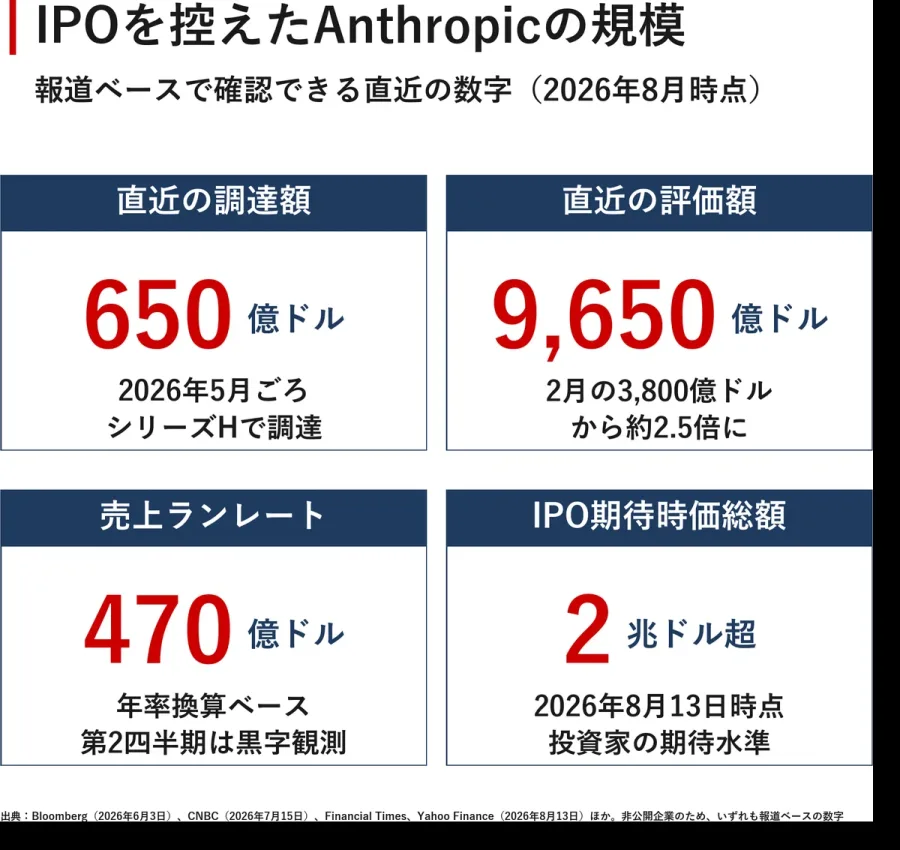
The scale of the figures also exceeds the range of a conventional IPO. It was reported that in the Series H round conducted around May 2026, they raised approximately $65 billion, and the post-money valuation reached approximately $965 billion. That is more than 2.5 times the approximately $380 billion as of February 2026 in just three months. The annualized revenue run rate is at the level of approximately $45 billion to $47 billion, and it has been pointed out that there is a possibility of the first quarterly profit in the second quarter of 2026, with revenue of approximately $10.9 billion. As of the report on August 13, 2026, it is said that investors are expecting a listing with a market capitalization exceeding $2 trillion, and there is even talk of a forecast that the run rate will reach $100 billion to $120 billion by the end of the year.
In other words, this is not a story about the "founder's private life." It is a story about a person with almost no public information being constantly present around the decision-making of a company that is about to enter the public market at a $2 trillion scale. Investors in a publicly traded company have the right to know the people who influence management and their interests. From that perspective, this report has clear public interest as economic journalism.
The Wall Street Journal goes further, writing: Despite her influence, there is almost no information about her online. And there were moves to delete mentions of her. This is a description based on the newspaper's analysis and the testimony of people familiar with the matter.
4. From an architecture degree to Silicon Valley: The reported background
According to The Information's reporting, Ms. Clark earned a degree in architecture from the California College of the Arts (CCA) and began working in Silicon Valley in the early 2000s. It is said that initially, she had almost no connections that could be called such within the industry.
What she did from there was to steadily continue meeting people around conferences, including TED. It is a description of her building relationships not inside the venue, but on the sidelines. The efforts during this period would later lead directly to Anthropic's fundraising.
This is also where the perspectives of the article's writers diverge. One can read the same facts as a "story of a person without connections building a network through effort," or as "the acquisition of influence through socializing." The expression "winding road" in The Information's article title can be read as intentionally containing that ambiguity.
One of the people who evaluated her early in that process was Eric Schmidt, who was the chairman of Google at the time. It has been reported that the two were in a casual dating relationship for a period.
5. 2011 to 2012: The few online traces were, of all things, Epstein documents
A sub-headline in a Wall Street Journal article states that she launched a business she herself called a "revolutionary porn company" and sought investment for it from Jeffrey Epstein. The Information reported the same, stating that the business was high-end pornography for women, with an e-commerce revenue model. Weinberg described this as "ahead of its time." Epstein declined to invest.
What is important here is that the act of soliciting funding itself is neither illegal nor improper. Between 2011 and 2012, Epstein was acting as an investor in the social circles of New York and Palm Beach, and many prominent figures were around him. On the other hand, the fact that he had pleaded guilty to Florida charges in 2008 was already public knowledge at the time, which is why contact during this period is attracting attention. Epstein was later indicted on federal charges including sex trafficking in 2019 and died while in custody. This article is intended to organize reported information and does not state that Ms. Clark had any legal issues.
And this incident occupies the most ironic position in this entire article. According to Weinberg's explanation, one of the few online traces of Ms. Clark is an email remaining in the released Epstein-related documents.
For a person whose name has almost disappeared from search results, the only reliably referenceable public record is, of all things, criminal case material. This composition illustrates the theme of the "information void," which will be discussed later, as clearly as possible. It is fundamentally impossible to choose what disappears and what does not.
6. The node of Eric Schmidt
Ms. Clark's second venture was named Female Algorithm Technologies. It was a concept for developing high-end health clinics for women, and according to The Information, it included the idea of analyzing credit card transaction history and GPS location data. As a concept in the mid-2010s, it falls into the quite cutting-edge category.
Schmidt made a small investment in this company. And it is reported that Dario Amodei's name was listed as an advisor on the pitch deck. Since the two are said to have started dating in 2014, the timing matches.
There is an episode often cited when discussing the relationship between Schmidt and Amodei. In 2018, Schmidt visited Amodei and Clark at a simple apartment near a highway in San Francisco. At the time, Amodei was still at OpenAI. Schmidt thought highly of Amodei and later decided to invest in Anthropic. Another report explicitly states that Schmidt met Amodei through Clark, who was his partner at the time.
The Wall Street Journal reports that she brought Schmidt to Anthropic as an early investor during its launch phase in early 2021. If this sequence is accurate, a portion of the initial capital for a company now valued at $2 trillion came through the network of a person who holds no official position.
The Information further reports that as Amodei advanced his career at OpenAI, Clark sent his research papers to wealthy tech contacts. It is described as her selecting and sending them to people who would be in a position to invest when he eventually started a company.
7. What the "Mother of AGI" fund concept indicates
The most symbolic fact in The Information's report is that she was planning to launch a fund to invest in AI startups. It is said to have been considered around the time Amodei founded Anthropic.
The name of that fund was Mother of AGI.
AGI is an abbreviation for Artificial General Intelligence. The sense of choosing the name "Mother of AGI" for herself speaks more directly than any other testimony to how this person perceived her own position. It does not seem that she was passively accepting the role of an advisor who stays behind the scenes.
Weinberg also writes that she explored taking a position within Anthropic or forming a fund early on. As a result, neither officially materialized. Not an employee, not a fund manager. Yet, she is closest to the CEO and continues to have contact with investors. This suspended position is the core governance issue in the article.
Another connection to politics has also been reported. According to Weinberg, a few weeks after Amodei clashed with the Department of Defense under the Trump administration, he flew to Florida with Clark to meet Jared Kushner and Ivanka Trump. Clark is said to have a close relationship with Ivanka. The possibility of investment in Anthropic was discussed there, but it is reported that the Kushner side declined.
8. Was it the article that was deleted, or the index?
In The Wall Street Journal's account, the most significant sentence as economic reporting is this: there were moves to delete mentions of her. The newspaper cites two grounds for this: its own analysis and the testimony of people familiar with the matter.
However, based on the publicly available descriptions, it is not possible to identify who performed the deletions, when they were performed, or to what extent. This is a part that should be handled with caution.
Generally speaking, there are several layers to the methods used to make online information less visible. First, there is the method of deleting the original page itself. Second, there is what is known as de-indexing, where the page remains but is removed from search engine indices. Third, there is the method of requesting that search engines remove links from search results for specific names, which corresponds to the "right to be forgotten" that spread following the European Court of Justice ruling in May 2014. Fourth, there is the deletion of Wikipedia entries or the setting of non-display options for search engines.
There is an important property common to all of these. In many cases, the original information itself has not disappeared. What has disappeared is the path to reach it. It is simply that it does not appear when searching by name, but the information still exists somewhere.
And fifth, there is an industry called online reputation management that provides a combination of these methods. It is a service that "tidies up" search results for individuals or companies through contracts ranging from thousands to hundreds of thousands of dollars. It is a legitimate business and also a valid means of relief for victims of defamation or individuals troubled by factually incorrect articles.
The problem is that the premise upon which this industry was built is already beginning to crumble.
9. Why Claude Cannot Answer: Training Data is a Mirror of the Internet
The Wall Street Journal bringing Claude's name into the headline was not just a play on words. It accurately describes the very structure of this article.
Large language models are created by training on massive amounts of text from the internet. If a person is written about extensively, the model can answer in detail about that person. If they are not written about, it cannot answer. The model's knowledge is a mirror of the internet.
Therefore, the model knows almost nothing about people whose information has been removed from search results, people about whom no articles were written in the first place, or people who do not have a Wikipedia entry. It is a technically natural consequence that Claude, created by Anthropic, cannot answer about the spouse of Anthropic's CEO. Rather, in this one respect, the model is behaving honestly.
In fact, until this article was published, entering her name into a search engine returned almost no meaningful results. It was a state where the profiles of unrelated people with the same name appeared at the top. One industry insider who introduced The Information's article wrote on social media: You can search for her on Google and find almost nothing, and that is by design.
Herein lies a structural problem in the era of AI search. Conventional search engines at least informed the user that something "could not be found." If there were zero results, it displayed zero results. The user could recognize the state of "no information."
Generative AI is different. In many cases, the model returns some kind of text. Regarding things it does not know, it either answers that it does not know, fills it in with general speculation, or in the worst case, generates a plausible falsehood. It is difficult for a blank to be conveyed as a blank.
10. Data Voids: Blanks Are Not Neutral
In the field of information retrieval research, this state is called a "data void." It refers to a state where high-quality information does not exist or is significantly lacking for a specific search term.
What makes data voids troublesome is that the blank is not neutral. The blank is not left alone; it is always filled with something. What fills it might be someone's blog who happened to write about that term, content intentionally aimed at the top of search results, or an AI that generates text based on speculation.
In other words, the act of erasing information is closer to handing over the initiative of the description to others, rather than erasing the description about that person. This case was exactly that. Where there had been almost zero public information for over a decade, two media outlets poured information in all at once on August 13 and 14, 2026. Because the blank had lasted so long, the framework of the first articles to fill it is highly likely to be fixed as her public profile.
Moreover, because the only public record remaining in that blank was the Epstein-related documents, even the entry point for the reporting was defined. If there had been an accumulation of her own communications or normal business reporting over these ten years, the center of gravity of the article would have been placed in a completely different location.
A low-exposure strategy has short-term effects. However, it is not information control, but information postponement. And the postponed information emerges at a time the person cannot choose and in a context the person cannot choose.
11. The $2 Trillion IPO and the Boundary of Disclosure Rules
From here on, these are the points that should be read as an investor.
In U.S. IPOs, there is an obligation to disclose related-party transactions in a registration document called an S-1. The basis for this is Item 404 of Regulation S-K. Significant transactions involving officers, directors, major shareholders, and their immediate family members must be described, including amounts and terms.
Since a spouse can be treated as a family member associated with a related party under the rules, transactions involving that spouse are subject to disclosure if they are material to the company. Typical examples include payments to companies managed by an officer's spouse, lease agreements for real estate held by a founder's relative, or service contracts with companies owned by relatives.
What is decisive here is that the trigger for disclosure is a 'transaction,' not a 'relationship.'
Advice given without compensation, without a contract, and without any exchange of money does not fall under the scope of disclosure in this framework. Securities regulations cannot capture, nor should they, a CEO discussing management with their spouse at home.
On the other hand, what investors want to know is not necessarily 'whether a transaction occurred,' but 'who is influencing the company's decision-making.' There is a clear gap between these two.
Regarding the introduction by Mr. Schmidt, Anthropic was a private startup at the time, and there is no disclosure obligation for the introduction channels of early investors. However, looking back from the perspective of a post-IPO company, the fact that a non-employee was involved in the introduction of initial capital serves as material for investors to evaluate the company's governance culture.
12. The Governance Vacuum of Non-Employee Advisors
Corporate governance textbooks are built on the premise of formal bodies such as the Board of Directors, Audit Committee, and Nominating and Compensation Committee. These are all mechanisms where records are kept, responsibilities are attached, and they can be verified from the outside.
However, in real companies, there are individuals outside of formal bodies who hold substantial influence. These include a founder's spouse, a retired founder, a major shareholder's personal advisor, or a long-time friend. They do not appear in meeting minutes, receive no compensation, and bear no legal liability. Yet, it is not uncommon for them to be the person the CEO consults with most candidly.
This is not limited to Anthropic, nor is it necessarily fraudulent. In companies like Oracle, Meta, and Tesla, cases where the founder's private network influenced management decisions have been reported repeatedly. Even in Japanese owner-managed companies, it is by no means rare for a founder's spouse to hold substantial decision-making power as an 'advisor.'
The problem is the gap between the magnitude of that influence and its low visibility. In this case, if the reported content is true, the scope of influence—including introductions of early investors, accompanying meetings with political figures, and activities at investor events—is quite broad. In contrast, public information has been almost zero for over a decade. The magnitude of this gap is what created the value for two media outlets to report on it simultaneously.
When investors read Anthropic's S-1, they cannot see this structure even if they look only at the Item 404 section and confirm 'no related-party transactions.' Disclosure documents only reflect what disclosure rules capture.
13. The Structure of a Founder-Family Company
This is not the first time a story about family has surrounded Anthropic.
CEO Dario Amodei and President Daniela Amodei are siblings. The two left OpenAI at the end of 2020 and co-founded Anthropic in 2021. Daniela's husband is Holden Karnofsky, known as a co-founder of GiveWell and Open Philanthropy (now Coefficient Giving).
In January 2025, Mr. Karnofsky joined Anthropic as a member of the technical staff. This was reported by Fortune on February 13, 2025, at which time Anthropic's valuation was $60 billion. He is in charge of the Responsible Scaling Policy, which is the framework for risk management associated with the deployment of advanced AI systems. The company explains that he reports to Chief Science Officer Jared Kaplan.
The same Fortune article points out that at this point, Anthropic has three close relatives in influential positions. The relationship between Mr. Karnofsky and the Amodei siblings is even older; it has been reported that Mr. Karnofsky was Dario's former roommate and that the three lived together during his engagement to Daniela.
Adding Ms. Clark to this, the core of Anthropic is composed around four people connected by blood and marriage. Three of them hold formal positions, and one does not.
Family management itself is not evil. Both in Japan and around the world, there are many family-owned companies that have succeeded with a long-term perspective and consistent values. For a company that upholds the philosophy of AI safety, which often conflicts with quarterly performance, a small core that shares values may have even functioned as a strength.
However, the story changes when it becomes a public company. There is a responsibility to explain the decision-making structure to millions of shareholders. A scale of $2 trillion raises the level of that accountability by one or two notches.
14. Privacy or Public Interest: How to Evaluate This Reporting
There are valid criticisms of this reporting.
Ms. Clark is not a public figure. She does not hold public office, is not a corporate executive, and does not communicate publicly herself. To what extent does digging up her business ventures and dating history from 15 years ago serve the public interest? This question deserves serious consideration.
On the other hand, there are strong arguments in defense of the reporting. First, she is not merely a spouse staying at home; she has consistently appeared in clearly public settings, such as meetings with heads of state, investor meetings, and encounters with political figures. Second, Anthropic is expected to enter the public market in a few months, and investors have an interest in knowing factors that could influence management. Third, her involvement, which directly relates to the capital structure through the introduction of early investors, has been reported.
As a principle for drawing the line, it can be summarized as follows: There is no reason to report on private life itself. However, specific involvement in a company's capital, personnel, and external relations can become a matter of public interest, regardless of whether the person holds a title.
In that sense, how much of the background of the 2011-2012 fundraising should be written about is a matter of debate. It cannot be said that The Wall Street Journal did not have the intention of attracting readers with their choice to place it in a sub-headline. On the other hand, since the path through which that information became public is through public documents from a criminal case, the choice not to report it would also be unnatural.
As readers, it is necessary to read the article's headline and the facts the article substantiates separately. The sensational parts of the sub-headline and the points regarding governance should be evaluated separately.
15. Three Points for Japanese Business Professionals to Take Away
This reporting is not limited to a distant US AI company. It contains three points that can be directly applied to the fields of management, public relations, and investment in Japan.
The first is the visualization of influence. To what extent do individuals without formal titles influence a company's important decision-making? The spouse of a founding family, a retired chairman, a long-term advisor, or an individual from a major business partner. Grasping this and keeping a record if necessary is directly linked to an organization's ability to provide explanations, regardless of whether it is listed. For companies aiming to go public, this is also a point that will inevitably be questioned by lead managing underwriters and audit firms.
The second is the risk posed by an information void. Japanese companies traditionally tend to suppress the exposure of personal information about their management teams. While that is a reasonable judgment in itself, bringing exposure close to zero is not synonymous with controlling information. A void will always be filled. It will be filled not by the company itself, but by news organizations, anonymous writers, or AI. A state where nothing is written is not safe; it is defenseless.
The third is the distribution of information in the AI search era. Customers, investors, job candidates, and business partners are now asking generative AI instead of search engines. The explanation of your company that returns there is the sum of the text that exists on the web. If the information on the official website is thin and there are only third-party articles, the AI will explain your company from the perspective of third parties. Conversely, if you continuously disseminate primary information, those words will be cited. This is a new practical task for public relations.
16. What Companies and Individuals Should Prepare for in the AI Search Era
I will write about practical preparations in a bit more detail.
On the corporate side, the first step is the maintenance of primary information. Place the management team's background, business history, and key figures on the corporate website in a structured, easy-to-read format. Do not just release press releases and leave them; keep them as pages that can be permanently referenced. This is not so much a search engine optimization measure as it is the task of preparing information sources for the company to be cited by AI.
Next is the internal maintenance of a stakeholder map. Understand who is involved in decision-making, separate from the formal organizational chart. In any phase—IPO preparation, fundraising, or M&A—external experts will always confirm this point. It is overwhelmingly less costly to organize it yourself in advance than to have it pointed out after the fact.
And the principle of choosing dissemination over deletion. It is a legitimate right to request the deletion of incorrect or illegal information. However, the strategy of thinning out traces simply for the reason of "not wanting to stand out" is increasingly likely to backfire in the era of AI search. This is because the longer a void continues, the greater the impact will be when someone eventually fills it.
On the individual side, it is to regularly check what returns for your own name on both search engines and generative AI. The answers from the two do not match. The answers from generative AI are often stuck with information from several years ago, mixed up with another person with the same name, or filled in with speculation. Knowing this, place primary information yourself if necessary. This becomes the minimum self-defense measure in the AI era.
Summary
What this series of reports has shown is three things.
First, the fact that there was an advisor at the core of a company preparing for a $2 trillion IPO about whom almost no public information existed. And that this exists in a realm not captured by current disclosure rules.
Second, the strategy of intentionally thinning out information is becoming difficult to sustain in the era of AI search. Voids are not left alone; they will eventually be filled by someone. The inability to choose who fills them is the greatest weakness of this strategy.
Third, the knowledge of generative AI is a mirror of what is written on the internet, inheriting the biases and voids present there. That Claude cannot answer about a certain person is not a flaw in the model, but a reflection of the information environment. When we ask AI something, behind the answer that returns lies a history of human choices—who wrote what, and who erased what.
Once Anthropic's S-1 is released, many investors will check what is written and what is not written in the Item 404 section. At that time, whether one can read the meaning of what is not written will be the value of having read this report.
References and Sources
Keach Hagey, Luke Jerod Kummer, "Even Claude Is in the Dark About Dario Amodei's Wife and Her Influence at Anthropic," The Wall Street Journal, August 14, 2026
https://www.wsj.com/tech/ai/claude-dario-amodei-wife-anthropic-e1eeda7d"Dario Amodei - Latest News and Updates," The Wall Street Journal
https://www.wsj.com/topics/person/dario-amodeiCory Weinberg, Jemima McEvoy, Stephanie Palazzolo, Jessica Lessin, "Anthropic's 'First Lady' Took a Winding Road to the Top," The Information, August 13, 2026
https://www.theinformation.com/articlesPost by Cory Weinberg (@coryweinberg), August 13, 2026
https://x.com/coryweinberg/status/2088021677615779920Post by Cory Weinberg (@coryweinberg), August 6, 2026
https://x.com/coryweinberg/status/2085430338697007611Post by Jemima McEvoy (@jemimacmcevoy), August 13, 2026
https://x.com/jemimacmcevoy/status/2088020733142471055Post by Nick Wingfield (@nickwingfield), August 13, 2026
https://x.com/nickwingfield/status/2088010909520400473Post by Amir Efrati (@amir), August 13, 2026
https://x.com/amir/status/2088014229752123633Jeremy Kahn et al., "Anthropic hired president Daniela Amodei's husband to work on the company's AI safety strategy," Fortune, February 13, 2025
https://fortune.com/2025/02/13/anthropic-hired-president-daniela-amodei-husband-ai-safety-responsible-scaling/"What to know about Anthropic cofounder Daniela Amodei," Fortune, December 2, 2025
https://fortune.com/2025/12/02/daniela-amodei-anthropic-cofounder-claude-openai/"Anthropic Said to Pick Morgan Stanley, Goldman Sachs to Lead IPO," Bloomberg, June 3, 2026
https://www.bloomberg.com/news/articles/2026-06-03/anthropic-said-to-pick-morgan-stanley-goldman-sachs-to-lead-ipo"Anthropic IPO: banks, investor meetings," CNBC, July 15, 2026
https://www.cnbc.com/2026/07/15/anthropic-ipo-banks-investor-meetings.html"Anthropic investors target $2 trillion valuation" Yahoo Finance, August 13, 2026
https://finance.yahoo.com/technology/ai/articles/anthropic-investors-target-2-trillion-132255261.htmlFinancial Times reporting on Anthropic IPO, August 2026
https://www.ft.com/content/840ac156-af1c-4a82-b260-ae791072fcfa"Wall Street's biggest banks just landed the AI IPO of the year" TheStreet, 2026
https://www.thestreet.com/investing/stocks/wall-streets-biggest-banks-just-landed-the-al-ipo-of-the-yearAlex Kantrowitz, "The Making Of Anthropic CEO Dario Amodei," Big Technology, July 29, 2025
https://kantrowitz.medium.com/the-making-of-anthropic-ceo-dario-amodei-449777529dd6"Dario and Daniela Amodei" TIME100 Most Influential People 2026, April 2026
https://time.com/collection/100-most-influential-people/2026/dario-daniela-amodei/Daniela Amodei, Wikipedia
https://en.wikipedia.org/wiki/Daniela_AmodeiDario Amodei, Wikipedia
https://en.wikipedia.org/wiki/Dario_AmodeiDaniela Amodei profile, Forbes, as of August 13, 2026
https://www.forbes.com/profile/daniela-amodei/U.S. Securities and Exchange Commission Regulation S-K Item 404 (Transactions with related persons, promoters and certain control persons)
Court of Justice of the European Union, Google Spain SL v. AEPD judgment, May 13, 2014 (the ruling that became the origin of the so-called "right to be forgotten")
(This article is based on reports published as of August 14, 2026. Articles from The Wall Street Journal and The Information are behind paywalls; this article primarily references the publicly available introductory portions, public posts by the respective reporters, and citations by other media outlets. All facts presented in this article are as reported by those media outlets and have not been independently verified by this author. Furthermore, this article does not claim that there have been any legal issues involving the individuals mentioned.)