Tires are essential components for vehicles to travel safely and comfortably. While we see tires every day, we may rarely have the opportunity to learn in detail about their internal structure or the roles each component plays.
In this article, we will focus on the five main structures that make up a tire(tread, sidewall, carcass, belt, and bead), and explain why each structure is necessary and what functions they perform, along with related trivia.
1. Tread: The interface with the road surface
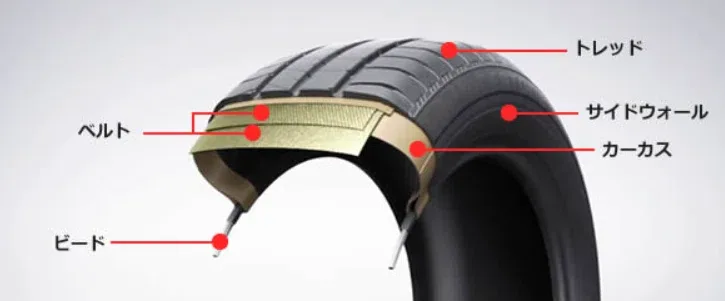
Transmission of driving and braking forces: The pattern (tread pattern) formed by grooves and slits (sipes) on the tread surface efficiently transmits engine power and braking force to the road. It also promotes water drainage during rainy weather, reducing the risk of hydroplaning.
Ensuring handling stability and cornering performance: The tread pattern and the rubber compound used contribute significantly to stability when driving straight and grip performance when cornering.
Ensuring wear resistance and damage resistance: Rubber with high wear and damage resistance is used to protect the inside of the tire from continuous friction with the road surface and damage from foreign objects such as nails.
Noise reduction: The design of the tread pattern also plays a role in suppressing pattern noise generated during driving.
Slip sign (wear indicator): A "slip sign" with a height of 1.6mm is usually provided at the bottom of the tread grooves. This indicates the wear limit of the tread, and when this sign is exposed, it indicates that it is time to replace the tire. This is a usage limit stipulated by law and is extremely important from the perspective of safe driving.
Evolution of tread patterns: Early tires had almost no grooves, but in the pursuit of improved safety and performance, various tread patterns have been developed to enhance drainage and grip. Today, computer simulation technology is used to create complex patterns optimized for specific performance requirements (e.g., quietness, wet performance, fuel efficiency).
2. Sidewall: Flexibility and protection for the side of the tire
The sidewall refers to the side part of the tire, which protects the overall skeleton of the tire and also significantly affects ride comfort.
Main roles of the sidewall
Protection of the carcass: It protects the carcass, which is the skeleton of the tire, from external impacts and damage caused by flexing during driving.
Shock absorption and improvement of ride comfort: It absorbs shocks received from the road surface during driving through its flexible deflection, improving the vehicle's ride comfort.
Display of tire information: Important information such as tire size, aspect ratio, speed symbol, manufacturer name, brand name, and manufacturing week number is displayed on this part.
Balancing thinness and strength: Although the thickness of the sidewall of a passenger car tire is relatively thin, at about a few millimeters, strength and durability capable of withstanding repeated loads and external impacts during driving are ensured through rubber compounding and ingenuity in the internal structure. This thinness contributes to the tire's flexibility and ride comfort.
Aspect as a design element: The sidewall not only contains information about the tire, but also effectively displays the manufacturer's logo, brand name, and tire model name, serving as a visual design element for the tire.
3. Carcass: The core component that forms the tire's skeleton
The carcass is one of the most important components that form the skeleton of a tire. It plays the role of maintaining the tire's shape and withstanding the vehicle's load and various forces during driving.
Main roles of the carcass
Maintaining tire shape: It supports the internal air pressure of the tire and maintains the overall shape of the tire.
Load support: It supports the weight of the vehicle body and its cargo.
Shock absorption and mitigation: It also plays a role in absorbing and mitigating shocks from the road surface.
Ensuring durability: Durability against repeated deformation and stress during driving is required. Synthetic fiber cords such as polyester, nylon, and rayon are mainly used.
Radial structure and bias structure: There are two types of methods for arranging tire carcass cords: "radial structure" and "bias structure." The mainstream for current passenger car tires is the radial structure, where carcass cords are arranged radially (in the radial direction) from the center of the tire. This increases the rigidity of the tread area, contributing to handling stability and reduced rolling resistance. In contrast, in a bias structure, the cords are layered in a diagonal direction.
Ply rating (PR): In the past, tire strength was indicated by the number of carcass plies, but with the evolution of cord materials, higher strength can now be obtained with fewer plies. Therefore, the notation "ply rating" (e.g., 6PR indicates strength equivalent to 6 plies) is used as an index of strength rather than the actual number of plies, especially for truck/bus tires and industrial vehicle tires.
4. Belt (Breaker): A high-rigidity layer that reinforces the tread area
The belt (also called a breaker in radial tires) is a reinforcing layer located on the outer circumference of the carcass and inside the tread rubber. It mainly plays the role of increasing the rigidity of the tread area.
Main roles of the belt
Improving tread surface rigidity: By firmly tightening the tread surface and increasing its rigidity, it improves handling stability, high-speed durability, and wear resistance.
Carcass protection: It also plays a role in protecting the carcass from external impacts and when foreign objects like nails attempt to penetrate it.
Reduction of rolling resistance: The improvement in tread area rigidity by the belt suppresses unnecessary tire deformation, which in turn contributes to a reduction in rolling resistance (improved fuel efficiency).
Adoption of steel cords: "Steel cords," made by twisting ultra-fine high-tensile steel wires, are widely used for the belts of passenger car radial tires. This steel belt suppresses tire deformation caused by centrifugal force during high-speed rotation and stabilizes the tread surface.
Importance of Cord Angle: The belt is typically composed of multiple layers (often two), and the steel cords in each layer are arranged to intersect at specific angles. This combination of cord angles is a critical design element that significantly influences various performance characteristics, such as straight-line stability, cornering performance, and durability.
5. Bead: The Lifeline That Secures the Tire to the Wheel
The bead is located at the inner circumference of the tire and plays the vital role of securely fixing the tire to the wheel rim.
Main Roles of the Bead
Secure Fixation to the Rim: It uses the air pressure inside the tire to press the tire firmly against the wheel rim, ensuring a tight seal. This prevents the tire from coming off the wheel even when subjected to significant forces during acceleration, deceleration, and cornering.
Ensuring an Air Seal (for Tubeless Tires): It maintains airtightness between the tire and the wheel rim, preventing air inside the tire from leaking.
Transmission of Driving and Braking Forces: It serves as the starting point for transmitting driving force from the engine and braking force from the brakes from the wheel to the tire. Embedded in the center of the bead is a tough, ring-shaped "bead wire" made of bundled high-tensile steel wires coated with rubber.
Role of the Bead Wire: The bead wire, which forms the core of the bead, is made from extremely high-strength steel wire, similar to that used for piano wire. This bead wire provides the fundamental strength required for the tire to be securely fixed to the wheel rim.
Key to Realizing Tubeless Tires: Technology to ensure high airtightness between the bead area and the wheel rim was essential for the realization of tubeless tires, which are now the mainstream. Precise design of the bead area and the selection of rubber materials make it possible to maintain air pressure without an inner tube.