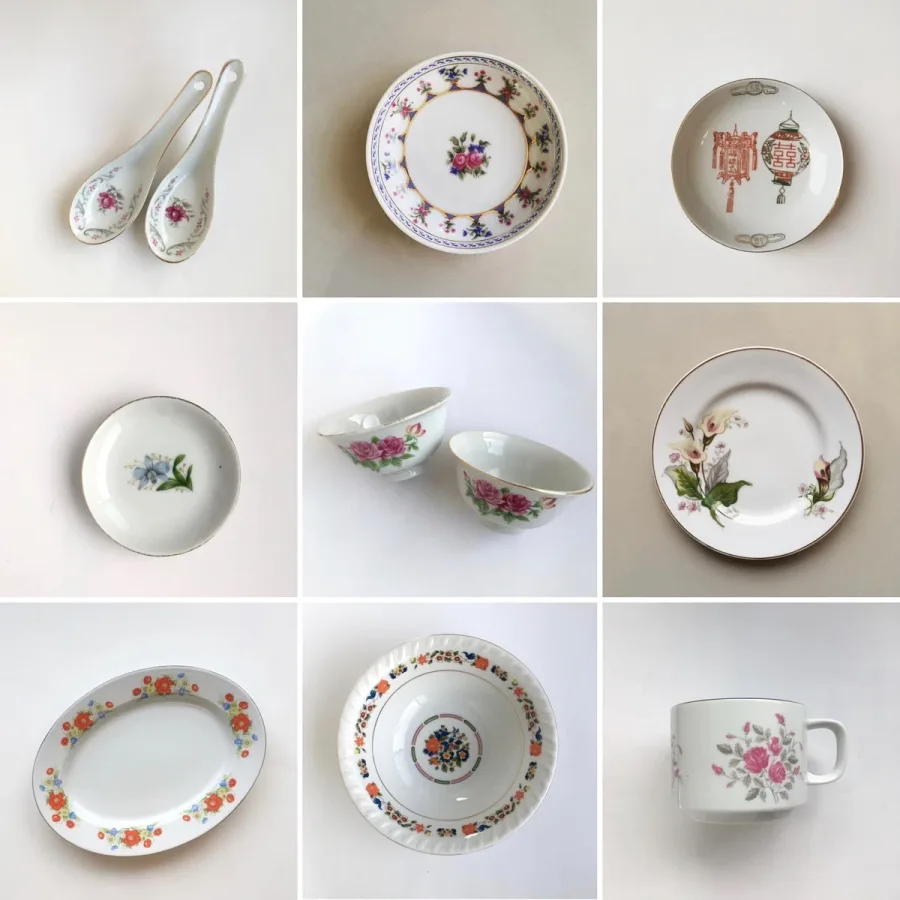
Are you familiar with Taiwan's major tableware manufacturer, "Tatung Porcelain"? The simple white tableware used in various restaurants across Taiwan, including Din Tai Fung, is often from Tatung Porcelain. It is easy to pair with anything, and being commercial-grade, it is durable. While I use these plain white dishes daily, another thing I love and collect besides them are the patterned pieces from Tatung Porcelain that are already out of production. I distinguish these from current products and have taken to calling them "Old Tatung."
When I moved to Taiwan, I brought only a carefully selected few pieces of tableware, intending to own as little as possible. However, I became hooked on the charm of old Taiwanese tableware, and now I have a massive amount of dishes at home, as if I were running a shop. The catalyst was likely Tatung's tableware. I was drawn to the many discontinued designs. Even after years of collecting, I still find patterns I have never seen before, and the variety seems endless.
I have been collecting the thick mugs that were a staple of old Tatung Porcelain, which I have taken to calling "chubby mugs," but I still do not know how many different patterns exist for that mug alone. The more I search, the more patterns I find that I have never seen before.
There are various floral patterns, designs that feel reminiscent of Showa-era retro, and even some that seem to evoke Europe or Scandinavia, which is hard to believe were made in old Taiwan. What exactly was the basis for these designs? There are many things I do not know, and it is fun to let my imagination run wild.
Where can you buy Old Tatung?
Now, as for where to get such tableware, you can find them at "Wujinhang" (hardware stores) or flea markets. In Taiwan, there are shops called Wujinhang, which are privately owned daily goods stores. In Japan, you might call them old-fashioned hardware stores, or perhaps a private version of a modern home center. Some shops deal only in screws, nails, building materials, plumbing, and electrical supplies, while others deal only in daily necessities like tableware.
Wujinhang are often run by elderly people, and I get the impression that they are gradually disappearing, perhaps because there is no one to take them over. I have visited various Wujinhang, and I have seen shops that have already closed down even though their signs are still up. Even in those Wujinhang, the main items they handle now are modern tableware. Whether it is Tatung or other brands, there are many dishes that you could say are found everywhere.
In the midst of this, you can very occasionally find dead stock that has remained unsold for a long time. Most shops will tell you that they no longer have old items, but if you manage to search, you can sometimes dig them out from the bottom of a pile of dust-covered dishes. If you are particularly lucky, you might come across a shop where old dishes are still piled high, but that is a very rare occurrence.
For more on visiting Wujinhang → Notes on Visiting Wujinhang
You can also find Old Tatung at flea markets held in various places on weekends and other times. In Taipei, there are the Fuhe Bridge Flea Market and the Chongxin Bridge Flea Market. However, for Taiwanese people above a certain age, this kind of tableware is recognized only as something like "we used to have that at home," and it is treated as mere daily household clutter, far from being considered antiques.
At flea markets, there are rarely items in like-new condition, and most of the time you are digging through a jumble of tableware that looks like household cast-offs. (So, while I collect them as a hobby, for hygiene reasons, I usually use deadstock from hardware stores for actual use.)
Variations of Old Tatung
To begin with, Taiwan's own history is not that long, and Tatung began producing porcelain in the 1960s. Before that, Taiwan lacked the materials and technology for porcelain production, so earthenware was made instead. Therefore, the items I collect and call "Old Tatung" are at most about 50 years old. It seems that Tatung Porcelain has always packed its tableware with rope, both in the past and today. If you go to what is commonly known as the Tatung Warehouse in Taipei, you can find many pieces of tableware tied up with such rope.
Although a very limited number of Tatung patterns have recently become popular in Japan as Taiwanese vintage, there are still countless other patterns that remain unknown. In Taiwan, they are generally not considered particularly valuable, and furthermore, as hardware stores themselves are disappearing one after another, I am personally worried that if we don't rescue them now, these kinds of vessels will gradually disappear.
All the items in the photo above are Old Tatung. They are small bowls that are often used in restaurants as serving bowls for soups and the like. The five designs lined up here are not very common, and among them, the one with the pale pink flowers in the center is one I have only found a few of so far.
While only limited patterns that have been introduced on Japanese television or featured in select shops for Taiwanese goods are traded at high prices, these designs are actually rarer than those.
Various Old Tatung logos
Now, beyond enjoying the abundant designs of Tatung tableware, for those who become a bit more of a fanatic, there is also the pleasure of comparing the logos on the back of the vessels. Even though the small bowls introduced above are all Tatung, each has a different logo mark.
The logo marks of Tatung Porcelain have changed over time, and even with the same mark, the ranks are color-coded, so there are versions with the same logo design but in different colors. However, because they are not collected or studied like the tableware of famous European manufacturers, detailed information such as which logo belongs to which era is not known. Based on information I have heard from hardware store owners and people at the Taiwan Bowl and Dish Museum in Yilan, I will introduce the items I have on hand by lining them up by logo difference below.
When the same design mark has different colors, red is said to be the highest rank, and there are also blue and gray, with gray likely being the lowest. (It is still unclear whether "rank" refers to quality or is just a design distinction.) The "TC" on the top left is thought to be from an even older era; I suspect T is the initial for Tatung, and C is the initial for the porcelain (ciqi) of Tatung Porcelain.
The oval plate on the top left of the photo above says "Microwave Safe," so it is quite close to modern times. Items from before that were decorated with gold or silver rims and could not be used in a microwave. The oval plate on the bottom right is the logo for the current plain white product. The two small plates are also ranked by color, but the mark is different from the aforementioned logo, featuring the Chinese characters for "Tatung Porcelain" inside a square.
The three on the left in the photo above are as mentioned before. The logo on the small plate at the bottom is said by a certain hardware store owner to be a logo used for exports. It is marked "made in TAIWAN / REP OF CHINA." Now that I think about it, it feels like many items with this mark have designs that appeal to Western tastes. The brown mark on the top right is rarely seen.
This blue logo looks similar to the brown one in the upper right of the previous photo, which I mentioned I rarely see, but it seems even older based on the way it is printed. The "T" logo mark somehow resembles the Fujiya logo, so I have taken to calling it the Fujiya series. It is unclear where it fits chronologically among the other logos.
Old Tatung with corporate logos and textAlso, items with corporate logos are often seen on old tableware, and I suspect they were used as promotional items. It is interesting how the logos are quite assertive, ignoring the balance of the design.
Furthermore, there are many items with text, not just corporate logos, but also those distributed for commemorations or given as birthday gifts. It is interesting to see dates included, which makes you wonder about when they were made. According to an antique shop owner, there are even people who collect only items with text.
By the way, the Tatung Company, famous for the "Tatung Rice Cooker"—a staple appliance said to be in every Taiwanese household—is a different company from Tatung Porcelain. As a slightly interesting item, there is this plump mug that seems to have been made by the Tatung Company as a promotional item, featuring both the "Tatung" logos along with their mascot character, the Tatung Boy (Tatung Baobao).
I once visited the Tatung Porcelain company because I wanted to know about the variations in their tableware designs and the history of their logos, but it seems they do not have such catalogs or materials, so I could not find out any details.
If anyone knows anything, I would appreciate it if you could let me know, even if it is just a small detail.
I have created an Instagram account where I display my collection, mainly tableware, like a catalog under the theme of "Old Things from Taiwan," so please take a look if you are interested. →→→ @taiwan5gold
I also write about the tableware museums and flea markets mentioned in the text on my blog, "Sokoha Note."