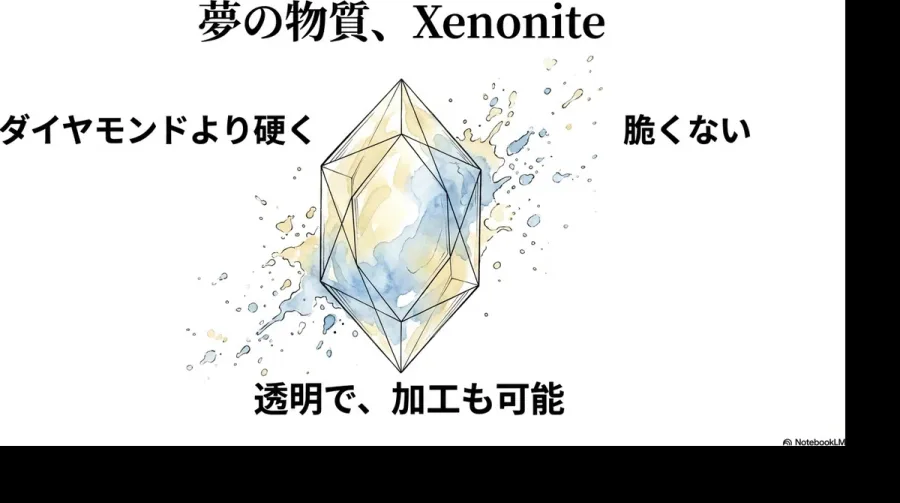
Xenonite is used for the hull of Rocky's spaceship and the various tools he creates. This fictional material plays a crucial role in "Project Hail Mary." It is harder than diamond, yet not brittle. It can be machined like metal and can also be made transparent. I would like to consider from the perspective of materials science whether such a dream material could truly exist.
What is Xenon?
First, let's start with the basics. Xenon is a noble gas and an element with the atomic number 54. It usually exists as a gas and is chemically almost inert. That is why it is called a "noble gas."
The very idea that this inert xenon could form solid compounds is bold. Moreover, the claim that it becomes an ultra-high-strength material is even more so.
In reality, xenon compounds do exist. Since the first xenon compound was synthesized in 1962, several others have been discovered. However, they are only stable under special conditions and are not the type of materials that could be used for structural purposes.
The Extreme Environment of Eridani
Rocky's home, Eridani, is an environment completely different from Earth. The atmosphere is primarily ammonia, and both the temperature and pressure are far higher than on Earth. The gravity is also strong.
In such extreme environments, chemical reactions that do not occur on Earth may be possible. Under high temperature and high pressure, elements that do not normally react may bond with each other.
In fact, even on Earth, compounds that do not exist at normal pressure have been synthesized through high-pressure experiments. Using a device called a diamond anvil cell, it is possible to create ultra-high pressures of several million atmospheres. Under such conditions, unexpected compounds can be formed.
Harder than diamond, yet not brittle?
The most notable characteristic of Xenonite is its combination of hardness and toughness.
Diamond is certainly very hard. However, it is brittle. If you apply force from the right direction, it will snap. This is a property derived from its crystal structure.
On the other hand, metals are relatively soft but have toughness. They absorb energy by deforming, making them difficult to break.
Xenonite is said to possess both hardness and toughness. This is the dream of materials scientists. In fact, even in modern materials science, the balance of hardness and toughness is an important research theme.
Various approaches are being attempted, such as ceramic matrix composites and high-performance materials through nanostructure control. Xenonite might be considered the ultimate form of that.
The Mystery of Transparency
Another astonishing property of Xenonite is that it can be made transparent. Rocky uses Xenonite as a substitute for window glass.
The transparency of a material depends on its electronic structure. Roughly speaking, a material becomes transparent if its electrons cannot be excited by the energy of visible light.
This is why glass and diamonds are transparent. On the other hand, metals have free electrons, so they absorb light of all wavelengths.
The fact that Xenonite becomes transparent means it has insulating properties. However, at the same time, it has sufficient strength as a structural material. This combination actually makes sense. Many ceramics are high-strength and transparent (or translucent).
High Workability
Rocky freely processes Xenonite inside the ship. Like a 3D printer, he creates the necessary tools one after another.
This high level of workability is also interesting. Usually, hard materials are difficult to process. To process a diamond, you have to use a diamond.
In the case of Xenonite, it is likely synthesized and processed through a chemical process. The high-temperature, high-pressure environment of Eridani may enable chemical reactions that are impossible on Earth.
Implications for Real-World Material Science
Honestly, the possibility of Xenonite actually existing is low. At the very least, the all-purpose material depicted in the novel cannot be explained by current science.
However, this is also a challenge to material scientists. Weir has shown us in a concrete form the dream that 'it would be wonderful if such a material existed.'
In fact, materials that were once the stuff of dreams, such as carbon nanotubes and graphene, are now being put to practical use. A day may come when a material like Xenonite is also realized.
It probably won't be a xenon compound, but there is a possibility that a material combining hardness, toughness, and transparency will be developed in some way.
Role in the Story
The fictional material called Xenonite plays a major role in the story. It is because of this that Grace and Rocky can solve various problems.
It is also an icon that demonstrates the technological superiority of the Eridian civilization. They may not be more advanced than humanity in scientific theory, but they are overwhelmingly superior in materials technology. This asymmetry makes the cooperative relationship between the two even more interesting.
I am looking forward to seeing how Xenonite will be visualized in next year's movie. How will they express the properties of being transparent, hard, and yet processable? It will be a chance for the CGI team to show off their skills.