*This article touches upon the developments in the 'Black Shooting Star' arc of 'Chiikawa.' Please be aware if you have not read it. Furthermore, what is written here is a discussion of the structure that can be read from the work, and does not claim to state the author's intentions.
■ The scene where Chiikawa realizes it's a loop and stops responding
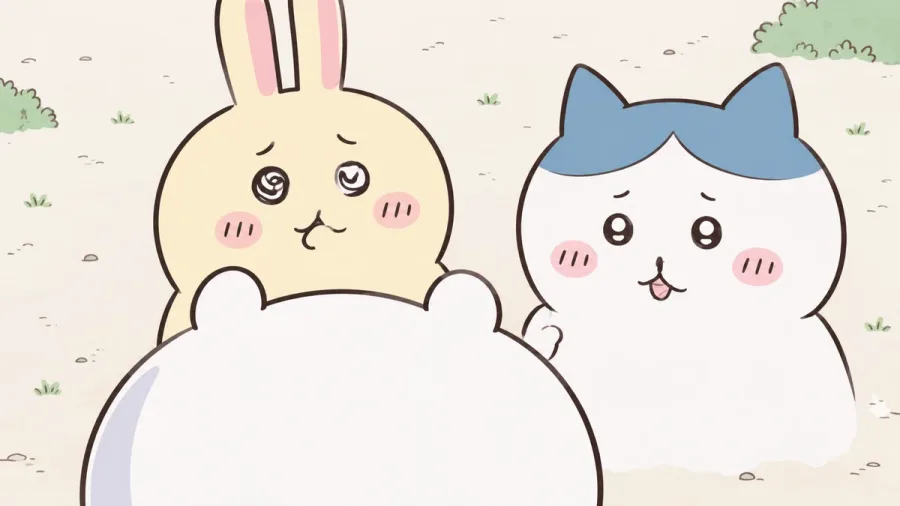
When I read the 'Black Shooting Star' arc of 'Chiikawa,' there was a scene that truly left me unable to move.
It is the scene after Chiikawa has realized that the same day is repeating. Hachiware and Usagi are worried and calling out to him in their usual way. Yet, Chiikawa does not answer. He doesn't even show a crying face.
All that is facing the reader is his small back.
'Chiikawa' is usually a work that shows emotions quite directly. When they cry, they cry loudly, and when they are scared, they tremble.
That is precisely why that silence and that back looked so strange.
I am someone who makes a living writing game scenarios and scripts. Because of my job, I have read quite a lot of time-loop stories, and I have designed them myself. Even so, I have rarely had the experience of being struck down by such simple art.
It felt as if I hadn't been surprised by a gimmick, but rather punched by the very daily life I had been reading up until then.
Why is that so effective? In this article, I will unravel the reasons one by one, starting from the structure of the story.
■ The gimmick of a loop itself is not rare
To be clear from the start, if you look only at the gimmick of a time loop, the 'Black Shooting Star' arc is not particularly new.
The same day repeats. Only the protagonist retains their memory. Those around them act as if it is the first time every time. They search for a key to escape. This framework itself has been used countless times in movies, games, and novels. If you are involved in games, you have likely seen a proposal using a loop at least once.
Many time-loop stories compete with this gimmick itself. They hide the conditions of the loop and reveal them later. They hide which iteration it is. They insert exceptions into the rules of memory inheritance.
Surprising the reader with the unexpectedness of the tricks or structure is the classic way of making them.
The 'Black Shooting Star' arc has almost none of that flashy gimmickry.
The cause of the loop is a wish Chiikawa made to the effect of 'I wish days like this would last forever,' and the black shooting star literally granted it.
If you look only at the form, it is retribution, and that causality is not particularly elaborate.
Even so, why is it effective?
The reason lies outside the gimmick, that is, in the daily life that 'Chiikawa' has built up until that point.
■ There was no future in the daily life of 'Chiikawa' to begin with
Here, I will confirm what kind of daily life the work 'Chiikawa' has depicted.
You weed the grass and get a reward. You eat delicious food. You play with friends. You sleep, and another similar day comes. There is no major growth or destination. You might earn qualifications for subjugation or increase your possessions, but that is not for the purpose of 'heading somewhere'.
In other words, every day in 'Chiikawa' is something that was looping from the start.
There is no guarantee that tomorrow will be different from today, and there is no need for it to be different in the first place.
What I want to focus on here is that the work never once denies this 'lack of a future.' It does not depict unchanging days as boring or stagnant. Readers do not feel anxious about it either. Rather, they accept the fact that they can 'read a similar daily life again' in the next episode as a sense of relief.
There is no future, but each moment is affirmed.
This is the form of daily life in 'Chiikawa'.
■ Even so, they were able to affirm their daily lives because they could share their emotions with friends
Then, why can they affirm a daily life without a future?
This is what I think.
It is not simply because they are spending the same time with friends.
It is because they are able to share the joy, surprise, and fear they felt during that time with their friends on the spot.
They eat delicious food and say to each other, 'This is delicious.' They jump for joy together when things go well. They encounter something scary and tremble together.
For Chiikawa, the most irreplaceable thing was not the event itself, but the irreplaceable moment of having someone there to feel it with them.
If you re-read the work, that is how it can be interpreted.
This is the crucial point. The daily life of 'Chiikawa' is happy not because tomorrow will come. It is because there are friends who accept the emotions of each and every moment. Even without a future, if that moment is full, every day can be affirmed. The work stands on that premise.
That is why readers do not find anything strange when they hear Chiikawa's wish. 'I wish days like this would continue forever' is not a wish to stop the future, but a wish for this sharing of emotions to continue.
■ What the black shooting star stole was that 'sharing'
Even after the loop begins, Chiikawa's daily life has hardly changed at all from the outside.
Hachiware and Usagi are right there. They can eat delicious food. They can go play. Just as wished, a happy day continues as it is. Since it was a world without a future in the first place, I do not think the fact that 'the future stopped coming' is the reason for the despair.
Only one thing has changed.
The fact that only Chiikawa knows it's "again".
For Hachiware and Usagi, that day is a first every time.
The two of them are genuinely enjoying the events of that day. However, Chiikawa cannot accept it with the feeling of it being the first time.
In scenes where the two are laughing, only Chiikawa cannot laugh with the same intensity.
Even if he voices his sense of unease, it just sounds like déjà vu to the other two.
What is broken here is not the sharing of time, but the sharing of emotions.
Even though the three of them are experiencing the same events in the same place, only Chiikawa cannot feel the same way.
The circuit that had always been open as a matter of course has now closed.
And the moment this sharing is lost, the "unchanging daily life" that had never been a problem before reveals itself as something terrifying for the first time. It is not that he despaired because the lack of a future is scary. Because the sharing of emotions disappeared, the lack of a future was exposed as a terror for the first time. That is the order of things.
In a typical time-loop story, carrying over memories is the protagonist's weapon. Each time they loop, they gain more information and get closer to clearing the challenge.
However, Chiikawa's memories are hardly a weapon.
This is because what Chiikawa wanted was not to clear a challenge, but to feel the same things as his friends with the same feelings.
Here, the axis of the work is flipped over just like that.
■ Why the depiction of his back is so piercing
Let's return to the opening scene.
Chiikawa does not reply to his worried friends. He does not show his expression. Only his back is drawn. I did not read this simply as a picture of him "feeling down."
It is not that Chiikawa cannot hear his friends' voices. Rather, he can hear them. But he cannot share the despair he is currently feeling on the same level as the two of them. Even if he explains it, it will be forgotten by tomorrow. Even though the voices reach him, he cannot share the emotions he is currently feeling. That is why he cannot answer.
I think this is significant. Until now, Chiikawa has always felt both happy and scary things together with his friends.
When he was troubled, he would make a troubled face, and his friends would accept that.
However, with this despair, he cannot do that. The emotional circuit that had always been open as a matter of course has been closed off.
In other words, I took that back view not as a depiction of emotion, but as a depiction of the fact that the circuit has closed, represented as distance on the screen.
The three of them are in the same frame.
Yet, only Chiikawa has temporarily dropped out of the place where they "feel together." By not showing his face, that dropout is established as a visual.
There is one more important thing in terms of script technique.
If you draw a crying face, the reader accepts the depth of that despair within the range of "sad enough to cry."
But if you can only see his back, the reader has no choice but to fill in that blank themselves.
By not drawing it, there is no upper limit to the depth of the despair.
Even on the front lines, there are often scenes where you want to add dialogue or reactions at the peak of emotion.
But in the most crucial scenes, pulling back is stronger.
I believe the back view in the Black Shooting Star arc is a perfect example of that.
■ Summary: What separates a 'daily life you don't want to change' from a 'hell that never changes'
Let's break it down.
Chiikawa's despair in the Black Shooting Star arc wasn't because tomorrow wouldn't come.
In the world of 'Chiikawa,' there was never really a 'tomorrow' to begin with.
Yet, they were able to affirm each day because they could share their fleeting emotions with their friends.
The black shooting star took away only that sharing.
It left their friends, their meals, and their play exactly as they were, while stripping away only the ability to 'feel together'.
That is why the usual happy scenery inverted into a landscape of despair without changing its outward appearance at all.
Can you affirm the same life if it repeats for eternity? This question exists in the world of philosophy, with Nietzsche's eternal recurrence being the prime example.
However, that question is basically directed at the individual.
The Black Shooting Star arc shows a slightly different answer. Whether or not you can affirm repetition is not decided by individual will or resolve.
It is decided by whether or not you can feel what you felt during that repetition together with someone else. That is how I read it.
To rephrase it as a screenwriting technique, this is an example where the work repurposed the very format it had previously affirmed into a format of horror. It doesn't bring in a new threat; it only replaces the contents of what the reader felt safe with. That's why even a simple gimmick works. Or rather, because it's simple, everything built up until that point becomes a blade.
For Chiikawa, a 'daily life you don't want to change' and a 'hell that never changes' were, in fact, separated by a hair's breadth.
What separates the two might not be whether tomorrow comes, but only that one point: whether you can share experiences and emotions with your friends.
The Black Shooting Star arc showed that without using a single difficult word, just through a back that wouldn't respond. That is probably the reason why I couldn't move during that scene.
The 'Black Shooting Star' arc discussed here is included in the original comic volume 5.
When you re-read the scenes where you can't see Chiikawa's expression or the process of the three friends drifting apart, you can confirm the details of the direction in a way different from the anime.