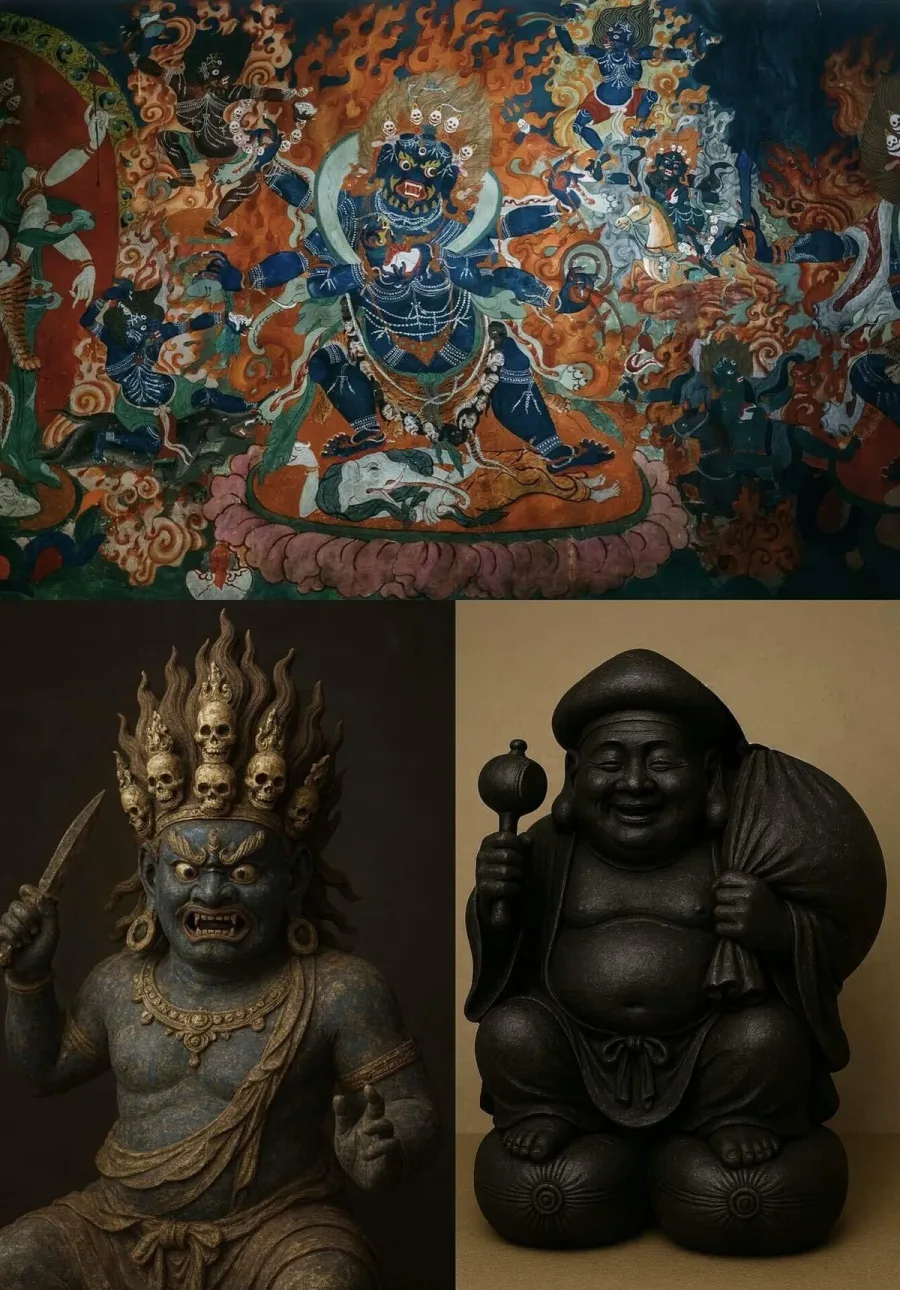
Daikokuten, familiar in Japan, is called Mahākāla in Sanskrit, and is known as 'Makakara' or 'Daikokuten' in Chinese translations. In Hinduism, he is one of the incarnations of Shiva, the god of destruction and rebirth, and holds the meaning of governing darkness, obscurity, and time; he is a god with terrifying and immensely powerful influence in many areas. Also known as a god of war, he was eventually incorporated into Buddhism and became a guardian deity.
Because he symbolizes darkness and obscurity, he is called Daikoku (Great Black), and there are many statues of him that are pitch black.
In Japan, his appearance changed significantly, and the image of him riding on rice bales, carrying a mallet in one hand and a large bag on his back, became established. Daikokuten is known as a god of wealth and fortune, but originally he was mainly enshrined in kitchens. The image of him riding on rice bales symbolizes the food that sustains life, and can be said to be a form of prayer for obtaining the food necessary to live.
Although Daikokuten originally held weapons such as swords, the reason the image of him holding a mallet became mainstream is that the change from a weapon to a 'tool' symbolizes working and one's job. To sustain life, one must work. It is thought that the desire to get a good job, do good work, and not lose one's job transformed his appearance into one holding a mallet. And the places where he is enshrined have changed from kitchens to workplaces (such as offices in modern times).
At our temple, Daikoku-sama is still enshrined in the kitchen, just as he has been throughout history.
The image of gold coins coming out of the mallet represents obtaining wealth through work, and can be said to be a symbol of the god 'giving' it to us.
He is a god who grants us wealth and fortune, but it is said that the large bag he carries contains many treasures. Even for Daikokuten, in order to give, he must first 'obtain.' What he once took as spoils of war before converting to Buddhism, he began to give to sentient beings after his change of heart—this transition is suggested by this appearance.
Now, I have long felt a power like a cosmic black hole in this Daikokuten. In recent years, I have had the opportunity to read the writings of people who propose similar views, and I feel a mysterious coincidence.
Daikokuten is a god who knows no defeat, to the extent that he is known as a god of war. When we hear of war, we tend to think of Asura, but Asura is often misunderstood as a god symbolizing war because he was originally a being who governed justice but was banished from the heavenly realm and fell into the Asura realm due to his battle with Taishakuten; on the other hand, Daikokuten's power is such that he can be called a professional of combat, surpassing even Asura.
He wins battle after battle, accumulates many spoils of war, and his financial power far exceeds that of other gods.
As an incarnation of Shiva, who symbolizes destruction and rebirth, he controls, takes, and accumulates everything as if swallowing it all. And then, eventually, he exhales it as if exploding, releasing the power for rebirth—I get an impression like a black hole.
Daikokuten is not just a god of wealth and fortune; because he is a god who knows no defeat, he is also worshipped as a charm for competitions, a charm for winning lawsuits, and a charm for work luck, and many people carry charms to benefit from Daikoku-sama's power.
The mallet as a tool also has a deep symbolic meaning of production, etc., and it has come to be enshrined as a folk belief regardless of Buddhism or sect as a symbol for offering prayers for prosperous business, in addition to industry.
Also, regarding money luck and financial fortune, it is said that the color 'black' calls for wealth, as if symbolizing Daikoku-sama's jet-black darkness.
As for winning luck, black is considered a lucky color for victory because it is a stronger color than others.
There is also a special appearance called Sanmen Daikokuten (Three-Faced Daikokuten), which is a fusion of the three faces of Daikokuten, Bishamonten, and Benzaiten. This symbolizes the power of career advancement and certain victory, and is reminiscent of Daikokuten's latent greatness.
I imagine there are many people who put their hands together in prayer to Daikoku-sama at the temples they visit for their first shrine visit of the New Year.
May you have good guidance.
I sincerely wish to see the Buddha, join my hands, and worship.