This is my hometown, but I live in a place called Shiraoi in Hokkaido. Recently, a large museum related to the Ainu was built, and we are fighting against depopulation.
When you think of the Ainu, what comes to mind? Golden Kamuy? Brown bears? Bear carvings? No, it has to be the Ainu makiri. This time, we will be tracking the makiri.
The makiri, a traditional Ainu blade, is a very unique existence within Japanese cutlery culture. To begin with, the Ainu are not part of the Japanese cultural framework; they are an ethnic group that does not worship the Emperor but instead practices nature worship.
Therefore, although they look similar to Japanese-style knives, their origins have a history completely different from that of Japanese swords or kitchen knives.
The greatest characteristic of the makiri is that the iron used for the blade was not made by the Ainu themselves.
In conclusion, the iron used for makiri blades was mainly obtained through trade with the Wajin (Japanese people).
Especially during the Edo period, the Matsumae Domain managed trade as a gateway connecting Ezochi with Honshu, and the Ainu people obtained iron products through barter with the Wajin.
They would offer salmon, kelp, furs, and hawk feathers, and in return, they would receive iron products such as kitchen knives, daggers, and farming tools.
The kitchen knives and small blades obtained at this time were not used as makiri exactly as they were.
In many cases, the shape of the blade was reshaped, or it was reforged by a blacksmith to suit the intended use, transforming it into the shape of a makiri.
Also, iron from broken swords, chipped kitchen knives, or worn-out farming tools was sometimes reused and reborn as a new blade.
The makiri blade was not born as a makiri from the start; it was often an existence that was reincarnated through reprocessing from iron that had been born as a different type of blade.
In Ainu society, there were no furnaces for iron production or large-scale blacksmithing divisions of labor.
Instead, a culture developed where they obtained the necessary iron through trade and optimized it for their daily lives.
What was required of the blade was not the brand or origin of the steel, but its practicality: whether it actually cut, whether it could be resharpened, and whether it was difficult to break.
The makiri born in this way is a blade whose blade material and forging technology are derived from the Wajin, while its usage, meaning, and decoration were cultivated entirely within Ainu culture.
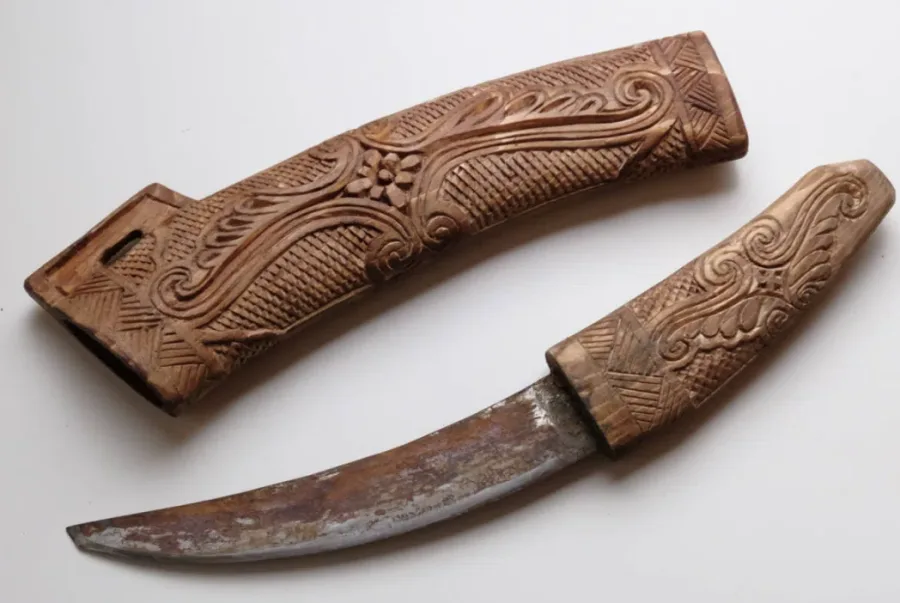
The patterns carved into the handle and sheath of the makiri are not mere decorations; they hold the meaning of an amulet to protect the owner.
Because the blade is a tool worn daily and is always close to the body, it also played a role in keeping disasters away.
There are several representative types of patterns often used for makiri.
First, 'moreu' is a spiral-shaped curved pattern.
It is said to have the meaning of entangling bad things in a vortex and driving them away when they try to enter the body or get near the person.
It is often carved continuously along the edges of the handle or the ends of the sheath, acting like a protective barrier.
Next, 'aiushi' is a pattern with sharp, protruding shapes like thorns or spikes.
It has the meaning of piercing and driving away evil entities when they approach, and it was considered to have particularly strong protective power among the patterns.
It is characterized by being often placed in boundary areas, such as the entrance of the sheath or the base of the handle.
'Ramramnoka' is a small triangular pattern that connects like fish scales.
It is considered a symbol of life force linked to water and fish, and it was imbued with the meaning of wishing for safety in hunting and fishing, and the blessing of food.
'Shiku' is a pattern representing an eye.
It has the role of an eye watching for bad things, and it is imbued with the meaning of finding disasters quickly and keeping them away.
It is often expressed as small circles or dots and is casually placed between other patterns.
The combination and shape of these patterns differ depending on the region, family line, and the person who carved them.
Even with the same pattern, the way of carving differs one by one, and it became a protection applied solely for the owner.
The history of the makiri is not just a story about a blade.
It is also a history of how different cultures met, incorporated technology from the outside to suit their own lives, and evolved it into a unique tool.
The blade is Wajin technology; the usage and meaning are Ainu culture.
I believe this fusion is the greatest charm of the blade known as the makiri.
Also, simply put, it's cool. It's a knife that should be re-evaluated. Though they aren't for sale.