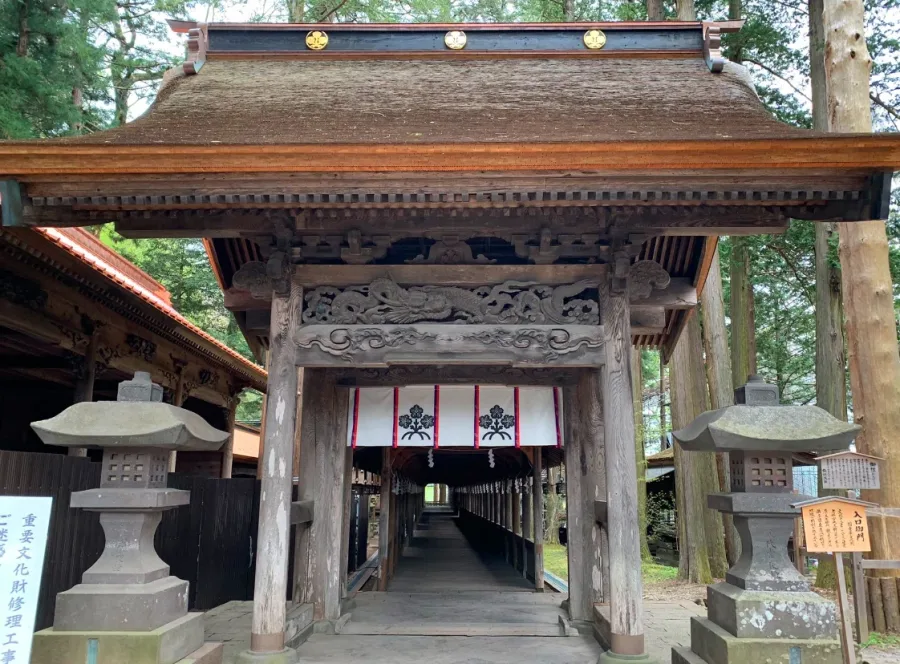
This is a summary of observations on Suwa Taisha (provisional).
Suwa Taisha is the head shrine for approximately 2,600 Suwa shrines, Suwa-sha, and Minakata shrines nationwide (according to the Comprehensive Survey of Shrine Rituals and Festivals).
Suwa Taisha consists of two shrines and four locations: the Kamisha (Upper Shrine) on the south side of Lake Suwa, which includes the Honmiya and Maemiya, and the Shimosha (Lower Shrine) on the north side, which includes the Harumiya and Akimiya.
The Kamisha Honmiya enshrines Takeminakata-no-kami.
The Kamisha Maemiya enshrines Yasakatome-no-kami.
The Shimosha Akimiya and Harumiya enshrine three deities: Takeminakata-no-kami, Yasakatome-no-kami, and Yaekotoshironushi-no-kami.
During the era of Shinbutsu-shugo (syncretism of Shinto and Buddhism), shrines and temples stood side by side. Until the separation of Shinto and Buddhism in the Meiji era, there was a Jinguji temple right next to the Kamisha.
Honji-suijaku theory is the concept that Shinto gods are temporary manifestations of true Buddhas or Bodhisattvas. The Honji-butsu for each shrine are as follows:
Kamisha Honmiya: Samantabhadra (Fugen Bosatsu)
Kamisha Maemiya: Cintamanicakra (Nyoirin Kannon)
Shimosha Akimiya: Sahasrabhuja (Senju Kannon)
Shimosha Harumiya: Bhaisajyaguru (Yakushi Nyorai)
However, rather than praying to Takeminakata or Samantabhadra, the feeling is more one of praying to Suwa Myojin or O-Suwa-sama.
In recent years, as research into faith has progressed, the image of Mishaguji-sama has also become stronger.
It seems that the natural worship, prayers, and presence of spirits from the Jomon period or even earlier remain, and that the faiths of each era—such as mythological gods and Buddhas—have been layered to form Suwa Myojin.
Suwa is a sacred site from ancient times.
Although this is from a strongly modern perspective, I have summarized the changes in Suwa faith from ancient times to the present as follows.
■ A sacred site since ancient times
Lake Suwa, where the Median Tectonic Line and the Itoigawa-Shizuoka Tectonic Line intersect, is a tectonic lake formed as if the tectonic lines were torn apart by about 12 km due to fault movement. It is said to have formed over approximately 1.2 million years.
There is a zero magnetic field on the Median Tectonic Line, where sacred sites and power spots are scattered; Ise Jingu, Suwa Taisha, and Kashima Jingu are said to be among them.
■ Jomon prayers
It seems there was movement of people from the Sea of Japan side, the Kanto region, and the Gifu region.Suwa obsidian was a brand-name product at the time and we have come to understand ancient times through surveys of the distribution of excavated obsidian from Suwa.
During the middle Jomon period (approx. 5,000 to 3,000 years ago), Jomon culture was at its peak, centered around the foot of the Yatsugatake Mountains. Many dwelling sites and Jomon pottery have been excavated.
A characteristic of Jomon pottery in this region is that frog and snake patterns are frequently seen.
Research also suggests that not only hunting but also field cultivation may have been practiced.
There are places where Jomon-period stone rods serve as the sacred objects for Mishaguji-sama, and Mishaguji is presumed to be a primitive form of nature worship, a stone god, or a snake god.
However, one must be careful, as it may have been something different from the nature worship conceived by modern people.
■ Yayoi prayers
People of the Yayoi period, who possessed rice cultivation technology, also began to migrate here. It is thought that it did not suddenly change from Jomon to Yayoi, but rather blended over a long period of time.
Rice cultivation likely led to the gods of water and wind becoming gods of agriculture and land development, often as snake or dragon gods.
Deer and wild boar were already commonly eaten since the Jomon period, but deer may have been hunted more frequently because they damaged rice fields.
Based on a story in the 'Harima no Kuni Fudoki' where rice seedlings grew overnight after catching a live deer and sowing rice in its blood, there is a theory that deer hunting was an act that brought about a bountiful rice harvest.
The 'Ontosai' ritual may look like a Jomon-era practice at first glance, but if one considers it a festival where hunting and fertility are paired, it seems to be a Yayoi prayer. Incidentally, deer figures are often depicted on bronze bells (dotaku) from the Yayoi period.
■ Convergence of myths
・Takeminakata
In the 'Kojiki', Takeminakata moves to Suwa in Shinshu after the transfer of the land of Izumo. In Suwa, it is said that he defeated and subjugated the indigenous Moriya god.
The Suwa clan, which claims Takeminakata as its ancestor, called themselves the Miwa clan and became the O-hori (High Priest) of the Kamisha. The name 'Miwa' suggests a connection to Izumo Taisha and Omiwa Shrine. They were likely Izumo-lineage Yayoi people.
This also overlaps with the story that Omononushi of Mt. Miwa (Omiwa Shrine) was a snake god.
・Yasakatome
Yasakatome, the consort of Takeminakata, is a deity of the Azumi-lineage Yayoi people, who trace their ancestry to Watatsumi, the god of the sea. They advanced from the Sea of Japan side through Azumino to the north side of Lake Suwa, and the Azumi-lineage Kanashi clan became the O-hori of the Shimosha. More on the O-hori later.
■ Buddhism and hunting (killing and eating meat)
Due to Shinbutsu-shugo, the Honji-butsu of the deities were determined, and temple halls and pagodas were built in the Jinguji. In an era when killing was prohibited by Buddhist thought, it became the only hunting shrine in Japan.
Falconry was prohibited except for the Suwa-sha's Onie-gari (offering hunt), and falconry by the Edo Shogunate was called the 'Suwa School' and continues to this day.
The 'Former Misayama Ruins,' a hunting ritual site of Suwa Taisha Shimosha used in the Middle Ages, also remains.
The 'Kajikimen' (deer-eating permit), a talisman that allows for the eating of meat, can still be obtained only at Suwa Taisha today.鹿食免
In recent years, research into the history of Suwa has progressed, and our understanding has deepened through the study of Jomon period artifacts. There is a growing interest in the research and contemplation of the Shinto rituals and ceremonies connected to the history of Suwa, which has been continuously woven since ancient times—from the Jomon period or even earlier—including the Mishaguji faith, which involves invisible spirits such as the energy of the earth and nature.
In fact, 'Mishaguji' is likely a name that predates written culture. Several other names have also been passed down, such as Mishakuji, Mishaguchi, Sakuji, and Shaguchi.
The O-Hori was the living deity of the Suwa Myojin and held the highest position at Suwa Taisha. Initially, the Kanetsashi clan became the O-Hori of the Lower Shrine, while the Suwa clan became the O-Hori of the Upper Shrine. Against the backdrop of the power struggle between the Lower and Upper Shrines and the rise of the samurai society, the Kanetsashi clan was destroyed during the Muromachi period.
The Upper Shrine was established as the main shrine, and the Moriya clan, descendants of the god Moriya, served for generations as the Jinchokan, who managed the Shinto rituals under the Suwa clan, the O-Hori and living deity.
The O-Hori and Jinchokan continued until the system was completely overhauled by the Meiji government.
Suwa Yorishige, who supports Hojo Tokiyuki, appears in the manga and anime The Elusive Samurai (by Yusei Matsui).
【Onbashira Festival】
A Shinto ritual held every seven years (in the traditional Japanese count). It is an energetic festival representative of Suwa, famous for people riding giant logs as they are transported from the mountains to the shrine and sliding down mountain slopes.
【Onto Festival】
A ceremony held at the Maemiya of the Upper Shrine, where offerings such as deer heads are presented to the gods to pray for a bountiful harvest.
【Osakuda Ritual】【Misayama Ritual】, etc.
Festivals to pray for a bountiful harvest of crops and hunting rituals using bows and arrows.
【Omuro Ritual】
A Shinto ritual that has since ceased and was considered the greatest secret rite.
It was a ritual performed by a limited number of people—the O-Hori, the Jinchokan, and the Shinshoku (divine messengers)—who would seclude themselves in a place called the Omuro, which retained the style of Jomon period pit dwellings.
It is said that secret rites involving the Mishaguji spirit and the snake god representing the Suwa Myojin were performed. It is thought that there may have been sexual elements connected to fertility. Since young boys were chosen as the O-Hori and Shinshoku, it may have also involved some form of rite of passage.
Released on January 2, 2025.
The 98-minute film by director Riko Hiro depicts the bounty of deer hunting and rice cultivation, while tracing Suwa's faith, history, and a recreation of the lost Omuro ritual against the backdrop of the relationship between nature and people and the changing seasons of Suwa. It was quite good, so I recommend it.
■ Shinano Province Ichinomiya Suwa Taisha
■ Onbashira Festival (Shikinen Zoei Onbashira Taisai)
■ Film 'Deer Country'
Jinchokan Moriya Historical Museum
I intend to add more in the future
(Planned)
This article was compiled to help people learn about Osuwa-sama, but I feel like I have fallen into a rabbit hole due to its profound depth.
I do not live in Suwa, so I believe there may be mistakes, differences in expression, or missing information. I would be very grateful if those who are knowledgeable could teach me. Thank you in advance. (Bowing)