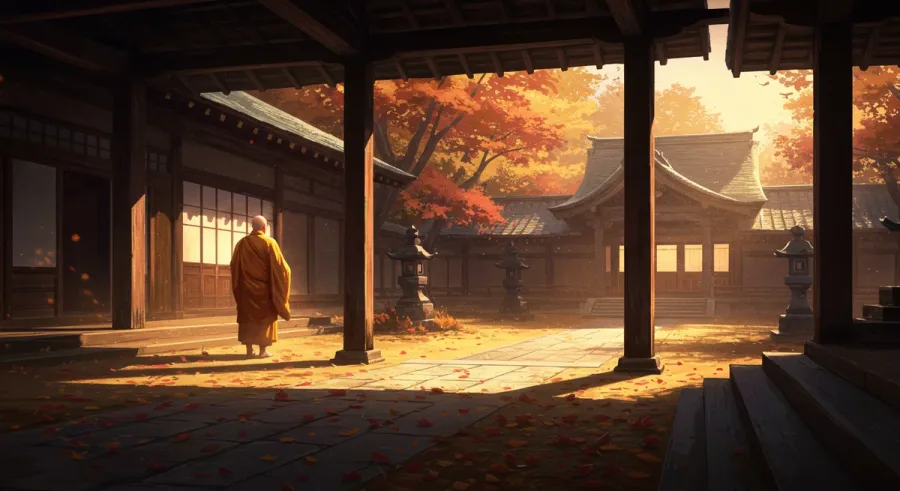
The kasaya became a 'promise' that bound the dead and the living—.
In a place called Watanabe in Settsu Province, there was a temple called Nagara no Bessho.
There was a monk there named Senshun. Senshun was now about 80 years old, and it is said that after studying at Mount Hiei in his youth, he eventually settled in this temple of his own accord.
This monk possessed a very precious kasaya, said to have been worn by Manjusri Bodhisattva when he preached the Buddhist law in ancient times, though the details of how he came to own it are unknown. It was a kasaya woven from lotus threads, and it is said that it was originally owned by the Sozu Zen'yu of Mount Hiei.
Near the temple where Senshun lived, there was a monk named Soshin. He lived in a place called Yanazu no Bessho and was about 60 years old. Soshin heard rumors of Senshun's kasaya from somewhere and wished to obtain this precious treasure at any cost. So, having learned that Senshun did not have any particular disciples, Soshin immediately went to him.
Senshun heard the thoughts of Soshin who had visited him and spoke as follows.
'What a noble aspiration to want to become a disciple in order to inherit this kasaya and pass it on to future generations. Very well. There are three types of kasaya: the Dai-e (nine-strip), the seven-strip, and the five-strip. Of these, I will first give you the five-strip one. I will make arrangements so that the rest can be handed over to you after I die.'
Soshin happily accepted the proposal. And so, he took the five-strip kasaya home.
However, after that, Soshin fell ill with a serious disease. Realizing that death was near, Soshin showed the kasaya to his disciples and asked them this:
'When I die, be sure to bury this kasaya with me.'
A few days later, Soshin died. As per his will, the disciples buried the kasaya with his body.
Some time later, a letter arrived for Soshin's disciples. The sender was Senshun, who had given the kasaya to Soshin. The letter said:
'I had promised to give all three of those kasaya to Soshin after my death. However, unfortunately, he passed away before me. I am heartbroken to hear such rumors. By the way, the three kasaya should be together. Please return them.'
The disciples told him the truth without hiding anything, saying that they had followed the deceased's will and buried the kasaya in the grave with his body. However, no matter how many times they told him the same thing, Senshun would not believe them. Meanwhile, Senshun remained at a loss, and the days passed in vain.
It was one autumn day in 1164 (the second year of Chokan), a year after Soshin's death. Soshin appeared in Senshun's dream and said:
'Thanks to you, I have been able to be reborn in the inner court of Tushita, that is, a truly beautiful place in the Pure Land. This is all thanks to my efforts day and night to cherish this kasaya and pass it on to future generations. However, seeing you deeply lament that the kasaya was buried according to my will, I felt sorry for you. I am very sorry. I will return it to you. Please look at the box containing the kasaya as soon as possible.'
Senshun, who woke up from the dream, immediately checked the contents of the box, and sure enough, all three kasaya were there. They were also neatly folded as they had been before. Although it was a mysterious event, tears spilled from Senshun's eyes, and he simply bowed his head to the three kasaya.
After that, Senshun died. The three kasaya were draped over his body.
This kasaya was inherited by a monk named Ben'ei, one of Senshun's few disciples, and when this Ben'ei died, this kasaya was also draped over his body. Since Ben'ei died only a few years ago, less than ten years ago, this anecdote is something that many people have heard and seen.
Old stories often contain very grateful tales about the Buddha, but that trend is decreasing year by year. Although they may rarely remain, as time passes and fewer people believe in the teachings of the Buddha, such miracles will likely appear or be told less and less. The world is becoming increasingly desolate, but this story is one of the few examples that have remained even in such times.
That is why people go to the trouble of visiting temples to pray. They are people who try to accumulate good deeds, and I cannot help but hope that there are many of them.
"The Returning of the Kasaya After Soshin's Death" (from the Hosshinshu) based on
*This story is a dramatization by the author based on the source above. The image was created using generative AI.