This time, it's a Jump analysis article.
It's about the latest chapter of ONE PIECE, 1179.
Of course, spoilers are included.
Please be aware of this.
*Updated on Tuesday, 4/7 with some additions.
In the latest chapter of One Piece, the
King of the World, 'Saint Nerona Imu', finally revealed their appearance.
Their bizarre visual contains so many elements that it cannot be dismissed simply as a 'final boss'.
In this article, we will decipher this appearance from three perspectives: 'race', 'mythology', and 'history'.
■ Conclusion: Imu is an 'Integrated Being'
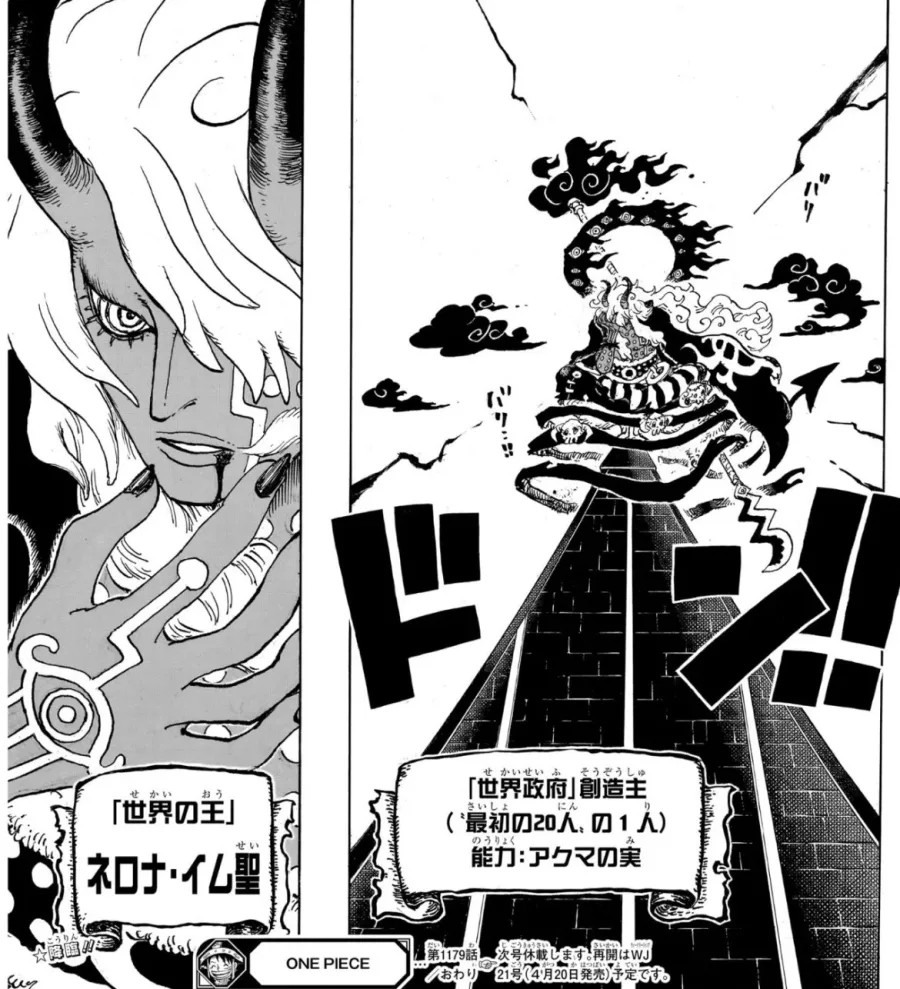
First, to state the conclusion, Imu is considered to be an 'integrated being' that encompasses all races and all history.
Reminiscent of the Lunarians, the Three-Eye tribe, and Ohara, in addition to tribal elements, as a character, they follow the lineage of
Kaido and Enel, plus eyes that recall Hawk-Eyes. They remind us of every race seen so far.
The decisive factor is the 'moon' element—hair and a silhouette that recall the Mink tribe's 'Sulong'.
On the back of Imu's appearance scene, there is also a ring reminiscent of the sun or a lunar halo, which is highly likely to be a contrast to Nika's appearance scene.
Even though they are the Sun God, the silhouette is the moon
, and just before Imu's appearance, sunlight
shines through.
If Imu is a contrast to Nika, they are the 'moon', and it can be interpreted that they represent
'total lunar eclipse' and 'total solar eclipse' respectively. In other words, Imu is also an entity that embodies the
'moon'
among these three poles:
• Sun (Nika) • Darkness (Blackbeard) • And the moon
. The skin color that reminds one of the Lunarians also comes from the English spelling 'Lunarian'
- 'Luna' = '
moon(moonlight)' - '-ian' = person of, race of: an English suffix.
This indicates they are a race that symbolizes the moon, and it is highly likely that the reason the government was searching for them at a high price is due to Imu.
■ Sun, Moon, and Darkness: A New Contrast of a Three-Pole Structure
Until now, One Piece has often been discussed in terms of the contrast: • Sun = Nika (Freedom) • Darkness = Marshall D. Teach (Gravity/Theft).
However, with the appearance of Imu, a third axis is added:
Moon = Integration, Observation, Domination
. This is a structure that depicts the 'world before dawn'
.
The sun and moon that appeared in the scene, and the 'total solar eclipse' brought by Luffy, are the 'omen of dawn'
that will repaint the world after a temporary darkness.
In contrast, the 'total lunar eclipse' that Imu wears is the light-absorbing, endless
'completion of the night'. The overlapping sun and moon.
Through the collision of the two, the shape of the world that has been hidden for 800 years will finally be exposed to the light of day.
Beyond a mere design contrast, it is thought that philosophical meanings are included in the One Piece worldview: 'observation of the world (determination)' and
'updating the world (overwriting)'
.
■ Mythological Motifs: Deities and the 'Logic of the Moon'
Luffy is often depicted as a 'free hero,' but this is not just an impression; there are several sources for it.
∙ Hanuman (the monkey god) and Nika's commonalities (stretching, leaping, relationship with the sun)
∙ Kintaro-like motifs (a hero of immense strength who communicates with animals, relationship with Kuma)
Eiichiro Oda thoroughly weaves these wordplays and mythological structures into the story.
From these, Luffy is a being positioned in the lineage of the
'Liberator' who lives with nature.
In contrast, Imu is a
'God-Buddha entity' that possesses both God (lightning = judgment) and Buddha (a being that encompasses everything). (Ne + Ro + Na (Ten) = God, I + Mu = Buddha)
Furthermore, what overlaps here is the concept of the moon in Japanese mythology as
a 'Yomi (Underworld)' concept. A place beyond the boundary of life and death
A realm governed by logic different from the present world
Imu's 'black flames' are the polar opposite of Nika's feathered robe and are strongly linked to this 'logic of the death side.'
As a composition, it can also be re-read as the opposition of
Sun Wukong (freedom/life) vs. Shakyamuni (integration/enlightenment/transcendence of death).
■ Yamato and Yamato Takeru: Contrast with the lineage of the Sun God
In deciphering Imu, there is one more person who cannot be overlooked. Kaidou's son——Yamato.
White long hair, horns, and the Inu Inu no Mi, Model: 'Oguchi no Magami'.
Oguchi no Magami is a divine beast deeply involved with Yamato Takeru in the 'Nihon Shoki,' and this is no coincidence.
Polar composition in Japanese mythology:
∙ Yamato Takeru (Sun, Hero, Liberation)
∙ Susanoo-no-Mikoto (Storm, Moon, Domination)
This is exactly the contrast structure between Luffy and Imu.
Furthermore, what should be noted is the death of Yamato Takeru.
He is defeated by the 'God of Mount Ibuki' after letting go of the Kusanagi sword.
What is important here is the overlap of traditions regarding the true identity of this 'God of Mount Ibuki.'
In other words, 'Great Serpent, Oni, and Mountain God' are often spoken of as the same fundamental lineage.
A sun hero who lost the Kusanagi sword was struck down by a god connected to the grudge of a great serpent
If we overlay this onto One Piece——
∙ God of Mount Ibuki = Imu (Fundamental Ruler, Moon God)
∙ Shuten-doji = Kaidou ('Oni' in whom Imu's lineage factor is strongly manifested)
∙ Yamata no Orochi = Kurozumi Orochi (Fundamental evil that actually appeared in Wano Country as the user of the Hebi Hebi no Mi, Model: 'Yamata no Orochi')
As mentioned above, Kintaro's other name is Kaidomaru——
The composition of Kintaro defeating Shuten-doji with sake overlaps directly with the battle between Luffy and Kaidou.
And if the lineage factor of the God of Mount Ibuki = Imu is deeply embedded within that 'Shuten-doji' Kaidou——
The reason Kaidou was called
'the strongest living creature in this world' might be decipherable not just as raw power, but as the manifestation of a divine lineage.
A sun hero lost his source sword and was killed by a 'serpent (dragon)'
This echoes the 'Harley Mural' where the history of One Piece is depicted.
The mural depicts a scene where Joy Boy fights a being that could be seen as a dragon (serpent) or a devil——
and for some reason, he is holding a sword and shield.
This sword and shield are Kusanagi no Tsurugi and Yata no Kagami(Yata Mirror), and while it cannot be confirmed if they are attached to a magatama, in short, are they not hinting at the
Three Sacred Treasures? As the name 'Yellow Monkey
' (Borsalino) indicates, those who manipulate light like the sun are also within this lineage.
How Yamato will move in the final chapter—the answer to that may be hidden within this mythological structure.
■ Comparison with Enel: The False God and the '13th Betrayal'
Imu's appearance is somewhat reminiscent of the god Enel. The ring-like object behind them and the thunderclouds, and while unconfirmed, the strange height compared to the background (the giant castle) also seem to be common points. And the decisive factor is
Enel: 'Fear is God'
Imu: 'Gods and Buddhas who fear D'
Despite being a god, they have turned to the 'side that fears'—
This indicates a major distortion: 'an existence that should be perfect is not perfect'. Also, as a major contrast,
Enel is one who aimed for the moon (Fairy Vearth)
Imu is one who has visuals symbolizing the moon There is also a cover story depicting Enel actually arriving on the moon, where there existed a civilization troubled by the lack of electricity (energy), and it seems
there was once a war.
From this, there is a possibility that they are an existence that was on the moon side, and if so, it can be inferred that it would be a perfect contrast. An even more important part is that when Enel appeared, a
cross was drawn in the center behind him.
A man who called himself a god and tried to destroy Skypiea by himself. Placing Christian motifs behind him is clearly intentional. There is a three-layered contrast here: ∙
Zeus (Thunder God/Monotheistic rule) ∙ Yahweh
(Distinctive way of laughing/Old Testament-like/Rule by fear) ∙ Christ
(One who carries the cross/but a false savior). And Imu also possesses the same monotheistic structure and is based on an elitist ideology that tramples on others. Imu's black feather robe has 12 eyes, and when combined with their own single eye, it becomes
13. (Only the bottom left one looks like a cross-shaped eye and seems to be missing)
In the story, it is explicitly stated that the total number of deep sea/deep-deep sea contractors is 13.
The number of Imu's eyes may be a hint that they are an existence that is 'watching' those 13 contractors. In Christianity, '13' is also the number of the
13th person at the Last Supper, Judas—the number of the traitor. And it is highly likely that a traitor already existed among these 13 people. The leading candidate for that is the former Five Elders
'Saint Jaygarcia Saturn'
.
Saturn →Satan (a fallen devil). In Christian theology, Satan is positioned as
the one who confuses good and evil—an entity that tests human faith and morality. Perhaps it was inevitable that he be erased, as his name implies. Saint Saturn's actions, which initially appeared to be those of an opposing force, ultimately created a situation that forced Imu to descend from the throne to the world below. If Saint Saturn, like Bartholomew Kuma, was a believer in Nika and belonged to the lineage of Nika—
That 'betrayal' was the trigger for the dawn
Of course, there are other candidates, but who is the true traitor? Are they among the 13 contractors, or is Imu themselves the answer—the eye carved into the feathered robe can be interpreted as a symbol of this. And apart from this structure, there is an actual
betrayal. ∙ Shallow Sea Contractor:
Saint Shanks
∙ The Original 20:
Lily Both are figures who, from different positions, created cracks in Imu's 'integration.' Shanks is blatant, but it is highly likely to be a contract termination disguised as an accident
of possibility.
Queen 'Nefertari D. Lily' scattered the Poneglyphs throughout the world. Imu calls this a 'mistake.' However, just as Christ was crucified to bear the sins of humanity—
∙ From Imu's perspective: Lily is a 'traitor' who prevented the complete integration of information. ∙ From the perspective of historical truth: Imu is the dictator who betrayed the original 20, and Lily was the “
true savior
”.
She also chose not to move to Mary Geoise and instead returned to Alabasta. The commonality between the two is that they both rejected the 'Holy Land,' which is clearly high in both physical and status terms, and chose to live on this 'blue star' of their own volition.
■ The True Nature of the Black Flame: The Root of the Curse
The black flame covering Imu. This also serves as a contrast to Luffy's (Nika's) white feathered robe. If Nika is an entity that opens the gateway to imagination, could Imu's black flame be
that which depicts its end? The performance shown when Saint Saturn departed, as if sucking the life out of him—that same 'presence' drifts within Imu's black flame.
Here, one hypothesis emerges. Imu is labeled as
『 Ability: Devil Fruit 』, but is this the integration source that created the Devil Fruits, or what is
“What is a Devil Fruit”
in the first place. Vegapunk stated—'Devil Fruits are the possibilities of human evolution that someone wished for.' In other words, Devil Fruits can be perceived as “spells” that have transformed into “curses”
where people's desires and thoughts have materialized. In fact, Decken and Shirahoshi call the ability a 'curse,' Leo calls it 'magic,' and those from Wano call abilities 'sorcery'—the interpretation varies by culture, but all are treated as something beyond human intellect. Details regarding Devil Fruits are in the analysis below.
Details regarding Devil Fruits are in the analysis below.
(The relationship between Tot Musica, Chopper, and Imu is also explored in this article.) And it is explicitly stated that 'Marshall D. Teach's' Yami Yami no Mi ability can also absorb
“Devil powers” through gravity.
This is not merely a physical theft, but can be considered a
meta-ability that acts on the dimension of curses (souls).
If the Yami Yami is an ability that attracts 'curses'
Imu, as the source that generates those curses, is connected to all Devil powers Blackbeard and Imu might be entities standing at opposite poles of the same dimension—
“stealing” and “creating”—if so, the eye in the black feathered robe might be a symbol of what resides or regenerates, and can be read as an expression of Imu's essence to “see, record, and integrate” everything, including souls
■ The Eye of Horus: Egyptian Mythology Carved into Imu
Mythological motifs are not limited to Asia. Intentional composition is incorporated into the paneling of scenes where Imu appears. The roof at their feet is cut into a triangle, and Imu stands at its apex—this is the very composition of the
Eye of Providence (All-Seeing Eye)
.
And Imu's face: ∙ The left eye is hidden ∙ The right eye is the same Hawk Eye as Mihawk. This is the
Eye of Horus (Eye of Wedjat)
.
In Egyptian mythology, Horus had his left eye injured in a battle against Set, the murderer of his father Osiris.
Because the moon god Thoth healed that left eye, it became a symbol of
“the recovery of what was lost.”
∙ Right eye = Sun (Eye of Ra)
∙ Left eye = Moon (Eye of Horus)
Imu is depicted as a being possessing both the sun and moon eyes.
And here emerges the hawk eye,
“Dracule Mihawk.”
The English spelling is “Dracule Mihawk”
∙ “Dracule” = A name meaning vampire or child of the devil
∙ Hawkeye = Resonance with the right eye of Horus (Sun)
As a being who shares the same lineage of “eyes” as Imu, a strong connection at the level of lineage factors is suggested.
■ Weapons and Lightning: The “Judgment” on the World and the Lineage of the Naginata
The naginata-like weapon held by Imu has a blade that is distorted like lightning.
In mythology, lightning consistently symbolizes royal authority, divine punishment, and judgment.
In other words, this weapon is the embodiment of the “power to make decisions” regarding the world itself.
Even more interesting is the choice of this “naginata” weapon.
The former Yonko, “Edward Newgate,” was also a symbolic figure of a “King” who wielded the naginata “Murakumogiri.”
With the departure of Whitebeard, the era moved forward.
The contrast between the “Supreme Ruler who built an era” and the “King of the World who has erased eras.”
And between Whitebeard and Imu, there is a surprising numerical coincidence.
The narration when Whitebeard died standing upright—
In summary,
“267 sword wounds, 152 bullets, 46 cannonballs.”
Decoding this:
∙ 267 = Nerona (2=NE, 6=RO, 7=NA)
∙ 152 - 46 = 106 = Imu (16=IMU *0 is not read)
It is too precise to be a coincidence.
It is natural to think of this as wordplay intentionally planted by Eiichiro Oda.
Furthermore, the one who broke through “Newgate (Gate of the New Era)” was “Monkey (Gate Key) D. Luffy,” who has broken through gates that had never been breached in history, including Enies Lobby, and even prisons.
As mentioned above, such wordplay is planted throughout One Piece, and the numbers of Whitebeard's wounds are also part of that lineage.
Looking at it from another mythological aspect, the shape of this weapon also resonates with the weapon held by Nezha, a character in the Chinese myths “Investiture of the Gods” and “Journey to the West.”
Nezha.
He possesses a spear wreathed in flames and wheels.
Many people have likely seen this in the famous manga “Hoshin Engi” by Ryu Fujisaki, or more recently in “FGO”.
In this design as well, they commonly hold a weapon called the
“Fire-tipped Spear,” and at their feet are
wheels wreathed in flames (Wind-Fire Wheels). It is small and hard to see, making it difficult to judge, but the ring-like design seen on Imu's waist in the green-circled area is reminiscent of Nezha's
“Wind-Fire Wheels”——equipment that moves through the divine realm wreathed in flames——. This may not be mere decoration, but rather suggests that Imu, like the Celestial Dragons and the Holy Knights, is a
“being that belongs to a heavenly realm different from the current world.”
Like Sun Wukong, Nezha is a warrior on the side of the heavenly realm, possesses armaments with high affinity for lightning and fire, and is a “being that transcends the physical body”
who died once and was resurrected with a lotus body. If Nezha is a “being who discarded the individual and was integrated into the side of the gods,” then Imu can be read as the “completed form that has integrated everything”
——the final destination of that lineage.
■ Contrast with Big Mom: The Mother Source and the Integrator
There is a contrast here that cannot be overlooked——
Big Mom, a.k.a. Charlotte Linlin.
Linlin used the power of the Soul-Soul Fruit to
share her own lifespan, and gave birth to subordinates called Homies. In Imu's appearance scene, there was also a depiction that seemed to have some kind of
soul dwelling within, keeping rhythm just like Nika, and it was similar to the Homies.
And, the representative of the Homies created by Linlin is,
∙ Prometheus(Sun's fireball) ∙
Zeus(Thundercloud) → later to Hera ∙
Napoleon(Bicorn hat) Imu's appearance clearly bears these motifs.
∙ Form wreathed in lightning = Zeus-like existence ∙ Two-horned skull at feet =
Napoleon (Bicorn) design ∙ Naginata design = similar form
Prometheus is the sun's flame
——This shares the same root as Nika's (Sun God) fire, and it is highly likely it is also deeply connected to Mother Flame
. And what is noteworthy is Hera. After Zeus was welcomed by Nami, he was "remade"
by Mam and transformed into a female existence. Ending one's lifespan once and changing gender——is this not a metaphor for a certain existence ending its original lifespan and changing form? The possibility arises that Imu, too, was once a different form but was integrated and reconstructed into "the current form" by some power. Mam is the
"motherly existence" who shares her soul to create children and a world. In contrast, Imu is the "integrator"
who collects and integrates everything, including their lineage factor. This can be said to be the highest version of the contrast structure between front and back that One Piece has repeatedly depicted, just as Crocodile and Doflamingo played the roles of "national heroes" while actually being rulers. The
"Totto Land where all races coexist" that was once put forward as the Four Emperor Big Mom. At first glance, it looked like a utopia, but was it not just a degraded copy of the "integration that encompasses all races within oneself"
that Imu has already carried out? While Mam tried to line them up side-by-side as family, Imu stacked them vertically as his own lineage factors. This difference in the precision of "integration" is the decisive difference between a pirate's dream that fades in a few decades and a god's rule that lasts 800 years.
■ Lineage Factors and Devil Fruits: Is Imu the Source?
In the Wano Country arc, it was explicitly stated that the "failed" SMILE that Momonosuke ate was an artificial Devil Fruit created based on Kaido's lineage factor (DNA). Devil Fruits are inseparable from the lineage factor of their users. If so——
If you trace the origin of all lineage factors, don't you arrive at Imu?
If Imu is an "integrated existence," then he is an existence that can even create Devil Fruit abilities by rearranging those lineage factors. A hypothesis holds that while Blackbeard is an existence that
"steals"
while Imu, as the source, is an existence that designs, collects, and reintegrates lineage factors——a hypothesis that holds.
■ Genealogy of the Underworld: Those Who Stand on the Side of Death
As if to correspond with Imu's "moon" and "death" nature, there exists a genealogy at the heart of the story that evokes the
"underworld".
∙ Silvers Rayleigh (Dark King, scar on eye) ∙ Roronoa Zoro (Calls himself King of Hell, wields Enma, one-eyed) Dark King Rayleigh, the one-eyed swordsman Zoro who possesses Enma——This
"underworld line"
is no coincidence. Zoro's one eye also overlaps with the hidden left eye of Horus. A symbol that "what was lost is restored"——the question of what Zoro "lost"
and what he will
"take back" takes on new meaning within the contrast structure with Imu. If Imu is the "ruler of the moon who integrates everything" , those connected to the genealogy of the underworld might play some role in the final phase as bearers of death and rebirth at the opposite extreme.
■ The Flip Side of ONE PIECE: An Interpretation of "Human Connection"
The term "One Piece" has taken on the meaning of
connection, integration, and unification of the world among readers. However, when viewed through the existence of Imu, another meaning emerges. "The result of making everything one"——that is not an ideal, but a possibility of
integration that is established only after erasing countless others
also comes into view.
• Imu: Unifying everything into one
• D: The force that breaks and shakes it
In other words, D is the force that resists integration = freedom itself.
■ Conclusion: The Story of the Dawn
Imu is the integration of races and abilities, the completed form of mythology, and the ruler of history, an existence bearing all of that.
And now, the story has reached the point where
• The Sun (Freedom)
• The Moon (Integration)
• The Darkness (Theft)
these three poles collide.
One Piece depicts more than just an adventure.
Can "making the world one" and "being free" coexist?
The answer to that question might just be—
the "Dawn". (End)
Thank you for watching.
❤️ Your likes are a great encouragement!