Is it just about reducing token consumption to 1/9th, or is it the foundation for building something like Qwen3.8? I've been peeking at the community having quite a skeptical debate about this, but it's interesting that they can't criticize it as much as they thought they could.
However, since it is a Chinese product, it might be better to verify its security thoroughly first.
The link is at the very bottom.
1. Overview: The Fusion of Deterministic Pipelines and AI Agents
In modern software development, code review is the cornerstone of quality control, but it is also a bottleneck that significantly slows down delivery speed.
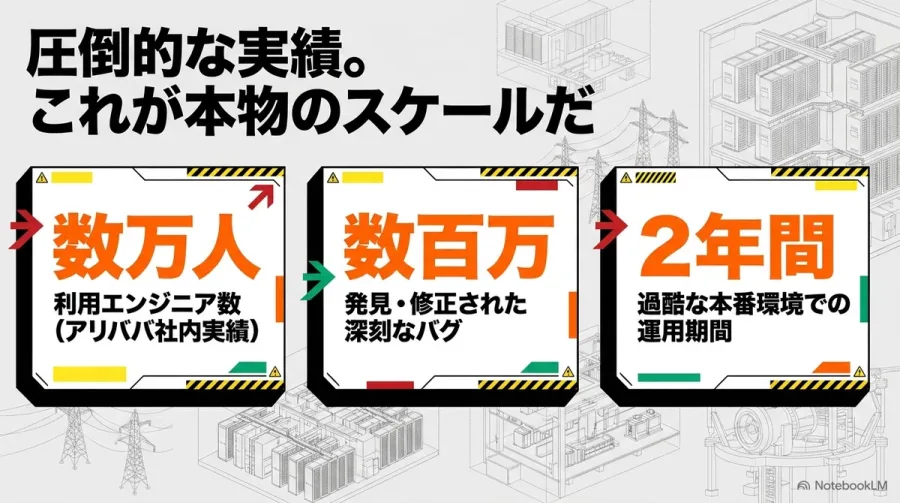
Especially in large-scale development organizations like Alibaba, they have long faced the difficult challenge of how to balance the 'uncertainty of LLMs' with the 'low latency required by CI/CD pipelines' for the massive amount of code changes generated by tens of thousands of developers.
The practical tool that has been refined in this harsh environment and has identified millions of defects is 'Open Code Review (OCR)'.
The essence of OCR's architecture lies in its hybrid structure of an engineering-driven 'deterministic pipeline' and 'LLM agents'.
It resolves the 'ambiguity of pointed-out issues' and 'instability of execution' that conventional AI tools often fall into by controlling them with logical constraints.
This design maximizes the powerful reasoning capabilities of AI while ensuring the 'reliability' and 'reproducibility' essential for enterprise-level development environments.
2. Performance: Pursuing High Precision and Overwhelming Cost Efficiency
Performance in professional code review does not just mean 'intelligence,' but 'accuracy that does not waste a developer's time'.
Based on large-scale operational data at Alibaba, OCR adheres to a design philosophy that minimizes noise (false positives) to the absolute limit.
Benchmark results tailored to practical work: Achieving high Precision and F1 scores In verification targeting 50 prominent repositories, 200 pull requests (PRs), and 10 programming languages, OCR demonstrated high Precision. This is the result of thoroughly eliminating false positives based on 1,505 ground-truth data points scrutinized by over 80 senior engineers.
Phenomenal resource efficiency: Token consumption about 1/9th that of general-purpose agents Compared to general-purpose agents like Claude Code, it reduces the token consumption required for a single review to about 1/9th. This is a direct result of the careful selection of context and optimization of rule matching, which will be described later.
Pipeline acceleration: Reduction in average execution time assuming CI/CD integration By minimizing the input information to the LLM through deterministic file filtering, execution time is significantly reduced. This allows for the integration of automated reviews without compromising the speed of the development cycle.
OCR adopts a strategy that prioritizes precision over recall. This is a sophisticated decision-making process to prevent 'alert fatigue' caused by developers being exposed to 'useless feedback.' This thorough meritocratic performance creates a decisive difference from other general-purpose models.
3. Performance comparison with other models: Breaking through the limits of general-purpose agents
General-purpose AI agents are extremely powerful, but in domain-specific tasks like code review, they can expose structural fragility.
Because the natural language-driven architecture is too flexible, it cannot maintain the 'constraints' of the review process, resulting in increased costs and decreased accuracy.
The reason OCR can outperform general-purpose agents like Claude Code in specific tasks lies not in simple prompt engineering, but in the distillation of a "scenario-specific toolset."
This is a reconstruction of the tool groups that contribute most stably to code review, based on deep analysis of tool call frequency, iteration rates, and inter-tool dependencies derived from large-scale operational data.
While general-purpose agents infer "how they should act" each time, OCR operates the LLM within "constraints" established by engineering. This "maximization of potential through constraints" is the key to overcoming the instability of language-driven models and achieving high reliability.
4. Problems Solved: The Three Chronic Issues of Existing AI Reviews
The factors behind the "disillusionment phase" faced by teams that introduce AI reviews are mainly concentrated in three technical challenges. OCR addresses these chronic issues head-on with deterministic logic.
Comprehensiveness to prevent "cutting corners": Intelligent bundle processing for multilingual files, etc. LLMs tend to evaluate only a portion of files in large diffs, but OCR prevents this with its own selection logic. For example, by "bundling" multilingual property files like message_en.properties and message_zh.properties into a single sub-agent for parallel processing, it ensures all files are reviewed while maintaining context, even in large change sets.
Eradicating "misaligned feedback": Improving positional accuracy by separating positioning and reflection To address the issue where feedback content does not match line numbers, OCR is equipped with independent "positioning modules" and "reflection modules." By using a two-stage process that first identifies the exact location and then re-verifies the validity of the content, it guarantees precise feedback at the line level.
Resolving quality instability: Strict rule matching via a template engine It stably detects specific defects such as NPEs (null pointer dereferences), thread safety issues, XSS, and SQL injection without relying on prompt fluctuations. By controlling rule matching according to file characteristics through a template engine, it maintains high-quality feedback at all times.
These solutions provide a foundation for engineers to dedicate time to high-level discussions that humans should handle, such as "architectural validity" and "design direction."
The true value of OCR lies in liberating engineers from the mental burden of routine bug checking.
5. How to Use: Practices from Introduction to CI/CD Integration
OCR features a "simple yet highly extensible" interface that senior engineers demand.
Prerequisites and Installation Operation requires Git >= 2.41. Installation can be done via npm install -g @alibaba/open-code-review, or by bulk introduction using the official sh / ps1 scripts.
Interactive Configuration and Automatic Verification Running the ocr config command initiates an interactive setup for providers such as OpenAI, Anthropic, and iFlytek Spark. Once configuration is complete, a connection test is automatically executed to immediately identify any environmental deficiencies.
-
Strategic Use of Execution Modes
ocr review: Precisely reviews changes such as pull requests based on Git diffs.
ocr scan: Audits specific directories without diffs or entire repositories to grasp the quality of unknown codebases.
Integration with the Ecosystem and Extensibility In addition to being embedded in CI environments like GitHub Actions, GitLab CI, and Gerrit, it also supports integration with Cursor and Claude Code.
This allows OCR to function not just as a tool, but as a quality infrastructure that supplies "advanced code review capabilities" to the existing agent ecosystem. By having autonomous agents call OCR, it provides a superior development experience where safer and higher-quality code generation becomes possible.
6. Conclusion: The Future of Reviews Where AI and Engineering Coexist
Open Code Review (OCR) presents a realistic solution that treats AI not as mere "magic," but as a "precision tool" controlled by engineering.
The hybrid approach of building safety fences with deterministic logic and running the powerful engine of an LLM inside them will become the standard for AI utilization in large-scale development.
The reliability forged at the massive scale of Alibaba proves that this is not merely an experimental project, but an infrastructure for 'standardizing' code quality across the organization.
By taming the uncertainty of AI through engineering prowess, we can return to the creative tasks that humans should truly focus on. The adoption of Open Code Review should be a valuable investment for any professional team.