◆ 0. History of the Spring Senior Triple Crown (Race System)
The Osaka Hai was promoted to G1 starting in 2017, so its history is short. The establishment of the Spring Senior Triple Crown [Osaka Hai, Tenno Sho (Spring), Takarazuka Kinen] also dates from 2017.
"Spring Senior Triple Crown" is a colloquial term and, like the Autumn Senior Triple Crown, it is not an official name recognized by the JRA, but it is a title used as a matter of course in horse racing games and the like. Furthermore, the JRA has established a bonus for winning all 3 races, so it can be said that, regardless of the name itself, the concept of the Spring Senior Triple Crown is formally acknowledged.
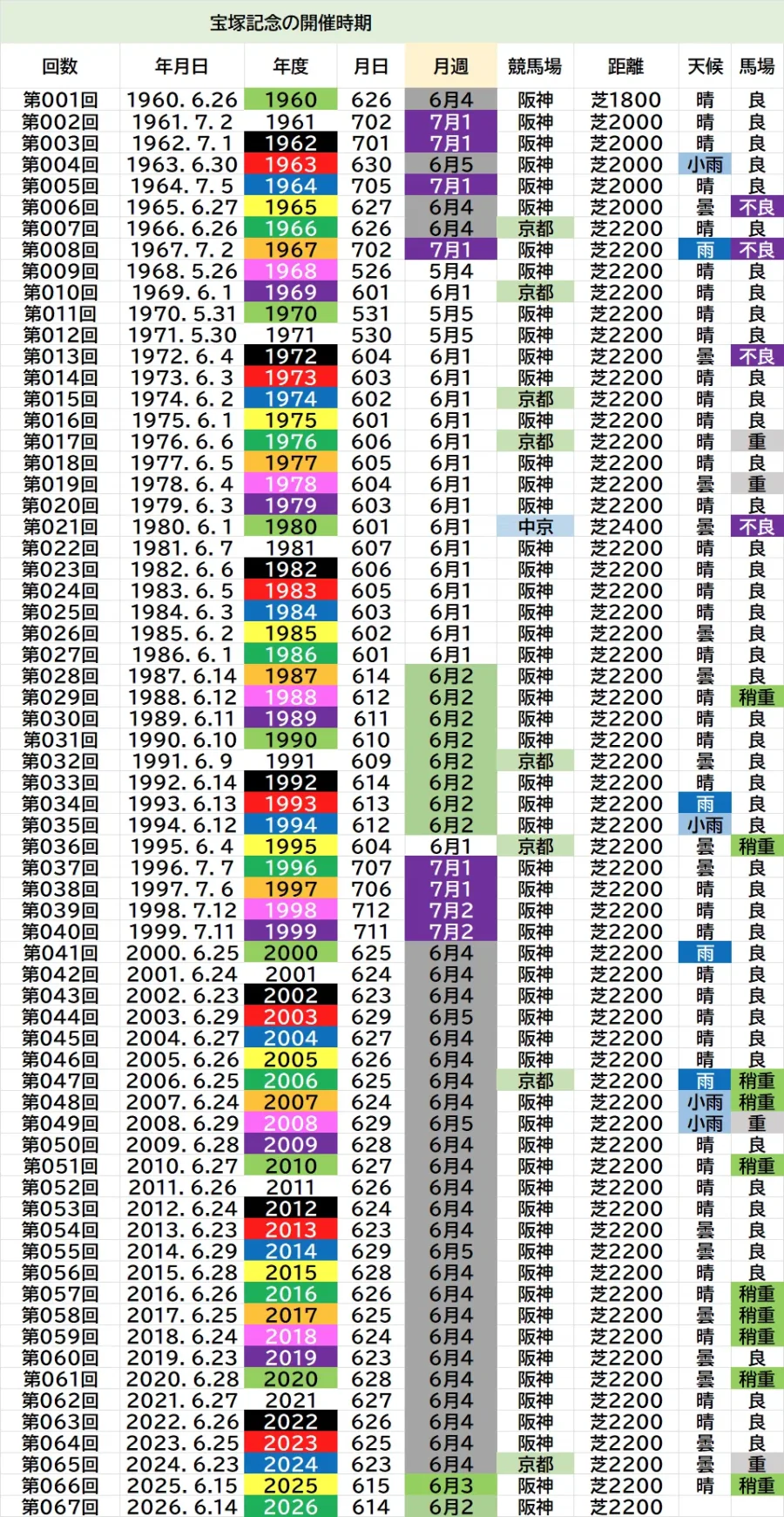
From 1968 to 1986, it was limited to older horses and was held early in the season, around the same time as the Yushun Himba and Tokyo Yushun. From 1987 to 1994, it was held in the second week of June, but in
1995, due in part to the Great Hanshin Earthquake, the schedule was changed from the original second week of June (11th) to the first week of June (4th), and the venue was changed to Kyoto Racecourse.
Holding the race in early to mid-June can potentially avoid the rainy season, prevent track deterioration due to bad weather or overuse, and increase the chances of avoiding extreme heat, which offers many benefits for racehorses, who are generally sensitive to heat.
However, when competing in the Spring Older Horse Triple Crown, the shortened interval between races can make the schedule difficult, though for some horses and training camps, it may be a better rotation than having an awkward gap.
Furthermore, the Yasuda Kinen (generally held in the first week of June) irregular Spring Older Horse Triple Crown would result in consecutive weeks of racing or only one week of rest, making it an unrealistic schedule.
Holding the race in late June to early July often means racing on a track that has been damaged by the rainy season, and since summer is in full swing, there is a high probability of extreme heat, making it a schedule where racehorses are prone to losing their physical condition during the adjustment process.
On the other hand, when competing in the Spring Older Horse Triple Crown, participating in the irregular Spring Older Horse Triple Crown or even a Quadruple Crown starting from the Yasuda Kinen creates more breathing room in the schedule, making it a realistic schedule.
◆ 1. Contenders for the Spring Older Horse Triple Crown (2017–2025)
Since the 2017 Osaka Hai was promoted to G1, the horses that have participated in all races of the Spring Older Horse Triple Crown are
The irregular Spring Senior Triple Crown consisting of the Osaka Hai, Yasuda Kinen, and Takarazuka Kinen saw Cadena compete in 2021.
No horse has yet achieved the Spring Senior Triple Crown or placed in all three races; Kitasan Black's record of 2 wins and one 9th place finish is the best performance since the Osaka Hai was promoted to G1 status.
In 2026, the Kitasan Black offspring Croix du Nord won both the Osaka Hai and the Tenno Sho Spring, but their participation in the Takarazuka Kinen is undecided. Among the horses that ran in the Osaka Hai and Tenno Sho Spring,
Tagano Dude has announced their intention to run in the Takarazuka Kinen, and barring any withdrawals, they are highly likely to become the fourth horse to participate in all three Spring Senior Triple Crown races since Justin Palace in 2025, following the Osaka Hai's promotion to G1.
◆ 2. Horses that challenged the Spring Senior Triple Crown including the Osaka Hai during the G2 era (up to 2016)
Horses that participated multiple timesBefore 1980, the Tenno Sho was a winner-take-all system, and once a horse won either the Tenno Sho Spring or Autumn, they were no longer eligible to run in the Tenno Sho, meaning there was a restriction that one could not win the Tenno Sho if they wanted to participate multiple times.
The only horse that could be said to have improved their performance in their second attempt compared to their first is
Suzuka Koban (1984-1985), who had 2 good finishes in their first attempt and 3 good finishes including 1 win in their second.
Kitasan Black (2016-2017) surpassed their first attempt (1 win and 3 good finishes) by winning twice in their second attempt, but they performed poorly in the third race, resulting in only 2 good finishes.
In 1987, Nishino Raiden finished 2nd in the Tenno Sho (Spring) but was disqualified due to interference caused by veering off course. Strictly speaking, they only had 2 good finishes, but even if the 3rd-place finisher Asahi Emperor, who was the subject of the interference, had won, there was a gap (0.4 seconds) to the 4th-place finisher Suda Hawk, so it is highly likely that the performance itself was worthy of a good finish.
Horses with good results (2 or more wins), including irregular onesThere is still no horse that has won all three Spring Senior Triple Crown races, including before the Osaka Hai was promoted to G1, with 2 wins being the best record.
In 1992, Kamino Cresse achieved an irregular Spring Senior Triple Crown. However, since the Osaka Hai in 1976, 1993, and 2007 were in the G2 era, it can be said that Kamino Cresse is the only one to have placed in all three races of the G1-level Spring Senior Triple Crown. Furthermore, they placed in all races across a distance range from the 1600m Yasuda Kinen to the 3200m Tenno Sho Spring, a 1600m difference, making the difficulty of race adaptability equal to or greater than that of the Spring Senior Triple Crown.
The candidates for the strongest horse among those who have competed in all three Spring Senior Triple Crown races are likely one of these three: the 1993
Mejiro McQueen, who had 3 top-two finishes and 2 wins, the 2007 Meisho Samson, and Kamino Cresse, who had 3 top-two finishes in the irregular Spring Senior Triple Crown.
◆ 3. Horses that ran in the irregular Spring Senior Triple Crown (any three races among the Osaka Hai, Tenno Sho Spring, Yasuda Kinen, and Takarazuka Kinen)
In 1992, Daiyusaku, and in 1993, Ikuno Dictus competed in all four Spring Senior Triple Crown races. Ikuno Dictus finished 2nd in both the Yasuda Kinen and the Takarazuka Kinen. The only horse to finish in the top two in all three races of the irregular Spring Senior Triple Crown was
Kamino Cresse in 1992. The two horses that performed well in all three were Kamino Cresse and Deep Sky
in 2008.
◆ 4. Career records for the Spring Senior Triple Crown
Spring Senior Triple Crown: Horses with career wins in all three: 1Mejiro McQueen is the only horse to have won the Osaka Hai, Tenno Sho Spring, and Takarazuka Kinen, even if not all in the same year.
Tsurumaru Boy finished 4th in the 2003 Tenno Sho Spring, but if he had finished 3rd, he would have been the first and only horse to have top-three finishes in all four races: the Osaka Hai, Tenno Sho Spring, Yasuda Kinen, and Takarazuka Kinen.
◆ 5. Horses that ran in the super-irregular Spring Senior Triple Crown (Triple Crown including the February Stakes, Takamatsunomiya Kinen, etc.)
In 2000, King Halo competed in the February Stakes, Takamatsunomiya Kinen, and Yasuda Kinen. He won the Takamatsunomiya Kinen for his first G1 victory and also performed well in the Yasuda Kinen, finishing 3rd as the first Japanese-trained horse. Given his record of finishing 5th in the Kikuka Sho and 4th in the Arima Kinen at the end of that year, he had the distance suitability to potentially compete and perform well in the Tenno Sho Spring and Takarazuka Kinen. In 2003,
Eagle Cafe competed in the February Stakes, Yasuda Kinen, and Takarazuka Kinen. In 2012,
Smile Jack competed in the February Stakes, Yasuda Kinen, and Takarazuka Kinen.