I was listening to Shin Takarajima for the first time in a while, and I thought it was interesting all over again.
What was particularly impressive was the opening intro.
At first, there is a slight sense of discomfort.
A Chinese-style synth.
A slightly detuned sound.
Layers of overlapping sounds.
A sense of floating without a clear focus.
Unlike standard J-Pop, you can't immediately get into the groove of the song comfortably.
Rather, it felt like being suddenly shown a 'huge painting with many overlapping lines'.
However, when you listen to Shin Takarajima to the end, the meaning of that painting changes.
The swaying that sounded like noise at first begins to resonate as 'humanity' by the end.
Below, I will present an illustration that explains the structure of this song first.
Intro 1: Showing the 'finished form' first
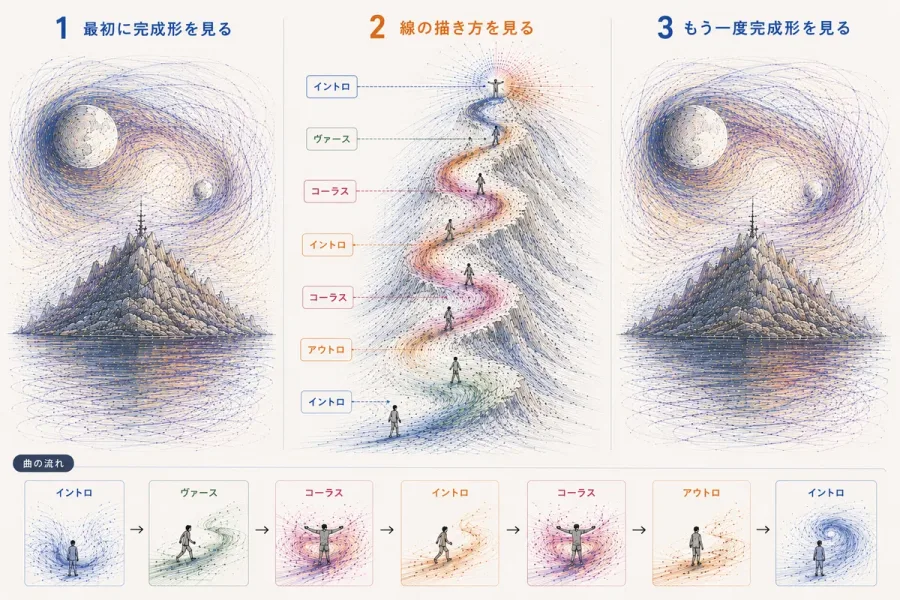
In Intro 1, which lasts until about 18 seconds into the song, the rhythm of the song has not yet begun.
However, at this point, the 'finished form' of the song has already been presented.
What is particularly impressive is the thickness of the synth.
Not a single note, but
slightly shifted sounds
detuning
reverberation
overlapping layers
gather together, and I feel like they are creating a massive space.
This doesn't feel like a single clean line, but rather
a painting made of countless overlapping lines.
Moreover, those lines don't perfectly align.
They sway a little, shift a little, and are a little murky.
That is why, at first,
'overwhelmed' comes before 'beautiful'.
However, at this point,
you still don't know how that painting was drawn.
Intro 2: The 'laws of motion' are presented
The impression of the song changes significantly with Intro 2, which begins around the 18-second mark.
Suddenly, you find yourself able to move your body to it.
What is presented here is the repetitive motif that governs the entire song.
The important thing is that this is not just a short melody.
Rather, it is where
at what cycle the lines are drawn
at what tempo the body sways
how one moves in this world
—the 'laws of motion'—are presented.
In other words,
Intro 1 = The finished painting
Intro 2 = The presentation of how it is drawn
is what it has become.
For the first time here,
'So that massive painting was drawn with this kind of movement?'
begins to become clear little by little.
'Shin Takarajima' is not about 'moving forward,' but about 'depicting'
Ordinary J-Pop moves forward by constantly adding new developments.
However, 'Shin Takarajima' is different.
Once the first chorus ends, it returns to intro 2 again.
In other words, this song is structured to
gradually layer lines
while repeating the same movement,
rather than continuing to advance toward new scenery.
That is why this song
is closer to 'depiction' than 'moving forward.'
Through the verses and chorus,
the listener
'Was this finished form
drawn with these kinds of lines?'
comes to understand this as a physical sensation.
In short, the entire song
is a 'making-of' video for a painting.
The 'human line' appears in the interlude
Personally, my favorite part is the long interlude after the second chorus.
I especially like the part where the motif is played with the distorted sound of the guitar.
What is interesting is
that it does not play an entirely new phrase.
Based on the motifs that have been repeated until then,
it is replayed with a different texture.
The lines up to this point
were, if anything, mechanical.
A uniform beat.
Minimal repetition.
Precise groove.
However, the moment the guitar enters,
distortion
noise
Swaying
Physicality
suddenly comes to the surface.
In other words, this is where the
human line begins to appear.
Not a neatly polished line, but a
swaying line.
A trembling line.
A slightly distorted line.
That instability,
conversely, begins to resonate as humanity.
In the outro, the meaning of 'swaying' changes
The final outro is truly beautiful.
And finally, the following lyrics continue.
Here, the song reveals its core.
What was initially a sense of discomfort,
detuning
swaying
instability
overlapping lines
was not merely noise.
It was
the 'traces of what a human has drawn'
all along.
In short, this song
does not aim for a perfect single line.
Rather,
while leaving the shaky lines as they are,
it still attempts to draw 'your song'.
Finally, look at the 'finished form' one more time
After the outro, the song returns to Intro 1 again.
Moreover, the ending features Intro 1 playing twice.
This part is truly beautiful.
When you first saw it,
it was a painting that was massive and incomprehensible.
But this time, it's different.
Throughout the entire song,
you have come to know how those lines were drawn.
That is why, in the end,
rather than just being overwhelmed,
you see the finished form
as a 'collection of shaky lines'.
Furthermore, by repeating it twice,
you are even given 'time to savor' the painting you have come to understand.
'Shin Takarajima' was a song that affirms 'shaky lines'
This song
does not aim for a perfectly straight, single line.
Rather,
shaky lines
overlapping lines
misaligned lines
while leaving these behind,
it attempts to draw 'your song'.
What sounded like noise at first
transforms into humanity by the end.
'Shin Takarajima' is not a song that erases noise,
it is a song that turns instability into 'human expression'.