An anime broadcast in 1998,
"serial experiments lain"
Born at the dawn of the internet, this work deals with themes such as "the net and reality," "the self and information," and "existence and God." As a controversial work that was far ahead of its time, it still boasts a deep-rooted popularity both in Japan and overseas.
At first glance, "lain" can be difficult to understand and is sometimes described as an "atmospheric anime" due to the sheer volume of information,
but if you carefully decipher the story, you will find surprisingly moving messages hidden within.
In this article, I will break down the anime version of the "lain" story
to a level that even elementary and junior high school students can understand,
explaining it as clearly as possible.
If you read this before watching all 13 episodes, you might find the story easier to understand.
※Please note that this article contains major spoilers.
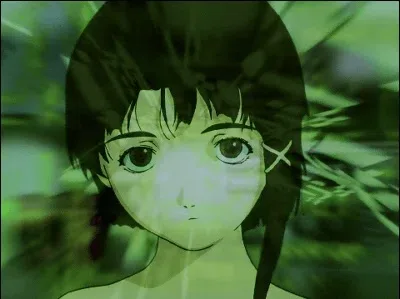
Lain was not a "human" from the beginning
I will jump straight to the core,
but the protagonist, Lain Iwakura, is depicted as a perfectly ordinary middle school student at the beginning of the story.
However, as the story progresses,
it becomes clear that she is"not human."Lain is an entity created by Masami Eiri, a former engineer who existed as a god in the Wired (a space similar to the internet in the story).
In other words, she is "a program that has taken on a physical form."Her "family," including her parents and sister, are merely temporary existences placed there to give Lain a sense of humanity.
Her mother, father, and sister were all "actors" following a script.
And in the beginning, Lain herself is completely unaware of this fact.
Chisa's death and the question "Who am I?"
The story begins with the suicide of Lain's classmate, Chisa Yomoda.
However, after she "dies," she sends emails to her classmates, saying, "I just discarded my body. I'm still alive. There is a God here (in the Wired)."
Triggered by this incident, Lain becomes interested in the world of the Wired and begins to face another reality.
High-performance "NAVI" PCs are delivered to her home one after another, and Lain naturally acquires hacking and construction skills.
Then, she realizes that there is a "lain with a different personality from herself" inside the Wired.
That lain was like a "different personality" who exposed people's secrets, spread rumors, and distorted the image of the real Lain.
The end of "playing family"
As Lain gets closer to her true identity, her temporary "family" gradually collapses.
Her sister, Mika, breaks down mentally because Lain denied her own existence, her mother becomes completely unresponsive, and her father disappears, saying his "role is over."
However, only her father, Yasuo, was an existence that went beyond his "role" until the end.
He says this to Lain as they part ways:
"It's not that I enjoyed playing family, but I loved you."And in the final episode, he appears again as a phantom and speaks gently to Lain.
In the beginning, Yasuo gives the impression of being an "eccentric" who is a NAVI nerd laughing at his monitor, but after watching all 13 episodes, you realize that he was a kind father who cared for Lain as much as Alice did and remained her emotional support until the end.
Masami Eiri's ambition and the meaning of 'God'
Masami Eiri, the man who calls himself the 'God of the Wired,' is a former engineer at Tachibana Labs.
He believed that by digitizing his consciousness and soul and uploading them to the Wired, he had become an existence that transcended death.
Eiri's goal was to connect the consciousness of all humanity to the net and liberate them from the constraints of the physical body. Lain was created to realize that ideal, an existence that could freely inhabit the Wired. However, Lain does not agree with his ideals. In the final episode, episode 12, Lain asks Eiri this question.
"You were certainly a god in the Wired. But what about before the Wired existed? You were just waiting for the Wired to take its current form. Were you just a proxy god for someone else?"
Eiri is shaken by these words. Despite calling himself 'God,' he cannot explain his own origins or basis. This was proof that he was not a god, but merely a ghostly piece of data. Enraged, Eiri screams, 'Are you saying there is really another god (besides me)?' and manifests in reality in a monstrous form, attacking Lain.
However, Lain replies quietly and powerfully.
"For you, physical bodies are meaningless, aren't they?"
This remark strikes at the contradiction that a 'God' who was supposed to have discarded his physical body has taken on a physical form in a fit of rage. Lain rejects the self-righteous and domineering 'God' that Eiri represents, and chooses 'herself' as someone who exists through connections and compassion. At this point, it can be said that Lain has surpassed Eiri and acquired the qualities of a 'true god.'
Existence means being in 'someone's memory'
In the end, Lain erases her existence from the memories of everyone except her best friend, Alice.
Regretting that she caused fear and trauma to people because of herself, she becomes convinced that everyone will be happy if I don't exist.
As a result, Lain rewrites the world where the boundaries between reality and the Wired had collapsed and become distorted, resetting everything. Lain's existence disappears from the world, and she becomes a
god who no longer exists in this world. There is a phrase in the work: "
If it's not in your memory, it never happened. Memory is just a record. Records can just be rewritten.
". Even so, in the reset world, only one person, her best friend Alice, remembered the traces of Lain deep in her heart.
"Hello... have we met before? We have, haven't we?"
When Alice asks this, Lain smiles quietly and replies:
"Nice to meet you"
The girl who was suffering, asking 'Who am I?', is no longer there. As they part ways, Alice says:
"
I see. Well then, goodbye. Maybe we'll meet again somewhere, sometime."
Lain whispers to herself:
"That's right. We can meet anytime."
The story quietly draws to a close with this scene.
In short, what is 'Lain'?
・At first, Lain thought she was a normal human.
・But in reality, she was a 'vessel for God' created by Masami Eiri to control the net world.
・Because Eiri needed a point of contact with the real world, he sent Lain into the world as a 'human girl' and provided a fake family, the Iwakura family.
・Triggered by Chisa's death, Lain touches a NAVI and meets 'another self = Lain' inside the Wired.
・Gradually, the boundary between reality and the net becomes blurred, and Lain and Lain merge. She transcends human limits and approaches 'Godhood.'
・Lain's personality changed because the Lain that already existed on the net 'awakened.'
・Ultimately, Lain makes the choice to 'erase herself from the world for the sake of people's happiness,' becoming an existence that quietly watches over them as a god.
Lain's multiple personalities = branched 'ego'
Various 'Lains' appear throughout the work. This is one of the major factors that confuses viewers, but it becomes easier to understand if you organize them as follows.
1. Real-world Lain
A shy, introverted, ordinary girl.
She has symptoms like hallucinations and auditory hallucinations,
and feels somewhat out of place. She is the most human-like Lain.
2. Wired Lain
The 'original Lain' who existed in the net from the beginning.
A being full of confidence and divine charisma.
She can directly interfere with phenomena on the net.
3. Scandalous Lain (Rumor-Spreading Lain)
A 'shadow personality' that exposes others' secrets and spreads rumors.
She has a drooping-eyed, condescending expression and a wicked side that enjoys touching upon the darkness of others.
4. Unified Lain
A being that appears in the final stages, where all Lains are integrated. She overlooks both reality and the net, and fully understands who she is. She is neither god nor human, but 'Lain herself'.
5. Lain as a meta-existence
A Lain who speaks to the outside of the work, even to the viewers.
It is symbolic that she asks 'Who am I?' at the beginning of the final episode.
She is depicted as 'Lain who exists within the viewer'.
What I felt from the anime 'Lain'
What this work conveys changes depending on the viewer's perspective.
However, when I finished watching the final episode, one certain lesson remained.
That is,
'people can be saved just by being remembered by one single person'.
Lain erased her own existence and rewrote the broken world.
This development is similar to the ending of the 2011 anime 'Puella Magi Madoka Magica', where Madoka rewrites herself into the law of causality itself to save all magical girls.
Both are choices of self-sacrifice, saying 'if I disappear, everyone will be saved'.
And that was not forced by anyone, but by their own will.
Both were forgotten by the world, without even the memory of being loved remaining, and they became as if they 'never existed' in anyone's heart.
However, Lain had Alice, and Madoka had Homura.
Even if it is just one person, if there is someone who keeps thinking of you, you will not be completely alone.
And Lain, who became a god, can exist anytime and anywhere.
Madoka also became a being who can watch over all eras and causality.
That is why they can say, 'we can meet anytime'.
What these 'beings who became concepts' obtained might have been a small yet powerful salvation: 'not being alone'.
Conclusion
Although 'serial experiments lain' may seem difficult and abstract at first glance, I feel that a universal theme flows at its foundation: 'What is it to be human?'.
The character Lain began the story as a lonely, shy 'ordinary girl', but changed into a being whose very identity was shaken.
But in the end, what she chose was to reset everything and prioritize the happiness of others.
No matter how much technology evolves and virtual space develops, what she chose in the end was 'a reality where hearts connect with someone'.
Lain could have become a god and had everything, but what she chose was the smile of her only friend, Alice.
That feels like it shows what is truly important to humans and what can be called 'happiness'.
Precisely because we live in an era like today, where we feel lonely despite being connected, Lain's hesitation and choices should give us a small but certain hint.
'Everyone is connected somewhere.'
This simple phrase might be the essence of the story of Lain.