AIDE (Advanced Intrusion Detection Environment) is a file integrity checker for Linux. By recording the hash values and timestamps of important system files and performing periodic rescans, it can detect signs of unauthorized changes or access.
✅ What is AIDE? (And why is it necessary?)AIDE (Advanced Intrusion Detection Environment) is a host-based IDS (Intrusion Detection System) specialized in file integrity monitoring.
It scans important files within the system (binaries, configuration files, logs, etc.) to create a database containing their hash values and timestamps. By comparing this database with the actual state of the files later, you can detect unauthorized or unintended changes.
For example:
/etc/passwd has been tampered with
/bin/ls has been rewritten by a rootkit
/etc/ssh/sshd_config has been modified without authorization
You can immediately discover situations like these.
Why is AIDE necessary?
Many modern attacks are stealthy, involving "sneaking in unnoticed and rewriting files," which antivirus software alone cannot catch.
Maintaining file integrity is the only way to detect backdoors, configuration errors, and malicious changes caused by tampering
If operations continue while logs, binaries, or configuration files remain altered, the damage can be prolonged and lead to serious information leaks
Having a mechanism like AIDE in place establishes a security posture where you can identify signs of change early and take immediate countermeasures
→ AIDE plays a vital role as a watchdog, not to "notice after something happens," but to "notice changes immediately."
Features of AIDE
High-precision integrity checks using hash values (md5, sha256, etc.)
Periodic check type, not real-time detection → Operated via cron or shell
Lightweight, fast, and simple; effective as an initial defense for rootkit detection
Records file hash values, permissions, timestamps, owners, etc.
Creates a database and compares it to detect the presence of tampering
Allows setting monitored directories and attributes with custom rules
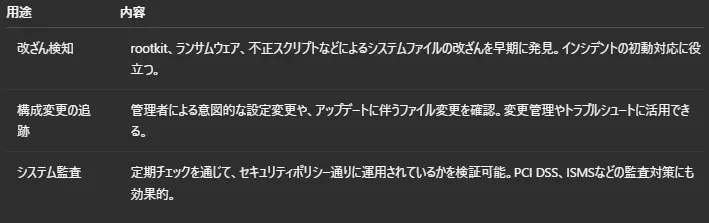
AIDE is not for "dealing with things after they happen," but rather a preventive security tool for "noticing anomalies early in the first place." Below are the typical uses and the significance of each application:
→ AIDE is also very effective for tracking "when, what, and why something changed," not just whether it was tampered with. |----------------|----------------------------------------------------------| | Tamper detection | Early discovery of tampering such as rootkits or malicious scripts | | Configuration change tracking | Confirming the impact of unintended file changes or package updates | | System auditing | As a log to confirm that operations are being conducted according to security policies |
✅ Tools and mechanisms related to AIDE→ In particular, the AIDE + auditd combination is powerful because it can simultaneously track "whether tampering occurred" and "the cause of it."
✅ How to use AIDE and the introduction flowAIDE installation (apt / yum)
Adjustment of initial configuration file /etc/aide/aide.conf
Creation of initial database (aide --init)
Execution of inspection and comparison of results (aide --check)
Automation of periodic scans with cron
Supplementary notes for each step
-
Installation:
Debian-based: sudo apt install aide
RHEL-based: sudo yum install aide
-
Adjustment of configuration file:
Describe monitored directories and attribute rules in /etc/aide/aide.conf.
Example: /etc p+i+n+u+g+s+b+m+c+sha512
Initial database creation:
-
Running a tampering check:
sudo aide --check
→ If there are differences, they are output as warnings.
-
Automation with cron:
Place a script in /etc/cron.daily/aide or set up automatic execution with a systemd timer.
→ By combining periodic checks with re-initialization (re-init) when the environment changes, AIDE achieves high-precision tampering detection.
✅ Summary of this articleAIDE is a host-based security tool specialized in file tampering detection.
It records hash values and attributes, and compares them later to see if there are any changes to detect unauthorized or unintended modifications.
It supports a wide range of uses, including tampering detection, configuration tracking, and audit compliance.
By combining it with auditd, cron, rsyslog, etc., operational practicality and accuracy are significantly improved.
Periodic checks are also effective for early detection of rootkits and ransomware.
→ AIDE, which watches for invisible "tampering," is the unsung hero that strengthens Linux server defenses. It is an essential component for security enhancement.