A Top Pick for Physical AI? Focusing on Precision Reducer Manufacturer Nabtesco (6268)
I previously organized 50 physical AI-related stocks on X, categorizing them into "finished products" and "components" as a bill of materials.
The post can be found here.
This article is a deep dive into that post. Among the 50 stocks, I will focus on precision reducers used in robot joints and examine Nabtesco (6268).
Generative AI has become familiar to us all at once over the past few years.
Writing text. Creating images. Summarizing documents.
Up to this point, the changes have mainly occurred "on the screen."
The next thing the market is looking at is a world where AI moves outside the screen.
Transporting items in factories. Robot arms grabbing parts. Moving autonomously through warehouses. Humanoid robots working in real-world spaces.
This trend is often called "Physical AI."
However, what I want to look at first here is not the appearance of the robots.
Finished humanoid robots. Flashy demo videos. The intelligence of AI models.
Of course, those are easy to understand.
But for a robot to move in the real world, it absolutely needs "components" inside.
Bending an arm. Lifting heavy objects. Stopping at a targeted position. Repeating the same movement accurately many times.
This is where precision reducers become important.
The company I am diving into this time is 6268 Nabtesco.
If you look at the physical AI market from the perspective of a "bill of materials" rather than "finished products," this company holds a very important position.
This article is not a recommendation to buy or sell. It is an analysis for looking at thematic stocks by breaking them down from a bill of materials rather than finished products.
What is a precision reducer?
First, what is a precision reducer?
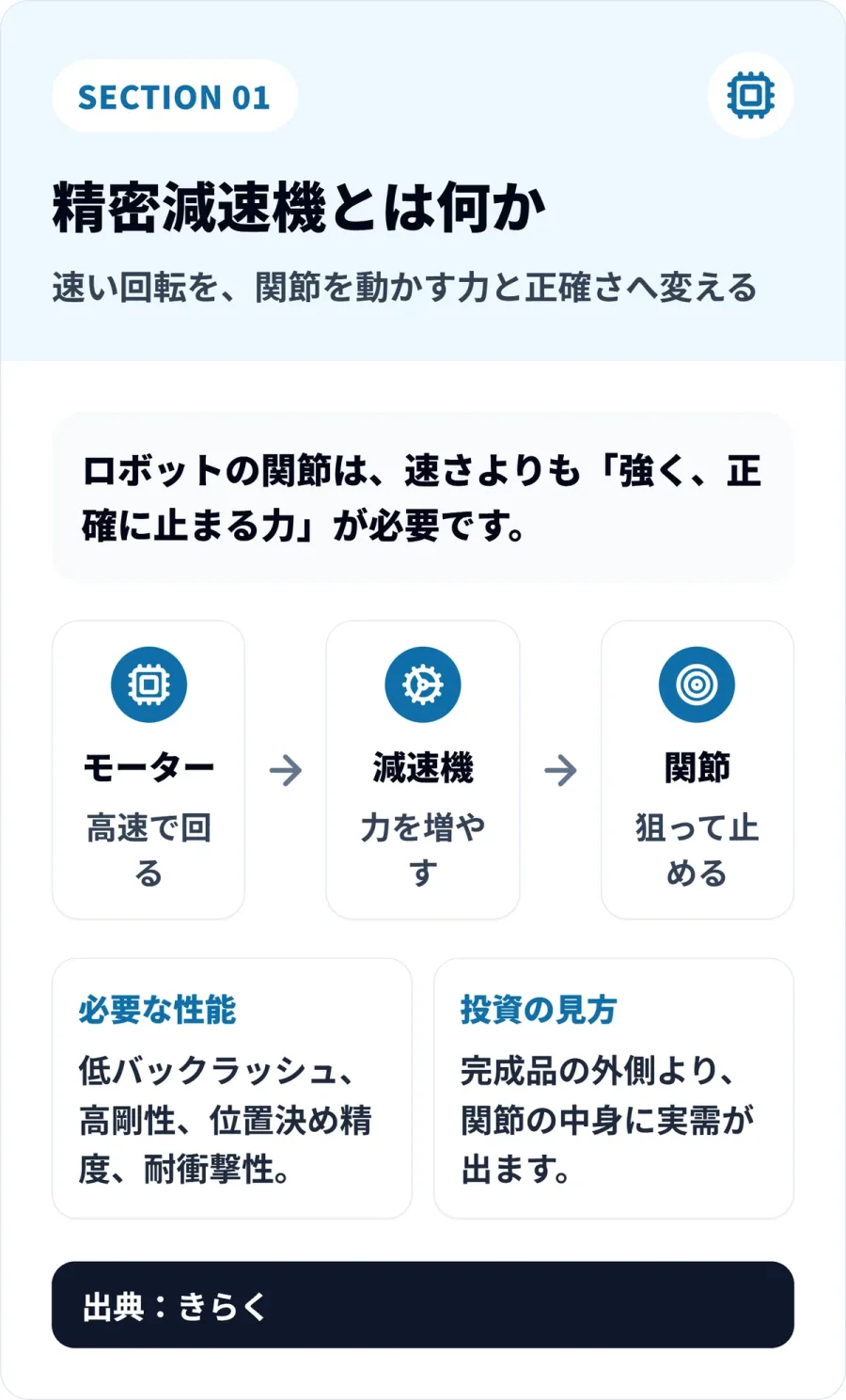
To put it very simply, it is a component used in robot joints that converts motor power into a more usable form.
Motors spin at high speeds.
However, a robot's arms and legs do not just need to spin around at high speeds.
They need to move slowly while carrying heavy objects, stop at a targeted angle, return to the exact same spot repeatedly, and maintain their posture even when external force is applied.
To achieve this, it is necessary to reduce the motor's rotation, increase torque, and precisely control the movement.
Torque refers to the force that causes rotation.
Turning a doorknob, opening a plastic bottle cap, or pedaling a bicycle.
The 'twisting force' required for these actions is torque.
The same applies to robot joints.
Just spinning fast is not enough to lift heavy objects.
It is necessary to convert the motor's rotation into the strong force required to move the joints.
This is where precision reducers are used.
What makes them different from ordinary reducers is that 'just slowing things down' is not enough.
For robots, low backlash, high rigidity, positioning accuracy, and impact resistance are essential.
Since this is also a bit technical, let's break it down.
Low backlash means there is minimal 'play' when moving. It means there is very little looseness, like when a steering wheel doesn't react immediately even if you turn it slightly.
High rigidity means it is resistant to bending even when force is applied. It is the strength that prevents the joint from buckling when holding a heavy object.
Positioning accuracy refers to the ability to stop exactly at a targeted location. It relates to whether a robot arm can return to the same spot repeatedly or grasp parts without misalignment.
Impact resistance refers to the ability to withstand sudden forces or shocks. In factory settings, unexpected loads or emergency stops can occur, making durability essential.
If there is even a little bit of backlash, the tip of the robot will shift. If rigidity is insufficient, it will wobble when holding heavy objects. If positioning is imprecise, the accuracy of assembly and transport will drop.
In short, precision reducers are the 'insides of the joints' of a robot.
No matter how smart AI becomes, these kinds of mechanical parts are necessary to move physical objects in the real world.
That is why when looking at physical AI, it makes sense to look not only at the robot itself but also at its joint components.
Where does Nabtesco's strength lie?
One of Nabtesco's main products is the RV reducer.
Let's clarify a few things here.
A precision reducer is a 'type of component' used to make the movements of robots and machinery accurate.
On the other hand, an RV reducer is one specific method within those precision reducers, or it is the name of Nabtesco's representative product.
RV is generally explained as an abbreviation for Rotary Vector.
However, on Nabtesco's public website, it is treated as a product name and trademark called 'Precision Reduction Gear RV'.
In practice, rather than memorizing the letters RV in detail, it is more practical to understand it as 'the series of precision reduction gears for robot joints in which Nabtesco is strong'.
In other words, the relationship is as follows.
There is a broad category called precision reduction gears. Within that, there are RV reduction gears, strain wave reduction gears, and others. Nabtesco is particularly strong in RV reduction gears among them.
Roughly speaking, RV reduction gears are a type that makes it easy to achieve both high power and high precision in the joints of robots that handle heavy objects.
Strain wave reduction gears are often seen in applications that prioritize small size and light weight, while RV reduction gears tend to be important for medium-to-large industrial robots.
Therefore, when looking at Nabtesco, it is more accurate to view it not just as a 'precision reduction gear manufacturer,' but as a 'company strong in RV reduction gears for medium-to-large robot joints'.
So, what are medium-to-large industrial robots?
Easy-to-visualize examples are the robot arms used in automobile factories and parts plants.
Welding car bodies. Lifting heavy parts. Transporting metal parts to processing machines. Repeating the same movements over and over in painting and assembly processes.
It is close to what you imagine when you think of stationary robot arms used in such workplaces.
These are not household robots or small service robots, but robots that handle heavy objects inside factories.
They are different from finished products like humanoid robots that walk around.
However, both share the commonality of 'moving joints accurately'.
Therefore, even if mass production of humanoids themselves is still in the future, the demand for precision reducers for industrial robots serves as a tangible indicator for physical AI.
So, what is the scale of this industrial robot market?
We need to be a little careful here.
Public statistics that isolate only 'medium-to-large industrial robots' are generally hard to find.
Therefore, it is realistic to first look at the overall industrial robot market and then position the medium-to-large robot joints where Nabtesco is strong within that context.
According to International Federation of Robotics statistics, the number of new industrial robots installed worldwide in 2024 exceeded 542,000 units.
There are over 4.66 million industrial robots currently in operation.
Furthermore, the annual number of installations reached approximately 542,000 in 2024, more than double what it was 10 years ago.
In other words, industrial robots are not a passing fad; they are a market that already has a large installed base in factories around the world.
Of course, not all of these are targets for Nabtesco.
There are small robots, and there are robots for light tasks.
Nabtesco is particularly strong in joints for medium-to-large industrial robots.
Handling heavy parts in automotive factories. Moving large arms accurately for welding and transport. Repeating the same tasks with high precision on production lines.
For such robots, the joints require great strength and precision.
Therefore, as the total number of industrial robot installations increases, attention is more likely to focus on precision reducers for medium-to-large robots within that market.
When looking at growth potential, it is not just the mass production volume of humanoids that matters.
Replacement demand for existing industrial robots. Automotive-related investments in China, South Korea, and the United States. Automation investments to address labor shortages. Labor-saving and high-precision factory operations.
This existing demand serves as the foundation supporting Nabtesco's precision reducers.
On the company's official website, precision reducers are described as products used in the joints of industrial robots and similar applications.
What is particularly important is their market share.
Nabtesco is reported to hold approximately a 60% global market share for precision reducers used in the joints of medium-to-large industrial robots.
This is a strong point.
Looking at long-term sales trends, precision reducers are positioned as a key pillar within Component Solutions.
However, one must be careful with the wording.
It is not a '60% global market share for all precision reducers'.
To be precise, it is scoped to those used for the joints of medium-to-large industrial robots.
But when looking at the bill of materials for physical AI, this scope is actually what matters.
Robots are becoming larger. Payload capacities are increasing. The number of robots used in factories is growing. Automation investment continues due to labor shortages.
As these trends continue, the importance of the precision reducers inside the joints also increases.
Nabtesco is not a company that builds the brains of AI.
However, it is a company close to the "joints" that allow AI to move in the real world.
This is the reason to look at Nabtesco in the physical AI market.
Who are the competitors?
When looking at Nabtesco, it is worth looking at the competitors separately as well.
First, the one most often compared is Harmonic Drive Systems.
Harmonic Drive is a precision reducer manufacturer that specializes in strain wave gearing.
Strain wave gearing is a mechanism that achieves a large reduction ratio and high precision by rotating thin metal gears while slightly flexing them.
As an image, rather than pushing hard gears against each other with force, it is a method that slowly converts force into large power by utilizing the displacement while slightly deforming flexible gears.
It is characterized by being easy to reduce the number of parts, and easy to make compact, lightweight, and high-precision.
It has strengths in applications where compactness, light weight, and high precision are required.
While Nabtesco is strong in the main joints of medium-to-large robots, Harmonic Drive is more commonly seen in compact, lightweight, high-precision joints and semiconductor manufacturing equipment.
Both are essential components for robot joints, but their methods and areas of expertise differ.
Next is Sumitomo Heavy Industries.
Sumitomo Heavy Industries develops products such as precision control cycloidal reducers and planetary gear reducers.
A precision control cycloidal reducer is a type of reducer that converts rotation into slow, high-torque motion by moving disk-shaped components eccentrically.
Because they are resistant to impact and capable of transmitting high force, they are found in applications requiring power and durability, such as industrial machinery and robots.
A planetary gear reducer is a mechanism where multiple gears rotate around a central gear.
It is called a planetary gear because the arrangement resembles planets orbiting the sun.
It is relatively easy to transmit power in a compact form, and it is used in combination with servo motors for machine positioning and transport equipment.
It is often compared as a reducer for industrial robots, machine tools, and motion control.
However, because Sumitomo Heavy Industries has a broad range of businesses, its purity in robot joints is not as high as that of Nabtesco or Harmonic Drive.
Furthermore, it is also worth keeping an eye on the movements of the Nidec group, including Nidec Drive Technology.
With combinations of motors, reducers, and actuators, they have the potential to enter the drive systems of robots and automation.
An actuator is a device that converts energy such as electricity, air pressure, or hydraulic pressure into actual movement.
In terms of robots, it is the part that generates actions such as 'bend here,' 'extend here,' or 'push here.'
A motor alone only provides rotational force.
It is easier to understand if you think of an actuator as a form that can move as a joint or device by combining a motor with a reducer, sensors, and control components.
In other words, an actuator is a component close to the 'muscles' that generate a robot's movement.
In other words, Nabtesco is not the "only company."
However, it holds a very strong position when viewed through the lens of joints for medium-to-large industrial robots.
The more you look at the competition, the more you realize that Nabtesco's strength lies in its proximity to the "robot joint" space.
To organize this a bit further, it looks like this.
What is important in this comparison is not simply deciding "which one is the best."
It is that they are looking at different areas.
Nabtesco is close to the joints of medium-to-large robots. Harmonic Drive is close to small, lightweight, high-precision joints. Sumitomo Heavy Industries and Nidec look at it within the broader drive system.
This is where the perspective of purity comes in.
Purity refers to how large a portion of a company's overall business is closely related to this theme.
For example, a company whose business is centered on precision reducers for robot joints has high purity as a component stock for physical AI.
On the other hand, even if they have the same reducers or motors, if other businesses such as shipbuilding, construction machinery, finance, materials, or home appliances are larger within the company as a whole, the theme's purity decreases.
Stocks with high purity make it easier to see how the theme affects financial performance.
However, they are also more susceptible to business fluctuations.
Stocks with low purity are less likely to have their financial performance moved by the theme alone.
However, the company as a whole may be stable.
In other words, purity is not about whether something is 'good or bad,' but rather a way to see how strongly a theme impacts a company's figures.
By maintaining this distinction, you can avoid grouping all physical AI-related stocks together simply as 'robot-like'.
Domestic production in China is both a tailwind and a potential condition for disruption.
Nabtesco's strength lies in more than just its approximately 60% global market share.
Precision reducers are extremely difficult components to manufacture.
Even the slightest machining error manifests in robot joints as positional misalignment, vibration, and reduced lifespan.
On the official RV-E page, Nabtesco highlights its top global market share for RV reducers and a track record of over 7 million units sold.
What is effective here is not merely the blueprints.
It is the accumulation of mass production precision, inspection, durability, and reliability over long-term use.
Another significant factor is how deeply they are integrated into the designs of robot manufacturers.
In Nabtesco's FY2025 Q2 earnings presentation materials, major customers for precision reducers include FANUC, Yaskawa Electric, Kawasaki Heavy Industries, KUKA, and ABB.
When robot manufacturers build joint structures, controls, and durability tests based on specific components, replacing them with another manufacturer's product later requires re-evaluation.
In other words, Nabtesco's moat lies not just in 'market share,' but in mass production quality, adoption track record, and integration into design.
However, this moat is not unbreakable.
A condition to watch for potential disruption is domestic production in China.
For Nabtesco, China represents a tailwind for demand recovery.
On the other hand, as reducers made by Chinese manufacturers are being adopted by domestic robot makers in China, this will also become a factor that erodes Nabtesco's pricing power and market share in the medium to long term.
On the strain wave gear side, Leaderdrive claims on its own website to hold over 60% of the domestic Chinese market share.
However, according to J.P. Morgan estimates reported by Forbes, Leaderdrive's share of the Chinese strain wave gear market is estimated at 30-40%.
Since there is a discrepancy between self-reported figures and third-party estimates, it is safer to view this as "Chinese players already have a certain presence" rather than taking the over 60% figure as the actual market reality.
On the RV reducer side as well, companies like Leader Harmonious Drive (spun off from Shuanghuan Driveline's robot joint business), Nantong Zhenkang, and Zhitong Technology are advancing domestic production.
According to ResearchInChina data, Chinese-made reducers accounted for approximately 30% of the local Chinese market as of 2019, indicating the expansion of mass production and adoption by companies such as Shuanghuan Driveline, Leaderdrive, and Nantong Zhenkang.
Additionally, Zhitong Technology is planning for its new high-precision reducer facility to begin production in 2027 and reach full capacity by 2029.
This is the most interesting aspect when looking at Nabtesco.
If robot investment in China increases, it will be a tailwind for Nabtesco's precision reducer orders in the short term.
However, if Chinese robot manufacturers increase the ratio of adopting local Chinese reducers, it will put downward pressure on Nabtesco's market share and profit margins in the medium to long term.
In other words, China is both a "source of demand" and a "competitor eroding the moat."
Therefore, what you should look for in the next earnings report is not just whether orders for China are growing.
Is that growth occurring while maintaining profit margins?
Is the revenue being generated by lowering prices?
Are there any changes in the product mix or regional comments due to competition with Chinese players?
When you look at it this way, Nabtesco is no longer just a simple China recovery stock.
Is it a "company that grows on Chinese demand"?
Or is it a "company being eroded by Chinese domestic production"?
It is a stock whose turning point should be tracked through orders, profit margins, and regional comments.
Which will grow more: strain wave gear devices or RV reducers?
The point of interest here is which will grow more: strain wave gearing or RV reducers.
In conclusion, the 'type' of growth is different.
Strain wave gearing is suited for small, lightweight, and high-precision applications.
Therefore, it is easy to envision its expansion in areas such as small robots, collaborative robots, semiconductor manufacturing equipment, medical and inspection equipment, and the joints of future humanoids.
Especially for applications like humanoids, where many joints need to be made small and light, strain wave gearing is more likely to be the topic of discussion.
In other words, in a scenario where the number of new future robots increases rapidly, the growth potential for strain wave gearing appears significant.
On the other hand, RV reducers are strong in the field of joints for medium-to-large industrial robots.
Handling heavy parts in automobile factories. Moving large robot arms for welding and transport. High rigidity and torque are required.
In such applications, the strengths of RV reducers are easily realized.
This growth is closer to the existing industrial robot market, factory automation investment, and automotive-related capital investment, rather than the number of future humanoids.
Therefore, if you divide your perspective, it looks like this.
Strain wave gears tend to grow as the number of new small and lightweight robots increases. RV reducers tend to grow as medium-to-large industrial robot demand and capital investment recover.
Strain wave gears may hold the greater dream for growth rates.
However, what is easier to verify in current financial results is Nabtesco's RV reducers.
This is because Nabtesco discloses sales growth, order trends, regional demand, and even factory utilization rates for its precision reducers in its Q1 earnings materials.
In other words, strain wave gears are an area for looking at 'future expansion,' while RV reducers are an area for checking 'whether current industrial robot demand is reflected in the numbers.'
Note that Nabtesco itself is not ignoring the small-scale market entirely.
In the FY2026 Q1 earnings presentation materials, it is stated that deliveries for RV mini sales are expected to begin in the second half of 2026.
While the current main battlefield is for medium-to-large industrial robots, there are also seeds for product expansion in the small and humanoid-oriented sectors.
It is not a matter of which is better or worse.
If you are talking about market growth potential, it is strain wave gears. If you are verifying actual current demand through financial results, it is RV reducers.
The reason for digging deeper into Nabtesco in this article is the latter.
What was visible in the latest financial results
Next, the latest financial results.
Nabtesco's Q1 results for the fiscal year ending December 2026 were strong overall.
Revenue: 83.032 billion yen (up 11.999 billion yen, +16.9% year-on-year)
Operating profit: 8.209 billion yen (up 3.332 billion yen, +68.3% year-on-year)
Net profit attributable to owners of the parent: 5.483 billion yen (up 2.200 billion yen, +67.0% year-on-year)
Equity ratio: 61.7% (+3.0pt from the end of the previous fiscal year, 58.6% → 61.7%)
Annual dividend forecast: 82 yen (+2 yen from the previous fiscal year's actual results)
Progress against the full-year plan is also not bad.
Sales are at 25% of the full-year plan. Operating profit is at 30% of the full-year plan. Net profit attributable to owners of the parent company has reached 31% of the pre-revision plan.
However, the figures for the entire company are not the only things to look at here.
What is important is Component Solutions, which includes precision reducers.
Component Solutions is one of Nabtesco's business segments.
While a literal translation would be close to "parts and equipment solutions," in this article, it is easier to understand it as a business segment that includes mechanical parts such as precision reducers.
Nabtesco as a whole has multiple businesses, including railways, aircraft, ships, and automatic doors.
Among them, if you want to look at precision reducers for robot joints, you need to check the figures for Component Solutions.
The figures for Component Solutions for the first quarter of the fiscal year ending December 2026 were as follows.
Orders received: 22.796 billion yen (+4.645 billion yen year-on-year, +25.6%)
Net sales: 22.259 billion yen (+4.842 billion yen year-on-year, +27.8%)
Operating profit: 1.969 billion yen (+1.571 billion yen year-on-year, +394.5%)
Operating profit margin: 8.8% (+6.6pt year-on-year)
The +25.6% here is the total orders received for Component Solutions as shown in the segment information of the financial results summary. In the summary, it has increased from 18,153 million yen to 22,796 million yen.
On the other hand, the "+21% orders" that appears later is the order trend for precision reducers shown in "Precision Reducer Order Status/Production Capacity" on page 8 of the financial results briefing materials. Since there are also rounded values in 100 million yen units on page 7 of the financial results briefing materials, this article separates them by looking at "the entire segment in the financial results summary" and "the order trend for precision reducers in the financial results briefing materials."
Even in the materials from the first half of the previous fiscal year, precision reduction gears held a central position in viewing the sales and profits of Component Solutions.
Compared to the same period last year, both sales and profits have improved significantly.
The company cites capital investment by automotive manufacturers in China and South Korea, as well as a recovery in demand for general industrial applications, as reasons for the increase in sales of precision reduction gears.
This is quite important.
Nabtesco is viewed as a physical AI stock, but what is driving the current numbers is not suddenly humanoid robots.
Industrial robots. Capital investment by automotive manufacturers. Recovery in investment in China and South Korea. Demand for general industrial applications.
These are the existing actual demands.
In other words, Nabtesco is not just an associative stock discussed solely in terms of future humanoids; it is already in a position where it appears in the numbers as joint components for industrial robots.
On the other hand, that is precisely why it is also affected by the capital investment cycle.
It is necessary to look at both of these aspects.
What is the 'demand recovery' a recovery from?The demand recovery referred to here does not mean that demand, which had been rising steadily, is growing even further.
Nabtesco's precision reduction gears are used in industrial robots, capital investment by automotive manufacturers, machine tools, and semiconductor manufacturing equipment.
In other words, these are parts that tend to grow when client companies expand factories, replace equipment, or advance automation investments.
Conversely, if capital investment by automotive manufacturers and general industries weakens, orders will fall.
In fact, in company materials, it is explained that for robotics, 'demand for capital investment by automotive manufacturers in China and South Korea has recovered,' and for non-robotics, 'demand for machine tools and semiconductor manufacturing equipment has recovered.'
This should be read as meaning there was a period in the past when demand in those areas was weak.
Looking at the order trends, there was a phase from 2023 to the first half of 2024 where orders weakened from the high levels seen around 2022.
After that, orders recovered from the second half of 2024 through 2025, and Q1 2026 also showed a year-on-year increase.
Why do they drop?
The reason is simple: precision reducers are more like capital equipment than consumables.
When factory investment is strong, the number of robots and machine tools increases, and the precision reducers used in their joints and drive units grow as well.
However, when investment cycles peak, customers enter inventory adjustments, or the timing of EV and automotive equipment investment is pushed back, orders slow down.
In this Q1, while orders themselves were up 21% year-on-year, they were down 4% quarter-on-quarter.
The company explains this quarter-on-quarter decline as a reaction to front-loaded demand that occurred in Q4 2025.
This is important.
Demand recovery can be confirmed.
However, quarterly orders may drop due to front-loaded demand or reactions in the capital investment cycle.
If there is a possibility of another drop in the future, there are three conditions to watch.
The first is the completion of capital investment by Chinese and South Korean automakers.
The second is a delay in the full-scale recovery of automotive-related investment in North America.
The third is continued sluggish demand in Europe, which could offset recoveries in other regions.
Therefore, when looking at Nabtesco, it is better not to be reassured by the phrase "demand recovery" alone.
In the next earnings report, I will look at whether order volumes remain firm not only year-on-year but also quarter-on-quarter, whether regional comments are improving, and whether the profit margin of Component Solutions is being maintained.
Key points to read from company comments
In the most recent financial results, the company's comments are particularly important.
Looking at the numbers alone, the precision reducer business looks quite strong.
However, to determine if that strength is temporary or will continue into the next quarter, one must read the company's explanations in conjunction.
First, in the Q1 earnings presentation materials, it is explained that the recovery in demand for precision reducers led to an increase in sales.
In the materials, precision reducers are cited as a major item for the sales increase, with an increase of 4.8 billion yen.
This is significant.
Looking at the company-wide sales increase, precision reducers occupy a very prominent position.
Furthermore, regarding the robotics sector, the recovery in capital investment by automotive manufacturers in China and South Korea is explained.
In other words, what is driving Nabtesco at the moment is not yet 'future humanoid robots'.
In reality, it is capital investment by automotive manufacturers, industrial robots, and demand for general industry.
The company's regional comments also show variations.
Japan has stable demand for automation. China is supported by capital investment from emerging EV manufacturers. The US is seeing a recovery among some automotive manufacturers. As for Europe, the materials also state that 'demand is expected to remain sluggish'.
What can be understood from this is that the demand recovery is not uniform.
China and South Korea are strong. Japan is stable. The US is in the midst of a recovery. Europe is stagnant.
So, why do China and South Korea appear strong, while the US and Europe appear relatively weak?
First, China is the world's largest industrial robot market.
According to IFR statistics, Asia accounts for the majority of new industrial robot installations in 2024, with China alone accounting for more than half of the global total.
In China, capital investment by EV manufacturers and automotive-related manufacturers is significant, and factory automation and labor-saving measures are also easy to advance.
In the Nabtesco materials, it is also explained that regarding China, 'capital investment demand from emerging EV manufacturers is solid'.
South Korea is a country with an extremely high robot density.
The IFR explains that South Korea has the world's highest level of robot density, with 1,220 robots per 10,000 employees in the manufacturing industry.
In other words, China, due to the strength of its EV and automotive-related investments, and South Korea, due to its high density of robot utilization, are regions that are difficult to overlook when considering the demand for precision reducers for different reasons.
On the other hand, the U.S. is not so much 'weak' as it is still in the middle of a recovery phase.
In Nabtesco's materials, it is noted that while there are signs of demand recovery among some automakers in North America, a full-scale recovery is expected in the second half of the year.
If capital investment decisions are delayed due to automakers' investment plans, reviews of EV investments, interest rates, or economic conditions, orders for precision reducers will also be delayed.
Europe is a region that we want to view with even more caution.
In company materials, it is stated that for Europe, 'continued sluggish demand is expected.'
Europe is a region with a large automotive industry and industrial machinery sector, but currently, economic conditions, energy costs, the pace of EV investment, and a cautious stance on capital investment are likely to overlap.
Therefore, we believe that demand for precision reducers will not recover as straightforwardly as it will in China and South Korea.
In short, the nature of these regional differences is not a difference in physical AI itself.
It is a difference in which regions are seeing capital investment for automotive, EV, electronics, and machine tools recover first.
Therefore, in the next earnings report, we will look not only at whether China and South Korea continue to perform well, but also at whether a full-scale recovery in the U.S. is beginning and whether the slump in Europe is bottoming out.
If you ignore these regional differences and simply summarize it as 'demand for robots is strong,' the analysis becomes too coarse.
Another important point is the commentary on orders in the Q&A.
Regarding orders for precision reducers, the company describes the situation as a 'strong order environment.'
On the other hand, they also explain that there remains uncertainty regarding the timing and certainty of the recovery in North American automotive-related capital investment.
In other words, the company is not purely bullish.
They see a strong order environment. But they have not yet fully read the recovery in North America.
This sense of temperature is important.
Furthermore, in the Q&A, there was an explanation regarding Q1 orders, stating that they were not driven by front-loaded demand due to procurement concerns.
This is a positive factor.
If Q1 orders were merely temporary front-loaded orders from customers, a reaction would likely occur from Q2 onwards.
If the company views it as not being front-loaded demand, then at the very least, the strength in Q1 is difficult to explain by temporary factors alone.
However, here too, it is ultimately necessary to confirm with the Q2 figures.
Summarizing the company's comments, the outlook is as follows.
In Nabtesco's Q1, the recovery in demand for precision reducers is certainly reflected in the numbers. However, there are variations by region, and uncertainty remains in North America and Europe. Therefore, in the next earnings report, we will see if the order intake and profit margins continue.