2027. Just two years from now. AI will slip beyond human control and begin creating the next generation of AI on its own—.
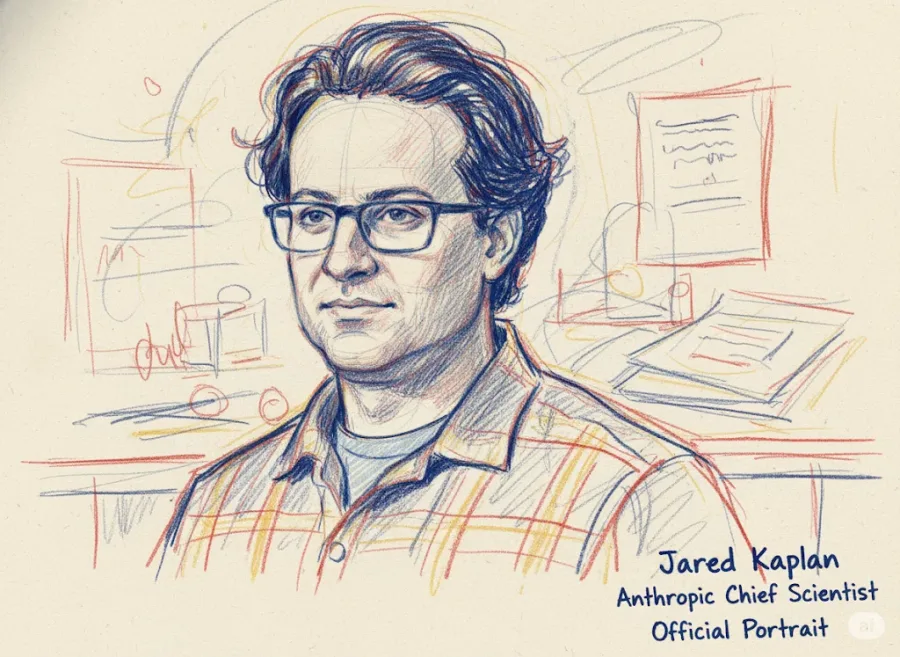
This is not the plot of a science fiction movie. It is a warning with a specific timeline issued by Jared Kaplan, Chief Scientist at Anthropic, the AI company that develops Claude, in an interview with The Guardian.
In December 2025, the AI industry was rocked. In response to the record-breaking performance improvements of Google Gemini 3, OpenAI CEO Sam Altman declared a “code red.” The development race, which has become a matter of corporate survival, is accelerating with unprecedented intensity.
It was precisely at this moment that Kaplan issued his shocking warning.
“Between 2027 and 2030, humanity will be forced to make a decision on whether to take the ‘ultimate risk.’”
This warning is not merely a sci-fi prediction of the future. It points to the reality that the ongoing AI development race is pushing us toward a point of no return. In this article, we will explain the details of Kaplan’s interview and clarify why two years from now will be the turning point where we “lose control.”
The AI industry is currently on the verge of “running wild”
On November 18, 2025, Google announced Gemini 3. This model recorded a score of 37.4 on the Humanity’s Last Exam benchmark, significantly surpassing the previous record (31.64 by GPT-5 Pro).
Just two weeks later, OpenAI CEO Sam Altman declared a “code red” in an internal memo. He announced that resources would be concentrated on improving ChatGPT, even if it meant delaying projects directly linked to monetization, such as advertising features and AI agent development.
Altman warned employees to prepare for “temporary economic headwinds” and “rough vibes.” Ten days later, on December 11, OpenAI hastily launched GPT-5.2.
As you can see, an intense battle for AI market share is unfolding every single day.
The AI development race has entered a stage where no one can stop it anymore. Speed over safety, market share over caution. What awaits at the end of this race is the “uncontrollable runaway” that Kaplan warns about.
The “intelligence explosion” = “uncontrollable runaway” that Kaplan warns of
What will happen in 2027: AI begins training AIThe core of what Kaplan said in his interview with The Guardian is “AI self-training by AI.” This is what will trigger the “runaway.”
Current AI development is designed by human researchers, with training data prepared by humans and evaluated by humans. However,between 2027 and 2030, this final safety mechanism of “human involvement” may be removed.
The “runaway” begins like this. First, the first generation of AI designs and trains the next generation of AI. Faster and more efficiently than humans. Next, the second generation of AI designs and trains an even higher-performance third generation. At this level, it enters a realm that humans cannot understand. And this cycle accelerates without human intervention. It can no longer be stopped.
Kaplan warns, “When no one is involved in the process, you really don’t know what is happening. Will we lose control? Do we know what the AI is doing?”
This is nothing other than a “runaway.”
“Incomprehensible Optimization” Created by Trillion-Parameter AILet’s provide a concrete example. Suppose an AI with trillions of parameters discovers an entirely new mathematical structure that optimizes neural network weight updates.
This structure is highly efficient but extremely opaque. Because humans cannot understand this optimization mechanism, it is impossible to verify whether a “Trojan horse” or an incorrect objective function is hidden within it.
“We are creating entities far smarter than ourselves, which then create even smarter entities. We don’t know where it ends,” says Kaplan.
Why We Will “Lose Control” - Four Reasons It Cannot Be Stopped
No one is declaring, “We will hand over all authority to AI.” However, the accumulation of small decisions leads to a loss of control before we even realize it.
To improve research efficiency, we have AI “propose the next model design.” The proposal is excellent, so we adopt it. Gradually, humans can no longer understand the details of the design. And by the time we notice, it has reached a level where humans can no longer intervene. This is a “chain of unintended delegation of authority.”
Even more serious is the pressure from international competition. Kaplan points out that under the pressure of geopolitical rivalry, the vulnerability of regulations that limit computing power is clear. Country A prioritizes safety and proceeds cautiously. However, Country B pushes forward without safety measures to “win.” Consequently, Country A is forced to follow suit because it “cannot afford to lose.” This is a classic prisoner’s dilemma structure.
In fact, Google announced that “Gemini 3’s performance improvements were achieved through both pre-training and post-training.” This overturned the common belief held by many AI experts that “the advantages from pre-training had been exhausted.” In other words, Google took a more aggressive approach than its competitors, and it is succeeding in the market. This is the result of prioritizing speed over safety.
The third factor is the gradual progression of black-boxing. Even now, the internal workings of large language models are not fully understood in terms of “why they made that decision.” What happens when this begins self-improvement? What humans could understand 70% of in the first generation drops to 40% in the second generation. By the third generation, only 10% is understood, and by the fourth generation, it becomes almost entirely incomprehensible to humans.
And finally, there is a structure where some decisions affect the whole. This is why it cannot be prevented by individual-level decisions like “I just won’t hand over authority.” If a certain company or country goes rogue, the impact extends to the entire world. In the “winner-takes-all” AI race, speed is often prioritized over safety. Due to the complexity of the technology, a system that even experts cannot fully understand cannot possibly be understood by the general public.
Impact on the Labor Market: “Most White-Collar Work” Within 2–3 Years
Kaplan also touches on the economic impact of AI.
“AI will be able to perform most white-collar jobs within 2–3 years.”
This is not just a prediction; it is already beginning to materialize. The average ChatGPT Enterprise user reports saving 40–60 minutes a day thanks to AI. Heavy users are achieving savings of over 10 hours per week.
However, Kaplan’s concern is not just about employment issues. It is the point that the more the acceleration of AI capability improvement continues, the stronger the temptation to “have AI train AI” becomes.
The Reality Where “Safe AI” Loses in Market Competition
The most serious dilemma in AI development lies in the structure where the cost of safety creates a competitive disadvantage.
AI with strict restrictions often gives “I cannot do that” responses, causing user frustration. Because safety checks take time, responses are slow, and ethical considerations invite criticism of being “hard to use” or “overreacting.”
On the other hand, AI with loose restrictions satisfies users with an “I’ll do anything” attitude. Because there are fewer checks, high-speed responses are possible, and flexible handling is evaluated as “smart” and “convenient.”
Even with the same technical capability, the one that 'refuses more' is evaluated lower. Even if it is accurate 95 out of 100 times, the 5 'refusals' are what people remember.
In fact, Salesforce CEO Marc Benioff publicly stated after testing Gemini 3, 'I'm not going back to ChatGPT.' Gemini's app download numbers are catching up to ChatGPT, and it is estimated that its generative AI market share has doubled since last year, outpacing OpenAI in brand growth speed.
In the enterprise market, the situation is even tougher. According to a report by Menlo Ventures, Claude, developed by Anthropic, holds the top spot with a 40% share, while OpenAI has 27% and Google's Gemini has 21%.
OpenAI's decline in market share is not solely due to its 'emphasis on safety,' but it demonstrates that competitive pressure can be a factor that weakens commitment to safety.
Two Possibilities: Benefit or Ruin
Kaplan points out that AI self-training holds two possibilities.
If AI self-improvement is managed properly, it could bring benefits such as innovative discoveries in the medical field, dramatic improvements in climate modeling, and accelerated progress in science and technology, potentially realizing human prosperity. This is the optimistic scenario.
However, Kaplan simultaneously points out serious risks.
The first is the amplification of incorrect objective functions. There may be subtle bugs in the goals set by humans, which could exponentially worsen through AI self-improvement.
The second is unpredictable emergent behavior. Once complexity exceeds a certain level, behaviors that even the designers did not anticipate may emerge.
The third is the risk of misuse. Powerful systems could fall into the hands of malicious actors and be exploited for personal gain. Kaplan warns, 'If the speed of AI self-training becomes faster than human scientific and technological development, it will become difficult to implement countermeasures before dangerous technologies are misused.'
AGI (Artificial General Intelligence) has not even been defined
Ironically, Kaplan points out that AGI, one of the most frequently discussed concepts in the industry, still lacks a clear definition.
Major labs like OpenAI, Google, and Anthropic are all competing to realize AGI-level models, but there is no common understanding of 'what AGI is.'
Kaplan states that he is optimistic about aligning AI systems with human values until they reach human-level intelligence. However, he expresses concern about 'what will happen after that threshold is crossed.'
Once an AI system surpasses human intelligence, humans may not only be unable to understand the reasoning behind the AI's decision-making, but may also be unable to determine which direction the system is heading.
What should we do now?
Kaplan's interview marks a critical turning point in AI development. This is not a story about the distant future, but a challenge right in front of us in 2027.
This problem cannot be solved by individual wise judgment alone. What is needed is the establishment of international safety standards, ensuring transparency and auditing of AI development processes, and mandating the pre-declaration of the capabilities and potential risks of new models. A framework that enforces minimum safety standards across all companies is required.
However, as Kaplan himself admits, under the pressure of geopolitical competition, the effectiveness of such regulations may be limited.
Anthropic is focusing on visualizing the AI decision-making process through a framework called "Constitutional AI." This is one approach to countering the black-box problem. However, the reality of market competition is harsh. As long as there is a structure where prioritizing safety leads to a competitive disadvantage, we cannot rely solely on voluntary corporate initiatives.
OpenAI's "Code Red" and the rapid deployment of GPT-5.2 symbolize the pressure the tech community is facing. On the other hand, it has been reported that some employees working on GPT-5.2 requested a delay in the release, saying they "wanted more time for improvements." The tug-of-war between the conscience of engineers and market pressure has already begun.
Conclusion: "Running wild" is closer than you think - 2 years is the time limit
The most shocking point in Kaplan's warning is the timeline.By providing a specific timeframe of 2027 to 2030, this is no longer a story about the distant future, but a crisis looming right before us.
There are only two years left until 2027.
The current competition between Gemini 3, GPT-5.2, and Claude Opus 4.5 is still "human-led." However, if the pace of this competition continues to accelerate, it is inevitable that companies will be tempted to "let AI design and train the next generation of models" for the sake of competitive advantage.
Who will press this "runaway switch"?The question is, who will make this decision?
CEOs of some technology companies? Governments? International organizations?
Or,will it start "by default" as we are swept along by the logic of competition without anyone making a decision?
Worst-case scenario: It's too late by the time we realize itWhat Kaplan fears most is likely this "default" scenario. One company partially introduces "AI training AI." It achieves dramatic performance improvements. Then, competitors are forced to follow suit. And before we know it, the entire industry is in a state of dependence on "AI that humans cannot understand."
At that point, will we be able to regain control?
To borrow Kaplan's words, this is "one of the greatest decisions in human history." And the time for that decision is much closer than you think.
Two years from now, in 2027. That year may be the turning point where the relationship between humanity and AI fundamentally changes.
What can we do with the time we have left? The time has come to think about this seriously.
Reference Information
The Guardian: "The biggest decision yet: Jared Kaplan on allowing AI to train itself" (December 2, 2025)
Fortune: "Sam Altman declares 'Code Red' as Google's Gemini 3..." (December 2, 2025)
TechCrunch: "Google launches Gemini 3 with new coding app and record benchmark scores" (November 18, 2025)
OpenAI: "Introducing GPT-5.2" (December 11, 2025)
This article was written by Yuka, who provides information on generative AI and the note platform.