Introduction
I believe everyone is aware that Japan's population (the number of people living here) is decreasing.
The "population decline problem" is often brought up as a "problem."
So, have you ever learned about or thought about what problems arise from a shrinking population, or how we should face them?
The Hokkaido Government has decided to write a note about Hokkaido's population decline problem.
We hope this will be a time for you to learn about and think about the "population decline problem."
Hokkaido's population trends and the reasons for the decline
First, I will talk about what is happening with Hokkaido's population.
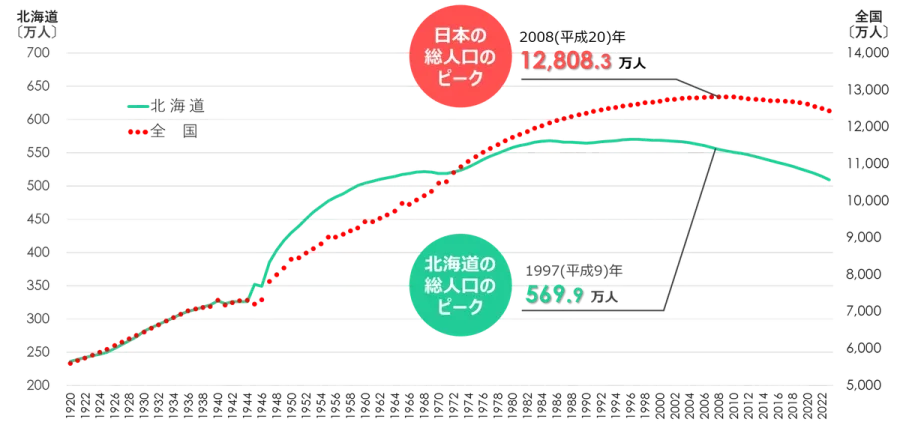
Hokkaido's population reached approximately 5.7 million in 1997 (Heisei 9). (That was 28 years ago!) It has been continuously declining since its peak in 1997, reaching 5.09 million in 2023 (Reiwa 5).
For Japan as a whole, the population reached approximately 128 million in 2008 (Heisei 20), and has been declining since that peak.
In other words, Hokkaido's population began to decline about 10 years before the population of Japan as a whole began to decline.
There are two types of population movement: "natural change" and "social change."
※ Natural change: The difference between the number of births and the number of deaths
Social change: The difference between the number of people moving in and the number of people moving out
If both differences are positive, it is a "natural increase/social increase," and if they are negative, it is a "natural decrease/social decrease."
In Hokkaido, it is a "natural decrease/social increase." Even so, the overall population is decreasing, and while the reasons cannot be stated in a single word, there are several things to consider.
The reason for the "natural decrease" is that the aging of the population has progressed, leading to an increase in the number of deaths, and the number of children being born is decreasing as various lifestyles increase with the changes of the times, such as the choice not to marry.
The reason for the "social increase" is that many foreigners have come to live in Hokkaido, but that is when looking at the total. When looking only at Japanese people, it is a "social decrease." We believe the reason for the decrease in Japanese people is that they are leaving Hokkaido for other regions for reasons such as higher education and employment.
What are the effects of a shrinking population?
Population decline is thought to affect various things. Here are some things that are considered to be affected.
Things considered to be affected ① Economy When the population decreases, the number of workers also decreases. This leads to labor shortages and a lack of successors. As a result, the production capacity for agricultural, forestry, and fishery products may decline because there are no successors, and factories may close because there are fewer workers. Of course, it is expected that this will affect a wide range of industries, not just the primary and secondary industries, but also the construction and transportation industries.
Also, it is thought that the money spent will also decrease as the number of people decreases. When the money spent decreases, shops such as supermarkets and convenience stores cannot continue, and shops will disappear from the town. The disappearance of shops means that there will be no places to shop or work. It may become difficult to continue living in a town without shops, which may lead to an even greater decrease in the population.
When the number of people decreases, the total amount of money spent on medical care will decrease. As a result, the number of hospitals may decrease. If a hospital that was nearby disappears, you will have to go to a hospital far away. It may happen that you cannot receive medical care immediately.
Although the total amount of money spent on medical care will decrease, it is expected that the medical expenses spent by each individual will increase. This is based on the idea that the aging of the population will progress, and under the current medical expense system, the burden will be placed heavily on those who are working.
The money spent on nursing care is the same, and it is thought that the burden on working people will increase.
When the number of people decreases, tax revenue decreases. Administrative services are supported by tax revenue. Administrative services include various things, such as town office counters, education, road maintenance and repair, garbage collection, and preparations for disasters. It is expected that the decrease in tax revenue that supports such services will affect the level of administrative services.
What will happen to Hokkaido in the future?
Population decline has already begun and is expected to continue. We at the Hokkaido Government have been promoting various initiatives under the belief that "while population decline will continue, we can slow down its pace." However, the reality is that we have not been able to change the speed of population decline.
With a sense of crisis regarding this situation, we have established a new outlook. It is the forecast that "by 2050, Hokkaido's population will be approximately 3.82 million, and the proportion of people under 65 years old will decrease even further."
Amidst the potential impacts of population decline, the Hokkaido Government has decided to move forward so that each and every person can continue to live with hope for the future, to attract more people to Hokkaido by highlighting the region's appeal, and to ensure that those living in Hokkaido can have peace of mind in their daily lives even as the population decreases.
Since this has become quite long, we will stop here for now. Next time, I would like to talk about what the Hokkaido Government will do in the face of population decline.
This article is based on the contents of the "Hokkaido Population Vision (2024 Revised Edition)" and the "3rd Hokkaido Comprehensive Strategy for Regional Revitalization." If you would like to know or see more detailed information, please check the link below.
[Regarding the Hokkaido Population Vision (2024 Revised Edition) and the 3rd Hokkaido Comprehensive Strategy for Regional Revitalization]https://www.pref.hokkaido.lg.jp/ss/csr/216638.html