Not limited to crabs, expensive food items sell well in December.
One might think that foreign tourists with money are a welcome presence, but it seems there are voices from the Tsukiji outer market saying, "Tourists, don't come!"
Even before the inbound tourism boom, Tsukiji and Ameyoko were places where "New Year's food" would sell like hotcakes at the end of the year. It has long been a common sight for these areas to be crowded with people looking for just that. Such customers have already decided what they want to buy, so they quickly purchase even expensive items and leave. The high turnover is helpful for the shops.
In other words, tourists who come to leisurely sightsee end up getting in the way.
Some may be angry, saying, "You're making money off inbound tourism, so it's ridiculous to tell people not to come just because it's inconvenient for your shop!" while others may understand the point mentioned above.
I won't write my own opinion on this matter, but either way, it is a story that reflects the current situation in Japan.
It is said that there are over 6,000 types of crabs, but Horsehair crab, snow crab, and king crab are the main ones. These are the three major crabs. (Matsuba crab and Echizen crab are just other names for snow crab; they are the same crab.)
If you aren't careful with cheap crabs, you are likely to end up "penny-wise and pound-foolish." (Do not buy a crab if it feels light when you hold it. It means the meat is sparse.)
Also, keep in mind that live crabs are not necessarily the best. Rather than ones that have become weak while sitting in sawdust, "hamayude" (beach-boiled) crabs, which are boiled immediately after being caught, are superior in both quality and taste.
Eating them raw, such as in sashimi or nigiri, has become more common. There is also crab shabu-shabu. However, crabs are originally meant to be boiled or steamed before being used in cooking. I don't deny eating them raw or as crab shabu-shabu, but honestly, I think boiling or grilling is delicious, and steaming is the best. That way, the flavor of the crab comes out better.
For both boiling and steaming, the basic time is 15 to 20 minutes from the point of boiling. For a normal size, 20 minutes is sufficient.
Since live ones will thrash about and lose their legs, tie them up with rubber bands or something similar beforehand. Alternatively, stun them in fresh water so they don't thrash.
To prevent the miso and juices from flowing out, place them with the belly facing up and heat them.
Rather than boiling, it is better to steam them if possible to enjoy them more deliciously.
For miso soup or hot pot, it is tastier to boil them from raw to extract the broth while cooking.
-----------------------------
-----------------------------
How to eat crab soup
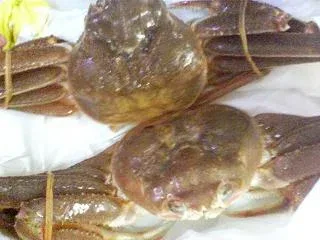
Regarding crab miso soup, have you ever had the experience of being served it in this state when dining out and not knowing what to do?
"How am I supposed to eat this?!"
or
"It's too much trouble, so I won't eat it."
If you didn't like crab in the first place, you wouldn't have ordered it. Many people leave it behind, but I assume it's not because they dislike it.
It's delicious, so you should try to eat it.
It will surely be served with a lid (if not, ask for a side plate), so first, take the crab out onto that lid.
Drink the soup first.
(If you eat the crab first, the soup will definitely get cold.)
By the time you finish drinking, the crab will have cooled down enough to touch, so use your hands to bend the legs at the base to detach them.
(It is common all over the world that it is not considered bad manners to use your hands to grab crab or shrimp while eating.)
Bend those legs again at the middle joint to split them in two. While you're at it, bend and remove the joint at the pointed tip as well.
This should have created a tube shape, so now we will perform the "tube extraction."
If you don't have special crab tools, use an unused pair of disposable chopsticks (do not use the chopsticks you are currently eating with).
Just like inserting a chopstick into a chikuwa, insert the disposable chopstick into the tube-shaped crab leg while rotating it, and the meat will be pushed out cleanly.
You can just gnaw on the meat at the base of the legs as is.
-----------------------------
-----------------------------
Preparing crab
I don't think there is a specific procedure for "preparing" crab. You turn it over, flip up the "apron," and remove the shell. Basically, that is all you need to do to be able to eat it.
Therefore, rather than how to prepare it, it's more about "how to eat it."
Or perhaps "how to peel the shell."
For those with strong teeth or dexterous hands, as mentioned above, just removing the shell is fine. You can break apart the shell where the meat is packed using your teeth or fingers as you eat. Originally, that is the tastier way to eat it.
The edible parts of a crab are the "leg meat" and "claw meat."
In the main body (under the shell), there is the "meat at the base of the legs" and the "crab miso."
The parts that cannot be eaten are the shell, the tendons, and the gills (dead man's fingers).
The point is "how to eat" these edible parts. Or, "how to make them as easy to eat as possible."
Depending on this "how much" factor, you change how you cut them.
The simplest method is to cut the legs off at the base and make a single vertical slit in the leg shell.
This is easy for the person serving, but difficult for the person eating.
Therefore, as a slightly more "considerate" way of serving, there is a method of shaving off the shell into an oval shape to make the meat easier to extract than just a single knife line before plating.
If you are not a little used to using a knife, there is a possibility that you will shave off the meat along with the shell.
A relatively easy cutting method that makes the meat the easiest to extract is to stand it upright, insert a knife into the center, and split it in two.
An even more recommended method is to use "kitchen shears," which are easier and more accurate for cutting the shell than a knife.
King Crab
The King Crab (Taraba-gani) is also known as the "King of Crabs."
It is no exaggeration to call it the true king of crabs, not just in name.A craving for crab meat can only be fully satisfied by a giant King Crab.
Only King Crab meat has the thickness (volume of meat) to fully enjoy the "umami of crab."
Along with being satisfying to eat, it is a protein containing abundant umami components such as glutamic acid and inosinic acid, and it is ultra-low fat, high protein, low cholesterol, and also rich in taurine. It is, without a doubt, a healthy food.
Even before such logic, it is simply delicious. It is said that while eating this, no matter how much of a "chatterbox" someone is, they will fall silent.
I wrote that it is the king of crabs, but it only has 3 pairs of walking legs, and while crabs walk sideways, King Crabs can also move vertically. The female's abdomen is also asymmetrical, and these are characteristics of hermit crabs. In other words, to be precise, it is a "crab-shaped hermit crab."
However, such academic details are irrelevant; it is one of the three major crabs and is distributed as a crab, so for us, it is a crab. Even in English, it is called a King crab.
With the improvement of distribution conditions, you can see raw King Crab sashimi, but the taste is extremely poor compared to heated King Crab. It is better to boil or grill it. From my experience as a chef, I feel that King Crab is better steamed.
A problem that cannot be avoided when writing about King Crab is the 2004 fake King Crab scandal. The reality of the industry, which was selling similar-looking blue king crabs as King Crabs, was revealed, and the Fair Trade Commission issued exclusion orders to major distributors for violating the Act against Unjustifiable Premiums and Misleading Representations, which was widely reported.
Since there are few visual differences between King crab and Hanasaki crab, and they are both classified as 'Decapoda, Lithodidae, Paralithodes,' they were likely sold as King crab. This is not uncommon in the seafood distribution industry.
However, they are indeed different from King crab, so since the incident, distributors have been required to provide accurate labeling. Mislabeling is prohibited, after all. Given the current harsh scrutiny regarding food fraud, I would like to think that no distributors are still pulling such nonsense, but...
How to distinguish between King crab and Hanasaki crabThis is a King crab.